Conal Holmes O’Connell O’Riordan, Irish dramatist and novelist, is born on April 29, 1874, at 3 Gardiner’s Row, Dublin.
O’Riordan is the youngest child among two sons and three daughters of Daniel O’Connell O’Riordan, a barrister and justice of the peace (JP), and Katharine O’Riordan (née O’Neil), who is her husband’s first cousin. At age of four he witnesses his mother’s death in a carriage accident. His formal education, firstly as a day student at Belvedere College, Dublin (1881–85), and secondly as a boarder at Clongowes Wood College, County Kildare (1887–88), is interrupted by ill health and periods of self-education at home, marked by omnivorous reading in his father’s library.
While engaged in military studies in Bonn, Germany (March–September 1890), preparatory to entering Royal Military Academy Sandhurst in Great Britain, he falls from a horse during riding lessons, suffering a back injury that results in permanent spinal damage, thus precluding a military career.
Left with limited means after his father’s death, O’Riordan moves to London in 1891, where, after attempting suicide, he finds work as a stage actor with the Independent Theatre Society of J. T. Grein and other companies, both in London and touring the provinces, and is noted for his interpretations of Henrik Ibsen. Active in the Irish Literary Society, where he meets W. B. Yeats, he writes fiction under the pseudonym “F. Norreys Connell,” which he also adopts for his stage work.
O’Riordan’s early publications include In the Green Park (1894), a collection of connected short stories, The House of the Strange Woman (1895), a provocative novel of sexual promiscuity in upper-class London bohemia, boycotted by some booksellers as being “morally tainted,” and several books reflecting his deep interest in all things military, most notably The pity of war (1906), a collection of Kiplingesque short stories. Largely abandoning fiction for some years to concentrate on writing for the stage, he returns to Dublin for the first time in fourteen years to direct his controversial one-act play The Piper, which opens at the Abbey Theatre on February 13, 1908. It is jeered as a slander on Irish patriots in disturbances mildly reminiscent of the “Playboy” riots thirteen months previously. The audience on the third night is placated by Yeats, who in a speech from the stage interprets the play – in which a party of rebels in the 1798 rising disdain to set sentries as they argue interminably and discursively, only to be surprised and slaughtered by yeomanry – as a satirical allegory on the fruitless debate that followed the Parnellite split. The work can more usefully be read as a meditation on the propensity of democracy to disintegrate at moments of crisis into ineffectual and dillusory demagoguery. The Piper weathers the controversy to become a frequently performed staple of the Abbey Theatre repertoire during the 1910s.
After the death of John Millington Synge, O’Riordan serves briefly as managing director of the Abbey Theatre from March 25 to July 2, 1909, during which time he produces and directs two of his own one-act plays – Time on April 1, in which he also acts, and An Imaginary Conversation on May 13 – as well as the first revival of Synge’s The Playboy of the Western World on May 27. Wearied by the repeated interferences in the theatre’s affairs by its financial backer, Annie Horniman, he resigns abruptly during her fit of pique when the actress Sara Allgood recites poetry at a private gathering of suffragettes.
O’Riordan scores a major triumph on the London stage with Captain Hannibal (1909), his adaptation of a novel by Stanley Weyman, on the proceeds of which he lives for many years. Settling permanently in London, in 1910 he purchases a house at 106 Meadvale Road, Ealing, his home for the rest of his life. Rejected by the British Army at the outset of World War I owing to his disability, after several failed attempts to secure war work he eventually goes to the front in 1918 in charge of YMCA rest huts at Étaples railway junction, where he befriends the doomed soldier poet Wilfred Owen.
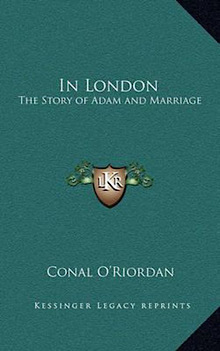
O’Riordan achieves his most accomplished writing within a cycle of twelve novels, published under his own name, chronicling the experiences of several inter-connected Irish and English families from the Napoleonic Wars to the 1920s. First of the series to appear was Adam of Dublin (1920), a combined Bildungsroman and roman-à-clef of the literary revival, with vignettes of Dublin slum life, Belvedere College, and the early years of the Abbey Theatre. He follows his protagonist, Adam Quinn, through the sexual turmoil of adolescence, an itinerant acting career, and an unhappy marriage in three sequels: Adam and Caroline (1921), In London (1922), and Married life (1924). These four novels chronologically conclude the narrative of the completed cycle. The narrative commences with the “Soldier” tetralogy – Soldier Born (1927), Soldier of Waterloo (1928), Soldier’s Wife (1935), and Soldier’s End (1938) – a picaresque treatment of the multifarious and farflung experiences of David Quinn, a forebear of Adam, from an Irish childhood and English education, to the Battle of Waterloo, where he suffers horrible facial mutilation, through the Irish famine and the American Civil War, to his death at the hands of Versaillais troops during the suppression of the Paris commune. Judith Quinn (1939) and Judith’s Love (1940), about the disappointments in love and marriage of a late-Victorian Dublin woman, link the narratives of the “Adam” and “Soldier” tetralogies, while The Age of Miracles(1925) and Young Lady Dazincourt (1926) are chronologically contemporaneous with the latter “Adam” novels. Inconsistent in intention, and uneven in execution, the cycle is strongest in its evocative descriptions of Dublin, London, and other cities, with their varied social strata, in different historical periods, in the sharp-edged, witty dialogue, and in the juxtaposition of dazzling comedy and an ironic sense of tragedy.
O’Riordan continues to write successful, if lightweight, stage plays. His 1928 production of Napoleon’s Josephine features a stellar cast including Edith Evans. Among his published plays are Shakespeare’s End, and Other Irish Plays (1912), Rope Enough (1914), His Majesty’s Pleasure (1925), The King’s Wooing (1929), and Captain Falstaff and Other Plays (1935). The historical commentary Napoleon Passes (1933) reflects his abiding interest in the French emperor. President of the Irish Literary Society from 1937 to 1939, he resigns after failing to persuade his colleagues to repudiate Ireland’s wartime neutrality. Despite age, disability, and increasing reclusivity, throughout World War II he serves as an air raid warden from 1940 to 1945. Elected a fellow of the Royal Society of Literature (1945–48), he represents the society on the council of the newly formed National Book League, and is the society’s Tredegar lecturer in 1946. Charming and convivial, a witty and erudite conversationalist, he cultivates numerous literary friendships, and is an inveterate womaniser, enjoying countless intimate relationships, both sexual and platonic.
O’Riordan marries firstly Florence Derby in 1903, a nurse eight years his senior, with whom he has one son. They are estranged by the time of her death in 1923. In 1924, he marries secondly Olga Buckley, his lover since 1920, and secretary to the wife of G. K. Chesterton. They have two sons (both born before the marriage) and one daughter. Despite considerable contemporary celebrity and critical acclaim, his work compared to that of Charles Dickens and Honoré de Balzac, he has been ignored by posterity. The best of his writing, especially the “Adam” and “Soldier” novels, merit rediscovery.
O’Riordan dies at his London home on June 18, 1948, the anniversary of the Battle of Waterloo. A special O’Riordan number of the Journal of Irish Literature (September 1985), edited by his daughter Judith, includes a portrait photograph, the text of The Piper, and a detailed chronology.
(From: “O’Riordan, Conal Holmes O’Connell (‘Norreys Connell’)” by Lawrence William White and Aideen Foley, Dictionary of Irish Biography, http://www.dib.ie, October 2009)