
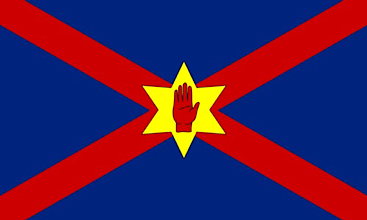
The Ulster Independence Movement, an Ulster nationalist political party, is founded on November 17, 1988, as the Ulster Independence Committee (UIC). The group emerges from the Ulster Clubs, after a series of 15 public meetings across Northern Ireland. Led by Hugh Ross, a Presbyterian minister from Dungannon, County Tyrone, the UIC seeks to end what it sees as the tyranny of rule from London (and potentially Dublin) and instead sets up an independent Northern Ireland.
The UIC initially has a network of 11 branches and first enters the political arena in 1990 when Ross stands in a by-election for the Upper Bann constituency following the death of sitting MP Harold McCusker. Finishing fourth out of eleven candidates with 1,534 votes (4.3%) (and ahead of the Alliance Party of Northern Ireland candidate), the result indicate to the UIC that there is potential for an Ulster nationalist party.
The Committee reconstitutes itself in 1994 as a full political party, largely as a reaction to the Downing Street Declaration, changing its name to the UIM and putting forward Ross as a candidate in the 1994 elections to the European Parliament (one of three pro-independence candidates to stand). Ross proves the most successful of the three, gaining 7,858 first preference votes (a 1.4% share) and retains his deposit. In the aftermath of this election a general meeting of pro-independence groups and individuals is organised by Ross after overtures are sent out to David Kerr, Robert Mooney (the other two Ulster nationalist candidates in the European election) and the Ballymena-based Ulster Party. Mooney does not turn up but Kerr and Agnes McLeister of the Ulster Party agree to pool resources and join forces with Ross’ movement.
Buoyed by the relative success of the previous election and the influx of new affiliates, the UIM puts up 40 candidates in 18 seats in the Northern Ireland Forum elections of 1996, its most high-profile election campaign. With every seat contested as well as the regional list (which is headed by Ross) Kerr is placed as a candidate in Belfast North with McLeister in North Antrim, while other candidates who have or will go on to have a higher profile include Willie Frazer in Newry and Armagh (who subsequently organise Families Acting for Innocent Relatives and Love Ulster) and Kenny McClinton and Clifford Peeples in Belfast West (a pastor who is later jailed for possession of explosives).
Despite this higher profile campaign, the UIM’s vote drops as parties directly associated with loyalist paramilitary groups, such as the Ulster Democratic Party and Progressive Unionist Party, begin to win votes. Alongside this, the party is still not the only Ulster nationalist option, and finishes behind Ulster’s Independent Voice in Belfast North and Strangford, while beating them in Belfast West and tying exactly with them in North Down. The UIM polls 2,125 votes (0.5%) across Northern Ireland and no representation is secured.
Party activity continues after the signing of the Good Friday Agreement, with the UIM playing a role in the unsuccessful ‘No’ campaign against it. The party fields two candidates in the Northern Ireland Assembly of 1998 but fail to win a seat. Seeing their chances becoming increasingly diminished, the UIM formally abandons their role as a political party in January 2000 and instead reconstitutes as a “ginger group.” This comes in the wake of a Channel 4 programme, “The Committee,” which alleges links between the UIM and loyalist killings, allegations that damage their credibility and see a number of members leave the group.
The UIM is all but dead now, even as a think tank, although some of its former members have continued as members of the Ulster Third Way.


