seamus dubhghaill

Promoting Irish Culture and History from Little Rock, Arkansas, USA


2 Comments

Death of Brian Dillon, Republican Leader & IRB Member

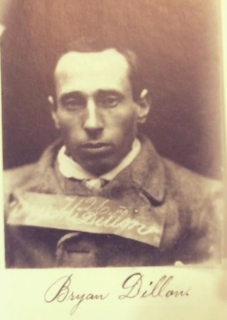
Brian Dillon, Irish republican leader and a member of the Irish Republican Brotherhood (IRB), dies at his home in Cork, County Cork, on August 17, 1872. He is a central figure in the Cork Fenian movement.

Dillon is born in Glanmire, County Cork, in 1830. As a child, he is injured in a heavy fall which results in curvature of the spine and general ill health. His family moves to a house near the corner of Old Youghal Road and Ballyhooly Road. He attends the School of Art for several years and becomes quite talented with brush and pencil. He lives through the Great Famine and becomes an ardent nationalist.

Dillon is appointed a Fenian leader in Cork by James Stephens, the head of the Irish Republican Brotherhood. Under his supervision the Fenian recruits drill on the Fair Field and at Rathpeacon and are hoping for a rebellion in 1865 when the Fenians are at their strongest. He often associates with other Cork Fenians such as John J. Geary, James Mountaine and John Lynch. He chairs the Fenian meetings at Geary’s pub.

In September 1865, police arrest Fenian leaders James Stephens and Jeremiah O’Donovan Rossa in Dublin, and Dillon in Cork. The police search his home and find a pair of field glasses, some drawings and some incriminating letters sewn into the mattress of his bed. He is remanded in Cork City Gaol until his trial.

On December 18, Dillon and another Cork Fenian, John Lynch, are tried together in the dock in Cork Courthouse by Judge Keogh. The charges are primarily based on information provided by an informer named John Warner, an ex-military pensioner. Isaac Butt and Mr. Waters represent the defendants. The charges are “in one indictment with having conspired to depose the Queen, &c., and with illegally drilling and being drilled in furtherance of that design.” Both are found guilty, based primarily on the testimony of informants, although John Warner’s account is very weak and unsatisfactory under cross-examination. The defendants are sentenced to ten years’ penal servitude.

Dillon is brought under armed guard by train from Cork to Dublin and then thrown into Mountjoy Gaol. He spends nearly a month there and suffers from lack of sleep. In January 1866, he and John Sarsfield Casey are handcuffed together on the tough and rough sea crossing between Kingstown and Holyhead. On arrival at Holyhead, they are then taken by train to Pentonville Prison. This is a very cold prison, and he becomes seriously ill in May 1866. He is transferred to the hospital wing of Woking Convict Invalid Prison, and this is to be his home for the next four-and-a-half years. Here he becomes Convict Number 2658.

In 1870, after five years imprisonment, a commission is set up to investigate the Fenian prisoners, and on account of his bad health, this commission recommends that Dillon be allowed home to Cork. In January 1871 he is transferred to Millbank Prison London and is set free two weeks later on February 8. The following day he arrives in Dublin and after a few days’ rest, he returns to Cork by train. All along the route thousands of people wait on the platforms to greet him and read special addresses of welcome. The train reaches Cork at 8:00 p.m. and even though a carriage and pair are waiting, he is glad to seek refuge in the first covered car he can find, so dense is the crowd all around him wanting to shake his hand. The triumphal procession from the station to his home then begins and the hills all along the route are lighted with tar barrels.

Amid emotional scenes Dillon meets his family and afterwards appears at one of the windows of the house and thanks the people of Ireland for the great reception he has received everywhere on his journey home to Cork. He is now in very poor health and his mother begins the task of nursing him back to health. Everything that loving care and money could do is done, and from New York comes a cheque for £50 from the generous-hearted O’Donovan Rossa. Other friends also contribute, but all to no avail. On Saturday, August 17, 1872, he dies at his home surrounded by his sorrowing relatives.

Dillon’s funeral is one of the biggest ever seen in Cork. The cortege is headed by the Barrack Street Band, and at least ten other bands take part. All have their instruments dressed in sombre black. On Monday, August 18, his remains are privately borne to St. Joseph’s cemetery, to a temporary resting place, as it has been decided to build a vault in the family burial ground in Rathcooney which will not be ready for a few days. Later the funeral route travels from Turners Cross along Anglesea Street, South Mall, Grand Parade, Patrick Street, McCurtain Street and St. Luke’s. The funeral procession stops outside his home and prayers are recited for the repose of his soul. The procession then moves on toward Ballyvolane and up the steep hill toward the graveyard at Rathcooney. On arrival at the newly built tomb, so dense is the crowd milling around the hearse that considerable difficulty is experienced in getting the coffin to the grave. The priests then read the burial service, and, in a hushed silence, Canon Freeman asks the entire assembly to kneel and recite the Lord’s Prayer aloud. He blesses the grave, and the mortal remains of Brian Dillon are lowered to rest. The coffin is then covered, and after Colonel Ricard O’Sullivan Burke‘s oration, the crowd quietly disperses.

Today Dillon’s name is inscribed in the National Monument on the Grand Parade and in street names like Dillon’s Cross, Brian Dillon Park and Brian Dillon Crescent. The Brian Dillons GAA club in the same area of Cork city is also named after him.

(Pictured: A mug shot of Brian Dillon)

Leave a comment

The Sheemore Ambush

The Sheemore ambush is an ambush carried out by the Irish Republican Army (IRA) on March 4, 1921, during the Irish War of Independence. It takes place at Sheemore near Carrick-on-Shannon, County Leitrim.

The ambush is carried out by the IRA’s South Leitrim Brigade on a British Army and Auxiliary Division convoy. The British force suffers casualties and admits one fatality, a captain in the Bedfordshire and Hertfordshire Regiment, although some local sources claim several more are killed.

On Friday morning, March 4, 1921, as the congregation makes their way out of the ‘First Friday Mass’ in the Roman Catholic parish church in Gowel, they are met by three lorries carrying 30–40 Auxiliaries, Royal Irish Constabulary (RIC), and British Army members. The men are lined up for searching on one side while a ‘female searcher’ attends to the women. There is no panic and as nothing is found and there are no arrests. The church had been identified as a likely place for volunteers of the IRA’s South Leitrim Brigade to attend. Father Edward O’Reilly, the church’s curate, is openly friendly towards the volunteers. After they search the church interior, the police and soldiers remount their lorries and continue back to Carrick-on-Shannon.

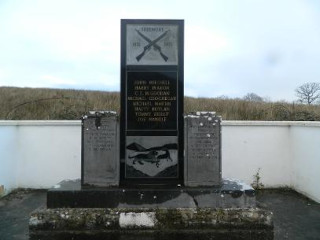
About 2 kilometres down the road, on the slopes of Sheemore, volunteers of the South Leitrim Brigade await them. The day before, the Brigade had received word from Joe Nangle from Drumshanbo of the British operation. They take up position behind a low wall which runs on the brink of an eighty-foot-high rock face on the side of Sheemore. It is four hundred yards from the road. There are seven volunteers – Brigadier Seán Mitchel (who was in command), Charles E. McGoohan (from Ballinamore), Michael Geoghegan (from Aughacashel), Mattie Boylan (from Carrick-on-Shannon), Michael Martin (from Ballinamore), Joe Nangle and Harry McKeon.

At the command from Mitchell, the IRA opens fire on the convoy. The members of the convoy jump from their lorries, and take cover behind a wall which runs along the road. The police run despite the shouts from the soldiers to stand their ground. The officer in command tries to use field glasses to spot the positions of the IRA. After a forty-five-minute gunfight the IRA withdraws, and the British make no attempt to follow them. Instead they gather up their casualties and return to Carrick-on-Shannon, where Black and Tans later undertake reprisals, burning and looting, and burn both the premises of the Leitrim Observer newspaper and the local rowing club to the ground. They also burn the Temperance Hall in Gowel.

Nurse Alice Grey (or Gray), the ‘female searcher,’ who is a member of the ambushed convoy, is recognised by the British authorities for her role in the incident.

Contemporary newspaper reports indicate that one officer and four men of the Bedfordshire Regiment were wounded, as were two members of the RIC. The British officer died the following day, and some people reportedly left the area for fear of reprisals.

(Pictured: Monument in memory of the Volunteers who took part in the Sheemore Ambush)


Leave a comment

Birth of Sir Peter O’Sullevan, Horse Racing Commentator

Sir Peter O’Sullevan, Irish-British horse racing commentator for the BBC, and a correspondent for the Press Association, the Daily Express, and Today, is born Newcastle, County Down on March 3, 1918. He is the BBC’s leading horse racing commentator from 1947 to 1997, during which time he describes some of the greatest moments in the history of the Grand National.

O’Sullevan is the son of Colonel John Joseph O’Sullevan DSO, resident magistrate at Killarney, and Vera (née Henry). As an infant, the family returns to his parents’ home at Kenmare, County Kerry and he is raised in Surrey, England. He is educated at Hawtreys Preparatory School, Charterhouse School, and later at Collège Alpin International Beau Soleil in Switzerland.

In the late 1940s O’Sullevan is involved in some of the earliest television commentaries on any sport and makes many radio commentaries in his earlier years (including the Grand National before it is televised for the first time in 1960). On television, he commentates on many of the major events of the racing year, including the Cheltenham Festival until 1994, The Derby until 1979, and the Grand National, Royal Ascot and Glorious Goodwood until he retires in 1997. During his career, he commentates on around 30 runnings of the Prix de l’Arc de Triomphe in Paris and racing from the United States and Ireland as well as trotting from Rome during the 1960s.

During his 50 years of commentating on the Grand National, O’Sullevan commentates on numerous historic victories. These include Bob Champion‘s run on Aldaniti in 1981 after recovering from cancer, 100/1 outsider Foinavon‘s win in 1967, and the three-times winner Red Rum in 1973, 1974 and 1977. He also commentates on the 1993 Grand National, which is declared void after 30 of the 39 runners fail to realise there had been a false start, and seven go on to complete the course. As the runners approach the second-last fence in the so-called “race that never was,” O’Sullevan declares it “the greatest disaster in the history of the Grand National.”

O’Sullevan becomes known as the “Voice of Racing.” In a television interview before his 50th and last Grand National in 1997, he reveals that his commentary binoculars came from a German submarine. He is knighted the same year – the only sports broadcaster at the time to have been bestowed that honour. He is also a racehorse owner, including of Be Friendly, who wins the King’s Stand Stakes at Ascot, and Prix de l’Abbaye de Longchamp. He is twice successful in the Haydock Sprint Cup (then Vernons Sprint) in 1966 and 1967. Another horse he owns is Attivo, whose victory in the 1974 Triumph Hurdle at the Cheltenham Festival is described by O’Sullevan as the most difficult race to call.

Attivo also wins the Chester Cup and the Northumberland Plate during the 1970s. O’Sullevan’s final race commentary comes at Newbury Racecourse for the 1997 Hennessy Gold Cup, and he visits the winners’ enclosure as a winning owner in the race which follows courtesy of Sounds Fyne’s victory in the Fulke Walwyn Chase. He is succeeded as the BBC’s lead commentator by Jim McGrath.

After his retirement, O’Sullevan is actively involved in charity work, fundraising for causes which revolve around the protection of horses and farm animals, including the International League for the Protection of Horses (ILPH), the Thoroughbred Rehabilitation Centre and Compassion in World Farming. The National Hunt Challenge Chase Cup (run at the Cheltenham Festival) is named after him in 2008 to celebrate his 90th birthday. In 2010, Aintree Racecourse names O’Sullevan as one of the eight inaugural “Grand National Legends.” His name is inscribed on a commemorative plaque at the course, alongside the likes of Ginger McCain and Captain Martin Becher.

O’Sullevan meets his wife Patricia, daughter of Frank Duckworth of Manitoba, Canada, at a ball in Manchester in 1947. She dies of Alzheimer’s disease in 2010.

O’Sullevan dies of cancer at his home in London on July 29, 2015.