seamus dubhghaill

Promoting Irish Culture and History from Little Rock, Arkansas, USA


1 Comment

Birth of Brendan Halligan, Economist & Politician

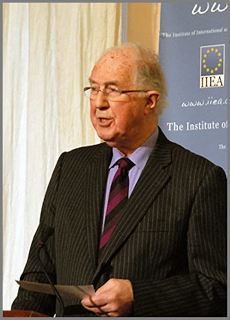
Brendan Halligan, economist and politician, is born in Dublin on July 5, 1936. He is founder and president of the Institute of International and European Affairs (IIEA), a think tank on European and international issues. He is president of the Ireland China Institute, an independent think tank based in Dublin which is officially launched in October 2019. His career spans Irish public sector bodies and work in the private sector. At various times he is General Secretary of the Labour Party, a Teachta Dála (TD), a Senator, and a Member of the European Parliament (MEP).

Halligan grows up in Rialto, Dublin, and is educated at St. James’s Christian Brothers School, Dublin. He studies at Dublin Institute of Technology (DIT) and becomes a chemical analyst in the CIÉ depot in Inchicore. He and three friends decided to go to university and form a co-operative and work at various jobs in London to fund their studies. In 1959, he begins an economics and law degree at University College Dublin (UCD). There he is influenced by lecturers including George O’Brien, Patrick Lynch and Garret FitzGerald. He receives a master’s degree in economics from UCD in 1964.

Following an early career as an economist, working with the Irish Sugar Company until 1967, Halligan becomes involved in politics. In that year, he becomes General Secretary of the Labour Party.

The party leader, Brendan Corish, relies on Halligan’s intellectual and political skills in his new role. Under Halligan, the party undergoes an energetic reorganisation. New structures and policies are put in place, coinciding with the party’s leftward policy shift and an acute anti-coalition stance. He strongly supports both approaches, but is instrumental in securing the party’s eventual, somewhat unwilling, reversal of its anti-coalition stance after its disappointing result in the 1969 Irish general election. The 1973 Irish general election results in a Fine Gael-Labour Party coalition government coming to power.

Halligan is appointed to Seanad Éireann in 1973. Three years later, he wins a by-election in Dublin South-West, and thus becomes a TD. After boundary changes, he stands in the new Dublin Finglas at the 1977 Irish general election but is not elected. He stands again in the revived Dublin North-West constituency at the 1981 and November 1982 Irish general elections, but again is not elected.

Halligan continues to serve as General Secretary of the party until 1980, and is appointed a Member of the European Parliament (MEP) from 1983 until 1984, replacing Frank Cluskey, where he specialises in economic affairs and energy policy.

In 1980, Halligan sets up CIPA, his own public affairs consultancy based in Dublin, and becomes a lecturer in Economics at the University of Limerick. He is also chairman of European Movement Ireland during the late 1980s. In 1985, he is appointed as Chairman of Bord na Móna, the Irish Peat Development Authority, a position he holds for ten years. In 1989 he founds the Institute of European Affairs (IEA), which later becomes the IIEA. He is Director of CIPA until 2014.

Resulting from his keen interest and experience in energy policy and renewable energy, Halligan serves as Chair of the Sustainable Energy Authority of Ireland from 2007 until 2014. He is President of the IIEA, and he is also a Board Member of Mainstream Renewable Energy.

In later years Halligan also works on the foundation and development of the Ireland China Institute (ICI), which, with its maxim bridging the gap between knowledge and understanding, seeks to strengthen Irish-Chinese diplomatic relations, developing cultural links and fostering a deeper understanding of the respective cultural norms and values between the two nations. He is also President of ICI.

Halligan dies on August 9, 2020, after a long illness. On his death, Taoiseach Micheál Martin describes him as “a man who gave his life to politics and the public service with a deep commitment to the institutions of the state.” European Commissioner for Trade Phil Hogan states that “Brendan was a committed European to his fingertips. He was a pragmatic European intellectual, in the tradition of Spinelli, Monnet and Schuman.”


Leave a comment

Death of Jim Mitchell, Fine Gael Politician

jim-mitchell

Jim Mitchell, senior Irish politician who serves in the cabinets of Taoiseach Garret FitzGerald, loses his three-year battle with cancer in Dublin on December 2, 2002.

Mitchell begins his political involvement when he supports Seán MacBride, leader of the radical republican Clann na Poblachta in the 1957 general election. He joins Fine Gael in 1967, becoming that party’s unsuccessful candidate in a by-election in 1970. He seeks a party nomination to run in the 1973 Irish general election. However, he agrees not to contest the seat to allow Declan Costello, a senior figure in his party and son of former Taoiseach John A. Costello, to be elected. Costello goes on to serve as Attorney General of Ireland in the 1973-1977 National Coalition of Fine Gael and the Labour Party.

Mitchell is elected to Dublin Corporation in 1974. In 1976, at the age of 29, he becomes the youngest ever Lord Mayor of Dublin. He is an unsuccessful candidate for Dáil Éireann in the 1973 general election in Dublin South-West and loses again in the 1976 by-election in the same constituency, to Labour’s Brendan Halligan.

In the 1977 general election he is elected to the 21st Dáil for the new constituency of Dublin Ballyfermot. With the party’s loss of power in 1977, the new leader, Garret FitzGerald appoints Mitchell to the Party’s Front Bench as spokesman on Labour. At the 1981 general election Mitchell is elected for the Dublin West and Fine Gael dramatically increases its number of seats, forming a coalition government with the Labour Party. On his appointment as Taoiseach, Garret FitzGerald causes some surprise by excluding some of the older conservative ex-ministers from his cabinet. Instead, young liberals like Mitchell are appointed, with Mitchell receiving the high-profile post of Minister for Justice, taking responsibility for policing, criminal and civil law reform, penal justice, etc. The Fine Gael-Labour government collapses in January 1982 but regains power in December of that year. Mitchell again is included in a FitzGerald cabinet, as Minister for Transport.

As Minister for Transport, Mitchell grants the aviation license to a fledgling airline called Ryanair on November 29, 1985. This is granted despite strong opposition by Ireland’s national carrier Aer Lingus. The issue of the license breaks Aer Lingus’ stranglehold on flights to London from the Republic of Ireland.

Mitchell, who is seen as being on the social liberal wing of Fine Gael, is out of favour with John Bruton when he becomes Fine Gael leader in 1990. When Bruton forms the Rainbow Coalition in December 1994, Mitchell is not appointed to any cabinet post.

Mitchell contests and wins Dáil elections in 1977, 1981, (February and November) 1982, 1987, 1989, 1992, 1997. He runs for his party as its candidate to become a member of the European Parliament in the 1994 and 1998 elections. He also is director of elections for Austin Currie, the Fine Gael candidate, in the 1990 presidential election.

In 2001, Bruton is deposed as Fine Gael leader and replaced by Michael Noonan. Mitchell serves as his deputy from 2001 to 2002. He also chairs the key Oireachtas Public Accounts Committee. The Committee’s work under his chairmanship is widely praised for its inquiry into allegations of corruption and wide-scale tax evasion in the banking sector.

Though regarded in politics as one of Fine Gael’s “survivors,” who holds onto his seat amid major boundary changes, constituency changes and by attracting working class votes in a party whose appeal is primarily middle class, Mitchell loses his Dublin Central seat in the 2002 general election. That election witnesses a large-scale collapse in the Fine Gael vote, with the party dropping from 54 to 31 seats in Dáil Éireann. Although Mitchell suffers from the swing against Fine Gael in Dublin, he is not aided by the fact that Inchicore, which is considered his base in the constituency has been moved to Dublin South-Central. He chooses not to run in that constituency as his brother, Gay, is a sitting Teachta Dála (TD) running for re-election for that constituency.

Mitchell earlier has a liver transplant in an attempt to beat a rare form of cancer which had cost the lives of a number of his siblings. Though the operation is successful, the cancer returns. Although he appears to be making a recovery, Jim Mitchell ultimately dies of the disease on December 2, 2002.

His former constituency colleague and rival, Taoiseach Bertie Ahern, describes Jim Mitchell as having made an “outstanding contribution to Irish politics.”


Leave a comment

Birth of Labour Party Leader Frank Cluskey

Frank Cluskey, Irish politician and leader of the Irish Labour Party from 1977 to 1981, is born in Dublin on April 8, 1930.

Cluskey is educated at St. Vincent’s C.B.S. in Glasnevin. He works as a butcher and then joins the Labour Party. He quickly becomes a branch secretary in the Workers’ Union of Ireland. At the 1965 general election he is elected as a Labour Party Teachta Dála (TD) for the Dublin South-Central constituency. In 1968 he is elected Lord Mayor of Dublin. In 1973 he is appointed Parliamentary Secretary to the Minister for Social Welfare, Brendan Corish. He introduces sweeping reforms to the area while he holds that position. He plays a leading role in initiating the EU Poverty Programmes.

The Fine Gael–Labour Party coalition is defeated at the 1977 general election resulting in the resignation of Brendan Corish as Labour Party leader. Cluskey is elected the new leader of the Labour Party. In 1981, the Labour Party enters into a coalition government with Fine Gael. However, Cluskey has lost his seat in Dáil Éireann at the 1981 general election and with it the party leadership. He is appointed on July 1, 1981, as a Member of the European Parliament (MEP) for Dublin, replacing Michael O’Leary, who had resigned the seat after succeeding Cluskey as Labour leader.

The coalition government falls in January 1982 over a budget dispute, and Cluskey is re-elected to the Dáil at the February 1982 general election. When the coalition returns to office after the November 1982 election, Cluskey is appointed as Minister for Trade, Commerce and Tourism. He then resigns from the European Parliament, to be replaced by Brendan Halligan.

On December 8, 1983, Cluskey resigns as Minister due to a fundamental disagreement over government policy about the Dublin Gas Company. He retains his Dáil seat in the 1987 general election.

Following his re-election Cluskey’s health begins to deteriorate. He dies in Dublin on May 7, 1989, following a long battle with cancer.