seamus dubhghaill

Promoting Irish Culture and History from Little Rock, Arkansas, USA


2 Comments

Birth of Activist Mary Ellen Spring Rice

mary-ellen-spring-rice

Mary Ellen Spring Rice, Irish nationalist activist during the early 20th century, is born into an aristocratic Anglo-Irish family in London, England on October 14, 1880.

Spring Rice is the daughter of Thomas Spring Rice, 2nd Baron Monteagle of Brandon, and a great-granddaughter of the British Chancellor of the Exchequer, Thomas Spring Rice, 1st Baron Monteagle of Brandon. Her maternal grandfather is the bishop, Samuel Butcher. She is brought up on the family’s Mount Trenchard estate overlooking the River Shannon. It is a progressive, liberal household and independence of thought is encouraged. So too is the Gaelic culture and, at home, she and her brothers are taught how to fluently speak the Irish language.

Before World War I, Spring Rice hosts many Irish nationalist and Conradh na Gaeilge meetings at her home, and she becomes a close friend of Douglas Hyde and her cousin Nelly O’Brien. During 1913 and 1914, she is actively involved in gun-running, most notably the Howth gun-running.

This involves helping to ship weapons to be used in an Irish uprising from Germany into Ireland. Together with Molly Childers, she raises £2,000 towards the purchase of 900 Mauser rifles from Germany, many of which are used in the 1916 Easter Rising. She sails on the Asgard to collect the guns and helps to unload them in Ireland.

During the Irish War of Independence, Spring Rice allows her Mount Trenchard home to be used as a safe house by Irish Republican Army fighters and the family boat is used to carry men and arms over the Shannon Estuary.

Con Collins stays with Spring Rice regularly. She helps train local women as nurses to tend to wounded nationalists and acts as an IRA message carrier between Limerick and Dublin. Throughout this time, she maintains her aristocratic façade and society connections, inviting senior Liberal Party politicians to Mount Trenchard to pressure them to support Irish independence.

Spring Rice starts to suffer from tuberculosis in 1923, and dies unmarried in a sanatorium in Clwyd, Wales, on December 1, 1924. She is buried in Ireland, where her coffin is draped in the Irish tricolour and escorted by an IRA guard of honour.

(Pictured: Mary Ellen Spring-Rice and Molly Childers with the German guns on board Asgard, 1914.)

Leave a comment

The Boston Massacre

boston-massacre-1770

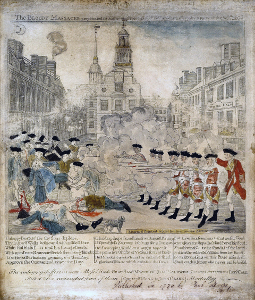
The Boston Massacre, a riot known as the Incident on King Street by the British, takes place in Boston, Massachusetts on March 5, 1770. British Army soldiers shoot and kill several people while under attack by a mob.

The incident is heavily publicized by leading Patriots, such as Paul Revere and Samuel Adams, to encourage rebellion against the British authorities. British troops have been stationed in Boston, capital of the Province of Massachusetts Bay, since 1768 in order to protect and support crown-appointed colonial officials attempting to enforce unpopular Parliamentary legislation.

Amid ongoing tense relations between the population and the soldiers, a mob forms around a British sentry, who is subjected to verbal abuse and harassment. He is eventually supported by eight additional soldiers, who are subjected to verbal threats and repeatedly hit by clubs, stones and snowballs. Without orders, they fire a ragged series of shots into the crowd, striking eleven men. Three Americans, ropemaker Samuel Gray, mariner James Caldwell, and Crispus Attucks, die instantly. Samuel Maverick, a 17-year-old apprentice ivory turner, is struck by a ricocheting musket ball at the back of the crowd and dies a few hours later, in the early morning of the next day. An Irish immigrant, Patrick Carr, dies two weeks later. Christopher Monk, another apprentice, is one of those seriously wounded in the attack. Although he recovers to some extent, he is crippled and eventually dies in 1780, purportedly due to the injuries he had sustained in the attack a decade earlier.

The crowd eventually disperses after Acting Governor Thomas Hutchinson promises an inquiry, but the crowd re-forms the next day, prompting the withdrawal of the troops to Castle Island. Eight soldiers, one officer, and four civilians are arrested and charged with murder. Defended by lawyer and future American president John Adams, six of the soldiers are acquitted, while the other two are convicted of manslaughter and given reduced sentences. The men found guilty of manslaughter are sentenced to branding on their hand. Depictions, reports, and propaganda about the event, notably the colored engraving produced by Paul Revere, further heighten tensions throughout the Thirteen Colonies.

(Pictured: Famous depiction of the Boston Massacre engraved by Paul Revere (copied from an engraving by Henry Pelham), colored by Christian Remick, and printed by Benjamin Edes. The Old State House is depicted in the background.)


Leave a comment

Death of Francis McCloskey, First Fatality of “The Troubles”

the-troubles

Francis McCloskey, a 67-year-old Catholic civilian, dies on July 14, 1969, one day after being hit on the head with a baton by an officer of the Royal Ulster Constabulary (RUC) during street disturbances in Dungiven, County Derry. McCloskey is sometimes considered to be the first fatality of The Troubles.

McCloskey is found unconscious on July 13 near the Dungiven Orange Hall following a police baton charge against a crowd who had been throwing stones at the hall. Witnesses later say they had seen police beating a figure with batons in the doorway where McCloskey is found, although police claim he had been unconscious before the baton charge and may have been hit with a stone.

The Troubles is the common name for the ethno-nationalist conflict in Northern Ireland that begins in the late 1960s and is deemed by most to end with the Good Friday Agreement of 1998. Although the Troubles mainly take place in Northern Ireland, violence spills over at times into parts of the Republic of Ireland, England, and mainland Europe.

The conflict is primarily political, but it also has an ethnic or sectarian dimension, although it is not a religious conflict. A key issue is the constitutional status of Northern Ireland. Unionists and loyalists, who are mostly Protestants and consider themselves British, generally want Northern Ireland to remain within the United Kingdom. Irish nationalists and republicans, who are mostly Catholic and consider themselves Irish, generally want it to leave the United Kingdom and join a united Ireland. The conflict begins amid a campaign to end discrimination against the Catholic/nationalist minority by the Protestant/unionist government and police force in 1968. The campaign is met with violence, eventually leading to the deployment of British troops and subsequent warfare.

The main participants in the Troubles are republican paramilitaries such as the Provisional Irish Republican Army (IRA) and Irish National Liberation Army (INLA), loyalist paramilitaries such as the Ulster Volunteer Force (UVF) and Ulster Defence Association (UDA), the British Army and Royal Ulster Constabulary (RUC), and political activists and politicians. The security forces of the Republic of Ireland play a smaller role. More than 3,500 people are killed in the conflict, of whom 52% were civilians, 32% are members of the British security forces, and 16% are members of paramilitary groups. There has been sporadic violence since the signing of the Good Friday Agreement, including a campaign by anti-ceasefire republicans.