seamus dubhghaill

Promoting Irish Culture and History from Little Rock, Arkansas, USA


Leave a comment

William III’s 1688 Invasion of England

On November 1, 1688, William III of Orange sets sail from Hellevoetsluis, the Netherlands, launching a second major expedition to invade England in the context of the Glorious Revolution. This is part of a broader political and military campaign to depose King James II of England (James VII of Scotland and James II of Ireland) and secure England as an ally in the upcoming Nine Years’ War against France.

James II, a Roman Catholic, had ruled since 1685 and faced deep Protestant opposition in England and Scotland. His policies, including the Declaration of Indulgence and prosecution of the “Seven Bishops,” alienates many. In June 1688, the birth of his Catholic son, James Francis Edward Stuart, threatens the Protestant succession, while his continued authoritarian rule fuels unrest.

Seven prominent Englishmen, known as the “Immortal Seven,” invite William to intervene, framing it as a defense of Protestantism and constitutional government. William, James’s nephew and son-in-law, sees the invasion as both a political opportunity and a strategic move to counter French expansion.

William assembles one of the largest fleets in European history, with 14,000–21,000 troops and a powerful navy. On November 5, 1688, he lands at Brixham in Torbay with his army. The campaign is marked by low casualties and minimal fighting, as James’s forces begin to collapse and many defect to William’s side.

By late November, James retreats from Salisbury and flees to France on December 23, 1688. William enters London without significant resistance, leading to the constitutional settlement in 1689, in which Mary II and William III become joint monarchs of England, Scotland, and Ireland.

The Glorious Revolution is often described as a “bloodless” revolution because it avoids large-scale battles, but it is a decisive political change that establishes parliamentary supremacy and lays the foundation for constitutional monarchy in Britain. William’s invasion is also notable as one of the last successful invasions of England.

In summary, on November 1, 1688, William III of Orange’s departure from Hellevoetsluis is the start of a swift and politically decisive campaign that ends James II’s reign and reshapes the British monarchy.

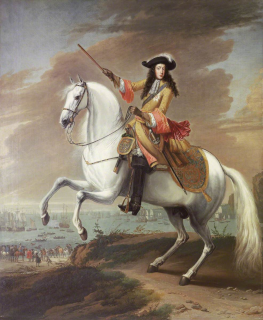
(Pictured: William III landing at Brigham on November 5, 1688)


Leave a comment

William of Orange Arrives in Brixham, England

On November 5, 1688, William of Orange, King of the Netherlands and son-in-law of King James II of England, arrives in Brixham, England, with 40,000 soldiers, sailors and volunteers, prior to marching on London to be crowned King William III as part of the Glorious Revolution.

He has been invited by the Protestant noblemen of the country to come and usurp the English throne. Led by Lord Monmouth, a group of Protestant nobles have unsuccessfully attempted to prevent the Catholic James from ascending to the throne on the death of Charles II in 1685. Since then, James has been disturbing the Protestant noblemen who have remained loyal to him in 1685 by giving Catholics more and more freedoms in both England and Ireland.

On May 7, 1688, James II issues a “Declaration of Indulgence” pledging religious toleration. Still the Protestant nobles are comforted by the fact that all the possible heirs to James are Protestant. Thus the country will be safely returned to a Protestant monarch in time and many of James’ reforms will be reversed. All that changes on June 10, 1688, when the Queen gives birth to a male heir, one who is to be raised as a Catholic.

Soon thereafter, an invitation is sent across to William, who is married to James’ sister Mary, to come and save England for Protestantism. This, William is more than happy to do, for Louis XIV of France is threatening to invade the Netherlands and what better way to ensure the support of England in that coming war than to become the King of that country.

The “Glorious Revolution,” as the British would come to call it, is now underway. In less than two months, James II flees for his life and goes into exile in France, never to return. For the native population of Ireland, the eventual results of this revolution are far from “glorious.” The results are death, destruction, poverty, hundreds of years of second-class citizenship in their own land, and a legacy of hatred between Protestant and Catholic in the north of Ireland that persists to this day.

(Pictured: “William III Landing at Brixham, Torbay, 5 November 1688” by Jan Wyck, National Maritime Museum)


Leave a comment

Death of William III, King of England, Scotland & Ireland

Kneller, Godfrey, 1646-1723; King William III (1650-1702)

William III, also widely known as William of Orange, dies at Kensington Palace on March 8, 1702, following a fall from his horse when it stumbles on a molehill. Upon his death, Anne accedes to the throne of Britain and Ireland.

William is sovereign Prince of Orange from birth, Stadtholder of Holland, Zeeland, Utrecht, Gelderland and Overijssel in the Dutch Republic from 1672 and King of England, Ireland and Scotland from 1689 until his death in 1702. As King of Scotland, he is known as William II. He is sometimes informally known in Northern Ireland and Scotland as “King Billy.”

William is born on November 4, 1650, at Binnenhof, The Hague, Dutch Republic. He inherits the Principality of Orange from his father, William II, who dies a week before William’s birth. His mother, Mary, is the daughter of King Charles I of England. In 1677, William marries his fifteen-year-old first cousin, Mary, the daughter of his maternal uncle James, Duke of York.

A Protestant, William participates in several wars against the powerful Catholic King of France, Louis XIV, in coalition with Protestant and Catholic powers in Europe. Many Protestants herald him as a champion of their faith. In 1685, William’s Catholic uncle and father-in-law, James, becomes king of England, Scotland and Ireland. James’s reign is unpopular with the Protestant majority in Britain. William, supported by a group of influential British political and religious leaders, invades England in what becomes known as the Glorious Revolution. On November 5, 1688, he lands at the southern English port of Brixham. James is deposed and William and his wife become joint sovereigns in his place.

William’s reputation as a staunch Protestant enables him to take power in Britain when many are fearful of a revival of Catholicism under James. William’s victory at the Battle of the Boyne in 1690 is still commemorated by loyalists in Northern Ireland and Scotland.

William and Mary reign together until Mary’s death from smallpox on December 28, 1694, after which William rules as sole monarch. Despite his conversion to Anglicanism, his popularity plummets during his reign as a sole monarch. His reign in Britain marks the beginning of the transition from the personal rule of the House of Stuart to the more Parliament-centred rule of the House of Hanover.

On March 8, 1702, William dies of pneumonia, a complication from a broken collarbone following a fall from his horse, Sorrel. The horse had been confiscated from Sir John Fenwick, one of the Jacobites who had conspired against William. Because his horse had stumbled into a mole’s burrow, many Jacobites toast “the little gentleman in the black velvet waistcoat.” Years later, Winston Churchill, in his A History of the English-Speaking Peoples, states that the fall “opened the door to a troop of lurking foes.” William is buried in Westminster Abbey alongside his wife. His sister-in-law, Anne, becomes queen regnant of England, Scotland and Ireland.

William’s death means that he would remain the only member of the Dutch House of Orange to reign over England.