seamus dubhghaill

Promoting Irish Culture and History from Little Rock, Arkansas, USA


Leave a comment

Death of Actress Betty Chancellor

Betty Chancellor, Irish actress, dies in Dún Laoghaire, County Dublin, at the age of 74 on April 27, 1984.

Chancellor is born at 8 Fitzwilliam Place, Dublin, on January 9, 1910. Her parents are John William Chancellor, a Dublin clockmaker, jeweler, and photographer, and Cicely Chancellor (née Granger). They marry in Billericay, Essex, in 1904. She has an elder sister, Joyce Fanny, who also becomes an actress. She attends Nightingale Hall and Alexandra College, going on to train as a secretary.

Chancellor’s first appearance on stage is as a fairy in a benefit performance at the Gaiety Theatre in 1914. She appears again at the Gaiety in 1922 as Gwennie in F. Anstey‘s The Man from Blankley’s, and then studies drama under Frank Fay. In the 1920s, she acts in the Dublin Drama League’s productions in the Abbey Theatre. Once she joins the Gate Theatre her career progresses, establishing her as one of the principal actresses in the Gate by the early 1930s.

Chancellor plays Naomi alongside Orson Welles in a production of Jud Süss in October 1931. Welles becomes infatuated with her and later describes her as “the sexiest thing that ever lived.” In 1931, she debuts in J. B. Fagan‘s production of The New Gossoon by George Shiels as Biddy Henley at the Apollo Theatre. Her most noted roles are as Toots in Youth’s the Season in 1932 by Mary Manning, Laura in a production of Carmilla in 1932, based on the Gothic novella by Sheridan Le Fanu, Ophelia in 1932 and Cicely in The Importance of Being Earnest in 1933. Touring with the Gate company in 1935, she plays Stella in its production of Lord Longford‘s Yahoo performed in the Westminster Theatre, London. She stars with James Mason in the Gate’s production of Pride and Prejudice in 1937. Disappointed with the parts she is getting at the Gate after that and much to the annoyance of Micheál Mac Liammóir and Hilton Edwards, she joins Lord Longford’s first provincial tour in 1937.

In the late 1930s, Chancellor works more often in London. Following her appearance as Baby Furze in the 1938 production of Spring Meeting by Molly Keane and John Perry, she is nominated as “Star of the Future” by the Daily Mail. She acts alongside Alec Guinness and Peggy Ashcroft in 1940 in Clemence Dane‘s Cousin Muriel at the Globe Theatre, directed by John Gielgud.

Chancellor returns to the Gaiety Theatre in 1941 to act with Hilton Edwards in a production of Caesar and Cleopatra by George Bernard Shaw, a production that marks the 75th anniversary of the Gaiety. The press welcomes her return to the company, but her fellow actors are disturbed by the fact she is then living with Denis Johnston, the husband of fellow actress Shelah Richards. After Johnston’s divorce, they marry in March 1945 in Dungannon, County Tyrone. She partly retires from acting to raise their sons, but also due to her increasing deafness that had begun in her teens.

In 1947, Chancellor appears in Johnston’s The Moon in the Yellow River at the Arts Theatre in London with Jack Hawkins. The family moves to the United States in November 1948, where she has the lead role in Shaw’s Candida at Amherst College, Massachusetts in 1950.

In 1969, Chancellor returns to Ireland with her family and settles in Dalkey, County Dublin. She dies in Dún Laoghaire on April 27, 1984, and is buried in the close of St. Patrick’s Cathedral, Dublin.
Leave a comment

Birth of Tony Award Nominated Actor Milo O’Shea

Milo Donal O’Shea, Irish actor twice nominated for the Tony Award for Best Actor in a Play for his performances in Staircase (1968) and Mass Appeal (1982), is born in Dublin on June 2, 1926.

O’Shea is raised in Dublin and educated by the Christian Brothers at Synge Street CBS, along with his friend Donal Donnelly. His father is a singer and his mother a ballet teacher. Because he is bilingual, he performs in English-speaking theatres and in Irish in the Abbey Theatre Company. At age 12, he appears in George Bernard Shaw‘s Caesar and Cleopatra at the Gate Theatre. He later studies music and drama at the Guildhall School of Music and Drama in London and is a skilled pianist.

O’Shea is discovered in the 1950s by Harry Dillon, who runs the 37 Theatre Club on the top floor of his shop, the Swiss Gem Company, 51 Lower O’Connell Street, Dublin. Early in his career he tours with the theatrical company of Anew McMaster.

O’Shea begins acting on the stage, then moves into film in the 1960s. He becomes popular in the United Kingdom, as a result of starring in the BBC sitcom Me Mammy alongside Yootha Joyce. In 1967–68 he appears in the drama Staircase, co-starring Eli Wallach and directed by Barry Morse, which stands as Broadway‘s first depiction of homosexual men in a serious light. For his role in that drama, he is nominated for the Tony Award for Best Actor in a Play in 1968.

O’Shea stars as Leopold Bloom in Joseph Strick‘s 1967 film version of Ulysses. Among his other memorable film roles in the 1960s are the well-intentioned Friar Laurence in Franco Zeffirelli‘s Romeo and Juliet (1968) and the villainous Dr. Durand Durand in Roger Vadim‘s counterculture classic Barbarella (1968). In 1984, he reprises his role as Dr. Durand Durand, credited as Dr. Duran Duran, for the 1985 Duran Duran concert film Arena (An Absurd Notion), since his character inspired the band’s name. He plays Inspector Boot in the 1973 Vincent Price horror/comedy film Theatre of Blood.

O’Shea is active in American films and television, such as his memorable supporting role as the trial judge in the Sidney Lumet-directed movie The Verdict (1982) with Paul Newman, an episode of The Golden Girls in 1987, and portraying Chief Justice of the United States Roy Ashland in the television series The West Wing. In 1992, he guest stars in the season 10 finale of the sitcom Cheers, and, in 1995, in an episode of the show’s spin-off Frasier. He appears in the pilot episode of Early Edition as Sherman.

Other stage appearances include Mass Appeal (1981) in which he originates the role of Father Tim Farley, for which he is nominated for the Tony Award for Best Actor in a Play in 1982, the musical Dear World in which he plays the Sewer Man opposite Angela Lansbury as Countess Aurelia, Corpse! (1986) and a 1994 Broadway revival of Philadelphia, Here I Come!.

O’Shea receives an honorary degree from Quinnipiac University in 2010.

O’Shea’s first wife is Maureen Toal, an Irish actress, with whom he has two sons, Colm and Steven. They divorce in 1974. His second wife is Irish actress Kitty Sullivan, whom he meets in Italy, where he is filming Barbarella and she is auditioning for Man of La Mancha. The couple occasionally act together, such as in a 1981 Broadway revival of My Fair Lady. O’Shea and Sullivan have no children together. They both adopt United States citizenship and reside in New York City, where they both live from 1976.

O’Shea dies on April 2, 2013, in New York City following a short illness at the age of 86. He is buried at Deans Grange Cemetery.


Leave a comment

Death of Irish Playwright George Bernard Shaw

George Bernard Shaw, Irish playwright, critic, and polemicist, dies at the age of 94 on November 2, 1950, at Ayot St. Lawrence, Hertfordshire, England. His influence on Western theatre, culture, and politics extends from the 1880s to his death and beyond.

Shaw writes more than sixty plays, including major works such as Man and Superman (1902), Pygmalion (1912) and Saint Joan (1923). With a range incorporating both contemporary satire and historical allegory, he becomes the leading dramatist of his generation, and in 1925 is awarded the Nobel Prize in Literature.

Shaw is born on July 26, 1856, at 3 Upper Synge Street in Portobello, a lower-middle-class area of Dublin. The Shaw family is of English descent and belong to the dominant Protestant Ascendancy in Ireland. Between 1865 and 1871, Shaw attends four schools, all of which he hates. His experiences as a schoolboy leave him disillusioned with formal education. In October 1871 he leaves school to become a junior clerk in a Dublin firm of land agents, where he works hard and quickly rises to become head cashier. During this period, he is known as “George Shaw”; after 1876, he drops the “George” and styles himself “Bernard Shaw.”

Shaw moves to London in 1876, where he struggles to establish himself as a writer and novelist and embarks on a rigorous process of self-education. By the mid-1880s he has become a respected theatre and music critic. Following a political awakening, he joins the gradualist Fabian Society and becomes its most prominent pamphleteer. He has been writing plays for years before his first public success, Arms and the Man in 1894. Influenced by Henrik Ibsen, he seeks to introduce a new realism into English-language drama, using his plays as vehicles to disseminate his political, social, and religious ideas. By the early twentieth century his reputation as a dramatist is secured with a series of critical and popular successes that include Major Barbara, The Doctor’s Dilemma, and Caesar and Cleopatra.

Shaw’s expressed views are often contentious. He promotes eugenics and alphabet reform and opposes vaccination and organised religion. He courts unpopularity by denouncing both sides in World War I as equally culpable, and although not a republican, castigates British policy on Ireland in the postwar period. These stances have no lasting effect on his standing or productivity as a dramatist.

The inter-war years see a series of often ambitious plays, which achieve varying degrees of popular success. In 1938 Shaw provides the screenplay for a filmed version of Pygmalion for which he receives an Academy Award. His appetite for politics and controversy remains undiminished. By the late 1920s he has largely renounced Fabian gradualism and often writes and speaks favourably of dictatorships of the right and left — he expresses admiration for both Mussolini and Stalin. In the final decade of his life, he makes fewer public statements, but continues to write prolifically until shortly before his death, refusing all state honours including the Order of Merit in 1946.

During his later years, Shaw enjoys tending the gardens at Shaw’s Corner. He dies on November 2, 1950, at the age of 94 of renal failure precipitated by injuries incurred when falling while pruning a tree. His body is cremated at Golders Green Crematorium on November 6, 1950. His ashes, mixed with those of his wife Charlotte, are scattered along footpaths and around the statue of Saint Joan in their garden.

Since Shaw’s death scholarly and critical opinion has varied about his works, but he has regularly been rated as second only to Shakespeare among English-language dramatists. Analysts recognise his extensive influence on generations of playwrights. The word “Shavian” has entered the language as encapsulating Shaw’s ideas and his means of expressing them.


Leave a comment

George Bernard Shaw Wins the Nobel Prize in Literature

George Bernard Shaw, Irish playwright, critic and polemicist, wins the Nobel Prize in Literature on November 11, 1925. Born in Dublin on July 26, 1856, Shaw is the only person to receive both a Nobel Prize in Literature and an Oscar (1938), for his work on the film Pygmalion, the adaptation of his play of the same name.

Shaw’s influence on Western theatre, culture and politics extends from the 1880s to his death and beyond. He writes more than sixty plays, including major works such as Man and Superman (1902), Pygmalion (1912) and Saint Joan (1923). With a range incorporating both contemporary satire and historical allegory, Shaw becomes the leading dramatist of his generation, culminating in 1925 with his awarding of the Nobel Prize in Literature.

Shaw moves to London in 1876, where he struggles to establish himself as a writer and novelist and embarks on a rigorous process of self-education. By the mid-1880s he has become a respected theatre and music critic. Following a political awakening, he joins the gradualist Fabian Society and becomes its most prominent pamphleteer. He has been writing plays for years before his first public success, Arms and the Man, in 1894. Influenced by Henrik Ibsen, he seeks to introduce a new realism into English-language drama, using his plays as vehicles to disseminate his political, social and religious ideas. By the early twentieth century his reputation as a dramatist is secured with a series of critical and popular successes that included Major Barbara, The Doctor’s Dilemma and Caesar and Cleopatra.

Shaw’s expressed views are often contentious. He promotes eugenics and alphabet reform and opposes vaccination and organised religion. He courts unpopularity by denouncing both sides in World War I as equally culpable, and although not a republican, castigates British policy on Ireland in the postwar period. These stances have no lasting effect on his standing or productivity as a dramatist. The inter-war years see a series of often ambitious plays, which achieve varying degrees of popular success. In 1938 he provides the screenplay for a filmed version of Pygmalion for which he receives an Academy Award.

Shaw’s appetite for politics and controversy remains undiminished. By the late 1920s he has largely renounced Fabian gradualism and often writes and speaks favourably of dictatorships of the right and left. He expresses admiration for both Benito Mussolini and Joseph Stalin. In the final decade of his life, he makes fewer public statements, but continues to write prolifically until shortly before his death on November 2, 1950, refusing all state honours including the Order of Merit in 1946.

Since Shaw’s death scholarly and critical opinion has varied about his works, but he has regularly been rated as second only to William Shakespeare among British dramatists. Analysts recognise his extensive influence on generations of English-language playwrights. The word “Shavian” has entered the language as encapsulating Shaw’s ideas and his means of expressing them.


Leave a comment

Birth of Playwright George Bernard Shaw

george-bernard-shaw

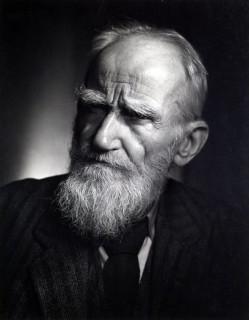
George Bernard Shaw, Irish playwright, critic, and polemicist, is born on July 26, 1856, at 3 Upper Synge Street in Portobello, a lower-middle-class area of Dublin. Shaw’s influence on Western theatre, culture, and politics extends from the 1880s to his death and beyond.

Shaw writes more than sixty plays, including major works such as Man and Superman (1902), Pygmalion (1912) and Saint Joan (1923). With a range incorporating both contemporary satire and historical allegory, Shaw becomes the leading dramatist of his generation, and in 1925 is awarded the Nobel Prize in Literature.

Shaw moves to London in 1876, where he struggles to establish himself as a writer and novelist and embarks on a rigorous process of self-education. By the mid-1880s he has become a respected theatre and music critic. Following a political awakening, he joins the gradualist Fabian Society and becomes its most prominent pamphleteer. Shaw has been writing plays for years before his first public success, Arms and the Man in 1894. Influenced by Henrik Ibsen, he seeks to introduce a new realism into English-language drama, using his plays as vehicles to disseminate his political, social, and religious ideas. By the early twentieth century his reputation as a dramatist is secured with a series of critical and popular successes that include Major Barbara, The Doctor’s Dilemma, and Caesar and Cleopatra.

Shaw’s expressed views are often contentious. He promotes eugenics and alphabet reform and opposes vaccination and organised religion. He courts unpopularity by denouncing both sides in World War I as equally culpable, and although not a republican, castigates British policy on Ireland in the postwar period. These stances have no lasting effect on his standing or productivity as a dramatist.

The inter-war years see a series of often ambitious plays, which achieve varying degrees of popular success. In 1938 he provides the screenplay for a filmed version of Pygmalion for which he receives an Academy Award. His appetite for politics and controversy remains undiminished. By the late 1920s he has largely renounced Fabian gradualism and often writes and speaks favourably of dictatorships of the right and left — he expresses admiration for both Mussolini and Stalin. In the final decade of his life, he makes fewer public statements but continues to write prolifically until shortly before his death, refusing all state honours including the Order of Merit in 1946.

During his later years, Shaw enjoys tending the gardens at Shaw’s Corner. He dies on November 2, 1950, at the age of 94 of renal failure precipitated by injuries incurred when falling while pruning a tree. His body is cremated at Golders Green Crematorium on November 6, 1950. His ashes, mixed with those of his wife Charlotte, are scattered along footpaths and around the statue of Saint Joan in their garden.

Since Shaw’s death scholarly and critical opinion has varied about his works, but he has regularly been rated as second only to Shakespeare among English-language dramatists. Analysts recognise his extensive influence on generations of playwrights. The word “Shavian” has entered the language as encapsulating Shaw’s ideas and his means of expressing them.