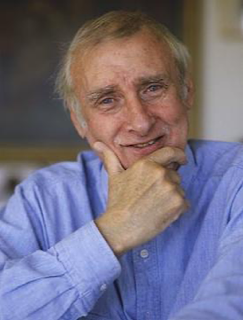
Milligan is the son of an Irish father, Leo Alphonso Milligan, a regimental sergeant major in the British Indian Army, and English mother, Florence Mary Winifred (née Kettleband). He is raised in India and Burma (Myanmar). He is educated at the Convent of Jesus and Mary, Poona, and later at St. Paul’s High School, Rangoon. He moves to England with his family in 1933. He serves in the army during World War II and, when he is wounded in combat, begins a struggle with manic-depressive illness that lasts the rest of his life. Toward the end of the war, he meets Harry Secombe, and they work together entertaining the troops. After the war the pair, along with Peter Sellers and Michael Bentine, begin spending time at the Grafton Arms pub, where they develope their comedy routines. BBC radio begins broadcasting the group’s work in 1951, as Crazy People, and in 1952 it is renamed The Goon Show. As such it continues until early 1960 (though Bentine soon leaves the show) and becomes a cult classic.
Milligan later acts onstage and in small parts in movies—including Monty Python’s Life of Brian (1979)—and writes numerous books of poems, war memoirs, the play The Bedsitting Room (with John Antrobus; first performed 1962), and a number of television series. He also supports a multitude of causes, especially those involving the environment. Because his father is Irish and he is born in India—and despite his years of military service—the British government does not consider him a citizen. Rather than take an oath of allegiance, he takes Irish citizenship. Nonetheless, he is made an honorary Commander of the British Empire in 1992 and is given an honorary knighthood in 2000.
Milligan dies from kidney failure, at the age of 83, on February 27, 2002, at his home on Dumb Woman’s Lane near Rye, East Sussex. On the day of his funeral, March 8, 2002, his coffin is carried to St. Thomas Church in Winchelsea, East Sussex, and is draped in the flag of Ireland. He had once quipped that he wanted his headstone to bear the words: “I told you I was ill.” He is buried at St. Thomas’ churchyard but the Chichester diocese refuses to allow this epitaph. A compromise is reached with the Gaelic translation of “I told you I was ill,” Dúirt mé leat go mé breoite, and in English, “Love, light, peace.” The additional epitaph Grá mhór ort Shelagh can be read as “Great love for you Shelagh.”
According to a letter published in the Rye and Battle Observer in 2011, Milligan’s headstone is removed from St. Thomas’ churchyard in Winchelsea and moved to be alongside the grave of his wife, but is later returned.
Sinclair’s parents are Thomas (1811–1867), merchant and ship-owner, and Sarah Sinclair (née Archer) (1800–1849). His father goes into business with his brother John (1808–1856), setting up a provisions and general merchant store at 5–11 Tomb Street, Belfast. John marries Eliza Pirrie, a relative of the prominent ship builder William Pirrie, 1st Viscount Pirrie. After the death of his father in 1867, Sinclair inherits £35,000 as his mother, brother and sister are all deceased.
In 1876, Sinclair marries Mary Duffin of Strandtown Lodge, Belfast. They have a daughter, Frances Elizabeth Crichton, and a son. She dies in 1879. He marries Elizabeth Richardson in 1882. She is the niece of John Grubb Richardson and the widow of Sinclair’s cousin, John M. Sinclair. They have three sons and two daughters.
Sinclair attends Royal Belfast Academical Institution and Queen’s College Belfast, graduating with a BA with gold medal for mathematics in 1856, and an MA with gold medals in logic, political economy, and English literature in 1859. After his father’s death, he takes over running the family business. He expands and grows it by merging it with another large provisions business with American branches, Kingan & Co. He is related to the Kingans through his cousin Sarah, who is married to the owner, Samuel Kingan.
Despite numerous requests, Sinclair never stands for parliament, instead serving as deputy lieutenant, justice of the peace, president of the Ulsterchamber of commerce in 1876 and 1902, and privy councilor in 1896. Having been a supporter of William Ewart Gladstone, he joins the Ulster Liberal Party in 1868, supporting the land acts of 1870 and 1881. Following the home rule bill of 1886, he convenes a meeting in the Ulster Hall of liberals on April 30, 1886, which passes a resolution in condemnation of the bill. Forming the Ulster Liberal Unionist Association, of which he is chair, he organises the Ulster Convention in Belfast. Held on June 17, 1892, it sees 11,879 Ulster unionists meet to protest home rule. Nine months after the convention, he is appointed to the executive committee of the new unionist clubs, which are founded to protect the union. The defeat of the British Liberal Party in 1895 significantly decreases the threat of home rule, leading to the unionists’ clubs being suspended, and Sinclair returning to his activities in liberal reform. He is the leading Ulster member of the recess committee from 1895, which is founded by Horace Plunkett. He supports Plunkett’s backing of T. P. Gill as secretary of the Irish Agricultural Organisation Society (IAOS) in 1899, in the face of strong protest by conservative unionists.
Despite his unionist politics, Sinclair is nonsectarian, and during his time as chairman of the convocation of the Queen’s University he defends the core non-sectarian principles of the institution and refuses to allow any form of denominational teaching. Through his work with the recess committee, he ensures that the new Department of Agriculture’s vocational and technical education will remain secular.
By 1904 and the devolution crisis, Sinclair sides with conservative unionists, being of the 30 members of the standing committee of the Ulster Unionist Council on its foundation in December 1904. He proposes that all suspended unionist clubs be reestablished in January 1911, with the purpose of increasing their membership and responsibilities. This results in the clubs taking up arms, with over 80 groups drilling by April 1911, which goes on to form the core of the Ulster Volunteers. On September 25, 1911, he is appointed to a five-man commission tasked with writing a constitution for a provisional government of Ulster. He is one of the contributors to the 1912 collection of essays from the unionist party, Against home rule. He identifies the six county Ulster, proffering the idea of a two-nation island, warning that Ulster will never form part of an independent Ireland. Later in 1912, he is tasked with drafting Ulster’s Solemn League and Covenant, a pledge for signatories to oppose and defeat home rule and never recognise an Irish parliament.
Sinclair dies from kidney failure on February 14, 1914, at his home, Hopefield House, Belfast. His funeral procession on February 18 is headed by 200 UVF officers. The Ulster Museum holds a portrait of Sinclair by Frank McKelvey, and QUB holds one by Henrietta Rae (pictured above). A memorial window at Church House, the headquarters of the Presbyterian Church, is unveiled in his memory on June 8, 1915, and there is a Sinclair Memorial Hall opened in his honour on September 10, 1915. A blue plaque is erected to him on the Duncairn Centre for Arts & Culture.
The Sinclair Ward in the Royal Victoria Hospital, Belfast, is originally funded by Sinclair’s father, in honour of his wife Sarah under the Sinclair Memorial Fund. The surgeon and politician Thomas Sinclair is also a relative.
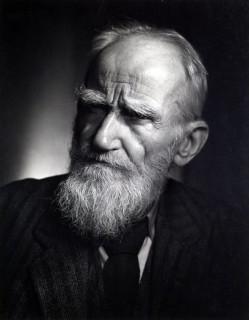
Shaw is born on July 26, 1856, at 3 Upper Synge Street in Portobello, a lower-middle-class area of Dublin. The Shaw family is of English descent and belong to the dominant Protestant Ascendancy in Ireland. Between 1865 and 1871, Shaw attends four schools, all of which he hates. His experiences as a schoolboy leave him disillusioned with formal education. In October 1871 he leaves school to become a junior clerk in a Dublin firm of land agents, where he works hard and quickly rises to become head cashier. During this period, he is known as “George Shaw”; after 1876, he drops the “George” and styles himself “Bernard Shaw.”
Shaw moves to London in 1876, where he struggles to establish himself as a writer and novelist and embarks on a rigorous process of self-education. By the mid-1880s he has become a respected theatre and music critic. Following a political awakening, he joins the gradualistFabian Society and becomes its most prominent pamphleteer. He has been writing plays for years before his first public success, Arms and the Man in 1894. Influenced by Henrik Ibsen, he seeks to introduce a new realism into English-language drama, using his plays as vehicles to disseminate his political, social, and religious ideas. By the early twentieth century his reputation as a dramatist is secured with a series of critical and popular successes that include Major Barbara, The Doctor’s Dilemma, and Caesar and Cleopatra.
Shaw’s expressed views are often contentious. He promotes eugenics and alphabet reform and opposes vaccination and organised religion. He courts unpopularity by denouncing both sides in World War I as equally culpable, and although not a republican, castigates British policy on Ireland in the postwar period. These stances have no lasting effect on his standing or productivity as a dramatist.
The inter-war years see a series of often ambitious plays, which achieve varying degrees of popular success. In 1938 Shaw provides the screenplay for a filmed version of Pygmalion for which he receives an Academy Award. His appetite for politics and controversy remains undiminished. By the late 1920s he has largely renounced Fabian gradualism and often writes and speaks favourably of dictatorships of the right and left — he expresses admiration for both Mussolini and Stalin. In the final decade of his life, he makes fewer public statements, but continues to write prolifically until shortly before his death, refusing all state honours including the Order of Merit in 1946.
During his later years, Shaw enjoys tending the gardens at Shaw’s Corner. He dies on November 2, 1950, at the age of 94 of renal failure precipitated by injuries incurred when falling while pruning a tree. His body is cremated at Golders Green Crematorium on November 6, 1950. His ashes, mixed with those of his wife Charlotte, are scattered along footpaths and around the statue of Saint Joan in their garden.
Since Shaw’s death scholarly and critical opinion has varied about his works, but he has regularly been rated as second only to Shakespeare among English-language dramatists. Analysts recognise his extensive influence on generations of playwrights. The word “Shavian” has entered the language as encapsulating Shaw’s ideas and his means of expressing them.