seamus dubhghaill

Promoting Irish Culture and History from Little Rock, Arkansas, USA


Leave a comment

Death of Frederick William Hall, Victoria Cross Recipient

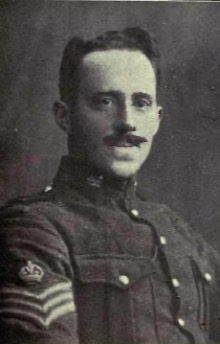
Frederick William Hall, VC, Irish Canadian recipient of the Victoria Cross, the highest and most prestigious award for gallantry in the face of the enemy that can be awarded to British and Commonwealth forces, dies on April 24, 1915, at Poelcappelle, Belgium.

Hall is born in Kilkenny, County Kilkenny, on February 21, 1885. His father is a British Army soldier from London. He emigrates to Canada around 1910, and lives on Pine Street in Winnipeg, Manitoba. He is 30 years old, and a company sergeant major (CSM) in the 8th (Winnipeg Rifles) Battalion, Canadian Expeditionary Force during World War I when he performs a deed for which he is awarded the Victoria Cross.

It is on the night of April 23, 1915, during the Second Battle of Ypres in Belgium that Hall discovers a number of men are missing. On the ridge above he can hear the moans of the wounded men. Under cover of darkness, he goes to the top of the ridge on two separate occasions and returns each time with a wounded man.

By nine o’clock on the morning of April 24 there are still men missing. In full daylight and under sustained and intense enemy fire, Hall, Cpl. Payne and Pvt. Rogerson crawl out toward the wounded. Payne and Rogerson are both wounded but return to the shelter of the front line. When a wounded man who is lying some 15 yards from the trench calls for help, Company Sergeant-Major Hall endeavors to reach him in the face of very heavy enfilade fire by the enemy. He then makes a second most gallant attempt and is in the act of lifting up the wounded man to bring him in when he falls, mortally wounded in the head. The soldier he is attempting to help is also shot and killed.

Hall’s name can be found on the Menin Gate Memorial to the Missing war memorial in Ypres, Belgium, honouring 56,000 troops from Britain, Australia, Canada and India whose final resting place in the Ypres salient is unknown.

In 1925, Pine Street in Winnipeg is renamed Valour Road because three of Canada’s Victoria Cross recipients resided on the same 700 block of that street: Frederick Hall, Leo Clarke and Robert Shankland. It is believed to be the only street in the British Commonwealth to have three Victoria Cross recipients to live on it, let alone the same block. A bronze plaque is mounted on a street lamp at the corner of Portage Avenue and Valour Road to tell the tale of these three men.


Leave a comment

RMS Carpathia Arrives in New York City with RMS Titanic Survivors

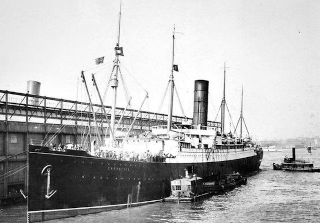
The RMS Carpathia, a Cunard Line transatlantic passenger steamship, arrives in New York City on April 18, 1912, with 705 survivors from the RMS Titanic, which sank in the North Atlantic three days earlier.

As she is making her way from New York to Fiume, Austria-Hungary (now Rijeka, Croatia), RMS Carpathia receives a distress call from the “unsinkable” RMS Titanic. RMS Carpathia’s captain, Arthur Rostron, later testifies that the distance to RMS Titanic was 58 nautical miles (67 miles) and was expected to take three and a half hours to reach the doomed liner as its top speed, which was about 14.5 knots.

However, braving dangerous ice fields of its own, Rostron orders extra stokers to feed coal and cut off heating and hot water elsewhere in order to supply the ship’s engines with as much steam as possible. These decisions help accelerate the ship to more than 17 knots and the RMS Carpathia arrives on the scene approximately one hour and 40 minutes after RMS Titanic went down. For the next four and a half hours, the ship rescues 705 survivors from RMS Titanic‘s lifeboats.

Slowed by storms and fog since early Tuesday, April 16, RMS Carpathia arrives in New York City on the cold and rainy evening of Thursday, April 18, escorted by the scout cruiser USS Chester. RMS Carpathia first bypasses Pier 54, its Cunard Line pier, and sails up the Hudson River to Pier 59, the berth for White Star Line and where RMS Titanic was supposed to have arrived. Having dropped off the empty lifeboats, RMS Carpathia then sails back toward Pier 54.

A tugboat filled with photographers follows the ship to the pier, and the flashlight of cameras lights up the ship in the night sky to reveal that the decks are crammed with passengers.

Tens of thousands of people gather around Pier 54 to meet them and receive the first physical confirmation of the maritime disaster. On the orders of Rostron, RMS Carpathia‘s passengers disembark first, believing the scene will become tumultuous as soon as RMS Titanic survivors first appear. That moment comes when a teary-eyed woman with makeshift clothes descends a gangway and stumbles away from the boat into the arms of an officer.

The RMS Carpathia is initially a transatlantic passenger ship that makes its maiden voyage in 1903. During World War I, she is used to transfer Canadian and American Expeditionary Forces to Europe.

On July 15, 1918, under the command of Captain William Prothero, RMS Carpathia is a part of a large convoy that is making its way from Liverpool to Boston. Two days later, carrying 57 passengers and 166 crew, she is torpedoed on the port side by a German U-boat off the southwest coast of Ireland.

A second strike follows, which penetrates the engine room, killing three firemen and two trimmers. Prothero gives the order to abandon ship and all passengers and the surviving crew members board the lifeboats.

A third torpedo strike hits the gunner’s rooms, resulting in a large explosion that dooms the ship. The U-boat starts approaching the lifeboats when the HMS Snowdrop arrives on the scene and drives away the submarine with gunfire before picking up survivors.

The wreck of the RMS Carpathia is only discovered in 2000 after an 80 year-long search for the missing ship.

(From: “On This Day: Carpathia arrives in New York with Titanic survivors” by Michael Dorgan, IrishCentral, http://www.irishcentral.com, April 15, 2022)


Leave a comment

Birth of James Hanley, Novelist & Playwright

james-hanley

James (Joseph) Hanley, British novelist, short story writer, and playwright of Irish descent, is born in Kirkdale, Liverpool, Lancashire on September 3, 1897. He publishes his first novel, Drift, in 1930. The novels and short stories about seamen and their families that he writes in the 1930s and 1940s include Boy (1931), the subject of an obscenity trial. He comes from a seafaring family and spends two years at sea himself. After World War II there is less emphasis on the sea in his works. While frequently praised by critics, his novels do not sell well. In the late 1950s, 1960s, and early 1970s he writes plays, mainly for the BBC, for radio and then for television, and also for the theatre. He returns to the novel in the 1970s. His last novel, A Kingdom, is published in 1978, when he is 80 years old.

Hanley is born to a working class family. Both his parents are born in Ireland, his father Edward Hanley around 1865, in Dublin, and his mother, Bridget Roache, in Queenstown, County Cork, around 1867. Both are well established in Liverpool by 1891, when they are married. Hanley’s father works most of his life as a stoker, particularly on Cunard Line liners, and other relatives have also gone to sea. He grows up living close to the docks. He leaves school in the summer of 1910 and works for four years in an accountants’ office. Then early in 1915 at the age of 17, he goes to sea for the first time. Thus life at sea is a formative influence and much of his early writing is about seamen.

In April 1917, Hanley jumps ship in Saint John, New Brunswick, Canada, and shortly thereafter joins the Canadian Expeditionary Force in Fredericton, New Brunswick. He fights in France in the summer of 1918, but is invalided out shortly thereafter. After the war he works as a railway porter in Bootle and devotes himself to a prodiguous range of autodidactic, high cultural activities – learning the piano, regularly attending concerts, reading voraciously and, above all, writing. However, it is not until 1930 that his novel Drift is accepted.

Hanley moves from Liverpool to near Corwen, North Wales in 1931, where he meets Dorothy Enid “Timothy” Thomas, neé Heathcote, a descendant of Lincolnshire nobility. They live together and have a child, Liam Powys Hanley, in 1933, but do not marry until 1947. In July 1939, as World War II is approaching, he moves to London to write documentaries and plays for the BBC. He moves back to Wales during the early years of the war, settling in Llanfechain on the other side of the Berwyn range from Corwen. In 1963, the Hanleys move to North London to be close to their son.

In 1937 Hanley publishes an autobiographical work, Broken Water: An Autobiographical Excursion, and while this generally presents a true overall picture of his life, it is seriously flawed, incomplete and inaccurate. Chris Gostick describes it as “a teasing palimpsest of truth and imagination.”

Hanley’s brother is the novelist Gerald Hanley and his nephew is the American novelist and playwright William Hanley. Hanley’s wife also publishes three novels, as Timothy Hanley. She dies in 1980. James Hanley himself dies in London on November 11, 1985 and is buried in Llanfechain, Wales.