seamus dubhghaill

Promoting Irish Culture and History from Little Rock, Arkansas, USA


Leave a comment

The Second Battle of Sabine Pass

A small Confederate force commanded by Lieutenant Richard W. Dowling, a red-headed 25-year-old native of Knockballyvishteal, Milltown, County Galway, and Houston saloon owner, wins one of the most remarkable victories of the American Civil War on September 8, 1863. The Second Battle of Sabine Pass is a failed Union Army attempt to invade the Confederate state of Texas. The Union Navy supports the effort and loses three gunboats during the battle, two captured and one destroyed. It is often credited as the war’s most one-sided Confederate victory. Confederate President Jefferson Davis writes in 1876 that he “considered the [second] battle of Sabine pass the most remarkable in military history.”

On the afternoon of September 8, 1863, Union Navy Lieutenant Frederick Crocker (“Acting Captain”) is in command of the advance squadron composed of four gunboats. Crocker is a veteran officer of considerable recent experience in Union river-gunboat actions and blockade duty. His ship is the USS Clifton, a steam-powered side-wheeler. Besides the USS Clifton, Crocker’s advance squadron includes USS Granite City, USS Sachem, and USS Arizona, all recently commissioned ironclad warships. Less than three miles southeast downriver, well out of range of the Confederate fort’s cannons, are anchored seven U.S. Navy transports carrying most of the Union Army soldiers of the landing force. The USS Suffolk, hosting invasion force commander Union Army Major General William B. Franklin and his staff, heads the seven-vessel squadron. Outside the principal Gulf shore sandbar, an additional two miles downstream of this squadron, lay at anchor the remaining ships of the 22-vessel invasion fleet. The total number of Union infantry assault troops in the landing force is given as 5,000 infantrymen, which includes 500 listed as aboard the USS Granite City, those aboard the six troop transports in the seven-ship squadron headed by USS Suffolk, plus an artillery company somewhere among them. The first wave of 500 men aboard USS Granite City, which steams as close behind USS Clifton as possible but out of range of the fort’s guns, are to land in the open space adjacent to and downstream of the fort. This is a flat, often muddy area already cleared of brush by the Confederate garrison as a clear field of fire for the canister and grapeshot of the fort’s artillery. The Union Army’s invasion plan, therefore, absolutely requires that the Confederate guns be silenced before any troops are debarked. This engagement is to be the largest amphibious assault on enemy territory in the history of the U.S. military to date.

Confederate Captain Leon Smith, who is at Beaumont, Texas, immediately orders all Confederate troops in Beaumont, some eighty men, aboard the steamer Roebuck and sends them down the river to reinforce Fort Griffin. Smith and a Captain Good ride to the fort on horseback, reaching the fort some three hours before the steamer, arriving just as the Union gunboats USS Clifton and USS Sachem come within range, and assist in the defense of the fort.

Dowling’s well practiced Irish-Texan artillerymen, whose chosen and officially approved unit name is “Jefferson Davis Guards,” had placed range-stakes in the two narrow and shallow river channels. These are the “Texas channel” near the southwest shore and the “Louisiana channel” against the Louisiana shore. The white-painted stakes are for determining accurate range of the fort’s six old smooth-bore cannons. Each “Davis Guards” gun crew during gunnery practice thereby works to predetermine the approximate amount of gunpowder needed for each type of projectile (ball, canister, or grapeshot) available for their specific gun and which specific guns, charges, and loads have the best potential to hit each range-stake.

Crocker’s squadron has no local river pilots, only general knowledge of the river’s channels, no assurance of locations of the constantly varying depths especially of large oystershell “reefs” or “banks” between the river’s two channels. There is no mention in official U.S. Navy reports of whether Union sailors were making observations and taking depth soundings from the gunboats now dangerous top decks, while the Confederate cannon shots pounded and shook their ships. The few maps to which they have access are old and outdated and cannot account for recent changes in river-bottom conditions. On Captain Crocker’s signal the USS Sachem, followed by USS Arizona, advance up the right channel (Louisiana side) as fast as they dare, firing their port-side guns at the fort. USS Clifton approaches in the lead, ascending the Texas channel at full speed. USS Granite City hovers out of range behind USS Clifton, having orders not to risk debarking the 500 assault troops until the fort surrenders or its guns are silenced. As USS Sachem enters among the range-stakes, the Confederates open fire. Then USS Clifton comes into range, followed by USS Arizona. Despite their old smoothbore cannon, one of which has just become inoperable, after only a few rounds it is obvious the Confederate artillerymen’s months of training and target practice is an astounding success as their aim is deadly accurate.

The Confederates capture USS Clifton and USS Sachem with a total of 13 heavy cannon, including at least two new potent Parrott rifles, which are handed over to Leon Smith’s Texas Marine Department. The Union casualties amount to two dozen killed and badly wounded, about 37 missing, and 315 Navy men captured. The combined Union Army and Navy invasion force withdraw and return to New Orleans. The Confederates have no casualties.

In recognition of the victory, the Confederate States Congress passes a resolution of special thanks to the officers and men of the Davis Guard. In addition, Houston residents raise funds to provide medals to the Guard. The Davis Guards Medals are made from silver Mexican pesos by smoothing off the coins, then hand-stamping and hand-engraving on one side the battle name and date and on the other side the initials “D G” and a cross pattée. The medals are hung on green ribbons and presented to the members of the Davis Guard. The official Confederate silver medals are presented in a public ceremony a year later and are the only such medal ever awarded by that government.

The Battle of Sabine Pass is of moderate tactical or strategic significance to the American Civil War. It is successful in ensuring that the anticipated overland Union invasion of Texas is delayed indefinitely. A Confederate supply line from Mexico to Texas had existed out of the Port of Bagdad since the outbreak of the war but is held by the increasingly isolated Mexican Republicans. By the time Imperial French and Mexican forces capture Baghdad in 1864, a supply line to anywhere in the Confederacy east of the Mississippi River is no longer feasible on account of the Union victory at Vicksburg in July 1863. The Confederacy is therefore forced to continue its reliance on blockade running to import valuable materials and resources.

In 1937 a statue of Dowling is unveiled on the site of the fort. In 1998 a bronze plaque honoring Dowling is unveiled at the Tuam Town Hall in County Galway.

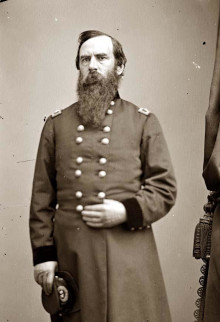
(Pictured: Richard William “Dick” Dowling, circa 1865)

1 Comment

The Philadelphia Nativist Riots

The Philadelphia nativist riots (also known as the Philadelphia Prayer Riots, the Bible Riots and the Native American Riots) are a series of riots that take place on May 6—8 and July 6—7, 1844, in Philadelphia, Pennsylvania, and the adjacent districts of Kensington and Southwark. The riots are a result of rising anti-Catholic sentiment at the growing population of Irish Catholic immigrants.

On July 3, Father John Patrick Dunn of the Church of St. Philip Neri in the Southwark District is warned that the church might be attacked during an upcoming parade held by the Native American Party. The Native American Party, a nativist political party, plans to hold a large parade the next day on Independence Day.

To prepare for violence, the church applies for an arsenal that a volunteer company could use in case the church is attacked. Pennsylvania Governor David R. Porter authorizes the formation of a company and the procurement of twenty-five muskets from the Frankford Arsenal. Major General Robert Patterson, commander of the Pennsylvania militia, puts the troops on alert in case of violence.

Five of the muskets placed in St. Philip Neri’s Church are discovered to be defective and are sent back to the Frankford Arsenal to be repaired. No violence occurs before or during the parade, but on July 5, a nativist mob numbering in the thousands gathers at the church after some observe five defective muskets being returned to the church. They then demand that the sheriff remove the weapons, while Father Dunn and volunteers rally to protect the church. Sheriff Morton McMichael and two aldermen search the church and remove twelve muskets. After leaving the church, the sheriff urges the crowd to disperse and leaves a volunteer posse to guard the church. The mob remains, and a man injured in the May riots makes a speech to the crowd, calling for a second search of the church. The sheriff, an alderman, and seventeen nativists enter the church and find three armed men, fifty-three muskets, ten pistols, a keg of gunpowder and ammunition. To avoid inciting the mob, the sheriff decides not to remove the armaments, and the search party stays in the church. Just after midnight, July 6, Major General Patterson orders a company of city guards to clear the streets. After the crowd disperses, the arms found within the church are removed.

By midday, the crowds return around St. Philip Neri’s Church. General George Cadwalader orders the crowds to disperse, but they do not. By the evening, the sheriff arrives with a 150-strong posse. Throughout the evening, the military presence grows, and three cannons are stationed on the streets. The soldiers clear the streets near the church, despite being pelted with rocks by the mob. Responding to the rock throwers, General Cadwalader orders a cannon to be fired at the crowd on Third Street. Former U.S. Congressman Charles Naylor begs the general not to fire. He and several others are arrested and held within the church. By the morning of July 7, most of the soldiers have left, but the crowds, led by an alderman and the sheriff, return and demand that the remaining guard release Naylor. Everyone except Naylor is released. The crowds grow, and a cannon is brought from a nearby wharf and used to threaten the church. After further negotiations, Naylor is released and carried home to cheers on people’s shoulders.

After Naylor is brought home, the mob attacks the church, damaging a wall with the cannon. A second cannon is brought from the wharfs and fired at the church, after which the mob pelts the building with rocks and break in through a side door. The soldiers fire on the men breaking into the church, who promptly retreat. After retreating, the nativists negotiate with the guard, who agrees to withdraw, allowing the nativists to guard the church. The crowd pelts the soldiers with rocks and some soldiers fire back, which only incites the mob further. The mob forces its way into the church, causing extensive damage to the interior. After about an hour, a group of twenty men organizes themselves to guard St. Philip Neri’s, and the mob leaves the church.

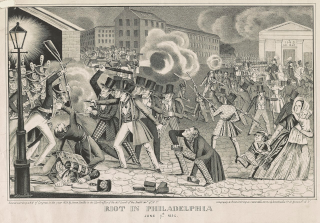
By the evening, a large number of soldiers arrive with orders to clear the streets, only to be stoned in the process. After a captain is attacked, the order is given to fire on the mob, which results in seven fatalities and nine injuries. Not long after, people with muskets and cannons arrive and fierce fighting breaks out between the soldiers and the mob. The fighting lasts for several hours, with the soldiers being fired upon from alleyways and the windows of nearby buildings. The soldiers bring in two cannons of their own and fire on the mob. The mob returns fire using their own cannons, armed with items such as nails, chains, knives and broken bottles. In an attempt to capture the mob’s cannons, soldiers charge one cannon’s position, only to be knocked off their horses by a rope tied across the street. The cannons are all eventually captured, and by early morning on July 8, the fighting has ended.

At least fifteen people, including rioters and soldiers, are killed in the riot, and at least fifty people are injured. Under Governor Porter’s orders, state troops continue to arrive in the city in the days afterward, but no further violence takes place. An estimated 5,000 militia are used to stop violence. Troops begin to withdraw from the city on July 10, and the church takes over responsibility from the district of Southwark of protecting the church on July 11. As with the May riots, a grand jury blames the Irish Catholics for the riots but supports the military’s response to the violence.

The riots gain national attention and condemnation. The riots are used as an issue in the 1844 U.S. Presidential election, the Democratic Party condemning the growing Native American Party and the Whig Party, which the Democrats accuse of involvement in the nativist movement. In Philadelphia, the Native American Party ends up making a strong showing in the city’s October election.

On July 11, 1844, Philadelphia passes an ordinance that gives the city a battalion of artillery, a regiment of infantry, and at least one full troop of cavalry to preserve peace within the city when necessary. The difficulty of quelling the riots and other crime leads the Pennsylvania General Assembly to pass an 1845 act that requires Philadelphia, the township of Moyamensing and the unincorporated districts of Spring Garden, Northern Liberties, and Penn to maintain a police force of one man per 150 taxable inhabitants. In 1850, another act is passed that establishes that the Philadelphia police force will police the city and seven surrounding districts. The inability to maintain order effectively in Philadelphia’s suburbs is an important argument for the consolidation of the city in 1854.

After the riots, Bishop Kenrick ends his efforts to influence the public education system and begins encouraging the creation of Catholic schools, with 17 being founded by 1860. The friars of the Church of St. Augustine sue the city of Philadelphia for not providing the church with adequate protection, claiming $80,000 in damages. The city argues that the friars cannot claim their civil rights were violated, as the Order of Saint Augustine is a foreign organization under the Pope. Furthermore, the city argues that the friars took a vow of poverty and cannot be property owners. The Augustinians end up proving the Order is incorporated in 1804 and is awarded $45,000. The church is rebuilt in 1848.

(Pictured: “Riot in Philadelphia,” lithograph by H. Bucholzer, 1844, Library of Congress)


Leave a comment

Birth of Richard Busteed, Union Army General & U.S. Federal Judge

Richard Busteed, Union Army general during the American Civil War and United States federal judge, is born in County Cavan on February 16, 1822. Busteed comes first to Canada, then the United States with his family while a child. They settle in New York City.

Busteed reads law in 1846. He enters private practice in New York City from 1846 to 1856 and is Corporation Counsel for New York City from 1856 to 1859. He serves as a Captain in the United States Army in 1861, and a Brigadier General from 1862 to 1863, during the American Civil War.

Once when confronted with black men being thrown out of a white railroad car by the conductor, Busteed pulls his pistol and defends the black men allowing them to stay.

Busteed receives a recess appointment from President Abraham Lincoln on November 17, 1863, to a joint seat on the United States District Court for the Middle District of Alabama, the United States District Court for the Northern District of Alabama and the United States District Court for the Southern District of Alabama vacated by Judge George Washington Lane. He is nominated to the same position by President Lincoln on January 5, 1864. He is confirmed by the United States Senate on January 20, 1864, and receives his commission the same day. His service terminates on October 20, 1874, due to his resignation.

Alabamians generally consider Busteed corrupt and pro-Northern. In December 1867, he is shot on the street in Mobile, Alabama by United States Attorney Lucien V. B. Martin, who fires two more shots into him after he falls. Martin goes to Texas and is never prosecuted, while Busteed recovers rapidly.

Busteed is nominated by President Ulysses S. Grant to the Supreme Court of the District of Columbia (now the United States District Court for the District of Columbia) on January 13, 1873. At the same time, President Grant nominates Judge David Campbell Humphreys, an Alabama native serving on the Supreme Court of the District of Columbia, to assume Busteed’s seat, each nomination made contingent on the other’s resignation. The Senate returns the nominations to the President as irregular in form on February 13, 1873.

In 1873, Busteed is the subject of an impeachment inquiry by the United States House of Representatives Judiciary Committee. The Committee recommends his impeachment on charges of failing to maintain a residence in his judicial district, failing to hold scheduled terms of court, and using his official position to promote his personal interests, specifically, by remitting a fine due to the Federal government in order to obtain release from a personal judgment against him in a State court. He resigns before the full House can vote on the recommendation.

Following his resignation from the federal bench, Busteed resumes private practice in New York City starting in 1874. He dies on September 14, 1898, in New York City and is interred in Woodlawn Cemetery in the Bronx, New York.


Leave a comment

Death of U.S. Union Army Colonel Patrick Kelly

colonel-patrick-kelly

Colonel Patrick Kelly of the Union Army‘s Irish Brigade (The Fighting Irish) dies on June 16, 1864, at the Siege of Petersburg during the American Civil War while leading the Irish Brigade forward against a Confederate position.

Kelly is born in Castlehacket, Tuam, County Galway and emigrates to the United States, landing in New York City. His wife Elizabeth is also from Tuam.

At the outset of the American Civil War, Kelly enlists in the Union Army and sees action as captain of Company E of the 69th New York Infantry at the First Battle of Bull Run. He briefly is a captain in the 16th U.S. Infantry. On September 14, 1861, he is named lieutenant colonel of the 88th New York Volunteer Infantry Regiment and fights in the Irish Brigade’s major battles in 1862. He commands the regiment at the Battle of Antietam. While stationed at Harpers Ferry, West Virginia following the Maryland campaign, he is promoted to colonel on October 20, 1862. He leads the regiment in the ill-fated attacks in front of Marye’s Heights in the Battle of Fredericksburg. He is acting commander of the Irish Brigade at the end of 1862.

After the 1863 Battle of Chancellorsville, Kelly is promoted to command the Irish Brigade following the resignation of Brigadier General Thomas Francis Meagher. He leads the heavily depleted brigade of fewer than 600 men in an attack at the Wheatfield during the Battle of Gettysburg. The brigade loses 198 of 532 troops engaged, approximately 37%.

Kelly resumes his role as colonel of his regiment as more senior officers return to the brigade. However, with the death of Colonel Richard Byrnes at the Battle of Cold Harbor in 1864, he again commands the brigade. At the age of 42, he dies during the Siege of Petersburg on June 16, 1864, when he is shot through the head while leading the Irish Brigade forward against Confederate earthworks. His body is recovered and sent back to New York for his funeral. He is buried in Calvary Cemetery in Woodside, Queens, New York.