Charles Bianconi, Italo-Irish passenger car entrepreneur, is born Carlo Bianconi in Tregolo, Costa Masnaga, Italy on September 24, 1786.
Bianconi moves from an area poised to fall to Napoleon and travels to Ireland in 1802, by way of England, just four years after the Irish Rebellion of 1798. At the time, British fear of continental invasion results in an acute sense of insecurity and additional restrictions on the admission of foreigners. He is christened Carlo but anglicises his name to Charles when he arrives in Ireland.
Bianconi works as an engraver and printseller in Dublin, near Essex Street, under his sponsor, Andrea Faroni, when he is 16. In 1806 he sets up an engraving and print shop in Carrick-on-Suir, County Tipperary, moving to Clonmel in 1815.
Bianconi eventually becomes famous for his innovations in transport and is twice elected mayor of Clonmel.
Bianconi is the founder of public transportation in Ireland, at a time preceding railways. He establishes regular horse-drawn carriage services on various routes from about 1815 onward. These are known as “Bianconi coaches” and the first service, Clonmel to Cahir, takes five to eight hours by boat but only two hours by Bianconi’s carriage. Travel on one of his carriages cost one penny farthing a mile.
In 1832 Bianconi marries Eliza Hayes, the daughter of a wealthy Dublin stockbroker. They have three children – Charles Thomas Bianconi, Catherine Henrietta Bianconi and Mary Anne Bianconi, who marries Morgan O’Connell and is the mother of his grandson John O’Connell Bianconi.
Bianconi’s transport services continue into the 1850s and later, by which time there are a number of railway services in the country. The Bianconi coaches continue to be well-patronised, by offering connections from various termini, one of the first and few examples of an integrated transport system in Ireland. By 1865 Bianconi’s annual income was about £35,000.
Charles Bianconi dies on September 22, 1875 at Longfield House, Boherlahan, County Tipperary. Having donated land to the parish of Boherlahan for the construction of a parish church, he wishes to be buried on the Church grounds. He, and his family, are buried in a side chapel, separate from the parish church in Boherlahan, approximately 5 miles from Cashel, County Tipperary.
In 1846, William Smith O’Brien, alongside John Mitchel, form the Irish Confederation with the Young Ireland movement which is dedicated to direct action against the British. Two short years later they are already calling for open rebellion, despite the fact that Ireland is now in the third year of the devastating famine which is leaving millions of the country’s people in brutal starvation.
Just a year after Black ‘47, the worst year of the Great Famine, the Young Ireland movement is hoping to uprise and overthrow the British but with the starving Irish just struggling to stay alive, dying or emigrating in their thousands, their revolutionary talk does little to act as a call to arms for the average Irish person.
Whereas the mistreatment of the Irish people by the British had rightly led to an increased radicalism in Irish nationalist movement, without the general Irish population able to think of anything other than staying alive, it seems doomed to failure, especially after the arrest of Mitchel before the rebellion is even started. He is convicted of sedition and transported to a penal colony in Australia before the revolt begins, a move that leads to an increased furor to revolt among the leaders that remain.
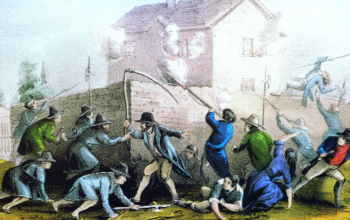
On July 29, 1848, O’Brien launches his rebellion. After being chased by a force of Young Irelanders and their supporters, a Royal Irish Constabulary unit takes refuge in a house and holds those inside as hostages.
It was evident to the rebels that the position of the police is almost impregnable. When a party of the Cashel police are seen arriving over Boulea Hill, the rebels attempt to stop them even though they are low on ammunition. The police continue to advance, firing up the road. It becomes clear that the police in the house are about to be reinforced and rescued. The rebels then fade away, effectively terminating both the era of Young Ireland and Repeal, but the consequences of their actions follow them for many years. This event is colloquially known as “The Battle of Widow McCormack’s cabbage plot.”
In O’Brien’s subsequent trial, the jury finds him guilty of high treason. He is sentenced to be hanged, drawn, and quartered. Petitions for clemency are signed by 70,000 people in Ireland and 10,000 people in England. On June 5, 1849, the sentences of O’Brien and other members of the Irish Confederation are commuted to transportation for life to Van Diemen’s Land (Tasmania in present-day Australia). In 1854, after five years in Van Diemen’s Land, O’Brien is released on the condition he never return to the United Kingdom. He settled in Brussels.
(Pictured: The attack on the Widow McCormack’s house on Boulagh Common, Ballingarry, County Tipperary)
After the failure of the Young Ireland Rebellion of 1848, O’Leary attempts to rescue the Young Ireland leaders from Clonmel Gaol, and is himself imprisoned for a week from September 8, 1849. He takes part in a further attempted uprising in Cashel on September 16, 1849, but this proves abortive.
On September 16, 1865, O’Leary is arrested and later tried on charges of high treason, eventually reduced to “treason felony.” He is sentenced to twenty years of penal servitude, of which five years are spent in English prisons, prior to his release and exile in January 1871. During his exile, he lives mainly in Paris, also visiting the United States, remains active in the IRB and its associated organisations, and writes many letters to newspapers and journals.
On the expiration of his 20-year prison term and therefore of the conditions associated with his release in 1885, O’Leary returns to Ireland. He and his sister, the poetEllen O’Leary, both become important figures within Dublin cultural and nationalist circles, which include William Butler Yeats, Maud Gonne, Rose Kavanagh, Rosa Mulholland, George Sigerson, and Katharine Tynan. He also functions as an elder statesman of the separatist movement, being active in the Young Ireland Society, and acts as president of the Irish Transvaal Committee, which supports the Boer side in the Second Boer War.
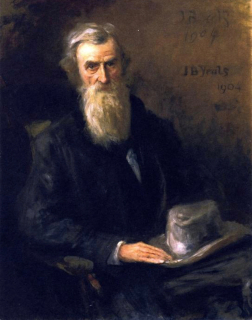
John O’Leary dies at his residence in Dublin on the evening of March 16, 1907. He is referred to famously by W.B. Yeats in his poem September 1913: “Romantic Ireland’s dead and gone/It’s with O’Leary in the grave.”
(Pictured: Painting of John O’Leary, a favorite subject of John Butler Yeats (1904). The National Gallery of Ireland owns three oil portraits of O’Leary.)
In the summer of 1647, Murrough O’Brien, 6th Baron Inchiquin, the Irish Protestant commander of the Protestant army of Cork, commences a campaign against the Irish Catholic strongholds in Munster. The counties of Limerick and Clare are raided, and he soon turns his attention to the bountiful eastern counties of Munster. In early September, his forces quickly take the Cahir Castle in Tipperary. This strong castle is well positioned to become a base for the Cork Protestant army, and it is used to raid and devastate the surrounding countryside. The Munster army under Lord Taaffe does not make any serious effort to oppose Inchiquin, probably the result of the political scheming of Donough MacCarty, 2nd Viscount Muskerry and other powerful Irish lords who hope to keep the Munster army intact for their own ends. As such, Inchiquin is allowed to make a major push towards the town and ecclesiastical centre of Cashel.
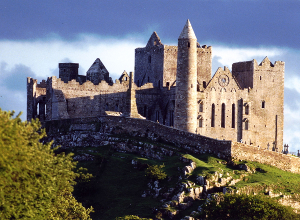
Inchiquin has already launched two minor raids against Cashel, and he now has the opportunity to launch a major assault. The Parliamentarian forces first storm nearby Roche Castle, putting fifty warders to the sword. This attack terrifies the local inhabitants of the region, some of whom flee to hiding places, while hundreds of others flee promptly to the Rock of Cashel, a stronger place than the town itself. Lord Taaffe has placed six companies in the fortified churchyard that sits upon the rock, and considers the place defensible, though he himself does not stay to put it to the test, leaving command to the Governor Lieutenant-Colonel Butler.
Arriving with his army at the Rock, Inchiquin calls for surrender within an hour. The defenders of the churchyard offer to negotiate but that is refused, and on the afternoon of September 15 the assault commences. The Parliamentarians are first reminded of earlier atrocities against Protestants, and then begin to deploy. The attack is led by around 150 dismounted horse officers with the remainder of the infantry following. Troops of horse ride along the flanks of the advancing force to encourage the infantry. The Irish soldiers attempt to drive off the attackers with pikes while the civilians inside hurl rocks down from the walls. In turn the attackers hurl firebrands into the compound, setting some of the buildings inside on fire. Although many are wounded, the Parliamentarians gradually fight their way over the walls, pushing the garrison into the church.
Initially, the Irish defenders manage to protect the Church, holding off the attackers trying to get through the doors, but the Parliamentarians then place numerous ladders against the many windows in the church and swarm the building. For another half an hour fighting rages inside the church, until the depleted defenders retreat up the bell tower. Only sixty soldiers of the garrison remain at this point, and they thus accept a call to surrender. However, after they have descended the tower and thrown their swords away, all are killed.
In the end all the soldiers and most of the civilians on the Rock are killed by the attackers. The Bishop and Mayor of Cashel along with a few others survive by taking shelter in a secret hiding place. Apart from these a few women are spared, after being stripped of their clothes, and a small number of wealthy civilians are taken prisoner, but these are the exceptions. Overall, close to 1,000 are killed, amongst them Lieutenant-Colonel Butler and catholic scholar Theobald Stapleton. The bodies in the churchyard are described by a witness as being five or six deep.
The slaughter is followed by extensive looting. There is much of value inside, for apart from pictures, chalices and vestments of the church, many of the slain civilians had also brought their valuables with them. The sword and ceremonial mace of the mayor of Cashel, as well as the coach of the bishop are captured. The plunder is accompanied by acts of iconoclasm, with statues smashed and pictures defaced. The deserted town of Cashel is also torched.
The atrocity at Cashel causes a deep impact in Ireland, as it is the worst single atrocity committed in Ireland since the start of fighting in 1641. Previously, the most infamous massacre amongst the Catholic population is that at Timolin in 1643, when 200 civilians are killed by James Butler, 1st Duke of Ormond‘s English Royalist army, but many more than this are killed at Cashel, and the Rock of Cashel is one of the chief holy places of Ireland. The slaughter of the garrison at Cashel and the subsequent devastation of Catholic held Munster earns Inchiquin the Irish nickname, Murchadh na Dóiteáin or “Murrough of the Burnings.”
Born Carlo Bianconi, in Tregolo, Costa Masnaga, Italy on September 24, 1786, he moves from an area poised to fall to Napoleon and travels to Ireland via England in 1802, just four years after the Irish Rebellion of 1798. At the time, British fear of continental invasion results in an acute sense of insecurity and additional restrictions on the admission of foreigners. He is christened Carlo but anglicises his name to Charles when he arrives in Ireland in 1802.
At the age of 16, Bianconi works as an engraver and printseller in Dublin, near Essex Street, under his sponsor, Andrea Faroni. In 1806 he sets up an engraving and print shop in Carrick-on-Suir, moving to Clonmel in 1815.
Bianconi eventually becomes famous for his innovations in transport and is twice elected mayor of Clonmel. He is the founder of public transportation in Ireland, at a time preceding railways. He establishes regular horse-drawn carriage services on various routes beginning in 1815. These are known as “Bianconi coaches” and the first service, Clonmel to Cahir, which takes five to eight hours by boat, takes only two hours by Bianconi’s carriage. Travel on a coach costs one penny farthing a mile.
Bianconi’s carriage services continue into the 1850s and later, by which time there are a number of railway services in the country. The Bianconi coaches continue to be well-patronised, by offering connections from various termini, one of the first and few examples of an integrated transport system in Ireland. By 1865 Bianconi’s annual income is about £35,000.
In 1832 Bianconi marries Eliza Hayes, the daughter of a wealthy Dublin stockbroker. They have three children. Bianconi dies on September 22, 1875 at Longfield House, Boherlahan, County Tipperary.
Having donated land to the parish of Boherlahan for the construction of a parish church, Bianconi wishes to be buried on the Church grounds. He, and his family, are buried in a side chapel, separate from the parish church in Boherlahan, approximately 5 miles from Cashel, County Tipperary.
Lacey is born on May 31, 1889 in the village of Attybrick, near Annacarty, County Tipperary. He joins the Irish Volunteers in 1913 and is sworn into the secretive Irish Republican Brotherhood (IRB) in 1914. He is introduced to the IRB by Seán Treacy. During the War of Independence (1919–1921) he is selected to command an IRA flying column of the 3rd Tipperary Brigade, in September 1920. The flying column mounts two successful ambushes of British forces – killing six British soldiers at Thomastown near Golden, and four Royal Irish Constabulary (RIC) men at Lisnagaul in the Glen of Aherlow.
In April 1921, following another ambush of British troops near Clogheen, he captures RIC inspector Gilbert Potter, whom he later executes in reprisal of the British hanging of republican prisoners.
In December 1921, Lacey’s unit splits over the Anglo-Irish Treaty. He opposes the Treaty and most of his men follow suit. He takes over command of the 3rd Tipperary Brigade as Séamus Robinson is appointed to commanded the anti-Treaty IRA’s Second Southern Division. In the ensuing civil war (June 1922-May 1923), he organises guerrilla activity in the Tipperary area against Pro-Treaty Irish Free State forces.
Denis Lacey is killed in an action against Free State troops at Ballydavid, near Bansha in the Glen of Aherlow on February 18, 1923. He is 33 years old at the time of his death. Over 1,000 Free State troops drawn from Cahir, Cashel, Clonmel, and Tipperary, under the command of General John T. Prout, with the intention of breaking up Lacey’s guerrilla unit, converge on the Glen where he and four other men from his column are billeted. Lacey and one of his men are killed and others are captured. Two National Army soldiers are killed in the action.
A memorial in Annacarty commemorates Lacey’s war service and subsequent death in action.
The Derrynaflan Chalice, an 8th- or 9th-century chalice, is found as part of the Derrynaflan Hoard of five liturgical vessels on February 17, 1980 near Killenaule, County Tipperary. According to art historian Michael Ryan the hoard “represents the most complex and sumptuous expression of the ecclesiastical art-style of early-medieval Ireland as we know it in its eighth- and ninth-century maturity.” The group is among the most important surviving examples of Insular metalwork.
The hoard is probably secreted during the turbulent 10th to 12th centuries, when Viking raids and dynastic turmoil create many occasions when valuables are hidden. The early and later 10th century is marked by a particular concentration of hoarding in Ireland.
Derrynaflan, the site of an early Irish abbey, is a small island of dry land situated in a surrounding area of peat bogs, in the townland of Lurgoe, County Tipperary, northeast of Cashel. The monastery is an important foundation in the period preceding the Viking raids. The present modest ruins of a small Cistercian nave-and-chancel abbey church there, however, date from a later period.
The Derrynaflan Hoard is discovered on February 17, 1980 by Michael Webb from Clonmel and his son, also Michael, while they are exploring the ancient monastic site of Derrynaflan with a metal detector. They have permission of the owners of the land on which the ruins stand to visit the site but they have no permission to dig on the lands. A preservation order had been made in respect of the ruin under the National Monuments Act, 1930, so that it is an offence to injure or to interfere with the site. The discovery is initially kept secret for three weeks.
The behaviour of the Webbs, and nearly seven years of litigation, culminating in the Supreme Court action where they unsuccessfully seek over £5,000,000 for the find, leads to the replacement of Irish laws of treasure trove by the law in the National Monuments (Amendment) Act, 1994, with a new Section 2 being included in the legislation.
The Ardagh Chalice dates from around the same period, perhaps a century earlier, of the Derrynaflan Hoard and is found close by in neighbouring County Limerick. At the time, the ruling dynasty in Tipperary and most of Munster are the Eóganachta, while their longtime allies and possible cousins the Uí Fidgenti rule in the Limerick area. Feidlimid mac Cremthanin, king-bishop of Cashel, who becomes King of Munster in 821 and dies in 847, is a patron of the monastic foundation at Derrynaflan and has been suggested as a possible patron of the chalice.
As a masterpiece of Insular art, the Derrynaflan chalice is included in the exhibition “The Work of Angels: Masterpieces of Celtic Metalwork, 6th–9th Centuries AD” (London, 1989). The Derrynaflan Hoard is donated to the Irish State and the items are now on display in the National Museum of Ireland.
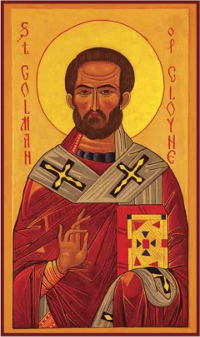
Saint Colmán of Cloyne, also known as Colmán mac Léníne, monk, founder, and patron of Cluain Uama, now Cloyne, County Cork, and one of the earliest known Irish poets to write in the vernacular, dies on November 24, 600.
Colmán is remembered as the founder of the monastery at Cluain Uama in Munster, which lay in the kingdom of the Uí Liatháin and the Uí Meic Caille, a sept of the former. The origin legend Conall Corc and the Corco Loígde claims that the land for the foundation is not given by the local king, but by Coirpre Cromm mac Crimthainn, who is king of Munster from the Eóganacht Glendamnach.
Cloyne appears to be his earliest settlement. The cathedral and round tower are situated on a limestone eminence in the midst of the valley, surrounded by rich meadows. In the rock is the cave extending in various branches underground to a great distance, from which the town derives its name. Here it is believed that Colmán took up his abode as a place of security. Colmán is also believed to have founded a monastery at what would become Killagha Abbey in County Kerry.
Colmán is credited with extraordinary poetic powers, being styled by his contemporaries “royal poet of Munster.” Several of his Irish poems are still extant, notably a metrical panegyric on Saint Brendan.
It is unclear whether Colmán is brought up as a Christian, but what is certain is that he is educated and becomes a bard or file, which requires a special education. As a member of the class of filí, he becomes attached to the court of Cashel where he remains until about the age of 48 years. In 570, he and Saint Brendan of Clonfert are said to have settled a dispute between rivals to the throne of Cashel and Aodh Caomh is acknowledged as king, the first Christian king of Cashel. The King is installed by Saint Brendan. During the time of the coronation Colmán and some others discover the lost shrine of Ailbhe of Emly. Brendan says that it is not right that the hands which have held this sacred relic should be defiled henceforth, thus it is that the son of Leinin offers himself to God. Brendan blesses him and gives him the name Colmán, which is a diminutive of Colm.
Colmán then goes to the school of Saint Iarlaithe of Tuam and after his studies he is next mentioned as preaching to the heathen population in the east of County Cork. He is described as a “religious and holy presbyter, who afterwards became a famous bishop.” The Prince of Déise, in the present county of Waterford, presents his child to Colmán for baptism. Colmán baptizes him Declán and urges his parents to educate him well in his faith. This child becomes Saint Declán of Ardmore.
Colmán is given churches in Erry and Killenaule by Coirpre Cromm mac Crimthainn, King of Munster (Cashel), as well as lands in Cloyne, County Cork. It may well be that the lands in Cloyne are conquered lands and to prevent the possibility of reconquest are given to the church. The Cloyne estate is large and contains some of the best land in the area.
After the king’s death (c. 580) Colmán somehow becomes involved in factional strife between Coirpre’s descendants in which some of them persecute him while others, the ancestors of the later dominant line, protect him.
His surviving verses date from the period 565 and 604, and are among the earliest examples of Irish writing in the Latin alphabet. He is commonly thought to have composed Luin oc laib, a poem in praise of Domnall mac Muirchertaig, king of Tara, and another poem on the death of Áed Sláine, king of the UÍ Néill. The latter poem has not survived complete.
Colmán dies on November 24, 600, and is likely buried is Cloyne, where he may have left a school of poetry in existence. The calendars are unanimous in dating his death on November 24, now his feast day.
Robert Peel (pictured), chief secretary of Ireland (1812-18), establishes the Peace Preservation Force to counter rural unrest on July 25, 1814. This rudimentary paramilitary police force is designed to provide policing in rural Ireland, replacing the 18th century system of watchmen, baronial constables, revenue officers, and British military forces.
Peel masterminds Act 54, George III, c.131, which is passed on July 25, 1814, to “provide for the better execution of the Laws in Ireland, by appointing Superintending Magistrates and additional Constables in Counties in certain cases.” On foot of this Act, Peel forms the Peace Preservation Force.
The Peace Preservation Force is at the disposal of the Lord Lieutenant of Ireland for use in any district that has been “proclaimed” in a disturbed area. The first resident magistrates are appointed under the 1814 Act.
Sir Richard Willcocks, a former Dublin Magistrate and Special Government Magistrate, is the first appointed Chief Magistrate of the Peace Preservation Force and is allocated to the Barony of Middlethird, County Tipperary, with twenty constables who are ex-cavalry sergeants operating from a base at Cashel. He is appointed Inspector General of Munster and Stipendiary Magistrate. He dies in Dublin and is buried in Chapelizod Church of Ireland Cemetery.
The cost of the Peace Preservation Force operation has to be paid for by the area “proclaimed,” and when tranquility is restored the force will be either withdrawn or disbanded. Between 1814 and 1922 a total of four members of the Peace Preservation Force are killed on duty, namely, Sub Constable Thomas Manning is shot dead on August 16, 1821 when his patrol challenges a gang of insurgents; Chief Police Magistrate Richard Going, is shot dead on October 14, 1821 by a gang of four men while out riding; Sub Constable Hugh Colligan is killed on January 31, 1822 when his barracks are attacked; Sub Constable Thomas Knox is killed on March 10, 1822 while on sick leave and is identified as a policeman.





 seamus dubhghaill