seamus dubhghaill

Promoting Irish Culture and History from Little Rock, Arkansas, USA


Leave a comment

Death of Robert Bates, Member of the Shankill Butchers

Robert William Bates, Northern Irish loyalist, dies in Belfast, Northern Ireland, on June 11, 1997. He is a member of the Ulster Volunteer Force and the infamous Shankill Butchers gang, led by Lenny Murphy.

Bates is born into an Ulster Protestant family and grows up in the Shankill Road area of Belfast. He has a criminal record dating back to 1966, and later becomes a member of the Ulster loyalist paramilitary organisation, the Ulster Volunteer Force (UVF). Bates, employed as a barman at the Long Bar, is recruited into the Shankill Butchers gang in 1975 by its notorious ringleader, Lenny Murphy. 

The gang uses The Brown Bear pub, a Shankill Road drinking haunt frequented by the UVF, as its headquarters. Bates, a “sergeant” in the gang’s hierarchy, is an avid participant in the brutal torture and savage killings perpetrated against innocent Catholics after they are abducted from nationalist streets and driven away in a black taxi owned by fellow Shankill Butcher, William Moore.

The killings typically involve grisly-throat slashings preceded by lengthy beatings and torture. Bates is said to have been personally responsible for beating James Moorhead, a member of the Ulster Defence Association (UDA), to death on January 30, 1977, and to have played a central role in the kidnapping and murder of Catholic Joseph Morrisey three days later.  He also kills Thomas Quinn, a derelict, on February 8, 1976, and the following day is involved in shooting dead Archibald Hanna and Raymond Carlisle, two Protestant workmen that Bates and Murphy mistake for Catholics.

Martin Dillon reveals that Bates is also one of the four UVF gunmen who carries out a mass shooting in the Chlorane Bar attack in Belfast city centre on June 5, 1976. Five people (three Catholics and two Protestants) are shot dead. The UVF unit bursts into the pub in Gresham Street and orders the Catholics and Protestants to line up on opposite ends of the bar before they open fire. He later recounts his role in the attack to police; however, he claims that he never fired any shots due to his revolver having malfunctioned. Forensics evidence contradicts him as it proves that his revolver had been fired inside the Chlorane Bar that night. Lenny Murphy is in police custody at the time the shooting attack against the Chlorane Bar takes place.

Bates is arrested in 1977, along with Moore and other “Shankill Butcher” accomplices. His arrest follows a sustained attack by Moore and Sam McAllister on Catholic Gerard McLaverty, after which they dump his body, presuming him dead. However, McLaverty survives and identifies Moore and McAllister to the Royal Ulster Constabulary who drive him up and down the Shankill Road during a loyalist parade until he sees his attackers. During questioning both men implicate Bates, and other gang members, leading to their arrests. Following a long period spent on remand, he is convicted in February 1979 of murder related to the Shankill Butcher killings and given ten life sentences, with a recommendation by the trial judge, Justice Turlough O’Donnell, that he should never be released.

At the start of his sentence, Bates is involved in a series of violent incidents involving other inmates. He later claims that he had perpetrated these acts in order to live up to his “Basher” nickname. He serves as company commander of the UVF inmates and becomes noted as a stern disciplinarian.

However, while in the Maze Prison, Bates is said to have “found God,” and as a result becomes a born again Christian. He produces a prison testimony, which is later reprinted in The Burning Bush, and, after publicly advocating an end to violence, is transferred to HM Prison Maghaberry.

In prison, Bates forms a friendship with Provisional IRA member and fellow detainee Brendan Hughes. Bates foil a UVF assassination plot on Hughes.

It has been alleged that his image appears on the cover of Searching for the Young Soul Rebels by Dexy’s Midnight Runners.

In October 1996, eighteen months prior to the signing of the Good Friday Agreement, Bates is cleared for early release by the Life Sentence Review Board. He is given the opportunity of participating in a rehabilitation scheme, spending the day on a work placement and returning to prison at night. As he arrives for work in his native Shankill area of Belfast early on the morning of June 11, 1997, he is shot dead by the son of a UDA man named James Curtis Moorehead, who Bates had killed in 1977. The killer identifies himself to Bates as the son of his victim before opening fire. The Sutton Index of Deaths attributes his assassination to a feud between the UVF and the UDA. Bates had been working at the Ex-Prisoners Interpretative Centre (EPIC), a drop-in centre for former loyalist prisoners.

Bates’s killing had not been sanctioned by the UDA leadership but nevertheless they refuse to agree to UVF demands that the killer should be handed over to them, instead exiling him from the Shankill. He is rehoused in the Taughmonagh area where he quickly becomes an important figure in the local UDA as a part of Jackie McDonald‘s South Belfast Brigade.

Bates’s name is subsequently included on the banner of a prominent Orange Lodge on the Shankill Road, called  Old Boyne Island Heroes. Relatives of Shankill Butchers victim Cornelius Neeson condemn the banner, stating that “it hurts the memory of those the butchers killed.” A fellow Lodge member and former friend of Bates defends the inclusion of his name to journalist Peter Taylor: “I knew him very well and he’d been a personal friend for twenty or thirty years and to me he was a gentleman.” He goes on to describe him as having been “an easy-going, decent fellow, and as far as the Lodge is concerned, a man of good-standing.”

Bates is buried in a Free Presbyterian Church of Ulster ceremony by Reverend Alan Smylie. His funeral is attended by a large representation from local Orange Lodges. Peace activist Mairead Maguire is also among the mourners, arguing that Bates had “repented, asked for forgiveness and showed great remorse for what he had done,” while a memorial service held at the spot of his killing two days after the funeral is attended by Father Gerry Reynolds of Clonard Monastery.[8]


Leave a comment

Death of Harry White, IRA Paramilitary

Harry White, an Irish republican paramilitary, dies in Dublin on April 12, 1989, following a sudden illness.

Born in Blackwater Street off Grosvenor Road in west Belfast in 1916, White is one of ten children (five sons and five daughters) of Billy White, water technician with Belfast Corporation, and his wife Kathleen (née McKane). As a boy he sings in the choir of Clonard Monastery. He plays in a céilí band as a teenager and is a lifelong aficionado of Irish music and plays the banjo and other string instruments (often smuggling guns in their cases). As a young man he is also an active member of Granuaile GAA club, playing hurling and Gaelic football.

White works as a plumber and joins the Irish Republican Army (IRA) at an early age, being imprisoned several times during the 1930s. He travels to England to take part in the IRA’s “S-Plan” bombing campaign of 1939 to 1940, then returns to Dublin to pass his bomb-making skills on to new recruits, including Brendan Behan. He then returns to England to become the IRA’s Manchester Operations Officer but, after a bomb he is working on goes off in the flat he is renting, he flees to Glasgow, then back to Ireland.

Shortly after returning to Ireland, White is arrested while giving a lecture on explosives in County Offaly and is interned at the Curragh Camp. The republican prisoners are split into two groups, one led by Pearse Kelly, and the other by Liam Leddy. White is unhappy with the situation and refuses to take sides. Shortly after his arrival, IRA Chief of Staff Seán McCool is also interned, and is concerned that the locations of many of the IRA’s arms caches are known only to him. McCool asks him to get the information to the new leadership by “signing out,” declaring that he is no longer involved with a paramilitary group. He refuses as doing so would be breaking IRA orders, but McCool persists, suggesting that he could resign from the army before signing out, thereby not contravening IRA rules. Once released, he immediately rejoins the IRA and passes on the information. He is also made IRA Quartermaster General by Chief of Staff Charlie Kerins. However, he is suspected of involvement in the killing of a police officer, Dinny O’Brien – something which he always denies – and has to go on the run.

In October 1942, White and a comrade are cornered in a house. Here the details are unclear. Tim Pat Coogan claims that White is in a house in Donnycarney in County Dublin with Maurice O’Neill (executed in Mountjoy Prison on November 12, 1942), while Danny Morrison claims that White is at a wedding reception in Cavan with Paddy Dermody. Both agree that there is a shoot-out in which one officer is killed, enabling White to escape, but he falls down a railway embankment and hides for two days before emerging, hoping that the police hunt is over. In Coogan’s version, he catches a bus to Dublin, covered in blood and mud; while, according to Morrison, he is assisted by a sympathetic soldier who helps him recover and cycles to Dublin with him. They agree that he reaches a safe house once in the capital. Morrison claims that the Donnycarney shootout occurs four months later and that White travels north, rather than returning to Dublin a second time.

On arrival in the north, White is made Officer Commanding of the IRA Northern Command. Kerins is arrested in Dublin in June 1944 and later tried for murder and hanged. White becomes the only member of the IRA leadership still free. A wanted man, he travels around until work is arranged for him by supporters in Altaghoney, County Londonderry, Northern Ireland. There, he works as a handyman and barber and sets up a dance band, also managing to acquire some explosives from a local Royal Ulster Constabulary (RUC) officer who wants rocks cleared from his field. For at least part of his time in Altaghoney, he serves as the IRA Chief of Staff.

White is finally captured and tried in October 1946 and is handed over to the Irish authorities. He is sentenced to death, but this is reduced to twelve years’ imprisonment on appeal, a defence in which his former comrade Seán MacBride is involved. He is actually released early in 1948 following a change in government which leaves Mac Bride in a ministerial post.

Following his release, White remains active in the IRA, but in a less high-profile way, as he is married and settles in Dublin. He supports the Provisional IRA following its split in 1970 and is involved in smuggling weapons across the border.

White publishes his autobiography in 1985, actually ghostwritten by Uinseann MacEoin. Entitled Harry, it attracts press attention for naming the IRA members who killed Kevin O’Higgins, names which Peadar O’Donnell separately confirms. White’s nephew, Danny Morrison, becomes a prominent Irish republican from the 1970s onward.

White dies on April 12, 1989, in Beaumont Hospital, Dublin, following a sudden illness. He is buried in the republican plot in Glasnevin Cemetery. He and his wife Kathleen, later a leading member of the National Graves Association, have a son and three daughters.


Leave a comment

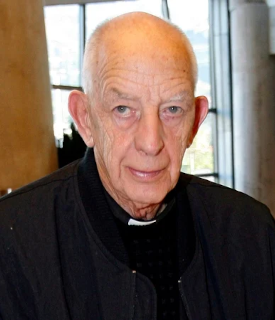
Birth of Fr. Alec Reid, Facilitator in the Northern Ireland Peace Process

Alexander Reid CSsR, Irish Catholic priest noted for his facilitator role in the Northern Ireland peace process, is born in Dublin on August 5, 1931. BBC journalist Peter Taylor subsequently describes Reid’s role as “absolutely critical” to the success of the peace process.

Reid is raised in Nenagh, County Tipperary, from the age of six following the death of his father. He studies English, history and philosophy at University College Galway.

Reid is professed as a Redemptorist in 1950 and ordained a priest seven years later. For the next four years, he gives Parish Missions in Limerick, Dundalk and Galway (Esker), before moving to Clonard Monastery in Belfast, where he spends almost the next forty years. The Redemptorist Monastery at Clonard stands on the interface between the Catholic nationalist Falls Road and the Protestant loyalist Shankill Road areas of west Belfast.

In the late 1980s, Reid facilitates a series of meetings between Gerry Adams and John Hume, in an effort to establish a “Pan-Nationalist front” to enable a move toward renouncing violence in favour of negotiation. Reid, himself a staunch nationalist who favours a united Ireland and the withdrawal of British forces from Northern Ireland, then acts as their contact person with the Irish Government in Dublin from a 1987 meeting with Charles Haughey up to the signing of the Good Friday Agreement in 1998. In this role, which is not public knowledge at the time, he holds meetings with various Taoisigh, and particularly with Martin Mansergh, advisor to various Fianna Fáil leaders. After the eventual success of the peace negotiations, Gerry Adams says, “there would not be a peace process at this time without [Father Reid’s] diligent doggedness and his refusal to give up.”

In 1988 in Belfast, Reid delivers the last rites to two British Army corporals, David Howes and Derek Wood of the Royal Corps of Signals, who are killed by the Provisional Irish Republican Army (IRA) – an event known as the corporals killings – after they drive into the funeral cortège of IRA member Kevin Brady, who had been killed in the Milltown Cemetery attack. A photograph of his involvement in that incident becomes one of the starkest and most enduring images of the Troubles. Unknown until years later, he is carrying a letter from Sinn Féin President Gerry Adams to Social Democratic and Labour Party (SDLP) leader John Hume outlining Adams’ suggestions for a political solution to the Troubles. Adams later tells the BBC in 2019 that Reid also advised U.S Ambassador to Ireland Jean Kennedy Smith during the peace process, stating “He was talking to her on the side and she was talking to her brother Teddy.”

After he moves to Dublin, Reid is involved in peace efforts in the Basque Country. In January 2003, he is awarded the Sabino Arana 2002 “World Mirror” prize, by the Sabino Arana Foundation in Bilbao, in recognition of his efforts at promoting peace and reconciliation. He and a Methodist minister, the Rev. Harold Good, announce that the IRA has decommissioned their arms at a news conference in September 2005.

Reid is involved in controversy in November 2005 when he makes comments during a meeting in Fitzroy Presbyterian Church concerning the Unionist community in Northern Ireland. When the loyalist activist Willie Frazer makes remarks that Catholics had butchered Protestants during the Troubles, Reid angrily responds, “You don’t want to hear the truth. The reality is that the nationalist community in Northern Ireland were treated almost like animals by the unionist community. They were not treated like human beings. They were treated like the Nazis treated the Jews.” Reid later apologises, saying his remarks had been made in the heat of the moment. In an interview with CNN, he says that “The IRA were, if you like, a violent response to the suppression of human rights.”

Reid dies in a Dublin hospital on November 22, 2013. He is survived by two sisters and an aunt, and is buried in Milltown Cemetery, Belfast.