
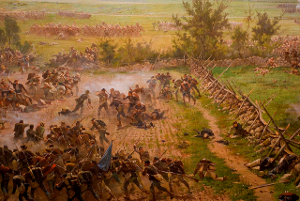
On July 3, 1863, at Gettysburg, Pennsylvania, as the sun rises behind the men of Colonel Dennis O’Kane’s Irish 69th Pennsylvania Volunteer Infantry on Cemetery Ridge, the most famous assault of the American Civil War is being prepared across the mile of open field in front of them. The 69th Pennsylvania will be at the very vortex of that assault, now known to posterity as Pickett’s Charge.
Pickett’s Charge is an infantry assault ordered by Confederate General Robert E. Lee against Major General George G. Meade‘s Union positions on the last day of the Battle of Gettysburg during the American Civil War. Its futility is predicted by the charge’s commander, Lt. General James Longstreet, and it is arguably an avoidable mistake from which the Southern war effort never fully recovers militarily or psychologically. The farthest point reached by the attack has been referred to as the high-water mark of the Confederacy. The charge is named after Maj. General George Pickett, one of three Confederate generals who lead the assault under Longstreet.
Pickett’s charge is part of Lee’s “general plan” to take Cemetery Hill and the network of roads it commands. On the night of July 2, Meade correctly predicts at a council of war that Lee will attack the center of his lines the following morning.
At 1:00 PM on July 3, a massive artillery bombardment by the Confederate guns sails mostly over the heads of the 69th. The bombardment is meant to soften up the Union defense and silence its artillery but is largely ineffective. About 3:00 PM the barrage slackens, and the rebel infantrymen begin their assault. “And let your work this day be for victory or to the death,” Colonel Dennis O’Kane tells his men as the furious rebel onslaught approaches. Approximately 12,500 men in nine infantry brigades advance over open fields for three-quarters of a mile under heavy Union artillery and rifle fire.
Soon the 69th is forced to refuse both flanks as the Confederate tide rolls up to them and laps around both sides. While many around them run, the 69th stands fast. Although some Confederates are able to breach the low stone wall that shields many of the Union defenders, they cannot maintain their hold and are repulsed with over 50% casualties. The regiment’s tenacious stand in front of the famous copse of trees is a pivotal part of the crucial Union victory and a decisive defeat for the Confederacy that ends the three-day battle and Lee’s campaign into Pennsylvania.
Good to his word, Colonel O’Kane is killed and, lying dead near the 69th’s position, wearing gray lay Pvt. Willie Mitchel of the 1st Virginia Infantry, son of Irish patriot John Mitchel. At the most crucial battle of America’s Civil War, Irish are killing Irish on a foreign field once again.
Years later, when asked why his charge at Gettysburg failed, Pickett replies, “I’ve always thought the Yankees had something to do with it.”

 seamus dubhghaill