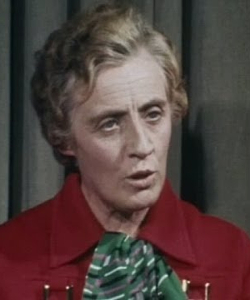
Drumm is born in Newry, County Down to a staunchly Irish republican family. Drumm’s mother has been active in the Irish War of Independence and the Irish Civil War. Drumm grows up in the village of Killean, County Armagh, where she plays camogie. She is active in the republican movement after meeting her husband, a republican prisoner. She begins to speak at many rallies and protest meetings and is soon elected as Vice President of Sinn Fein. She becomes involved in the Northern Ireland Civil Rights Association in the 1960s and works to rehouse Catholics forced from their homes by loyalist intimidation.
Drumm is jailed twice for seditious speeches. After she is released from HM Prison Armagh, raids on her house by the security forces escalate. She is widely demonised in the British media and is already a target for assassination when she is admitted to Belfast’s Mater Hospital for eye treatment in October 1976.
While recovering from the operation, Drumm is shot at point blank range in a joint operation by the Ulster Volunteer Force and the Ulster Defence Association who are able to enter and leave the hospital undisturbed. No one has ever been convicted of her murder.
Drumm’s speeches and quotations can be found on murals across Northern Ireland, including:
“The only people worthy of freedom are those who are prepared to go out and fight for it every day, and die if necessary.”
“We must take no steps backward, our steps must be onward, for if we don’t, the martyrs that died for you, for me, for this country will haunt us forever.”
In the 1780s, County Armagh is the most populous county in Ireland, and the center of its linen industry. Its population is equally split between Protestants, who dominate in the northern part of the county, and Catholics, who dominate in the south. Sectarian tensions increase throughout the decade and are exacerbated by the relaxing of some of the Penal Laws, failure to enforce others, and the entry of Catholics into the linen industry at a time when land is scarce, and wages are decreasing due to pressure from the mechanised cotton industry.
By 1784, sectarian fighting breaks out between gangs of Protestants and Catholics. The Protestants re-organise themselves as the Peep o’ Day Boys, with the Catholics forming the Defenders. The next decade sees an escalation in the violence between the two and the local population as homes are raided and wrecked.
On the morning of September 21, the Defenders, numbering around 300, make their way downhill from their base, occupying Daniel Winter’s homestead, which lay to the northwest of The Diamond and directly in their line of advance. News of the advance reaches the Peep o’ Day Boys who quickly form at the brow of the hill where they have made their camp. From this position, they gain three crucial advantages: the ability to comfortably rest their muskets allowing for more accurate shooting, a steep uphill location which makes it hard for attackers to scale, and a direct line-of-sight to Winter’s cottage, which the Defenders have made their rallying point.
The shooting begins and, after Captain Joseph Atkinson gives his weapon and powder to the Peep o’ Day Boys, he rides to Charlemont Garrison for troops to quell the trouble. There is no effective unit stationed in the garrison at the time, despite the fact a detachment of the North-Mayo Militia is stationed in Dungannon and a detachment of the Queen’s County Militia is at Portadown.
The battle is short, and the Defenders suffer “not less than thirty” fatalities. James Verner, whose account of the battle is based on hearsay, gives the total as being nearly thirty, while other reports give the figure as being forty-eight, however this may be taking into account those that die afterwards from their wounds. A large number of Defenders are also claimed to have been wounded. One of those claimed to have been killed is “McGarry of Whiterock,” the leader of the Defenders. The Peep o’ Day Boys on the other hand, in the safety of the well-defended hilltop position, suffered no casualties.
In the aftermath of the battle, the Peep o’ Day Boys retire to James Sloan’s inn in Loughgall, and it is here that James Wilson, Dan Winter, and James Sloan found the Orange Order, a defensive association pledged to defend “the King and his heirs so long as he or they support the Protestant Ascendancy.” The first Orange lodge of this new organisation is established in Dyan, County Tyrone, founding place of the Orange Boys.
The Belfast News Letter is originally printed in Joy’s Entry in Belfast. The Joys are a family of Huguenot descent who add much to eighteenth-century Belfast, noted for their compiling materials for its history. Francis Joy, who founds the paper, had come to Belfast early in the century from the County Antrim village of Killead. In Belfast, he marries the daughter of the town sovereign and sets up a practice as an attorney. In 1737, he obtains a small printing press which is in settlement of a debt and uses it to publish the town’s first newspaper at the sign of “The Peacock” in Bridge Street. The family later purchases a paper mill in Ballymena and are able to produce enough paper not only for their own publication but for the whole province of Ulster.
Originally published three times weekly, the Belfast News Letter becomes a daily in 1855. The title is now located at two addresses – a news section in Donegall Square South in central Belfast, and a features section in Portadown, County Armagh. Before the partition of Ireland, the Belfast News Letter is distributed island wide.
The newspaper’s editorial stance and readership, while originally republican, is now strongly unionist. Its primary competitors are the Belfast Telegraph and The Irish News. The Belfast News Letter has changed hands several times since the mid-1990s, and since 2005 is owned by the Johnston Press holding company Johnston Publishing (NI). The full legal title of the newspaper is the Belfast News Letter, although the word “Belfast” no longer appears on the masthead.
Historical copies of the Belfast News Letter, dating back to 1828, are available to search and view in digitised form at the British Newspaper Archive.
The crown forces are organized in six regiments — two forward, two centre, and two rear, and with cavalry at centre. As soon as they leave Armagh garrison, they are all harassed with gunfire from rebel forces concealed in the woods. As a result, the different regiments become separated from one another as they pause to deal with the hit and run attacks. The problem is accentuated when one of their ox-drawn artillery pieces becomes stuck in the bog with a damaged wheel and a rear regiment stays behind to guard it as it is slowly coaxed through the bog. The regiment at the front of the march encounters a mile-long trench, 4 feet wide and 5 feet deep. The regiment succeeds in crossing the trench but then comes under heavy attack from large forces and decides to retreat back across the trench, suffering significant losses during the retreat. This regiment then merges into the ranks of the other forward regiment.
At this point, Henry Bagenal is killed by a shot through the head. Command of the army is assumed by Thomas Maria Wingfield. Further demoralising the crown troops and causing chaos, their gunpowder store explodes, apparently ignited accidentally by the fuse of a matchlock musket. Daunted, Wingfield decides to retreat to Armagh. The commander of the forward part either doesn’t get the command or refuses to obey it or is unable to execute an orderly retreat and judges it necessary to maintain his forward position. Seeing their enemy in confusion, the O’Neill cavalry rushes at the head of the forward part, followed by swordsmen on foot. Crown troops in this part of the field are cut to pieces and any wounded left on the field after the battle are slain as well. The rest of the crown forces have to struggle their way back to the Armagh garrison. They reach it largely intact but are harried all the way by the Irish.
Crown forces lose approximately 1,500 men in the battle, including 18 “captains” or officers. Three hundred soldiers desert to the rebels including two English recruits. Out of 4,000 soldiers who set out from Armagh, just over 2,000 reach the town after the battle and become virtual prisoners inside. The cavalry breaks out and dashes south escaping the Irish.
After three days of negotiations, it is agreed that the crown troops can leave Armagh as long as they leave their arms and ammunition behind and that the garrison of the Blackwater Fort surrenders. O’Neill’s forces suffer perhaps 200 to 300 casualties in the battle, though sources for the number lost on O’Neill’s side are very scanty. In light of the battle’s outcome, the court at London greatly and rapidly increase its military forces in Ireland. Simultaneously, many in Ireland who have been neutral on the sidelines begin to support the rebellion. Thus, the ultimate outcome of the battle is an escalation of the war.
On June 21, 1877, a day that will long be remembered as Black Thursday, ten members of the Molly Maguires, an Irish labor organization, are executed in Pennsylvania, the first of twenty executions that make up the largest mass execution of any group by the U.S. federal government in history.
The Molly Maguires is an Irish 19th-century secret society active in Ireland, Liverpool, and parts of the eastern United States, best known for their activism among Irish American and Irish immigrant coal miners in Pennsylvania. The Mollies are believed to have been present in the anthracite coal fields of Pennsylvania in the United States since at least the Panic of 1873.
Members of the Mollies are accused of murder, arson, kidnapping and other crimes, in part based on allegations by Franklin B. Gowen and the testimony of a Pinkerton detective, James McParland, a native of County Armagh. Fellow prisoners testified against the defendants, who were arrested by the Coal and Iron Police. Gowen acts as a prosecutor in some of the trials. The Molly Maguires become largely inactive following the executions of 1877 and 1878.
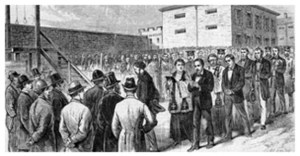
On June 21, 1877, the first ten executions take place. Six Mollies – James Carroll, James Roarity, Hugh McGehan, James Boyle, Thomas Munley, and Thomas Duffy – are hanged in the prison at Pottsville, Pennsylvania. The sheriff hangs them successively two-by-two rather than build special gallows to accommodate six. An immense crowd gathers covering the surrounding hills. Boyle carries a blood-red rose and McGehan has two roses in his lapel. Carrol and Roarity declare their innocence from the scaffold. In County Donegal, McGehan’s relatives meet in the kitchen and, it is said, the sky blackens at the moment of hanging.
On the same date, Alexander Campbell, John “Yellow Jack” Donohue, Michael J. Doyle, and Edward J. Kelly are hanged at a Carbon County prison in Mauch Chunk for the murders of John P. Jones and Morgan Powell, both mine bosses. Here gallows have been erected to accommodate four hangings and the four are hung at the same instant. Campbell, just before his execution, allegedly slaps a muddy handprint on his cell wall stating, “There is proof of my words. That mark of mine will never be wiped out. It will remain forever to shame the county for hanging an innocent man.” The handprint remains to this day.
Ten more condemned, Thomas Fisher, John “Black Jack” Kehoe, Patrick Hester, Peter McHugh, Patrick Tully, Peter McManus, Dennis Donnelly, Martin Bergan, James McDonnell, and Charles Sharpe, are hanged at Mauch Chunk, Pottsville, Bloomsburg, and Sunbury over the next year. Peter McManus is the last Molly Maguire to be tried and convicted for murder at the Northumberland County Courthouse in 1878.
The Armagh rail disaster occurs on June 12, 1889, near Armagh, County Armagh, when a crowded Sunday school excursion train fails to negotiate a steep incline. The steam locomotive is unable to complete the climb and the train stalls. The train crew decides to divide the train and take the front portion forward, leaving the rear portion on the running line. The rear portion has inadequate brakes and rolls back down the gradient, colliding with a following train. Eighty people are killed and 260 are injured, about a third of them children. It is the worst rail disaster in the United Kingdom in the nineteenth century and remains Ireland’s worst railway disaster ever.
Armagh Sunday school organises a day trip to the seaside resort of Warrenpoint, a distance of about 24 miles. A special Great Northern Railway of Ireland train is arranged for the journey, intended to carry about eight hundred passengers. The railway route is steeply graded and curved.
Asked to provide a train to take 800 excursionists, the locomotive department at Dundalk sends fifteen vehicles however instructions provided to the engineer are that the train is to consist of thirteen vehicles. The engineer objects to the use of fifteen vehicles. Witnesses say that the engineer asks for a second engine if the additional carriages are added but his request is refused by the station master as no additional engines are available.
Initially, the train progresses up the steep gradient at about 10 mph but stalls about 200 yards from the top of the gradient. To prevent the train from rolling back, the brakes are applied. The chief clerk directs the train crew to divide the train and proceed with the front portion to Hamilton’s Bawn station about two miles away, leaving it there and returning for the rear portion.
After uncoupling the rear portion, the engineer attempts to proceed on with the front portion. Initially, it rolls back slightly, jolting the rear portion which begins to roll back and gathers speed down the steep gradient back towards Armagh station. The train crew reverses the front portion and tries to catch the rear portion, but this proves to be impossible.
The line is operated on a time interval system so there is no means at Armagh of knowing that the line is not clear. The following scheduled passenger train leaves Armagh after the required 20-minute interval. It is proceeding up the gradient at about 25 mph when the engineer sees the approaching runaway vehicles at a distance of about 500 yards. He brakes his train and has reduced speed to 5 mph at the moment of collision. The two rearmost vehicles of the excursion train are utterly destroyed, and the third rearmost is very badly damaged.
Paisley becomes a Protestant evangelical minister in 1946 and remains one for the rest of his life. In 1951, he co-founds the fundamentalist Free Presbyterian Church of Ulster and is its leader until 2008. Paisley becomes known for his fiery speeches and regularly preaches and protests against Catholicism, ecumenism and homosexuality. He gains a large group of followers who are referred to as “Paisleyites.”
Paisley becomes involved in Ulster unionist/loyalist politics in the late 1950s. In the mid-late 1960s he leads and instigates loyalist opposition to the Catholic civil rights movement in Northern Ireland. This leads to the outbreak of The Troubles in the late 1960s, a conflict that engulfs Northern Ireland for the next thirty years. In 1970, he becomes Member of Parliament for North Antrim and the following year he founds the Democratic Unionist Party (DUP), which he leads for almost forty years. In 1979, he becomes a Member of the European Parliament.
Throughout the Troubles, Paisley is seen as a firebrand and the face of hard-line unionism. He opposes all attempts to resolve the conflict through power-sharing between unionists and Irish nationalists/republicans, and all attempts to involve the Republic of Ireland in Northern affairs. His efforts help bring down the Sunningdale Agreement of 1974. He also opposes the Anglo-Irish Agreement of 1985, with less success. His attempts to create a paramilitary movement culminate in Ulster Resistance. Paisley and his party also oppose the Northern Ireland peace process and Good Friday Agreement of 1998.
In 2005, Paisley’s DUP becomes the largest unionist party in Northern Ireland, displacing the Ulster Unionist Party (UUP), which has dominated unionist politics since 1905. In 2007, following the St. Andrews Agreement, the DUP finally agrees to share power with republican party Sinn Féin and consent to all-Ireland governance in certain matters. Paisley and Sinn Féin’s Martin McGuinness become First Minister and deputy First Minister respectively in May 2007. Paisley steps down as First Minister and DUP leader in May 2008 and leaves politics in 2011. Paisley is made a life peer in 2010 as Baron Bannside.
In November 2011, Paisley announces to his congregation that he is retiring as a minister. He delivers his final sermon to a packed attendance at the Martyrs’ Memorial Hall on December 18, 2011, and finally retires from his religious ministry on January 27, 2012.
Paisley dies in Belfast on September 12, 2014. He is buried in Ballygowan, County Down on September 15 following a private funeral and a public memorial for 800 invited guests is held in the Ulster Hall on October 19. An obituary in The New York Times reports that late in life Paisley had moderated and softened his stances against Roman Catholics but that “the legacies of fighting and religious hatreds remained.”