seamus dubhghaill

Promoting Irish Culture and History from Little Rock, Arkansas, USA


Leave a comment

Irish Free State Suspends Executions

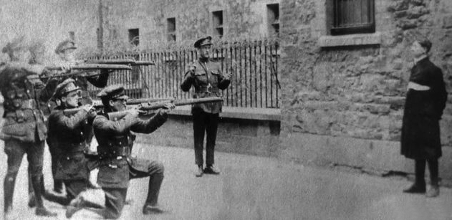
irish-free-state-executionsOn February 8, 1923, the Irish Free State suspends executions until February 18, offering an amnesty to anyone who surrenders before that date.

In the aftermath of the sudden death of Arthur Griffith and the killing of Michael Collins, in August 1922, William T. Cosgrave becomes chairman of the provisional government. Cosgrave and his colleagues remain wedded to a ruthless military and political strategy that ensures, by May 1923, a decisive win over the Republicans and the end of the Irish Civil War. Cosgrave’s analysis is that “the executions have had a remarkable effect. It is a sad thing to say, but it is nevertheless the case.” He could also be chilling in his resolve: “I am not going to hesitate and if the country is to live and if we have to exterminate 10,000 republicans, the 3 millions of our people are bigger than the ten thousand.”

The Free State suspends executions and offers an amnesty in the hope that anti-treaty fighters will surrender. However, the war drags for another two months and witnesses at least twenty more official executions.

Several Republican leaders narrowly avoid execution. Ernie O’Malley, captured on November 4, 1922, is not executed because he is too badly wounded when taken prisoner to face a court-martial and possibly because the Free State is hesitant about executing an undisputed hero of the recent struggle against the British. Liam Deasy, captured in January 1923, avoids execution by signing a surrender document calling on the anti-treaty forces to lay down their arms.

The Anti-Treaty side calls a ceasefire on April 30, 1923 and orders their men to “dump arms,” ending the war on May 24. Nevertheless, executions of Republican prisoners continue after this time. Four Irish Republican Army (IRA) men are executed in May after the ceasefire order and the final two executions take place on November 20, months after the end of hostilities. It is not until November 1924 that a general amnesty is offered for any acts committed in the civil war.

In highlighting the severity of the Free State’s execution policy, however, it is important not to exaggerate its extent. The Free State takes over 12,000 Republicans prisoner during the war, of whom roughly 80, less than 1%, are executed. How those who are executed are chosen from the others captured in arms is unclear, however many more men are sentenced to the death penalty than are actually shot. This is intended to act as a deterrent to anti-Treaty fighters in the field, who know that their imprisoned comrades are likely to be executed if they kept up their armed campaign.

Perhaps this realism is also beginning to affect the republican self-declared “men of faith.” Dan Breen, who leads an IRA column in Tipperary during the Civil war, tells his fellow republicans, “In order to win this war you’ll need to kill 3 out of every 5 people in the country and it isn’t worth it.”


Leave a comment

Birth of Irish Nationalist Joseph Mary Plunkett

joseph-mary-plunkett

Joseph Mary Plunkett, Irish nationalist, poet, journalist, and a leader of the 1916 Easter Rising, is born at 26 Upper Fitzwilliam Street in Dublin on November 21, 1887.

Both his parents come from wealthy backgrounds, and his father, George Noble Plunkett, has been made a papal count. Despite being born into a life of privilege, young Joe Plunkett does not have an easy childhood.

Plunkett contracts tuberculosis at a young age. This is to be a lifelong burden. His mother is unwilling to believe his health is as bad as it is. He spends part of his youth in the warmer climates of the Mediterranean and North Africa. He spends time in Algiers where he studies Arabic literature and language and composes poetry in Arabic. He is educated at the Catholic University School and by the Jesuits at Belvedere College in Dublin and later at Stonyhurst College, in Lancashire, England, where he acquires some military knowledge from the Officers’ Training Corps. Throughout his life, Plunkett takes an active interest in Irish heritage and the Irish language and also studies Esperanto. He is one of the founders of the Irish Esperanto League. He joins the Gaelic League and begins studying with Thomas MacDonagh, with whom he forms a lifelong friendship. The two are both poets with an interest in theatre, and both are early members of the Irish Volunteers, joining their provisional committee. Plunkett’s interest in Irish nationalism spreads throughout his family, notably to his younger brothers George and John, as well as his father, who allows his property in Kimmage, south Dublin, to be used as a training camp for young men who wish to escape conscription in Britain during the First World War. Men there are instead trained to fight for Ireland.

Sometime in 1915 Plunkett joins the Irish Republican Brotherhood (IRB) and soon after is sent to Germany to meet with Roger Casement, who is negotiating with the German government on behalf of Ireland. Casement’s role as emissary is self-appointed, and, as he is not a member of the IRB, the organisation’s leadership wishes to have one of their own contact Germany to negotiate German aid for an uprising the following year. Plunkett is seeking, but not limiting himself to, a shipment of arms. Casement, on the other hand, spends most of his energies recruiting Irish prisoners of war in Germany to form a brigade to fight instead for Ireland. Some nationalists in Ireland see this as a fruitless endeavour, and prefer to seek weapons. Plunkett successfully gets a promise of a German arms shipment to coincide with the rising.

Plunkett is one of the original members of the IRB Military Committee that is responsible for planning the Easter Rising, and it is largely his plan that is followed. Shortly before the rising is to begin, Plunkett is hospitalised following a turn for the worse in his health. He has an operation on his neck glands days before Easter and has to struggle out of bed to take part in what is to follow. Still bandaged, he takes his place in the General Post Office with several other of the rising’s leaders, including Patrick Pearse and Tom Clarke, though his health prevents him from being terribly active. His energetic aide-de-camp is Michael Collins.

Following the surrender Plunkett is held in Kilmainham Gaol, and faces a court-martial. Seven hours before his execution by firing squad at the age of 28, he is married in the prison chapel to his sweetheart Grace Gifford, a Protestant convert to Catholicism, whose sister, Muriel, had years before also converted and married his best friend Thomas MacDonagh, who is also executed for his role in the Easter Rising. Plunkett is executed by firing squad on May 4, 1916, and is the fourth and youngest signatory of the Proclamation of the Irish Republic to be executed.

Plunkett’s brothers, George Oliver Plunkett and Jack Plunkett, join him in the Easter Rising and later become important Irish Republican Army (IRA) men. His father’s cousin, Horace Plunkett, is a Protestant and unionist who seeks to reconcile unionists and nationalists. Horace Plunkett’s home is burned down by the Anti-Treaty IRA during the Irish Civil War.

The main railway station in Waterford City is named after Plunkett as is Joseph Plunkett Tower in Ballymun. Plunkett barracks in the Curragh Camp, County Kildare is also named after him.


Leave a comment

Execution of Thomas Kent

thomas-kent

Irish nationalist Thomas Kent is executed at Cork Detention Barracks on May 9, 1916. Kent’s story is one of the stranger episodes that happens after the rebellion in Dublin has been quelled. Unlike the Dublin rebels, Kent does not go out to fight. Rather the British come to him looking for trouble.

Kent is part of a prominent nationalist family who lives at Bawnard House, Castlelyons, County Cork. After spending some time in Boston, he returns to Ireland because of poor health. He is active in the Land League, Sinn Féin, and the Irish Republican Brotherhood. With the launch of the Irish Volunteers in 1913, he is prominent with another legendary Cork man, Terence MacSwiney, in organizing and training recruits.

The Kent family is prepared to take part in the Easter Rising but when the mobilisation order is countermanded by Eoin MacNeill, commander of the Irish Volunteers, on April 22, they stay at home. The rising nevertheless goes ahead in Dublin on Easter Monday. The Royal Irish Constabulary (RIC) is dispatched to arrest well-known sympathizers throughout the country including, but not limited to, known members of the Irish Republican Brotherhood, Sinn Féin, and the Irish Volunteers.

When the Kent residence is raided at 3:45 AM on May 2, the RIC is met with resistance from Thomas and his brothers Richard, David, and William. A gunfight lasts for four hours, during which RIC officer Head Constable William Rowe is killed and David Kent is seriously wounded. Eventually the Kents are forced to surrender, although Richard makes a last-minute dash for freedom and is fatally wounded.

Thomas and William are tried by court martial on May 4 on a charge of “armed rebellion.” William, who is not political, is found innocent, but Thomas is found guilty in the death of Constable Rowe and is sentenced to death. Before being led out for his execution, Kent says, “I have done my duty as a soldier of Ireland and in a few moments, I hope to see the face of God.” He is executed by firing squad in Cork in the early morning hours of May 9. David Kent is brought to Dublin where he is charged with the same offence, found guilty, and sentenced to death, but the sentence is commuted, and he is sentenced to five years penal servitude.

Apart from the singular case of Roger Casement, Thomas Kent is the only person outside of Dublin to be executed for his role in the events surrounding Easter Week. He is buried on the grounds of Cork Prison, formerly the Military Detention Barracks at the rear of Collins Barracks, Cork. The former army married quarters at the rear of Collins Barracks are named in his honour.

Taoiseach Enda Kenny offers a state funeral to the Kent family early in 2015 which they accept. Kent’s remains are exhumed from Cork prison in June 2015 after being buried for 99 years. The state funeral is held on September 18, 2015, at St. Nicholas’ Church in Castlelyons. Kent lay in state at Collins Barracks in Cork the day before. The requiem mass is attended by President Michael D. Higgins, with Enda Kenny delivering the graveside oration.