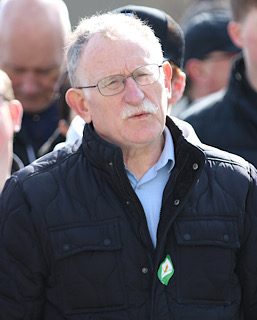
Desmond Ellis, Sinn Féin politician who has been a Teachta Dála (TD) for the Dublin North-West constituency since the 2011 Irish general election, is born in Finglas, Dublin, on September 23, 1953.
Ellis is from an Irish republican family, and both of his grandfathers fought in the Easter Rising in 1916. He later owns a television repair business.
Ellis is a former Provisional Irish Republican Army prisoner. He is arrested in 1981, when explosives and bomb making equipment are found under his bed. He is charged with possession of explosives. He jumps bail, but is arrested in Buffalo, New York in February 1982 and extradited to the Republic of Ireland, where in April 1983, he is sentenced to ten years’ imprisonment in Portlaoise Prison. He is convicted of possessing multiple power-timer units for IRA bombs, including those suspected of being used in the Hyde Park and Regent’s Park bombings. In 1983, his fingerprints are found on a huge cache of IRA explosives found in a forest outside the Berkshire town of Pangbourne. The cache is linked to the Harrods and Hyde Park bombings. On November 14, 1990, after thirty-five days on hunger strike, he becomes the first person extradited from the Republic of Ireland to the United Kingdom under the 1987 Extradition Act. He goes on hunger strike to protest efforts to send him to Britain, but is extradited in the sixth week of his fast. His hunger strike draws considerable domestic and international attention, and at one point Taoiseach Charles Haughey intervenes, asking Ellis’ parents to ask him to give it up, but they refuse. He is acquitted at his trial in London in October 1991.
Ellis is first elected to Dublin City Council in 1999, for the Finglas local electoral area. He unsuccessfully contests the 2002 Irish general election in the Dublin North-West constituency, and receives 4,781 first-preference votes (18.3%). He is again unsuccessful at the 2007 Irish general election in the same constituency, receiving 4,873 votes (15.7%). At the 2011 Irish general election, he is elected to the 31st Dáil with 7,115 (21.7%) of the first-preference votes.
In October 2014, following claims made by Máiría Cahill that she had been raped as a 17-year-old by a member of the Provisional IRA, Ellis states that “If an allegation was made against a volunteer it would have to be investigated [internally]…To be honest they were not qualified to deal with something like sexual abuse”. Based on this, Philip Ryan of the Irish Independent accuses Ellis of admitting that the IRA ran “kangaroo courts.”
In 2015, Ellis refuses to comment on if Sinn Féin leader Gerry Adams should distance himself from Thomas ‘Slab’ Murphy, an Irish republican found guilty of tax fraud and an allegedly a former IRA Chief of Staff.
At the 2016 Irish general election Ellis is again elected with 7,571 (20.5%) of the first-preference votes.
In September 2016, a bill is put forward, which if passed would criminalise hare coursing. Sinn Féin supports the legalisation of hare coursing and decides to apply the party whip. As Ellis opposes it he declines to vote. He defies party instructions by not informing party whip Aengus Ó Snodaigh that he will not be taking part in the vote so he could be excused. He is subsequently given a written warning.
In December 2016, during a session of the Dáil, Ellis and his fellow Sinn Féin TD Martin Ferris are accused by Fine Gael TD Alan Farrell of having information in relation to the shooting of Brian Stack, the chief prison officer at Portlaoise Prison, in 1983. Sinn Féin leader Gerry Adams had just delivered an address to the Dáil in relation to Stack when Farrell rises and uses Dáil privilege to state Gerry Adams had listed Ellis and Ferris as amongst people who may have information about the Stack death in an e-mail to the Garda Commission in February 2014, and ask that the two should also address the Dáil on the matter. Ellis immediately responds by stating, “I refute [sic] any allegations. For the information, the man in question claims to be a solicitor, I was actually in jail for the period. In Portlaoise, and before that in America, so you should check your facts. You’re a disgrace.” Ferris follows Ellis, and states, “On the record of this house; In 2013, I met with gardaí at their request regarding the death of Brian Stack, I co-operated fully with them and I have nothing to answer for, and it’s a disgrace what you have come in here naming. You should be ashamed of yourself.” In December 2016, Ellis states he had received death threats following the exchange in the Dáil.
In February 2018, Ellis is censured by Sinn Féin after he states publicly that fellow party member and councillor for Ballymun Noeleen Reilly is “not fit to represent Sinn Féin” and that she had waged a social media campaign against him. For her part, Reilly is suspended by the party for six months.
At the 2020 Irish general election Ellis is again elected with 14,375 first-preference votes (44.4%). He is a poll topper in the 2020 general election along with many Sinn Féin TDs in the 2020 election. He is criticised for joining his supporters singing “Come Out, Ye Black and Tans” at the count, but he dismisses the suggestion it is inappropriate.
At the 2024 Irish general election, Ellis is re-elected to the Dáil.
Ellis is in favour of the abolition of the local property tax. He supports the repealing of the Eighth Amendment, which forbids abortion in the Republic of Ireland. He believes refugees should have the right to work in Ireland and believes the system of direct provision should come to an end.
In 2012, the Irish Independent, citing released internal documents held by the British government that were previously sealed for 30 years, alleges that by 1982 British authorities believe Ellis to be linked to “50 murders” as part of his time in the Provisional IRA. The allegation specifically cites a telegraph from the British embassy in Washington, D.C., to American counterparts in which they claim that Ellis is linked by “forensic evidence to some 50 murders” across Northern Ireland and the Republic of Ireland. The Irish Independent claims another document states that Ellis is a “leading member” of the Provisional IRA.
Sinn Féin denounces the allegations as an “Indo Smear” and releases a statement declaring, “This is not the first time such unsubstantiated allegations have been made and Dessie Ellis rejects them as he has repeatedly done. Following a prolonged hunger strike in the 1990s to protest his extradition to Britain, Dessie successfully beat these trumped-up charges in court. Dessie Ellis has made no secret of his involvement in the republican struggle over many decades, including within the ranks of the IRA. Dessie has also been an important persuader for the Peace Process for many years.” Ellis does not make any personal statement on the allegations and refers journalists to Sinn Féin’s official statement.
Ellis is proficient in karate, holding a black belt, and teaches martial arts to young people. He is married to Anne Ellis (née Dunne) with grown up children.