seamus dubhghaill

Promoting Irish Culture and History from Little Rock, Arkansas, USA


Leave a comment

Demolition of HM Prison Maze Begins

maze-prison

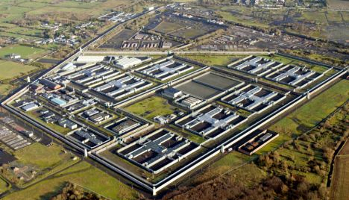
Bulldozers begin demolishing Northern Ireland‘s notorious HM Prison Maze, previously known as Long Kesh Detention Centre, on October 31, 2006. The prison once housed the most dangerous guerrillas from both sides of the province’s sectarian conflict.

Among the inmates at Maze are ten Irish nationalist hunger strikers who starved themselves to death in 1981. The prison has been empty since 2000, after the release of most guerrilla prisoners under the Good Friday Agreement, which ushered in relative peace after 30 years of fighting in which 3,600 people died.

A sports stadium, equestrian center, hotel, and shopping center are originally proposed for the 360-acre site in County Antrim. In January 2009, however, Sports Minister Gregory Campbell rules out the plan for a multi-sports stadium which has divided political and sporting opinion, opting instead to explore alternatives with the soccer, rugby, and Gaelic Athletic Association (GAA) authorities.

Northern Ireland first and deputy first ministers, Peter Robinson and Martin McGuinness, announce in 2010 that an agreement has been reached on building a peace and conflict resolution facility at the Maze site. It will also host the Royal Ulster Agricultural Society’s annual show. On February 2, 2012, European funding of £18m is approved for building the contentious conflict resolution centre.

Planning permission for the peace centre on the site of the former prison is granted on April 18, 2013. However, in June the Orange Order calls on unionist politicians to halt the peace centre plan, objecting to its location on the former prison site.

On August 15, 2013, Peter Robinson calls a halt to the peace centre plan. In a letter to Democratic Unionist Party (DUP) members, he says it would be wrong to proceed without a consensus about how it will operate. As a result, in October 2013 the European Union funding programme withdraws its £18m offer in financial support for the Maze peace centre.

That the Maze Prison development remains unrealised 16 years after the site’s closure testifies to the complexities involved. That the prospect of redevelopment has never been taken off the table affirms the ineluctable power ideas of profit still hold.


Leave a comment

Anne Letitia Dickson Elected UPNI Leader

anne-letitia-dickson

Anne Letitia Dickson is elected leader of the Unionist Party of Northern Ireland (UPNI) on September 15, 1976, becoming the first woman to lead a political party in Ireland.

Born in London on April 18, 1928, Dickson moves with her family to Northern Ireland at an early age and is educated at Holywood and Richmond Lodge School. After service as the Chair of the Northern Ireland Advisory Board of the Salvation Army she becomes actively involved in politics for the Ulster Unionist Party (UUP). Elected as chair of the Carrick Division Unionist Association she later becomes a member of the Newtownabbey Urban District Council, serving as Vice-Chair from 1967 to 1969.

Dickson is then elected as an Ulster Unionist politician for the Carrick constituency in the Parliament of Northern Ireland at Stormont as a supporter of Prime Minister Terence O’Neill. After the dissolution of the Stormont Parliament, she is elected in the 1973 Assembly election for South Antrim as an Independent Unionist candidate having resigned from the Ulster Unionist Party in 1972.

After the Ulster Unionist party split in 1974 over the Sunningdale Agreement, Dickson joins the newly formed Unionist Party of Northern Ireland along with other supporters of former Northern Ireland prime minister Brian Faulkner. She retains her seat in South Antrim in the 1975 constitutional convention election. After the retirement of Brian Faulkner in 1976 she becomes leader of the Unionist Party of Northern Ireland, becoming the first woman to lead a major political party in Northern Ireland.

In 1979 Dickson contests the Belfast North constituency in the Westminster election, polling 10% of the vote, the best performance by a UPNI candidate in Northern Ireland, however her intervention is sufficient to split the moderate Unionist vote resulting in the seat being gained by the Democratic Unionist Party (DUP).

The Unionist Party of Northern Ireland disbands in 1981 after poor results in the local government elections and Dickson retires from active politics. Subsequently she is chair of the Northern Ireland Consumer Council from 1985 to 1990.


Leave a comment

IRA Announces End of 36-Year Armed Campaign

ira-ends-armed-campaignThe Irish Republican Army (IRA) issues a statement on July 28, 2005, announcing the end of its 36-year armed campaign and its resumption of disarmament. The campaign of armed conflict has a cost 3,500 lives, 1,800 of them at the hands of the Provisionals.

The IRA says its members have been ordered to pursue peaceful means and not to “engage in any other activities whatsoever” – a reference to the low-level paramilitary activities which have angered not just unionists, but the London and Dublin governments. The IRA gives no indication that it will disband.

Sinn Féin president Gerry Adams calls it an “emotional day” and, flanked by senior members of Sinn Féin, speaks directly to IRA volunteers by saying, “National liberation struggles have different phases – a time for struggle, a time for war, and also a time to engage, to put the war behind us all – this is that time.” He declares the IRA statement means the group is now committed to “purely peaceful and democratic methods” and calls it “a direct challenge to the Democratic Unionist Party (DUP) to decide if they want to put the past behind them and make peace with the rest of the people of the island.”

The DUP reserves judgment, although an initial “holding statement” on their website from the party leader, Rev. Ian Paisley, criticises the failure to declare clearly they will end all criminal activity.

Taoiseach Bertie Ahern says the British and Irish governments have worked for 11 years for this outcome. He says, “The war is over, the IRA’s armed campaign is over, paramilitarism is over and I believe that we can look to the future of peace and prosperity based on mutual trust and reconciliation and a final end to violence.”

Praising the “clarity” of the IRA statement, British Prime Minister Tony Blair says, “This may be the day when finally, after all the false dawns and dashed hope, peace replaces war, politics replaces terror on the island of Ireland.”

The IRA statement follows the release the previous night of IRA bomber Sean Kelly by the British government “on the expectation” of a move by the terrorist group.


Leave a comment

Signing of the Good Friday Agreement

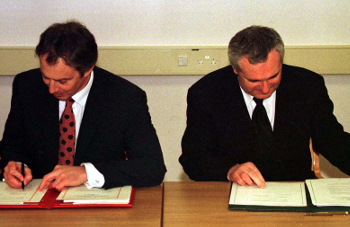
After nearly two years of talks, the Good Friday Agreement, a major political development in the Northern Ireland peace process of the 1990s, is signed by Irish Taoiseach Bertie Ahern and British Prime Minister Tony Blair on Good Friday, April 10, 1998 in Belfast, Northern Ireland.

The Good Friday Agreement brings to an end the 30 years of sectarian conflict in Northern Ireland known as “The Troubles.”  Northern Ireland’s present devolved system of government is based on the Agreement.

The Agreement is made up of two inter-related documents: (1) a multi-party agreement by most of Northern Ireland’s political parties and (2) an international agreement between the British and Irish governments called the British-Irish Agreement.

The Agreement sets out a complex series of provisions relating to a number of areas including the status and system of government of Northern Ireland within the United Kingdom (Strand 1), the relationship between Northern Ireland and the Republic of Ireland (Strand 2), and the relationship between the Republic of Ireland and the United Kingdom (Strand 3).

Issues relating to civil and cultural rights, decommissioning of weapons, justice and policing are central to the Agreement.

The Agreement is approved by voters across the island of Ireland in two referendums held on May 22, 1998. The people of both Northern Ireland and the Republic of Ireland need to approve the Agreement in order for it to come into effect. In Northern Ireland, voters are asked whether they support the multi-party agreement. In the Republic of Ireland, voters are asked whether they will allow the state to sign the agreement and allow necessary constitutional changes to facilitate it.

The British-Irish Agreement comes into force on December 2, 1999. The Democratic Unionist Party (DUP) is the only major political group in Northern Ireland to oppose the Good Friday Agreement.


Leave a comment

Birth in Belfast of Ian Paisley

ian-paisley

Ian Richard Kyle Paisley, loyalist politician and Protestant religious leader from Northern Ireland is born on April 6, 1926, in Armagh, County Armagh.

Paisley becomes a Protestant evangelical minister in 1946 and remains one for the rest of his life. In 1951, he co-founds the fundamentalist Free Presbyterian Church of Ulster and is its leader until 2008. Paisley becomes known for his fiery speeches and regularly preaches and protests against Catholicism, ecumenism and homosexuality. He gains a large group of followers who are referred to as “Paisleyites.”

Paisley becomes involved in Ulster unionist/loyalist politics in the late 1950s. In the mid-late 1960s he leads and instigates loyalist opposition to the Catholic civil rights movement in Northern Ireland. This leads to the outbreak of The Troubles in the late 1960s, a conflict that engulfs Northern Ireland for the next thirty years. In 1970, he becomes Member of Parliament for North Antrim and the following year he founds the Democratic Unionist Party (DUP), which he leads for almost forty years. In 1979, he becomes a Member of the European Parliament.

Throughout the Troubles, Paisley is seen as a firebrand and the face of hard-line unionism. He opposes all attempts to resolve the conflict through power-sharing between unionists and Irish nationalists/republicans, and all attempts to involve the Republic of Ireland in Northern affairs. His efforts help bring down the Sunningdale Agreement of 1974. He also opposes the Anglo-Irish Agreement of 1985, with less success. His attempts to create a paramilitary movement culminate in Ulster Resistance. Paisley and his party also oppose the Northern Ireland peace process and Good Friday Agreement of 1998.

In 2005, Paisley’s DUP becomes the largest unionist party in Northern Ireland, displacing the Ulster Unionist Party (UUP), which has dominated unionist politics since 1905. In 2007, following the St. Andrews Agreement, the DUP finally agrees to share power with republican party Sinn Féin and consent to all-Ireland governance in certain matters. Paisley and Sinn Féin’s Martin McGuinness become First Minister and deputy First Minister respectively in May 2007. Paisley steps down as First Minister and DUP leader in May 2008 and leaves politics in 2011. Paisley is made a life peer in 2010 as Baron Bannside.

In November 2011, Paisley announces to his congregation that he is retiring as a minister. He delivers his final sermon to a packed attendance at the Martyrs’ Memorial Hall on December 18, 2011, and finally retires from his religious ministry on January 27, 2012.

Paisley dies in Belfast on September 12, 2014. He is buried in Ballygowan, County Down on September 15 following a private funeral and a public memorial for 800 invited guests is held in the Ulster Hall on October 19. An obituary in The New York Times reports that late in life Paisley had moderated and softened his stances against Roman Catholics but that “the legacies of fighting and religious hatreds remained.”


Leave a comment

Gerry Adams Assassination Attempt

adams-assassination-attempt

Sinn Féin president Gerry Adams is seriously wounded in an assassination attempt in central Belfast on March 14, 1984. As the car containing Adams and four other leading Sinn Féin members leaves Belfast Magistrate’s Court, a vehicle pulls alongside and three Ulster Defence Association (UDA) gunmen fire approximately 20 shots into the car. Adams is shot in the neck and shoulder, Seán Keenan in the face, Joe Keenan in the body and hands, and Kevin Rooney in the body. Bob Murray is the only person in the car to escape without injury.

The republicans are in Belfast facing charges of obstruction after the Royal Ulster Constabulary (RUC) attempt to remove an Irish tricolour from a Sinn Féin election cavalcade. After the shooting, Adams is rushed to the Royal Victoria Hospital, where he undergoes surgery to remove the three bullets.

The three loyalist death squad members who carry out the assassination attempt are arrested shortly after the attack by off-duty RUC and British soldiers who open fire on them before ramming their car. One of the UDA gunmen accidentally shoots himself in the foot during the escape attempt.

Following his release from the hospital later in the month, Gerry Adams says it is “quite obvious that British Intelligence were aware” of the operation and that “they wanted myself and my comrades out of the way.” Democratic Unionist Party (DUP) Stormont Assembly member George Seawright expresses regret that Adams has not been killed. The Ulster Unionist Party (UUP) and the British Government remain tight-lipped while Will Glendinning of the Alliance Party of Northern Ireland uses the attack to remind voters he was “totally opposed to the politics of Gerry Adams.”

A Sinn Féin statement released just hours after the attack says, “If the shooting was an attempt to drive us off the streets or underground, it has already failed.” The party says that such attacks are a constant danger, and that it is a testament to Sinn Féin that they continue their work despite such threats.