seamus dubhghaill

Promoting Irish Culture and History from Little Rock, Arkansas, USA


Leave a comment

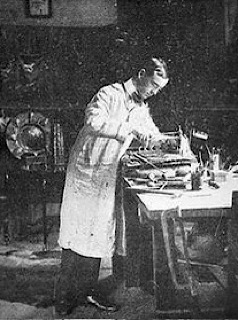
Death of Denis Santry, Architect & Cartoonist

Denis Santry, Irish architect and cartoonist, dies in Durban, South Africa, on April 14, 1960. He is a pioneer of animated cartoons in South Africa and the architect of the several prominent structures in Singapore, including the Sultan Mosque and The Cenotaph.

Santry is born in Cork, County Cork, on May 14, 1879, to Denis Santry, Sr., a carpenter and joiner. He studies at the Cork Municipal School of Art from 1894 to 1896 after serving an apprenticeship as a cabinetmaker. In 1895, he also studies at the Crawford School of Art. In 1897, he is articled to architect James Finbarre McMullen. From 1897 to 1898, he studies at the Royal College of Art in London under a Lane scholarship. While he is at the college, he wins the Queen’s prize for freehand drawing. After graduating, he returns to McMullen’s office and works there for the next two years.

Santry comes to South Africa at the end of 1901 due to ill health. He settles in Cape Town and is employed at Tully & Waters, an architectural firm, from 1901 to 1902. He then spends a year working for architect William Patrick Henry Black. In 1903, his cartoons begin to appear in local newspapers and magazines, including the South African Review. He uses the pseudonym “Adam” in his cartoons. He continues to work as an architect until 1910 when he begins working as a cartoonist, as well as a metalworker, sculptor and filmmaker. He then moves to Johannesburg and is employed at the Sunday Times and The Rand Daily Mail as a cartoonist. During World War I, his cartoons are reproduced in several other countries. He becomes a pioneer of animated cartoons in South Africa. He is a member of the Royal Society of Arts and a council member of the South African Society of Artists.

Santry comes to Singapore in 1918 and joins the architectural firm Swan & Maclaren as a partner. While in Singapore, he serves as the architect of several prominent buildings and monuments, including the Sultan Mosque, The Cenotaph, the Maritime Building, the Hongkong and Shanghai Bank Building and the Telok Ayer Chinese Methodist Church. He serves as the first president of the St. Patrick’s Society Singapore, the first president of the Singapore Amateur Boxing Association, the chairman of the Singapore Art Club, a member of the board of control of the Victoria Theatre and Concert Hall, a member of the Censorship Appeal Board and the vice-president of the Straits Settlements Association. He is also a frequent contributor to the Straits Produce, a satirical magazine. He helps to found the Singapore Society of Architects and the Institute of Architects of Malaya and is the founder and the chairman of the Singapore Musical Society. He retires to England in March 1934.

Santry returns to South Africa in 1940. Following the end of World War II, he resumes his practice as a result of lost income caused by the Japanese occupation of Malaya. In 1950, he becomes a member of the Institute of South African Architects. He designs several private houses in Hillcrest, KwaZulu-Natal.

Santry marries Madeline Hegarty in 1904. From 1910 to 1918, he lives in Kleine Schuur on Rhodes Avenue in Johannesburg. The house is designed by prominent architect Herbert Baker. He dies in Durban, South Africa, on April 14, 1960.


Leave a comment

Birth of Catherine O’Brien, Irish Stained Glass Artist

Catherine Amelia “Kitty” O’Brien, Irish stained glass artist and a member and director of An Túr Gloine, is born in Durra House, Spancill Hill, County Clare, on June 19, 1881.

O’Brien is one of five children of Pierce O’Brien, a gentleman landowner, and Sophia Angel St John O’Brien. Her first cousin is woodcarver Sophia St John Whitty. She attends the Mercy Convent in Ennis, going on to win a scholarship to the Dublin Metropolitan School of Art. While there she studies under William Orpen and Alfred E. Child who teach her the art of stained glass.

Among O’Brien’s first commissions is the St. Ita window for St. Brendan’s cathedral in Loughrea, County Galway, in 1904, which is designed by Sarah Purser. She joins An Túr Gloine in 1906, beginning her career there by designing Angel of the Annunciation window in the Enniskillen convent chapel. For a window in the Wilson private chapel at Coolcarrigan House, NaasCounty Kildare, in 1912, she incorporates Celtic design, some drawing on the Book of Durrow. In 1914, she tours the cathedrals of ParisRouen, and Chartres with Purser and Wilhelmina Geddes. She designs three windows depicting St. John, St. Flannan, and St. Munchin, for the Honan Chapel at University College Cork in 1916. Her 1923 design of the centenary memorial window in St. Andrew’s church, Lucan, represents the parable of the Good Shepherd. When in 1925 An Túr Gloine becomes a cooperative society, she becomes a shareholder along with Ethel RhindEvie Hone, and Michael Healy.

O’Brien’s 1926 lunette The Spirit of Night represents night, twilight, and dawn, and is for the private home of Keng Chee in Singapore, which is later demolished. The window of St. Catherine of Siena for the Sacred Heart convent chapel in Newton, Massachusetts dates from 1927. Her 1931 St. Patrick window, for the De La Salle school, East Coast Rd., Singapore, commissioned by architect Denis Santry, is the only extant stained-glass work by an Irish artist in that country. Much like Rhind, O’Brien also employs opus sectile, such as in her 1936 Mass in Penal Days in the Franciscan friary, AthloneCounty Westmeath. She contributes two windows, Pelican and Lamb and Host and Chalice: Wheat and Grapes, to the ten windows An Túr Gloine produces for Brophy College ChapelPhoenix, Arizona in 1937. From 1937 until 1947, she works on 22 opus sectile panels for the Protestant Church in Ennis.

Purser retires from An Túr Gloine in 1940, and O’Brien succeeds her as director, going on to purchase it and the contents in 1944. She rents a section of the premises to fellow stained-glass artist Patrick Pollen from 1954 onwards. She exhibits at the 1953 Irish Exhibition of Living Art, and the 1958 exhibition of the Arts and Crafts Society of Ireland. When the An Túr Gloine studios are damaged by fire in 1958, she rebuilds them and reopens by 1959. She is an active member of the Soroptimists and the Guild of Irish Art Workers. The last work she completes is a three-light window for the Church of St. MultoseKinsale, County Cork, in 1962. A commission for two windows for the private chapel of Áras an Uachtaráin for President Éamon de Valera is left unfinished at her death.

O’Brien dies in Dublin on July 18, 1963, and is buried in Whitechurch Parish Graveyard, County Dublin. She is commemorated in a window designed by Pollen in St. Laurence O’Toole chapel, Christ Church Cathedral, Dublin, where for forty years she made floral arrangements. Over 150 of her An Túr Gloine drawings from notebooks are now in the National Gallery of Ireland.

(Pictured: Stained glass window in the south wall of Ferns Cathedral, Ferns, County Wexford)