seamus dubhghaill

Promoting Irish Culture and History from Little Rock, Arkansas, USA


Leave a comment

Death of Éamon de Valera

eamon-de-valera-dead

Éamon de Valera, prominent politician in twentieth-century Ireland, dies at the age of 92 in Linden Convalescent Home, Blackrock, County Dublin on August 29, 1975. His wife, Sinéad de Valera, four years his senior, had died the previous January, on the eve of their 65th wedding anniversary.

De Valera’s political career spans over half a century, from 1917 to 1973. He serves several terms as head of government and head of state. He also leads the introduction of the Constitution of Ireland.

De Valera is a leader in the Irish War of Independence and of the anti-Treaty opposition in the ensuing Irish Civil War (1922–1923). After leaving Sinn Féin in 1926 due to its policy of abstentionism, he founds Fianna Fáil, and is head of government from 1932 to 1948, 1951 to 1954, and 1957 to 1959, serving as President of the Executive Council and later Taoiseach. He resigns after being elected President of Ireland. His political creed evolves from militant republicanism to social and cultural conservatism.

Assessments of de Valera’s career are varied. He has often been characterised as a stern, unbending, devious, and divisive Irish politician. Biographer Tim Pat Coogan sees his time in power as being characterised by economic and cultural stagnation, while Diarmaid Ferriter argues that the stereotype of de Valera as an austere, cold and even backward figure is largely manufactured in the 1960s and is misguided.

On September 2, 1975, Éamon de Valera makes his final journey through the streets of Dublin to his final resting place at Glasnevin Cemetery. De Valera’s body is taken from St. Patrick’s Hall in Dublin Castle, where it has lain in state, to the the St. Mary’s Pro-Cathedral, where a requiem Mass is celebrated by his grandson, Father Seán Ó Cuív, and then on to Glasnevin Cemetery.

On a day of national mourning, over 200,000 people pay tribute to the statesman along the three-mile funeral route from Dublin city centre to Glasnevin. The Army No. 1 Band plays Wrap the Green Flag Round Me as de Valera is carried into Glasnevin Cemetery.

In attendance at the funeral are family, friends, colleagues, politicians, dignitaries, diplomats, veterans of the 1916 Easter Rising, and citizens who want to pay their respect. The final prayers are recited at the graveside by Father Ó Cuív. The firing party of young cadets from the Curragh fire a final volley in tribute over the grave.

Leave a comment

The Theft of the Irish Crown Jewels

irish-crown-jewels-reward

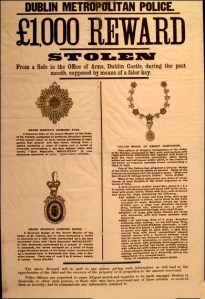
The theft from Dublin Castle of the Irish Crown Jewels, the heavily jeweled star and badge regalia of the Sovereign and Grand Master of the Order of St. Patrick, as well as the collars of five knights of the Order is discovered on July 6, 1907. The theft has never been solved and the jewels have never been recovered.

Prior to 1903, the insignia of the Sovereign and those of deceased Knights are in the custody of the Ulster King of Arms, the senior Irish officer of arms, and are kept in a bank vault. In 1903, the jewels are transferred to a safe, which is to be placed in the newly constructed strongroom in Dublin Castle beside the Ulster King of Arms’ office. The new safe is too large for the doorway to the strongroom and Arthur Vicars, the Ulster King of Arms, instead stores it in his office. Seven latch keys to the door of the Office of Arms are held by Vicars and his staff, and two keys to the safe containing the insignia are both in the custody of Vicars. Vicars is known to regularly get drunk on overnight duty and he once awoke to find the jewels around his neck. It is not known whether or not this is a prank or a practice for the actual theft.

The insignia are last worn by the Lord Lieutenant, Lord Aberdeen, on March 15, 1907, at a function to mark Saint Patrick’s Day on March 17. They are last known to be in the safe on June 11, when Vicars shows them to a visitor to his office. The jewels are discovered to be missing on July 6, four days before the start of a visit by King Edward VII and Queen Alexandra to the Irish International Exhibition, at which it is planned to invest Bernard FitzPatrick, 2nd Baron Castletown, into the Order. The theft reportedly angers the King, but the visit goes on as scheduled, however, the investiture ceremony is cancelled.

A police investigation is conducted by the Dublin Metropolitan Police (DMP). Posters issued by the DMP depict and describe the missing jewels. Detective Chief Inspector John Kane of Scotland Yard arrives on July 12 to assist. His report, which is never released, is said to name the culprit but is suppressed by the Royal Irish Constabulary (RIC).

Vicars refuses to resign his position, and similarly refuses to appear at a Viceregal Commission into the theft. Vicars argues for a public Royal Commission instead, which has the power to subpoena witnesses. He publicly accuses his second in command, Francis Shackleton, of the theft. Kane explicitly denies to the Commission that Shackleton, brother of the explorer Ernest Shackleton, is involved. Shackleton is exonerated in the Commission’s report, and Vicars is found to have “not exercise[d] due vigilance or proper care as the custodian of the regalia.” Vicars is compelled to resign, as are all the staff in his personal employ.


Leave a comment

First Known Meeting of the Parliament of Ireland

parliament-of-ireland-coat-of-arms

The Parliament of Ireland meets at Castledermot in County Kildare on June 18, 1264, the first definitively known meeting of this Irish legislature. There is some evidence to suggest that the word “parliament” may have been in use as early as 1234.

There is nothing new about parliamentary assemblies in Ireland. The Normans, who begin to settle in Ireland in 1169, are the first to give Ireland a centralised administration. The Irish legal system and courts of law are, in large measure, inherited from them. So too is the Irish legislature which is directly descended from the parliament which develops in medieval Ireland.

The Parliament of Ireland is formally founded in 1297 by the Justiciar, Sir John Wogan, to represent the Irish and Anglo-Norman population of the Lordship of Ireland. It exists in Dublin from 1297 until 1800 and is comprised of two chambers – the House of Commons and the House of Lords. The House of Lords consists of members of the Irish peerage and the bishops (after the Reformation, Church of Ireland bishops), while the Commons is directly elected, albeit on a very restricted franchise.

The main purpose of parliament is to approve taxes that are then levied by and for the Lordship of Ireland. Those who pay the bulk of taxation, the clergy, merchants, and landowners, naturally comprise the members. In 1541 the parliament votes to create the Kingdom of Ireland.

Over the centuries, the Irish parliament meets in a number of locations both inside and outside Dublin. The first meeting at Castledermot in June 1264 takes place some months earlier than the first English Parliament containing representatives of towns and cities. However, this Irish Parliament is a meeting of Irish nobles and bishops, not representatives of Irish people. Later, in the 15th century, Irish parliaments began to invite representatives of the people.

Among its most famous meeting places are Dublin Castle, the Bluecoat School, Chichester House and its final permanent home, the Irish Parliament House in College Green.


Leave a comment

Birth of Activist & Feminist Hanna Sheehy-Skeffington

hanna-sheehy-skeffington

Johanna Mary “Hanna” Sheehy-Skeffington, Republican activist and feminist, is born in Kanturk, County Cork, on May 24, 1877.

Sheehy is the eldest daughter of Elizabeth McCoy and David Sheehy, an ex-Fenian and Member of Parliament (MP) for the Irish Parliamentary Party, representing South Galway. One of her uncles, Father Eugene Sheehy, is known as the Land League Priest, and his activities land him in prison. He is also one of Éamon de Valera‘s teachers in Limerick. When Hanna’s father becomes an MP in 1887, the family moves to Drumcondra, Dublin.

Sheehy is educated at the Dominican Convent on Eccles Street, where she is a prize-winning pupil. She then enrolls at St. Mary’s University College, a third level college for women established by the Dominicans in 1893, to study modern French and German. She sits for examinations at Royal University of Ireland and receives a Bachelor of Arts degree in 1899, and a Master of Arts Degree with first-class honours in 1902. This leads to a career as a teacher in Eccles Street and an examiner in the Intermediate Certificate examination.

Sheehy marries Francis Skeffington in 1903, and they both take the surname Sheehy Skeffington, which they do not hyphenate but use as a double name. In 1908, they found the Irish Women’s Franchise League, a group aiming for women’s voting rights.

Sheehy-Skeffington gets into numerous scuffles with the law. She is jailed in 1912 for breaking windows of government buildings in support of suffrage as part of an IWFL campaign. That same year she also throws a hatchet at visiting British Prime Minister Herbert Asquith. She loses her teaching job in 1913 when she is arrested and imprisoned for three months after throwing stones at Dublin Castle and assaulting a police officer in a feminist action. While in jail she goes on hunger strike and is released under the Prisoner’s Temporary Discharge of Ill Health Act but is soon rearrested.

Being free from her teaching job enables Sheehy-Skeffington to devote more time to the fight for suffrage. She is influenced by James Connolly and during the 1913 lock-out works with other suffragists in Liberty Hall, providing food for the families of the strikers.

She strongly opposes participation in World War I which breaks out in August 1914 and is prevented by the British government from attending the International Congress of Women held in The Hague in April 1915. The following June her husband is imprisoned for anti-recruiting activities. He is later shot dead during the 1916 Easter Rising after having been arrested by British soldiers.

Sheehy-Skeffington refuses compensation for her husband’s death, which is offered on condition of her ceasing to speak and write about the murder. Rather, she travels to the United States to publicise the political situation in Ireland. In October 1917, she is the sole Irish representative to League for Small and Subject Nationalities where, along with several other contributors, she is accused of pro-German sympathies. She publishes British Militarism as I Have Known It, which is banned in the United Kingdom until after the World War I. Upon her return to Britain she is once again imprisoned, this time in Holloway prison. After release, Sheehy-Skeffington attends the 1918 Irish Race Convention in New York City and later supports the anti-Treaty Irish Republican Army (IRA) during the Irish Civil War.

In 1926, Sheehy-Skeffington becomes a founding member of Fianna Fáil and is elected to the party’s Ard Comhairle. During the 1930s, she is assistant editor of An Phoblacht. In January 1933, she is arrested in Newry for breaching an exclusion order banning her from Northern Ireland. At her trial she says, “I recognize no partition. I recognize it as no crime to be in my own country. I would be ashamed of my own name and my murdered husband’s name if I did…Long live the Republic!” She is sentenced to a month’s imprisonment.

Sheehy-Skeffington is a founding member of the Irish Women Workers’ Union and an author whose works deeply oppose British imperialism in Ireland. Her son, Owen Sheehy-Skeffington, becomes a politician and Irish Senator.

Hanna Sheehy-Skeffington dies in Dublin on April 20, 1946, at the age of 68 and is buried with her husband in Glasnevin Cemetery, Dublin.


Leave a comment

Oliver Plunkett Beatified by Pope Benedict XV

oliver-plunkett

Oliver Plunkett, Roman Catholic Archbishop of Armagh and Primate of All Ireland, is beatified by Pope Benedict XV on May 23, 1920.

Plunkett is born on November 1, 1625, in Loughcrew, County Meath, to well-to-do parents with Hiberno-Norman ancestors. He is ordained a priest in 1654 and deputed by the Irish bishops to act as their representative in Rome. Meanwhile, the Cromwellian conquest of Ireland (1649–1653) has defeated the Roman Catholic cause in Ireland. In the aftermath, the public practice of Roman Catholicism is banned, and Roman Catholic clergy are executed. As a result, it is impossible for Plunkett to return to Ireland for many years.

He eventually sets foot on Irish soil again on March 7, 1670, as the English Restoration of 1660 has begun on a basis of toleration. After arriving back in Ireland, he sets about reorganising the ravaged Roman Church and builds schools both for the young and for clergy, whom he finds “ignorant in moral theology and controversies.” The Penal Laws have been relaxed in line with the Declaration of Breda in 1660 and Plunkett is able to establish a Jesuit College in Drogheda in 1670.

On the enactment of the Test Act in 1673, to which Plunkett does not agree for doctrinal reasons, the college is closed and demolished. Plunkett goes into hiding, traveling only in disguise, and refusing a government edict to register at a seaport to await passage into exile. In 1678, the so-called Popish Plot, concocted in England by clergyman Titus Oates, leads to further anti-Roman Catholic action. Archbishop Peter Talbot of Dublin is arrested, and Plunkett again goes into hiding.

Despite being on the run and with a price on his head, Plunkett refuses to leave his flock. At some point before his final incarceration, he takes refuge in a church that once stood in the townland of Killartry, in the parish of Clogherhead in County Louth, seven miles outside Drogheda. He is arrested in Dublin in December 1679 and imprisoned in Dublin Castle. Plunkett is tried at Dundalk for conspiring against the state by allegedly plotting to bring 20,000 French soldiers into the country, and for levying a tax on his clergy to support 70,000 men for rebellion.

Plunkett is found guilty of high treason in June 1681 “for promoting the Roman faith” and is condemned to death. He is hanged, drawn, and quartered at Tyburn on July 1, 1681, the last Roman Catholic martyr to die in England.

Oliver Plunkett is beatified on May 23, 1920, and canonised in 1975, the first new Irish saint for almost seven hundred years, and the first of the Irish martyrs to be beatified. For the canonisation, the customary second miracle is waived. Plunkett has since been followed by 17 other Irish martyrs who were beatified by Pope John Paul II in 1992. Among them are Archbishop Dermot O’Hurley, Margaret Ball, and the Wexford Martyrs.


Leave a comment

Rebels Surrender Ends the 1916 Easter Rising

pearse-surrenders-to-lowe

The Irish Volunteers and Irish Citizen Army rebels headquartered at the General Post Office (GPO) on Sackville Street, after days of shelling, are forced to abandon their headquarters when fire caused by the shells spreads to the GPO. James Connolly, Commandant of the Dublin Brigade, has been incapacitated by a bullet wound to the ankle and has passed command on to Patrick Pearse. Michael Joseph O’Rahilly, a founding member of the Irish Volunteers, is killed in a sortie from the GPO. The rebels tunnel through the walls of the neighbouring buildings in order to evacuate the Post Office without coming under fire and take up a new position at 16 Moore Street.

On Saturday, April 29, 1916, from the new headquarters on Moore Street, after realising that they will not break out of this position without further loss of civilian life, Pearse issues an order for all companies to surrender. Pearse surrenders unconditionally to Brigadier-General William Henry Muir Lowe (photo). The surrender document reads:

“In order to prevent the further slaughter of Dublin citizens, and in the hope of saving the lives of our followers now surrounded and hopelessly outnumbered, the members of the Provisional Government present at headquarters have agreed to an unconditional surrender, and the commandants of the various districts in the City and County will order their commands to lay down arms.”

The other posts surrender only after Pearse’s surrender order, carried by nurse Elizabeth O’Farrell, reaches them. Sporadic fighting, therefore, continues into Sunday, April 30, when word of the surrender is received by the other rebel garrisons. Command of British forces has passed from Lowe to General John Maxwell, who arrives in Dublin just in time to accept the surrender. Maxwell is made temporary military governor of Ireland.

The surrender signals the end of the 1916 Easter Rising, the most significant campaign in the struggle for Irish independence since the Irish Rebellion of 1798. The Rising leaves large parts of the city decimated and results in thousands of casualties. It is also, unambiguously, a spectacular military failure. And yet it is the spark that lights the fuse on the Irish War of Independence which, within five years, forces the British government to the negotiating table to discuss the terms of Irish independence.

Martial law, which was declared in Dublin by British authorities, remains in effect in Ireland through the fall of 1916.

The 1916 Easter Rising results in at least 485 deaths, according to the Glasnevin Trust. More than 2,600 are wounded, including at least 2,200 civilians and rebels, at least 370 British soldiers, and 29 policemen. The vast majority of the Irish casualties are buried in Glasnevin Cemetery in the aftermath of the fighting. British families come to Dublin Castle in May 1916 to reclaim the bodies of British soldiers and funerals are arranged. Soldiers whose bodies are not claimed are given military funerals in Grangegorman Military Cemetery.


Leave a comment

Birth of Irish Revolutionary Robert Emmet

robert-emmet

Robert Emmet, Irish nationalist, Republican, orator, and one of the most famous revolutionaries in Irish history, is born at 109 St. Stephen’s Green in Dublin on March 4, 1778. He is the youngest son of Dr. Robert Emmet, a court physician, and his wife Elizabeth Mason.

Emmet attends Oswald’s school in Dopping’s-court, off Golden-lane. He enters Trinity College, Dublin, in October 1793 at the age of fifteen. In December 1797, he joins the College Historical Society, a debating society. While he is in college, his brother Thomas and some of his friends become involved in political activism. Robert becomes secretary of a secret United Irish Committee in college and is expelled in April 1798 as a result. That same year he flees to France to avoid the many British arrests of nationalists that are taking place in Ireland. While in France, Emmet garners the support of Napoleon, who promises to lend support when the upcoming revolution starts.

After the 1798 rising, Emmet is involved in reorganising the defeated United Irish Society. In April 1799, a warrant is issued for his arrest. He escapes and soon after travels to the continent in the hope of securing French military aid. His efforts are unsuccessful, as Napoleon is concentrating his efforts on invading England. Emmet returns to Ireland in October 1802.

In March of the following year, Emmet begins to prepare a new rebellion, with fellow Anglo-Irish revolutionaries Thomas Russell and James Hope. The revolutionaries conceal their preparations, but a premature explosion at one of Emmet’s arms depots kills a man, forcing Emmet to advance the date of the rising before the authorities’ suspicions are aroused.

Despite being unable to secure help from Michael Dwyer‘s Wicklow rebels and many rebels from Kildare turning back due to the scarcity of firearms, the rising begins in Dublin on the evening of July 23, 1803. Failing to seize the lightly defended Dublin Castle, the rising amounts to a large-scale disturbance in the Thomas Street area. Emmet witnesses a dragoon being pulled from his horse and piked to death, the sight of which prompts him to call off the rising to avoid further bloodshed. However, sporadic clashes continue into the night until finally quelled by British military forces.

Emmet flees into hiding, moving from Rathfarnam to Harold’s Cross so that he can be near his sweetheart, Sarah Curran. He is captured on August 25 and taken to Dublin Castle, then later removed to Kilmainham Gaol. Vigorous but ineffectual efforts are made to procure his escape.

Emmet is tried for and found guilty of high treason on September 19, 1803. Chief Justice Lord Norbury sentences Emmet to be hanged, drawn, and quartered, as is customary for conviction of treason. The following day, Emmet is executed in Thomas Street near St. Catherine’s. He is hanged and beheaded after his death. Out of fear of being arrested, no one comes forward to claim his remains.

Emmet’s remains are first delivered to Newgate Prison and then returned to Kilmainham Gaol, where the jailer is under instructions to be bury the remains in a nearby hospital’s burial grounds if no one claims them. No remains have been found there and though not confirmed, it appears that he was secretly removed and reinterred in St. Michan’s Church, a Dublin church with strong United Irish associations. There is also speculation that the reamins are buried secretly in the vault of a Dublin Anglican church. When inspected in the 1950s, a headless corpse is found in the vault but cannot be identified. The widely accepted theory is that Emmet’s remains are transferred to St. Peter’s Church in Aungier St. under cover of the burial of his sister in 1804. In the 1980s the church is deconsecrated, and all the coffins are removed from the vaults. The church has since been demolished.


Leave a comment

An Garda Síochána na h-Eireann is Formed

An Garda Síochána na h-Eireann (Guardians of the Peace of Ireland), the police force of Ireland more commonly referred to as the Gardaí or “the guards,” is formed on February 21, 1922. The service, originally named the Civic Guard and headquartered in Dublin’s Phoenix Park, is headed by the Garda Commissioner who is appointed by the Irish government.

The Civic Guard is formed by the Provisional Government in February 1922 to take over the responsibility of policing the fledgling Irish Free State. It replaces the Royal Irish Constabulary (RIC) and the Irish Republican Police of 1919–22. In August 1922, the force accompanies Michael Collins when he meets the Lord Lieutenant in Dublin Castle.

The Garda Síochána (Temporary Provisions) Act 1923, enacted after the creation of the Irish Free State on August 8, 1923, provides for the creation of “a force of police to be called and known as ‘The Garda Síochána.'” Under section 22, the Civic Guard are deemed to have been established under and are to be governed by the Act. The law therefore effectively renames the existing force.

While most recruits to the Garda come from the ranks of the Irish Republican Army, which had fought against the RIC, about one hundred ex-RIC men become part of the new force. Problems become apparent when some recruits do not conceal their dislike of the ex-RIC instructors and refused to salute them. On May 15, 1922, over 1,200 recruits break ranks during Morning Parade, seize the armoury, and take over the Kildare Depot. Negotiations between the mutineers and the Provisional Government of Ireland over control of the force lasts seven weeks, during which time the Irish Civil War has begun. Commissioner Michael Staines resigns in September and is replaced by Eoin O’Duffy.

During the Irish Civil War, the new Free State sets up the Criminal Investigation Department as an armed, plain-clothed, counter-insurgency unit. It is disbanded after the end of the war in October 1923 and elements of it are absorbed into the Dublin Metropolitan Police, which was founded in 1836.

In Dublin, policing remains the responsibility of the Dublin Metropolitan Police until it merges with the Garda Síochána in 1925. Since then the Garda has been the only civil police force in the state now known as Ireland. Other police forces with limited powers are the Military Police within the Irish Defence Forces, the Airport Police Service, and Dublin Port and Dún Laoghaire Harbour police forces.

The Garda medal of honour, the Scott Medal, An Garda Síochána’s highest honour, is named after Colonel Walter Scott, the American philanthropist that endowed the fund for the original medals.


Leave a comment

Laying of the Foundation Stone of Nelson Pillar

nelson-pillar

Construction of Nelson Pillar, a large granite pillar topped by a statue of Horatio Nelson in the middle of O’Connell Street (formerly Sackville Street) in Dublin, begins with the laying of the foundation stone on February 15, 1808, by the Lord Lieutenant the Duke of Richmond.

News of Nelson’s victory at Trafalgar reaches Dublin on November 8, 1805, and is greeted with boisterous celebrations in the streets, alongside mourning for the death of the hero. Within a month the Lord Mayor of Dublin, James Vance, calls a meeting of nobility, clergy, bankers, merchants, and citizens to plan a monument in Nelson’s memory, which is to be funded by public subscription.

The duke, dressed in a general’s uniform and accompanied by the Duchess in deep mourning for the dead hero, arrive at the foundation stone laying in a state coach drawn by six horses. The procession from Dublin Castle to the site includes Horse Yeomanry and Foot Yeomanry, sailors, officers of the Army and the Navy, subscribers, the committee, the Provost and Fellows of Trinity College, the Lord Mayor, the Common Council, sheriffs, aldermen, and peers according to their degrees.

The pillar is a Doric column that rises 121 feet from the ground and is topped by a 13-foot-tall statue of Nelson carved in Portland stone, giving it a total height of 134 feet, some 35 feet shorter than Nelson’s Column in London. The diameter of the column is 13 feet at the bottom and 10 feet at the top. All of the outer and visible parts of the pillar are granite from the quarry of Goldenhill, Manor Kilbride, County Wicklow. The interior is black limestone.

The pillar is completed by August 1809 and the statue of Nelson is hoisted into place. The statue is the work of Thomas Kirk, a young Cork-born sculptor then at the beginning of a successful career. The statue adds £630 to the cost of the pillar, which totals almost £7,000.

The monument is opened to the public on Trafalgar Day, October 21, 1809, the fourth anniversary of the battle. It offers the citizens of Dublin an unprecedented perspective on their city. For the payment of ten pence, they can climb the 168 steps of the inner stone staircase to the viewing platform.

nelson-pillar-bombing

On October 29, 1955, a group of University College Dublin students lock themselves inside the pillar and try to melt the statue with flame throwers. From the top they hang a poster of Kevin Barry, a Dublin Irish Republican Army (IRA) volunteer who is executed by the British during the Irish War of Independence. Gardaí force their way inside with sledgehammers. They take the students’ names and addresses and bring them downstairs. Rather than arrest the students, the Gardaí merely confiscate their equipment and tell everyone to leave quietly. None are ever charged.

At 1:32 AM on March 8, 1966, a bomb destroys the upper half of the pillar, throwing the statue of Nelson into the street. The bomb is planted by a group of former Irish Republican Army (IRA) volunteers in what is believed to mark the commemoration the 50th anniversary of the Easter Rising.

Six days after the original damage, on the morning of Monday, March 14, 1966, Irish Army engineers blow up the rest of the pillar after judging the structure to be too unsafe to restore. This planned demolition causes more damage on O’Connell Street than the original blast, breaking many windows.

The rubble from the monument is taken to the East Wall dump and the lettering from the plinth is moved to the gardens of Butler House, Kilkenny.


Leave a comment

Birth of IRA Leader Seán Treacy

sean-allis-treacy

Seán Allis Treacy, one of the leaders of the Third Tipperary Brigade of the Irish Republican Army during the Irish War of Independence, is born on February 14, 1895, in Soloheadbeg, County Tipperary.

Treacy leaves school at the age of 14 and works as farmer while also developing deep patriotic convictions. He is a member of the Gaelic League, and of the Irish Republican Brotherhood (IRB) from 1911 and the Irish Volunteers from 1913.

He is picked up in the mass arrests following the Easter Rising in 1916. He spends much of the following two years in prison, where he goes on hunger strike on several occasions.

In 1918, Treacy is appointed Vice Officer-Commanding of the 3rd Tipperary Brigade of the Irish Volunteers, which becomes the Irish Republican Army in 1919.

On January 21, 1919, Treacy and Dan Breen, together with Seán Hogan, Séamus Robinson, and five other volunteers, help to ignite the conflict that is to become the Irish War of Independence. They ambush and shoot dead Constables Patrick MacDonnell and James O’Connell of the Royal Irish Constabulary (RIC), who are guarding a transport of gelignite explosives, during the Soloheadbeg Ambush near Treacy’s home. Treacy leads the planning of the ambush and briefs the brigade’s OC Robinson on his return from prison in late 1918. Robinson supports the plans and agrees they will not go to GHQ for permission to undertake the attack.

As a result of the Soloheadbeg Ambush, South Tipperary is placed under martial law and declared a Special Military Area under the Defence of the Realm Act. After Soloheadbeg ambush party member Seán Hogan is arrested on May 12, 1919, Treacy, Breen, and Séamus Robinson are joined by five men from the IRA’s East Limerick Brigade to organise Hogan’s rescue. Hogan is brought to the train which is intended to take him from Thurles to Cork city on May 13, 1919. As the train steams across the Tipperary border and into County Limerick, the IRA party boards the train in Knocklong. A close-range struggle ensues on the train. Treacy and Breen are seriously wounded in the gunfight and two RIC men die, but Hogan is rescued. His rescuers rush him into the village of Knocklong where a butcher cuts off his handcuffs using a cleaver.

A search for Treacy and the others is mounted across Ireland. Treacy leaves Tipperary for Dublin to avoid capture. In Dublin, Michael Collins employs Treacy on assassination operations with “the Squad“. In the summer of 1920, he returns to Tipperary and organises several attacks on RIC barracks before again moving his base of operations to Dublin.

By spring 1920 the political police of both the Crimes Special Branch of the Royal Irish Constabulary (RIC) and G-Division (Special Branch) of the Dublin Metropolitan Police (DMP) have been effectively neutalised by IRA counterintelligence operatives working for Michael Collins. The British thoroughly reorganise their administration at Dublin Castle and begin to import dozens of professional secret service agents from all parts of the British Empire into Ireland to track down IRA operatives and Sinn Féin leaders.

On October 11, 1920, Treacy and Breen are holed up in a safe house on the north side of Dublin when it is raided by a police unit. In the ensuing shootout, two senior British officers are wounded and die the next day while Treacy and Breen are wounded, Breen seriously. Treacy and Breen manage to escape through a window and shoot their way through the police cordon.

Treacy is discovered at the Republican Outfitters shop at 94 Talbot Street on October 14 a British Secret Service surveillance team led by Major Carew and Lt. Gilbert Price. They were stalking him in hopes that he would lead them to Collins or to other high-value IRA targets. Treacy realises that he is being followed and runs for his bicycle but grabs the wrong bike, taking one that is far too big for him, and falls. Price draws his pistol and closes in on Treacy. Treacy draws his parabellum automatic pistol and shoots Price and another British agent before he is hit in the head, dying instantly.

Treacy is buried at Kilfeacle graveyard where, despite a large presence of British military personnel, a volley of shots is fired over the grave.