seamus dubhghaill

Promoting Irish Culture and History from Little Rock, Arkansas, USA


Leave a comment

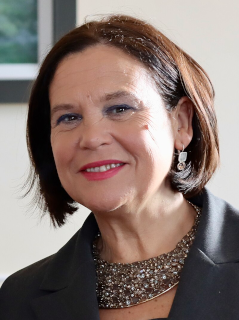
Birth of Mary Lou McDonald, Current President of Sinn Féin

Mary Louise McDonald, Irish politician and President of Sinn Féin since February 2018, is born in Dublin on May 1, 1969.

McDonald is born into a middle-class family in south Dublin. Her father Patrick McDonald, a builder and surveyor, and her mother Joan, separate when she is nine years old, and she stays with her mother in Rathgar. She has three siblings, one older and two younger. Her great-uncle, James O’Connor, was a member of the Anti-Treaty IRA and was executed at the Curragh Camp during the Irish Civil War.

McDonald is educated at Rathgar National School and at the Catholic all-girls, Notre Dame des Missions in Churchtown, South Dublin, where she is involved in debating. She then attends Trinity College Dublin (TCD), the University of Limerick and Dublin City University (DCU), studying English Literature, European Integration Studies and Human Resource Management.

She works as a researcher for the Institute of European Affairs, a consultant for the Irish Productivity Centre, a human resources consultancy that is jointly operated by Ibec and Irish Congress of Trade Unions (ICTU), and a trainer in the Partnership Unit of the Educational and Training Services Trust.

McDonald starts her political career by first joining Fianna Fáil in 1998 but leaves the party after a year due to core policy differences, particularly in relation to Northern Ireland and social justice. She quickly realises that Sinn Féin is a more appropriate party for her Republican views after meeting Sinn Féin members through the Irish National Congress.

She first runs for office at the 2002 Irish general election when she unsuccessfully contests the Dublin West constituency for Sinn Féin, polling 8.02% of first preference votes.

In 2004, McDonald becomes Sinn Féin’s first Member of the European Parliament (MEP) in Ireland, when she is elected at the 2004 European Parliament election in Ireland for the Dublin constituency, receiving over 60,000 first preference votes. She serves until 2009 and is a prominent member of the Employment and Social Affairs committee and Civil Liberties committee.

McDonald is an unsuccessful candidate in the Dublin Central constituency at the 2007 Irish general election. In 2009 she becomes the vice president of Sinn Féin.

McDonald contests the Dublin Central constituency again at the 2011 Irish general election, this time picking up 13.1% of first preference votes. She is successful in taking the last seat in the constituency. Following the election, she becomes Sinn Féin’s Spokesperson for Public Expenditure and Reform and is a member of the Public Accounts Committee from then until 2017.

After her re-election to the Dáil at the 2016 Irish general election, in which she tops the poll in Dublin Central, she becomes Sinn Féin’s All-Ireland Spokesperson for Mental Health and Suicide Prevention, which she holds until being elected president of Sinn Féin in 2018.

At a Sinn Féin party conference on November 18, 2017, Gerry Adams is re-elected party leader but announces that he will ask party leadership to call for a special Ard Fheis to be held within three months to choose a new president, and that he will not stand for re-election as TD for the Louth constituency in the next election.

At the close of nominations to succeed Adams on January 20, 2018, McDonald is announced as the president-elect of Sinn Féin, as she is the sole nominee to enter the race. She is confirmed as president at a special Ard Fheis on February 10, 2018, in Dublin.

McDonald is nominated as Taoiseach on February 20, 2020, but is defeated 45 to 84. On June 26, 2020, Fianna Fáil, Fine Gael, and the Green Party form a coalition government, leaving Sinn Féin as the largest opposition party, and McDonald as Leader of the Opposition. She dismisses the coalition agreement as a “marriage of convenience,” and accuses Fianna Fáil and Fine Gael of conspiring to exclude Sinn Féin from government.

At the 2024 Irish general election, McDonald is re-elected to the Dáil topping the poll in Dublin Central with Sinn Féin increasing their seat share by two seats, remaining the second largest party by representation in the Dáil and attaining 19% of the first preference votes, a fall of 5.5% from 2020 and fall behind Fianna Fáil by 2.9% and Fine Gael by 1.8%.

McDonald is again nominated as Taoiseach on December 18, 2024, but is defeated 44 to 110.

McDonald’s husband, Martin Lanigan, works as a gas control superintendent for the emergency dispatch division of Gas Networks Ireland, a state infrastructure provider. They have two children and live in Cabra, Dublin.


Leave a comment

Birth of Tony Gregory, Independent Politician & Teachta Dála

Tony Gregory, Irish independent politician and a Teachta Dála (TD) for the Dublin Central constituency from 1982 to 2009, is born on December 5, 1947, in Ballybough on Dublin‘s Northside.

Gregory is the second child of Anthony Gregory, warehouseman in Dublin Port, and Ellen Gregory (née Judge). He wins a Dublin Corporation scholarship to the Christian BrothersO’Connell School. He later goes on to University College Dublin (UCD), where he receives a Bachelor of Arts degree and later a Higher Diploma in Education, funding his degree from summer work at the Wall’s ice cream factory in Acton, London. Initially working at Synge Street CBS, he later teaches history and French at Coláiste Eoin, an Irish language secondary school in Booterstown. His students at Synge Street and Coláiste Eoin include John Crown, Colm Mac Eochaidh, Aengus Ó Snodaigh and Liam Ó Maonlaí.

Gregory becomes involved in republican politics, joining Sinn Féin and the Irish Republican Army (IRA) in 1964. In UCD he helps found the UCD Republican Club, despite pressure from college authorities, and becomes involved with the Dublin Housing Action Committee. Within the party he is a supporter of Wicklow Republican Seamus Costello. Costello, who is a member of Wicklow County Council, emphasises involvement in local politics and is an opponent of abstentionism. Gregory sides with the Officials in the 1970 split within Sinn Féin. Despite having a promising future within the party, he resigns in 1972 citing frustration with ideological infighting in the party. Later, Costello, who had been expelled by Official Sinn Féin, approaches him and asks him to join his new party, the Irish Republican Socialist Party. He leaves the party after Costello’s assassination in 1977. He is briefly associated with the Socialist Labour Party.

Gregory contests the 1979 local elections for Dublin City Council as a “Dublin Community Independent” candidate. At the February 1982 general election, he is elected to Dáil Éireann as an Independent TD. On his election he immediately achieves national prominence through the famous “Gregory Deal,” which he negotiates with Fianna Fáil leader Charles Haughey. In return for supporting Haughey as Taoiseach, he is guaranteed a massive cash injection for his inner-city Dublin constituency, an area beset by poverty and neglect.

Although Gregory is reviled in certain quarters for effectively holding a government to ransom, his uncompromising commitment to the poor is widely admired. Fianna Fáil loses power at the November 1982 general election, and many of the promises made in the Gregory Deal are not implemented by the incoming Fine GaelLabour Party coalition.

Gregory is involved in the 1980s in tackling Dublin’s growing drug problem. Heroin had largely been introduced to Dublin by the Dunne criminal group, based in Crumlin, in the late 1970s. In 1982 a report reveals that 10% of 15- to 24-year-olds have used heroin at least once in the north inner city. The spread of heroin use also leads to a sharp increase in petty crime. He confronts the government’s handling of the problem as well as senior Gardaí, for what he sees as their inadequate response to the problem. He co-ordinates with the Concerned Parents Against Drugs group in 1986, who protest and highlight the activities of local drug dealers and defend the group against accusations by government Ministers Michael Noonan and Barry Desmond that it is a front for the Provisional IRA. He believes that the solution to the problem is multi-faceted and works on a number of policy level efforts across policing, service co-ordination and rehabilitation of addicts. In 1995 in an article in The Irish Times, he proposes what would later become the Criminal Assets Bureau, which is set up in 1996, catalysed by the death of journalist Veronica Guerin. His role in its development is later acknowledged by then Minister for Justice Nora Owen.

Gregory also advocates for Dublin’s street traders. After attending a sit-down protest with Sinn Féin Councillor Christy Burke, and future Labour Party TD Joe Costello on Dublin’s O’Connell Street in defence of a street trader, he, Burke and four others are arrested and charged with obstruction and threatening behaviour. He spends two weeks in Mountjoy Prison after refusing to sign a bond to keep the peace.

Gregory remains a TD from 1982 and, although he never holds a government position, remains one of the country’s most recognised Dáil deputies. He always refuses to wear a tie in the Dáil chamber stating that many of his constituents could not afford them.

Gregory dies on January 2, 2009, following a long battle with cancer. Following his death, tributes pour in from politicians from every party, recognising his contribution to Dublin’s north inner city. During his funeral, politicians from the Labour Party, Fianna Fáil and Fine Gael are told that although they speak highly of Gregory following his death, during his time in the Dáil he had been excluded by many of them and that they were not to use his funeral as a “photo opportunity.” He is buried on January 7, with the Socialist Party‘s Joe Higgins delivering the graveside oration.

Colleagues of Tony Gregory support his election agent, Dublin City Councillor Maureen O’Sullivan, at the 2009 Dublin Central by-election in June. She wins the subsequent by-election.


Leave a comment

Maurice Ahern is Elected Lord Mayor of Dublin

Maurice Ahern, Fianna Fáil politician and brother of Taoiseach Bertie Ahern, is elected Lord Mayor of Dublin on July 3, 2000. Fine Gael’s P. J. Hourican, a native of County Longford, is elected Lord Mayor of Cork.

Ahern is born in Dublin in 1938. He is a member of Dublin City Council for the Cabra–Glasnevin local electoral area from 1999 to 2009. He is first elected at the 1999 Irish local elections, topping the poll. He is re-elected at the 2004 Irish local elections. Prior to his election as the Lord Mayor of Dublin in 2000, he is the former Leader of the Fianna Fáil group on the council. He is a member of the Irish Sports Council.

Ahern is married to Moira Murray, and they have five sons and one daughter. His eldest son, Dylan Ahern, is found dead in his apartment on November 22, 2009.

Ahern is the elder brother of Bertie and Noel Ahern, both of whom serve as Fianna Fáil TDs, with Bertie serving as Taoiseach from 1997 to 2008.

Ahern is the Fianna Fáil candidate in the Dublin Central by-election which is held on June 5, 2009. He loses that election being beaten into 5th place. On the same day, he also loses his council seat in the 2009 Irish local elections.


Leave a comment

Birth of Ciarán Cuffe, Politician & European Parliament Member

Ciarán Cuffe, Irish politician who has served as a Member of the European Parliament (MEP) from Ireland for the Dublin constituency since July 2019, is born in Shankill, Dublin, on April 3, 1963. He is a member of the Green Party, part of the European Green Party. He previously serves as a Minister of State from 2010 to 2011. He is a Teachta Dála (TD) for the Dún Laoghaire constituency from 2002 to 2011.

Cuffe is the son of Luan Peter Cuffe and Patricia Sistine Skakel. His father, who trains at Harvard University under Walter Gropius, is an architect who was involved in town planning for Dún Laoghaire and Wicklow before taking over his brother-in-law’s architectural practice. Through his mother, he is a grandson of George Skakel, a founder of Great Lakes Carbon Corporation, and a nephew of Ethel Skakel Kennedy. His cousins include the children of Ethel and Robert F. Kennedy. His granduncle was the Fianna Fáil TD Patrick Little, and his great-grandfather, Philip Francis Little, was the first Premier of Newfoundland in 1854. He is a member of the Dublin Cycling Campaign and has cycled coast-to-coast across the United States.

Cuffe attends the Children’s House Montessori School in Stillorgan, Gonzaga College in Ranelagh, the University of Maine at Orono, University College Dublin (UCD), and the Ca’ Foscari University of Venice. He has degrees in architecture and urban planning from UCD. He teaches a master’s programme in urban regeneration and development at the Dublin Institute of Technology (DIT), Bolton Street. In 2019, he completes a Master of Science in cities at the London School of Economics (LSE).

Cuffe joins the Green Party in 1982, and campaigns with Students Against the Destruction of Dublin (SADD) in the 1980s. He is twice elected to Dublin City Council, in 1991 and 1999, for the South Inner City electoral area. In 1996, he launches a free bikes scheme in which bicycles are placed around Dublin city centre for use by the public.

Cuffe is an unsuccessful candidate for the Dublin Central constituency at the 1997 Irish general election but is elected to the Dáil Éireann at the 2002 Irish general election for the Dún Laoghaire constituency.

In June 2003, Cuffe steps down as the Green Party’s environment spokesperson after it is revealed that he held shares worth $70,000 in a number of oil exploration companies which he had inherited when his late mother had left him $1.3 million in her will. He is re-elected at the 2007 Irish general election.

Following the 2007 election, the Green Party forms a coalition government with two other political parties and a number of independent TDs. Just after the election, on May 28, 2007, Cuffe writes in his blog: “A deal with Fianna Fáil would be a deal with the Devil. We would be spat out after 5 years and decimated as a party.” He loses his seat at the 2011 Irish general election.

On March 23, 2010, as part of a reshuffle, Cuffe is appointed as Minister of State at the Department of Agriculture, Fisheries and Food, at the Department of Transport and at the Department of the Environment, Heritage and Local Government, with special responsibility for Horticulture, Sustainable Travel, and Planning and Heritage.

While Cuffe is minister, the Oireachtas enacts the Planning and Development (Amendment) Act 2010 to address land-use planning failures and over-zoning of development land. The legislation reforms the way development plans and local area plans are made and, for the first time in Irish legislation, includes a definition of Anthropogenic Climate Change and required energy use to be taken into account in planning decisions. He publishes the Climate Change Response Bill 2010, and an update of the National Spatial Strategy. He is head of the Irish delegation at the 2010 United Nations Climate Change Conference in Cancún, Mexico.

Cuffe promotes healthy eating for children, school gardens and local markets. He publishes bills to address climate change, noise pollution, and heritage protection. In January 2011, he launches a new policy of allowing bicycles on off-peak Dublin Area Rapid Transit (DART) trains.

Cuffe resigns as Minister of State on January 23, 2011, when the Green Party withdraws from government.

At the 2014 Irish local elections, Cuffe is elected to Dublin City Council for Dublin North Inner City area, on the 13th count. He is appointed chairperson for the Dublin City Council Transportation Committee in 2014. As a member of the Central Area Committee for Dublin City Council, he works to provide a site for the Gaelscoil Choláiste Mhuire primary school on Dominick Street in 2017. He introduces 30 km/h speed limits to residential and school areas of Dublin and also advocates for a car-free College Green. He calls for an increase in affordable housing in Dublin, specifically for people with different incomes. Speaking on the Strategic Development Zone in the Dublin Docklands, he states, “We have seen a lot of cranes in the Docklands but not a lot of homes. Particularly affordable homes.” He proposes a Motion declaring a Climate Emergency which is approved at a meeting of the Council on May 13, 2019.

Cuffe is selected as the Green Party candidate for the Dublin constituency at the 2019 European Parliament elections. He tops the poll, receiving 63,849 votes and is elected as an MEP on the 13th count, with 17.54% first preference votes. He is also re-elected to Dublin City Council, but due to the prohibition on a dual mandate, this seat is co-opted to fellow Green Party member Janet Horner.

Cuffe is a member of the European Parliament Committee on Transport and Tourism (TRAN) and is the Coordinator of the Greens-European Free Alliance (Greens/EFA). He is also a member of the European Parliament Committee on Industry, Research and Energy (ITRE), and has written an initiative report, The Cuffe Report, on maximising the Energy Efficiency of the EU building stock (2020/2070). In 2022, he is appointed rapporteur on the directive on the Energy Performance of Buildings (EPBD).

Cuffe is President of the European Forum for Renewable Energy Sources (EUFORES), a cross-party European parliamentary network gathering members of European, regional and national parliaments of the EU, and works to promote renewable energy and energy efficiency.

In June 2023, Cuffe is the recipient of the Energy, Science and Research Award at The Parliament Magazine‘s annual MEP Awards.


Leave a comment

Birth of Maureen O’Sullivan, Irish Independent Politician

Maureen O’Sullivan, former Irish Independent politician who serves as a Teachta Dála (TD) for the Dublin Central constituency from 2009 to 2020, is born in East Wall, Dublin, on March 10, 1951.

O’Sullivan is educated locally at Mount Carmel school. After completing a BA at University College Dublin (UCD), she then goes on to work as an English and History teacher and guidance counsellor in a secondary school in Baldoyle, a position she holds for thirty years.

O’Sullivan is a member of Tony Gregory‘s local political organisation in the 1970s, first canvassing for him and later serving as his election agent. She is co-opted onto Dublin City Council for the North Inner City local electoral area from September 2008 to June 2009, after the retirement of Mick Rafferty. After the death of Tony Gregory, she wins the resulting by-election which is held on the same day as the local elections where she also wins a seat on Dublin City Council, for the North Inner City local electoral area. Marie Metcalfe is co-opted to take the seat due to the dual mandate rule. Subsequently Anna Quigley replaces Metcalfe on Dublin City Council, who is in turn replaced by Mel MacGiobúin in March 2014. MacGiobúin fails to be elected at the local elections held in May.

O’Sullivan is re-elected to the Dáil at the 2011 Irish general election. She joins the Dáil technical group which gives independents and minor parties more speaking time in Dáil debates. She describes a proposal for political gender quota legislation as “tokenistic” and that women are able to get themselves nominated for election.

In December 2015, O’Sullivan and fellow independent TDs Clare Daly and Mick Wallace each put forward offers of a €5,000 surety for a 23-year-old man being prosecuted under terrorism legislation in the Special Criminal Court in Dublin charged with membership of an illegal dissident republican terrorist organisation.

After the 2016 Irish general election O’Sullivan unsuccessfully stands for election as Ceann Comhairle. She joins a technical group aligned with Independents 4 Change, while remaining outside the Independents 4 Change party. She is criticised by the brother of late TD Tony Gregory, over an allegedly false claim made in her election literature.

On January 16, 2020, O’Sullivan announces she will not be standing in the 2020 Irish general election in February.


Leave a comment

Death of Tony Gregory, Independent Politician & TD

Tony Gregory, Irish independent politician and a Teachta Dála (TD) for the Dublin Central constituency from 1982 to 2009, dies in Dublin on January 2, 2009.

Gregory is born on December 5, 1947, in Ballybough on Dublin’s Northside, the second child of Anthony Gregory, warehouseman in Dublin Port, and Ellen Gregory (née Judge). He wins a Dublin Corporation scholarship to the Christian BrothersO’Connell School. He later goes on to University College Dublin (UCD), where he receives a Bachelor of Arts degree and later a Higher Diploma in Education, funding his degree from summer work at the Wall’s ice cream factory in Acton, London. Initially working at Synge Street CBS, he later teaches history and French at Coláiste Eoin, an Irish language secondary school in Booterstown. His students at Synge Street and Coláiste Eoin include John Crown, Colm Mac Eochaidh, Aengus Ó Snodaigh and Liam Ó Maonlaí.

Gregory becomes involved in republican politics, joining Sinn Féin and the Irish Republican Army (IRA) in 1964. In UCD he helps found the UCD Republican Club, despite pressure from college authorities, and becomes involved with the Dublin Housing Action Committee. Within the party he is a supporter of Wicklow Republican Seamus Costello. Costello, who is a member of Wicklow County Council, emphasises involvement in local politics and is an opponent of abstentionism. Gregory sides with the Officials in the 1970 split within Sinn Féin. Despite having a promising future within the party, he resigns in 1972 citing frustration with ideological infighting in the party. Later, Costello, who had been expelled by Official Sinn Féin, approaches him and asks him to join his new party, the Irish Republican Socialist Party. He leaves the party after Costello’s assassination in 1977. He is briefly associated with the Socialist Labour Party.

Gregory contests the 1979 local elections for Dublin City Council as a “Dublin Community Independent” candidate. At the February 1982 general election, he is elected to Dáil Éireann as an Independent TD. On his election he immediately achieves national prominence through the famous “Gregory Deal,” which he negotiates with Fianna Fáil leader Charles Haughey. In return for supporting Haughey as Taoiseach, he is guaranteed a massive cash injection for his inner-city Dublin constituency, an area beset by poverty and neglect.

Although Gregory is reviled in certain quarters for effectively holding a government to ransom, his uncompromising commitment to the poor is widely admired. Fianna Fáil loses power at the November 1982 general election, and many of the promises made in the Gregory Deal are not implemented by the incoming Fine GaelLabour Party coalition.

Gregory is involved in the 1980s in tackling Dublin’s growing drug problem. Heroin had largely been introduced to Dublin by the Dunne criminal group, based in Crumlin, in the late 1970s. In 1982 a report reveals that 10% of 15- to 24-year-olds have used heroin at least once in the north inner city. The spread of heroin use also leads to a sharp increase in petty crime. He confronts the government’s handling of the problem as well as senior Gardaí, for what he sees as their inadequate response to the problem. He co-ordinates with the Concerned Parents Against Drugs group in 1986, who protest and highlight the activities of local drug dealers and defend the group against accusations by government Ministers Michael Noonan and Barry Desmond that it is a front for the Provisional IRA. He believes that the solution to the problem is multi-faceted and works on a number of policy level efforts across policing, service co-ordination and rehabilitation of addicts. In 1995 in an article in The Irish Times, he proposes what would later become the Criminal Assets Bureau, which is set up in 1996, catalysed by the death of journalist Veronica Guerin. His role in its development is later acknowledged by then Minister for Justice Nora Owen.

Gregory also advocates for Dublin’s street traders. After attending a sit-down protest with Sinn Féin Councillor Christy Burke, and future Labour Party TD Joe Costello on Dublin’s O’Connell Street in defence of a street trader, he, Burke and four others are arrested and charged with obstruction and threatening behaviour. He spends two weeks in Mountjoy Prison after refusing to sign a bond to keep the peace.

Gregory remains a TD from 1982 and, although he never holds a government position, remains one of the country’s most recognised Dáil deputies. He always refuses to wear a tie in the Dáil chamber stating that many of his constituents could not afford them.

Gregory dies on January 2, 2009, following a long battle with cancer. Following his death, tributes pour in from politicians from every party, recognising his contribution to Dublin’s north inner city. During his funeral, politicians from the Labour Party, Fianna Fáil and Fine Gael are told that although they speak highly of Gregory following his death, during his time in the Dáil he had been excluded by many of them and that they were not to use his funeral as a “photo opportunity.” He is buried on January 7, with the Socialist Party‘s Joe Higgins delivering the graveside oration.

Colleagues of Tony Gregory support his election agent, Dublin City Councillor Maureen O’Sullivan, at the 2009 Dublin Central by-election in June. She wins the subsequent by-election.


Leave a comment

Death of Jim Mitchell, Fine Gael Politician

jim-mitchell

Jim Mitchell, senior Irish politician who serves in the cabinets of Taoiseach Garret FitzGerald, loses his three-year battle with cancer in Dublin on December 2, 2002.

Mitchell begins his political involvement when he supports Seán MacBride, leader of the radical republican Clann na Poblachta in the 1957 general election. He joins Fine Gael in 1967, becoming that party’s unsuccessful candidate in a by-election in 1970. He seeks a party nomination to run in the 1973 Irish general election. However, he agrees not to contest the seat to allow Declan Costello, a senior figure in his party and son of former Taoiseach John A. Costello, to be elected. Costello goes on to serve as Attorney General of Ireland in the 1973-1977 National Coalition of Fine Gael and the Labour Party.

Mitchell is elected to Dublin Corporation in 1974. In 1976, at the age of 29, he becomes the youngest ever Lord Mayor of Dublin. He is an unsuccessful candidate for Dáil Éireann in the 1973 general election in Dublin South-West and loses again in the 1976 by-election in the same constituency, to Labour’s Brendan Halligan.

In the 1977 general election he is elected to the 21st Dáil for the new constituency of Dublin Ballyfermot. With the party’s loss of power in 1977, the new leader, Garret FitzGerald appoints Mitchell to the Party’s Front Bench as spokesman on Labour. At the 1981 general election Mitchell is elected for the Dublin West and Fine Gael dramatically increases its number of seats, forming a coalition government with the Labour Party. On his appointment as Taoiseach, Garret FitzGerald causes some surprise by excluding some of the older conservative ex-ministers from his cabinet. Instead, young liberals like Mitchell are appointed, with Mitchell receiving the high-profile post of Minister for Justice, taking responsibility for policing, criminal and civil law reform, penal justice, etc. The Fine Gael-Labour government collapses in January 1982 but regains power in December of that year. Mitchell again is included in a FitzGerald cabinet, as Minister for Transport.

As Minister for Transport, Mitchell grants the aviation license to a fledgling airline called Ryanair on November 29, 1985. This is granted despite strong opposition by Ireland’s national carrier Aer Lingus. The issue of the license breaks Aer Lingus’ stranglehold on flights to London from the Republic of Ireland.

Mitchell, who is seen as being on the social liberal wing of Fine Gael, is out of favour with John Bruton when he becomes Fine Gael leader in 1990. When Bruton forms the Rainbow Coalition in December 1994, Mitchell is not appointed to any cabinet post.

Mitchell contests and wins Dáil elections in 1977, 1981, (February and November) 1982, 1987, 1989, 1992, 1997. He runs for his party as its candidate to become a member of the European Parliament in the 1994 and 1998 elections. He also is director of elections for Austin Currie, the Fine Gael candidate, in the 1990 presidential election.

In 2001, Bruton is deposed as Fine Gael leader and replaced by Michael Noonan. Mitchell serves as his deputy from 2001 to 2002. He also chairs the key Oireachtas Public Accounts Committee. The Committee’s work under his chairmanship is widely praised for its inquiry into allegations of corruption and wide-scale tax evasion in the banking sector.

Though regarded in politics as one of Fine Gael’s “survivors,” who holds onto his seat amid major boundary changes, constituency changes and by attracting working class votes in a party whose appeal is primarily middle class, Mitchell loses his Dublin Central seat in the 2002 general election. That election witnesses a large-scale collapse in the Fine Gael vote, with the party dropping from 54 to 31 seats in Dáil Éireann. Although Mitchell suffers from the swing against Fine Gael in Dublin, he is not aided by the fact that Inchicore, which is considered his base in the constituency has been moved to Dublin South-Central. He chooses not to run in that constituency as his brother, Gay, is a sitting Teachta Dála (TD) running for re-election for that constituency.

Mitchell earlier has a liver transplant in an attempt to beat a rare form of cancer which had cost the lives of a number of his siblings. Though the operation is successful, the cancer returns. Although he appears to be making a recovery, Jim Mitchell ultimately dies of the disease on December 2, 2002.

His former constituency colleague and rival, Taoiseach Bertie Ahern, describes Jim Mitchell as having made an “outstanding contribution to Irish politics.”