seamus dubhghaill

Promoting Irish Culture and History from Little Rock, Arkansas, USA


Leave a comment

Birth of Revolutionary Leader Thomas MacDonagh

thomas-macdonagh

Thomas MacDonagh, political activist, poet, playwright, educationalist, revolutionary leader, and one of the seven leaders of the Easter Rising of 1916, is born in Cloughjordan, County Tipperary, on February 1, 1878.

MacDonagh grows up in a household filled with music, poetry, and learning and is instilled with a love of both English and Irish culture from a young age. He attends Rockwell College and spends several years in preparation for a missionary career but soon realizes that it isn’t the life for him and leaves the college. He teaches briefly at St. Kieran’s College in Kilkenny and, from 1903, is employed as a professor of French, English, and Latin at St. Colman’s College, Fermoy, County Cork, where he forms a branch of the Gaelic League. He moves to Dublin and establishes strong friendships with such men as Eoin MacNeill and Patrick Pearse.

In Dublin, MacDonagh joins the staff St. Enda’s School upon its establishment in 1908, as a French and English teacher and Assistant Headmaster. In January 1912 he marries Muriel Gifford and takes the position of lecturer in English at the National University, while continuing to support St Enda’s. MacDonagh remains devoted to the Irish language and, in 1910, he becomes tutor to a younger member of the Gaelic League, Joseph Plunkett.

In 1913, MacDonagh and Plunkett attend the inaugural meeting of the Irish Volunteers and join its Provisional Committee. MacDonagh is later appointed Commandant of Dublin’s 2nd battalion and eventually made commandant of the entire Dublin Brigade. MacDonagh develops strong republican beliefs and joins the Irish Republican Brotherhood (IRB) in the summer of 1915. Around this time, Tom Clarke asks MacDonagh to plan the grandiose funeral of Jeremiah O’Donovan Rossa, which is a resounding propaganda success largely due to the graveside oration delivered by Pearse.

MacDonagh joins the secret Military Council that is planning the rising in April 1916, just weeks before the rising takes place. Although joining the Council during the late stages of the planning process, MacDonagh is, nevertheless, a signatory of the Proclamation of the Irish Republic.

During the rising, MacDonagh’s battalion is stationed at the massive Jacob’s Biscuit Factory complex. On the way to this destination the battalion encounters veteran Fenian John MacBride, who joins the battalion as second-in-command.

Although MacDonagh’s battalion is one of the strongest, they see little fighting as the British Army avoids the factory and establishes positions in central Dublin. MacDonagh receives the order to surrender on April 30, although his entire battalion is fully prepared to continue the engagement. Following the surrender, MacDonagh is court martialled and executed by firing squad at Kilmainham Gaol in Dublin on May 3, 1916, at the age of thirty-eight.


1 Comment

Tomás MacCurtain Elected Sinn Féin Lord Mayor of Cork

tomas-maccurtain

Tomás MacCurtain is elected Sinn Féin Lord Mayor of Cork on January 31, 1920.

MacCurtain is born at Ballyknockane in the Parish of Mourne Abbey on March 20, 1884. He attends Burnfort National School until the family moves to Blackpool on the north side of Cork city in 1897, where he attends The North Monastery School. He becomes active in numerous cultural and political movements and joins the Blackpool branch of the Gaelic League, becoming its secretary in 1902. He works in his early career as a clerk and in his free time teaches the Irish language. He joins the Fianna Éireann in 1911 and is a founding member of the Irish Volunteers.

At the outset of the Easter Rising in April 1916, MacCurtain commands a force of up to 1,000 men of the Irish Volunteers who assemble at various locations around County Cork. MacCurtain and his officers await orders from the volunteer leadership in Dublin, but conflicting instructions and confusion prevail, and the Cork volunteers never entered the fray. A tense week-long stand-off develops when British forces surround the volunteer hall. A negotiated agreement leads to the surrender of the volunteers’ arms to then Lord Mayor of Cork Thomas Butterfield on the understanding that they will be returned. The weapons are not returned and MacCurtain is jailed in the Frongoch Prisoner of War camp in Wales. Eighteen months later, after the general amnesty of participants in the Rising, MacCurtain returns to active duty as a Commandant of what is now the Irish Republican Army (IRA).

By 1918, MacCurtain is a brigade commander in the IRA. During the Conscription Crisis in the autumn 1918, he actively encourages the hiring of the women of Cumann na mBan to cater for Volunteers. MacCurtain is personally involved with Michael Collins‘ Squad that attempts to assassinate Lord John French, whose car is missed as the convoy passes through the ambush positions. Despite the setback he remains brigadier of No.1 Cork when he is elected the Sinn Féin councillor for NW Ward No. 3 of Cork in the January 1920 council elections and is chosen by his fellow councillors to be the Lord Mayor. He begins a process of political reform within the city.

On his 36th birthday, March 20, 1920, MacCurtain is shot dead in front of his wife and son by a group of men with blackened faces in retaliation for the shooting of a policeman. MacCurtain’s house in the city’s Blackpool area is also ransacked. The assassins are found to be members of the Royal Irish Constabulary (RIC) by the official inquest into the event.

The killing causes widespread public outrage. The coroner’s inquest passes a verdict of wilful murder against British Prime Minister Lloyd George and against certain members of the RIC. Michael Collins later orders his personal assassination squad to hunt down and kill the police officers involved in the attack. RIC District Inspector Oswald Swanzy, who had ordered the attack, is fatally shot with MacCurtain’s own revolver while leaving a Protestant church in Lisburn, County Antrim on August 22, 1920, sparking a “pogrom” against the Catholic residents of the town. MacCurtain is buried in St. Finbarr’s Cemetery, Cork.


1 Comment

Birth of Former IRA Chief of Staff Seán McBride

sean-macbride

Seán McBride, Irish government minister, prominent international politician, and a former Chief of Staff of the Irish Republican Army (IRA), is born in Paris on January 26, 1904. He is the son of Major John MacBride and Maud Gonne.

After his father’s execution for his participation in the Easter Rising of 1916, Seán is sent to school at Mount St. Benedict’s, Gorey, County Wexford in Ireland. In 1919, at the age of 15, he joins the Irish Volunteers, which fights as part of the Irish Republican Army, and takes part in the Irish War of Independence. He is imprisoned by the Irish Free State but is released in 1924 and resumes his IRA activities. He returns to Dublin in 1927 and becomes the Director of Intelligence of the IRA.

Toward the end of the 1920s, after many supporters have left the IRA to join Fianna Fáil, some members start pushing for a more left-wing agenda. After the IRA Army Council votes down the idea, MacBride launches a new movement, Saor Éire (“Free Ireland”), in 1931. Although it is a non-military organisation, Saor Éire is declared unlawful along with the IRA, Cumann na mBan, and nine other organizations.

In 1936, MacBride becomes Chief of Staff of the IRA after Moss Twomey is sent to prison for three years. At the time, the movement is in a state of disarray, with conflicts between several factions and personalities. In 1937, MacBride is called to the bar and then resigns from the IRA when the Constitution of Ireland is enacted later that year. As a barrister, MacBride frequently defends IRA political prisoners, but is not unsuccessful in stopping the execution of Charlie Kerins in 1944 who is convicted of killing Garda Detective Dennis O’Brien in 1942. In 1946, during the inquest into the death of Seán McCaughey, MacBride embarrasses the authorities by forcing them to admit that the conditions in Portlaoise Prison are inhumane.

In 1946, MacBride founds the republican/socialist party Clann na Poblachta, hoping it would replace Fianna Fáil as Ireland’s major political party. In October 1947, he wins a seat in Dáil Éireann at a by-election in the Dublin County constituency. However, at the 1948 general election Clann na Poblachta wins only ten seats.

MacBride is serving as Minister of External Affairs when the Council of Europe drafts the European Convention on Human Rights. He serves as President of the Committee of Ministers of the Council of Europe from 1949 to 1950 and is credited with being a key force in securing the acceptance of this convention, which is finally signed in Rome on November 4, 1950. He is instrumental in the implementation of the Repeal of the External Relations Act and the Declaration of the Republic of Ireland in 1949.

In 1951, Clann na Poblachta is reduced to only two seats after the general election. MacBride keeps his seat and is re-elected again in 1954. Opposing the internment of IRA suspects during the Border Campaign (1956–62), he contests both the 1957 and 1961 general elections but fails to be elected both times. He then retires from politics but continues practicing as a barrister. He expresses interest in running as an independent candidate in the 1983 Irish presidential election but does not receive sufficient backing and ultimately does not enter the contest.

Throughout the 1950s, 1960s, and 1970s, MacBride works tirelessly for human rights worldwide. He is a founding member of Amnesty International and serves as its international chairman from 1961 until 1975. During the 1980s, he initiates the Appeal by Lawyers against Nuclear War which is jointly sponsored by the International Peace Bureau and the International Progress Organization.

MacBride is awarded the Nobel Peace Prize in 1974 as a man who “mobilised the conscience of the world in the fight against injustice.” He later receives the Lenin Peace Prize (1975–76) and the UNESCO Silver Medal for Service (1980).

Seán MacBride dies in Dublin on January 15, 1988, just eleven days shy of his 84th birthday. He is buried in a simple grave in Glasnevin Cemetery, Dublin.


Leave a comment

Death of Lily Kempson, Last Survivor of the Rising

lily-kempson

Lily Kempson, aged 99, the last surviving participant in the 1916 Easter Rising, dies in Seattle, Washington, on January 22, 1996. Born into the ranks of Dublin’s poor, Elizabeth Ann `Lily’ Kempson shares two rooms with her 92-year-old grandmother, her parents, and eight siblings.

Early on the morning of April 24, 1916, Lily dresses quietly so as to not disturb the other family members. Leaving undetected, Lily never returns home.

When Lily arrives at Liberty Hall, preparations for the Rising are already well underway. Weeks earlier Constance Markievicz and other women members of the Citizens Army, perhaps Lily amongst them, had stacked grenades and ammunition in the basement. Now this weaponry, already dispersed throughout the city, is to be used to defend the proclamation of an Irish Republic.

The initial plan for women to primarily take care of the wounded is scrapped. Attached to the Red Cross unit, Lily Kempson and her female comrades are swiftly incorporated within the main body of the fight. Lily is armed with a revolver. A handful of women, who have already played a key role in securing access to St. Stephens Green, set about evacuating civilians and guarding the gates. The insurgents dig in but they were unable to secure surrounding buildings because of a chronic shortage of personnel.

As dawn breaks on Tuesday morning, Lily is awakened by the rattle of machine gun fire. The British have occupied the Shelbourne, a hotel overlooking the park. The insurgents hold the Green for less than twenty hours. Throughout the week-long siege of Dublin, Kempson acts as a courier for Patrick Pearse and the other men inside the General Post Office (GPO).

The superior firepower of the British and the strategic advantage of the Shelbourne make evacuation of the park as inevitable as it is urgent. A line of retreat has been secured. In an advance party of three men and three women, Lily Kempson accompanies Constance Markievicz and Mary Hyland to seize the College of Surgeons, a sturdy building overlooking the north of the Green. It is here the Green’s contingent makes their heroic last stand, holding the ground for five days. They surrendered only after receiving a dispatch directly from the General Post Office. As their contingent prepares to surrender, Lily is chosen to carry the garrison’s last dispatches to addresses throughout the city.

In the immediate aftermath of The Rising, the Kempsons’ Dublin home is raided by the British army, but Lily is not to be found. Lily makes the decision to leave Ireland when her name appears on a British list of wanted suspects. Using her sister’s passport, she travels to England and boards a ship to New York. From New York, she then sails on to Seattle where she meets and marries a fellow Irishman, Matt McAlerney. They have seven children, 34 grandchildren, and 116 great-grandchildren by the time Lily passes away.

In her final years she attracts the attention of the local American press. Each Easter she briefly becomes a celebrity as her story of being the last survivor is retold.


Leave a comment

Death of Irish Actor Barry Fitzgerald

© Copyright 2010 CorbisCorporation

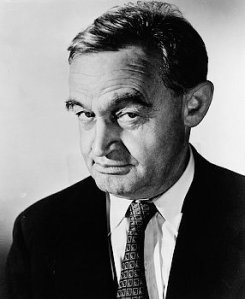
Barry Fitzgerald, Irish stage, film, and television actor, dies on January 14, 1961.

Fitzgerald is born William Joseph Shields in Walworth Road, Portobello, Dublin, Ireland, on March 10, 1888. He is the older brother of Irish actor Arthur Shields. He goes to Skerry’s College in Dublin before going on to work in the civil service while also working at the Abbey Theatre.

Unknown to many, Fitzgerald is also a patriot. In 1916 he is a member of the Irish Volunteers and is prepared to fight in the Easter Rising on Easter Sunday when the orders are countermanded. On Easter Monday the revolution is on again, and Shields goes to the Abbey Theatre and retrieves his rifle from under the stage. He goes around the corner to Liberty Hall and joins with James Connolly’s Irish Citizen Army.

He then marches to the General Post Office on Sackville Street where he fights before evacuating on Friday. He is sent to Stafford Prison in England with another famous rebel, Michael Collins, and from there they are both sent to the Frongoch internment camp in Wales. Both return to Dublin by the end of 1916, Collins to terrorise the British and Shields to return to the Abbey Theatre stage.

By 1929, he turns to acting full-time. He is briefly a roommate of famed playwright Sean O’Casey and stars in such plays as O’Casey’s Juno and the Paycock and the premiere of The Silver Tassie.

Fitzgerald goes to Hollywood to star in another O’Casey work, The Plough and the Stars (1936), directed by John Ford. He has a successful Hollywood career in such films as The Long Voyage Home (1940), How Green Was My Valley (1941), And Then There Were None (1945), The Naked City (1948), and The Quiet Man (1952). Fitzgerald achieves a feat unmatched in the history of the Academy Awards. He is nominated for both the Best Actor Oscar and the Best Supporting Actor Oscar for the same performance, as Father Fitzgibbon in Going My Way (1944). He wins the Best Supporting Actor Award. This feat will likely never be matched as the Academy Award rules have since been changed to prevent this. During World War II, Oscar statues are made of plaster rather than gold due to wartime metal shortages. Being an avid golfer, Fitzgerald later breaks the head off his Oscar statue while practicing his golf swing.

Fitzgerald has two stars on the Hollywood Walk of Fame, one for films located at 6220 Hollywood Blvd. and one for television located at 7001 Hollywood Blvd.

Fitzgerald returns to live in Dublin in 1959. He dies of heart failure on January 14, 1961, and is buried at Deansgrange Cemetery in Dublin.


Leave a comment

Birth of Thomas Patrick Ashe

thomas-patrick-ashe

Thomas Patrick Ashe, a member of the Gaelic League, the Irish Republican Brotherhood (IRB), and a founding member of the Irish Volunteers, is born in Lispole, County Kerry, on January 12, 1885. Ashe enters De La Salle Training College, Waterford, in 1905 and begins a teaching career as principal of Corduff National School, Lusk, County Dublin, in 1908.

Ashe plays a major part in the 1916 Easter Rising outside the capital city commanding the Fingal battalion of the Irish Volunteers. Ashe is commandant of the 5th battalion of the Dublin brigade, a force of 60–70 men engaging British forces around north County Dublin during the rising. They are armed only with a few rounds, about a dozen service rifles, a dozen Mausers, and a dozen Martini-Henry carbines. Some of Ashe’s men are armed only with a shotgun against the well-equipped army regulars.

Ashe’s battalion wins a major victory in Ashbourne, County Meath, where they engage a much larger force. They capture a significant quantity of arms and up to twenty Royal Irish Constabulary (RIC) vehicles. Eleven RIC members, including County Inspector Alexander Gray, and two volunteers are killed during the 5-1/2-hour battle. Twenty-four hours after the rising collapses, Ashe’s battalion surrenders on the orders of Patrick Pearse. On May 8, 1916, Ashe and Éamon de Valera are court-martialled and sentenced to death. The sentences are commuted to penal servitude for life. Ashe is imprisoned in Lewes Prison in Lewes, East Sussex, England.

De Valera, Ashe, and Thomas Hunter lead a prisoner hunger strike on May 28, 1917. With accounts of prison mistreatment appearing in the Irish press and mounting protests in Ireland, Ashe and the remaining prisoners are freed on June 18, 1917, by David Lloyd George as part of a general amnesty.

Upon his release, Ashe returns to Ireland and begins a series of speaking engagements. In August 1917, he is arrested and charged with sedition for a speech that he makes in Ballinalee, County Longford, where Michael Collins is also speaking. He is detained at the Curragh but is then transferred to Mountjoy Prison in Dublin. He is convicted and sentenced to two years hard labour. Ashe and other prisoners, including Austin Stack, demand prisoner of war status. On September 20, 1917, Ashe again goes on hunger strike. He dies at the Mater Hospital on September 25, 1917, after being force fed by prison authorities. At the inquest into his death, the jury condemns the staff at the prison for the “inhuman and dangerous operation performed on the prisoner, and other acts of unfeeling and barbaric conduct.” His body lies in state at Dublin City Hall and is buried in Glasnevin Cemetery in Dublin.

Ashe is a relative of Catherine Ashe, the paternal grandmother of American actor Gregory Peck, who emigrates to the United States in the 19th century. The Ashe Memorial Hall built in 1928, housing the Kerry County Museum, in Tralee, County Kerry, is named after him while Nelson Street, also in Tralee, is renamed Ashe Street.


Leave a comment

The Easter Rising Centennial

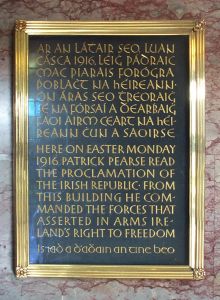
GPO_Easter_Rising_Plaque

I publish this site as we prepare to enter the year 2016, which will be an important year to Ireland and those of Irish heritage around the world. During the upcoming year, we mark the centennial of the Easter Rising of 1916 which began on Easter Monday, April 24, 1916, and lasted for six days.

Approximately 1,200 Volunteers and Citizen Army members, led by Patrick Pearse and James Connolly, took over strongpoints in Dublin with the General Post Office being their headquarters. The British army, which had vastly superior numbers and artillery, quickly suppressed the Rising. Pearse agreed to an unconditional surrender on Saturday, April 29, 1916.

Ninety people were sentenced to death in a series of courts martial, which began on May 2. Fifteen of those, including all seven signatories of the Proclamation, had their sentences confirmed by British General John Maxwell and were executed by firing squad at Kilmainham Gaol in Kilmainham, Dublin between May 3 and 12.

Although lasting but six days, the Rising succeeded in bringing physical force republicanism back to the forefront of Irish politics.

Annual commemorations, rather than taking place on April 24–29, are typically based on the date of Easter, which is a moveable feast. The official programme of centenary events in 2016 climaxes from March 26 (Good Friday) to April 3 (Easter Saturday) with other events earlier and later in the year taking place on the calendrical anniversaries.