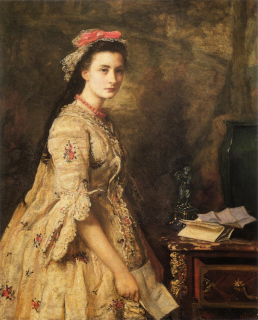
Esther Vanhomrigh, Irish woman of Dutch descent and a longtime lover and correspondent of Jonathan Swift, dies in Celbridge, County Kildare, on June 2, 1723. Swift’s letters to her are published after her death. Her fictional name “Vanessa” is created by Swift by taking Van from her surname, Vanhomrigh, and adding Esse, a pet form of her first name, Esther.
Vanhomrigh is born in Dublin on February 14, 1688, the eldest of four children of Bartholomew Van Homrigh, a merchant of Amsterdam and afterwards of Dublin, who is appointed commissary of the stores by King William III upon his expedition into Ireland. He serves as Lord Mayor of Dublin from 1697–98. Her mother, also named Esther, is the daughter of John Stone, an Irish commissioner of revenue. She grows up at Celbridge Abbey in County Kildare.
Vanhomrigh’s father dies in 1703, and his widow moves her family to London in 1707. She becomes acquainted with Swift in December of that year while the family is en route for London, at Dunstable, and it is here that their intense 17-year relationship begins. She is 22 years younger than Swift, and it is obvious from the beginning that he admires her for her rugged qualities, as he does not admire very delicate women. She is said “not to be a beauty,” although it is difficult to be sure about this since no contemporary portrait of her exists (the famous 1868 Millais portrait is a work of artistic imagination). Swift later serves as her tutor. After her mother dies in 1714, she follows Swift to Ireland, and returns to Celbridge Abbey, but she is desperately miserable there.
Their relationship is fraught. It is broken up after 17 years by Swift’s relationship with another woman, Esther Johnson, whom he calls “Stella,” in 1723. Swift has known Stella since about 1690, when she is a little girl in the household of his employer Sir William Temple; their relationship is intense and it is possible that they secretly married in 1716. Vanhomrigh is thought to have asked Swift not to see Stella again, and he apparently refuses, thus putting an end to their relationship.
Vanhomrigh never recovers from his rejection and dies on June 2, 1723, likely from tuberculosis contracted from nursing her sister Mary, who had died of the same disease in 1720, as had their mother before her. Some accuse Swift of inadvertently causing her death.
Vanhomrigh’s father had left her well provided for, but she is burdened by debts accumulated by her mother and her spendthrift brother Bartholomew. In her will, she names the barristerRobert Marshall and George Berkeley, the celebrated philosopher and future Bishop of Cloyne, executors and joint residuary legatees of her estate, although she knew neither man well. Due to the debts, a protracted lawsuit ensues and a large part of the estate is lost in legal costs. It is widely reported that she had made it a condition of the inheritance that her executors publish all her correspondence with Swift, but in fact, no such stipulation seems to have been made.
Swift, whose letters to her are published after her death, is not mentioned in her will, perhaps a final retaliation against a man whose neglect made her “live a life like a languishing death.”
Esther Johnson, an Englishwoman known as “Stella” and known to be a close friend of Jonathan Swift, dies on January 28, 1728. Whether or not she and Swift are secretly married, and if so, why the marriage is never made public, is a subject of debate.
Johnson is born in Richmond, Surrey, England, on March 13, 1681, and spends her early years at Moor Park, Farnham, home of Sir William Temple, 1st Baronet. Here, when she is about eight, she meets Swift, who is Temple’s secretary. He takes a friendly interest in her from the beginning and apparently supervises her education.
Johnson’s parentage has been the subject of much speculation. The weight of evidence is that her mother acts as companion to Temple’s widowed sister, Martha, Lady Giffard, and that Johnson, her mother and her sister Anne are regarded as part of the family. Her father is said to have been a merchant who died young. Gossip that she is Temple’s illegitimate daughter seems to rest on nothing more solid than the friendly interest he shows in her. There are similar rumours about his supposed relationship with Swift.
When Swift sees Johnson again in 1696, he considers that she has grown into the “most beautiful, graceful and agreeable young woman in London.” Temple, at his death in 1699, leaves her some property in Ireland, and it is at Swift’s suggestion that she move to Ireland in 1702 to protect her interests, but her long residence there is probably due to a desire to be close to Swift. She generally lives in Swift’s house, though always with female companions like Rebecca Dingley, a cousin of Temple whom she has known since childhood. She becomes extremely popular in Dublin and an intellectual circle grows up around her, although it was said that she finds the company of other women tedious and only enjoys the conversation of men.
In 1704, their mutual friend, the Reverend William Tisdall, tells Swift that he wishes to marry Johnson, much to Swift’s private disgust, although his letter to Tisdall, which outlines his objections to the marriage, is courteous enough, making the practical point that Tisdall is not in a position to support a wife financially. Little is known about this episode, other than Swift’s letter to Tisdall. It is unclear if Tisdall actually proposes to her. If he does, he seems to have been met with a firm rejection, and he marries Eleanor Morgan two years later. He and Swift, after a long estrangement, become friends once more after Johnson’s death.
Johnson’s friendship with Swift becomes fraught after 1707 when he meets Esther Vanhomrigh, daughter of the Dutch-born Lord Mayor of Dublin, Bartholomew Van Homrigh. Swift becomes deeply attached to her and invents for her the name “Vanessa.” She in turn becomes infatuated with him and after his return to Ireland follows him there. The uneasy relationship between the three of them continues until 1723 when Vanessa, who is by now seriously ill from tuberculosis, apparently asks Swift not to see Johnson again. This leads to a violent quarrel between them, and Vanessa, before her death in June 1723, destroys the will she had made in Swift’s favour, leaving her property to two men, George Berkeley and Robert Marshall, who though eminent in their respective callings are almost strangers to her.
Whether Swift and Johnson are married has always been a subject of intense debate. The marriage ceremony is allegedly performed in 1716 by St. George Ashe, Bishop of Clogher, with no witnesses present, and it is said that the parties agree to keep it secret and live apart. Johnson always describes herself as a “spinster” and Swift always refers to himself as unmarried. Rebecca Dingley, who lives with Johnson throughout her years in Ireland, says that Johnson and Swift were never alone together. Those who know the couple best are divided on whether a marriage ever took place. Some, like Mrs. Dingley and Swift’s housekeeper Mrs. Brent laugh at the idea as “absurd.” On the other hand, Thomas Sheridan, one of Swift’s oldest friends, believes that the story of the marriage is true. He reportedly gives Johnson herself as his source. Historians have been unable to reach a definite conclusion on the truth of the matter. Bishop Ashe dies before the story first becomes public, and there are no other witnesses to the supposed marriage.
A collection of Johnson’s witticisms is published by Swift under the titles of “Bon Mots de Stella” as an appendix to some editions of Gulliver’s Travels. A Journal to Stella, a collection of 65 letters from Swift to Johnson, is published posthumously.
In 1722, Martha, Lady Giffard, dies and leaves money to Johnson and Swift’s sister, Mrs. Fenton, who had been her companion in 1711.
Johnson’s health begins to fail in her mid-forties. In 1726, she is thought to be dying and Swift rushes back from London to be with her but finds her better. The following year it becomes clear that she is gravely ill. After sinking slowly for months, she dies on January 28, 1728, and is buried in St. Patrick’s Cathedral, Dublin. Swift is inconsolable at her death and writes The Death of Mrs. Johnson in tribute to her. When Swift dies in October 1745, he is buried beside her at his own request. A ward in St. Patrick’s University Hospital is named “Stella” in her memory.
In the 1994 film Words Upon the Window Pane, based on the play by William Butler Yeats, Johnson is played by Bríd Brennan. The plot turns on a séance in Dublin in the 1920s, where the ghosts of Swift, Johnson and Vanessa appear to resume their ancient quarrel.
Berkeley is the eldest son of William Berkeley, a cadet of the noble family of Berkeley whose ancestry can be traced back to the Anglo-Saxon period and who had served as feudal lords and landowners in Gloucester, England. Little is known of his mother. He is educated at Kilkenny College and attends Trinity College Dublin, where he is elected a Scholar in 1702, being awarded BA in 1704 and MA and a Fellowship in 1707. He remains at Trinity College after completion of his degree as a tutor and Greek lecturer.
Berkeley’s earliest publication is on mathematics, but the first that brings him notice is his An Essay Towards a New Theory of Vision, first published in 1709. In the essay, he examines visual distance, magnitude, position and problems of sight and touch. While this work raises much controversy at the time, its conclusions are now accepted as an established part of the theory of optics.
The next publication to appear is A Treatise Concerning the Principles of Human Knowledge in 1710, which has great success and gives him a lasting reputation, though few accept his theory that nothing exists outside the mind. This is followed in 1713 by Three Dialogues between Hylas and Philonous, in which he propounds his system of philosophy, the leading principle of which is that the world, as represented by our senses, depends for its existence on being perceived.
For this theory, the Principles gives the exposition and the Dialogues the defence. One of his main objectives is to combat the prevailing materialism of his time. The theory is largely received with ridicule, while even those such as Samuel Clarke and William Whiston, who do acknowledge his “extraordinary genius,” are nevertheless convinced that his first principles are false.
Shortly afterwards, Berkeley visits England and is received into the circle of Joseph Addison, Alexander Pope and Richard Steele. In the period between 1714 and 1720, he intersperses his academic endeavours with periods of extensive travel in Europe, including one of the most extensive Grand Tours of the length and breadth of Italy ever undertaken. In 1721, he takes holy orders in the Church of Ireland, earning his doctorate in divinity, and once again chooses to remain at Trinity College Dublin, lecturing this time in Divinity and in Hebrew. In 1721-22 he is made Dean of Dromore and, in 1724, Dean of Derry.
In 1723, following her violent quarrel with Jonathan Swift, who had been her intimate friend for many years, Esther Vanhomrigh names Berkeley her co-heir along with the barrister Robert Marshall. Her choice of legatees causes a good deal of surprise since she does not know either of them well, although Berkeley as a very young man had known her father. Swift says generously that he does not grudge Berkeley his inheritance, much of which vanishes in a lawsuit in any event. A story that Berkeley and Marshall disregarded a condition of the inheritance that they must publish the correspondence between Swift and Vanhomrigh is probably untrue.
In 1725, Berkeley begins the project of founding a college in Bermuda for training ministers and missionaries in the colony, in pursuit of which he gives up his deanery with its income of £1100.
In 1728, Berkeley marries Anne Forster, daughter of John Forster, Chief Justice of the Irish Common Pleas, and his first wife Rebecca Monck. He then goes to America on a salary of £100 per annum. He lands near Newport, Rhode Island, where he buys a plantation at Middletown – the famous “Whitehall.” He purchases several enslaved Africans to work on the plantation. He also brings John Smibert to New England, the Scottish artist he “discovered” in Italy, who is generally regarded as the founding father of American portrait painting. Meanwhile, he draws up plans for the ideal city he plans to build on Bermuda. He lives at the plantation while he waits for funds for his college to arrive. The funds, however, are not forthcoming and he leaves America and returns to London in 1732.
Berkeley and his wife have four children who survive infancy: Henry, George, William and Julia, and at least two other children who die in infancy. William’s death in 1751 is a great cause of grief to his father.
Berkeley is nominated to be the Bishop of Cloyne in the Church of Ireland on January 18, 1734. He is consecrated as such on May 19, 1734. He is the Bishop of Cloyne until his death on January 14, 1753, although he dies at Oxford.
While living in London’s Saville Street, Berkeley takes part in efforts to create a home for the city’s abandoned children. The Foundling Hospital is founded by royal charter in 1739, and Berkeley is listed as one of its original governors.
Berkeley’s last two publications are Siris: A Chain of Philosophical Reflexions and Inquiries Concerning the Virtues of Tarwater, And divers other Subjects connected together and arising one from another (1744) and Further Thoughts on Tar-water (1752). Pine tar is an effective antiseptic and disinfectant when applied to cuts on the skin, but he argues for the use of pine tar as a broad panacea for diseases. His 1744 work on tar-water sells more copies than any of his other books during Berkeley’s lifetime.
Berkeley remains at Cloyne until 1752, when he retires. With his wife and daughter Julia, he goes to Oxford to live with his son George and supervise his education. He dies soon afterwards and is buried in Christ Church Cathedral, Oxford. His affectionate disposition and genial manners make him much loved and held in warm regard by many of his contemporaries. Anne outlives her husband by many years, dying in 1786.
(Pictured: “Bishop George Berkeley,” oil on canvas portrait by John Smibert, c. 1727)