seamus dubhghaill

Promoting Irish Culture and History from Little Rock, Arkansas, USA


Leave a comment

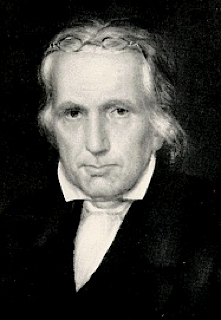
Death of Thomas Campbell, Presbyterian Minister

Thomas Campbell, a Presbyterian minister who becomes prominent during the Second Great Awakening of the United States, dies on January 4, 1854. Born in County Down, he begins a religious reform movement on the American frontier. He is joined in the work by his son, Alexander. Their movement, known as the “Disciples of Christ,” merges in 1832 with the similar movement led by Barton W. Stone to form what is now described as the American Restoration Movement (also known as the Stone-Campbell Restoration Movement).

Campbell is born on February 1, 1763, in County Down, Ireland (now Northern Ireland), and is raised as an Anglican. He is ordained a minister in the Scottish Seceder Presbyterian Church sometime after graduating from the University of Glasgow in 1786. He leaves Ireland for the United States in April 1807. This move is prompted by the advice of his physician. Once in America, disagreement arises between him and other Presbyterians over certain points related to Calvinist doctrine and the administration of the Eucharist.

The Campbell wing of the movement is launched when Campbell publishes the Declaration and Address of the Christian Association of Washington in 1809. The Presbyterian Synod had suspended his ministerial credentials. In the Declaration and Address he sets forth some of his convictions about the church of Jesus Christ, as he organises the Christian Association of Washington, in Washington County, Pennsylvania, not as a church but as an association of persons seeking to grow in faith. On May 4, 1811, the Christian Association reconstitutes itself as a congregationally governed church. With the building it constructs at Brush Run, Pennsylvania, it becomes known as Brush Run Church.

When their study of the New Testament leads the reformers to begin to practice baptism by immersion, the nearby Redstone Baptist Association invites Brush Run Church to join with them for the purpose of fellowship. The reformers agree, provided that they will be “allowed to preach and to teach whatever they learned from the Scriptures.”

Thomas and his son, Alexander, work within the Redstone Baptist Association during the period 1815 through 1824. While both the Campbells and the Baptists share practices of baptism by immersion and congregational polity, it is soon clear that the Campbells and their associates are not traditional Baptists. Within the Redstone Baptist Association, some of the Baptist leaders consider the differences intolerable when Alexander Campbell begins publishing a journal, Christian Baptist, which promotes reform. The Campbells anticipated the conflict and move their membership to a congregation of the Mahoning Baptist Association in 1824.

Campbell is a student of the Enlightenment philosopher John Locke. While he does not explicitly use the term “essentials,” in the Declaration and Address, Campbell proposes the same solution to religious division as had been advanced earlier by Herbert and Locke: “[R]educe religion to a set of essentials upon which all reasonable persons might agree.” The essentials he identifies are those practices for which the Bible provides “a ‘Thus saith the Lord,’ either in express terms or by approved precedent.” Unlike Locke, who sees the earlier efforts by Puritans as inherently divisive, he argues for “a complete restoration of apostolic Christianity.” He believes that creeds serve to divide Christians. He also believes that the Bible is clear enough that anyone can understand it and, thus, creeds are unnecessary.

Campbell combines the Enlightenment approach to unity with the Reformed and Puritan traditions of restoration. The Enlightenment affects the Campbell movement in two ways. First, it provides the idea that Christian unity can be achieved by finding a set of essentials that all reasonable people can agree on. The second is the concept of a rational faith that is formulated and defended on the basis of a set of facts derived from the Bible.

Thomas dies on January 4, 1854, in Bethany, West Virginia, and is buried next to his wife in the Campbell family cemetery.


Leave a comment

Irish National Day of Mourning

BERTIE AHERN IRISH RESPONSE TO TERRORIST ATTACK ON UNITED STATES OF AMERICA

The Irish government declares a National Day of Mourning on September 14, 2001. Schools, businesses, and shops are shut down in an unprecedented gesture of sympathy following the attack on the World Trade Center in New York City three days earlier.

Thousands of people queue for hours in front of the United States Embassy in Ballsbridge, Dublin, waiting patiently to sign one of the many books of condolences to be presented to the U.S. government in the aftermath of the attack. At John F. Kennedy’s ancestral home in Dunganstown, County Wexford, the U.S. flag flies at half-mast and the house is closed to visitors.

As it was on the day that Kennedy was assassinated, everyone remembers where they were on September 11. But on September 14 in Ireland, the churches are full and the offices, shops and pubs dark and silent as the country mourns with its American relatives, colleagues and friends.

Bouquets of flowers, teddy bears, candles and messages are left at the Embassy, as thousands stand with heads bowed. The building’s facade is turned into a shrine to those who died in New York, Washington, D.C. and Pennsylvania. There are both tears and applause when 250 firefighters from all over Ireland parade past the Embassy as a mark of respect to the hundreds of firefighters lost in New York. People weep openly as they hear of the casualties and more details emerge of that terrible morning.

The nation prays as industrial and commercial life comes to a halt and offices, government departments and all places of entertainment close for mourning. In every parish and diocese religious services are held, with the biggest, an ecumenical service in Dublin, attended by Taoiseach Bertie Ahern, President Mary McAleese and many other cabinet members. At least 2,000 people attempt to squeeze into St. Mary’s Pro-Cathedral, which holds only 1,500. Outside, a group of U.S. students break into the American national anthem and the crowd falls silent.

The bells of Christ Church Cathedral ring muffled for 90 minutes to mark the occasion, and at 11:00 AM towns and villages fall silent as the people join in a European-wide three minutes of silence. At noon, all trains stop for five minutes, and special services are held in practically every town in the country. In Bray, County Wicklow, so many people show up that the church runs out of communion. A number of people approaching the altar are given a blessing instead.

In Dublin’s universities in the months following the attacks, Irish students who were present in New York at the time are offered free counseling to help them deal with the “nightmares and flashbacks.”

A fund for the families of the victims started by Independent News and Media, which donates the money from the sales of all its newspapers on September 14, reaches more than 120,000 punts. It is given to The American Ireland Fund in the presence of U.S. Ambassador to Ireland, Richard Egan. Money is collected throughout the country for many months.

(From: “Ireland’s National Day of Mourning” by Irish America staff, http://www.irishamerica.com, December/January 2002 | Pictured: Taoisearch Bernie Ahern and Tanaiste Mary Harney with members of the Irish Cabinet sign the book of condolences in the U.S. Embassy in Dublin three days after the terrorist attacks)


7 Comments

The Last Execution in the Republic of Ireland

michael-manning

Michael Manning, Irish murderer, becomes the twenty-ninth and last person to be executed in the Republic of Ireland on April 20, 1954.

Manning, a 25-year-old carter from Johnsgate in Limerick, County Limerick, is found guilty of the rape and murder of Catherine Cooper, a 65-year-old nurse who works at Barrington’s Hospital in the city, in February 1954. Nurse Cooper’s body is discovered on November 18, 1953, in the quarry under the New Castle, Dublin Road, Castletroy. She is found to have choked on grass stuffed into her mouth to keep her from screaming during the committal of the crime.

Manning expresses remorse at the crime which he does not deny. By his own account, he is making his way home on foot after a day’s drinking in The Black Swan, Annacotty when he sees a woman he does not recognise walking alone. “I suddenly lost my head and jumped on the woman and remember no more until the lights of a car shone on me.” He flees at this point but is arrested within hours, after his distinctive hat is found at the scene of the crime.

Although Manning makes an impassioned plea for clemency in a letter to Minister for Justice Gerald Boland, his request is denied despite it also being supported by Nurse Cooper’s family. The execution by hanging is duly carried out on April 20, 1954, in Mountjoy Prison, Dublin by Albert Pierrepoint, who has traveled from Britain where he is one of three Senior Executioners.

Frank Prendergast, subsequently Teachta Dála (TD) for Limerick East who knew Manning well, recalls later, “Friends of mine who worked with me, I was serving my time at the time, went up to visit him on the Sunday before he was hanged. And they went to Mass and Holy Communion together and they played a game of handball that day. He couldn’t have been more normal.”

Manning leaves a wife who is pregnant at the time of the murder. His body is buried in an unmarked grave in a yard at Mountjoy Prison.

The death penalty is abolished in 1964 for all but the murder of gardaí, diplomats and prison officers. It is abolished by statute for these remaining offences in 1990 and is finally expunged from the Constitution of Ireland by approval by referendum of the Twenty-First Amendment on June 7, 2001.

The hanging of Michael Manning inspires a play by Ciaran Creagh. Creagh’s father, Timothy, is one of the two prison officers who stays with Michael Manning on his last night and Last Call is loosely based on what happened. It is shown in Mountjoy Prison’s theatre for three nights in June 2006.