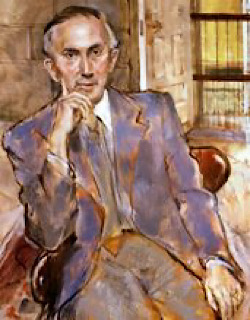
Lyons is a lecturer in history at the University of Hull and then at Trinity College Dublin. He becomes the founding Professor of Modern History at the University of Kent in 1964, serving also as Master of Eliot College from 1969 to 1972.
Lyons principal works include Ireland Since the Famine, the standard university textbook for Irish history from the mid-19th to late-20th century, which The Times calls “the definitive work of modern Irish history” and a biography of Charles Stewart Parnell.
Lyons is critical of Cecil Woodham-Smith‘s much-acclaimed history of the Great Irish Famine and has generally been considered among the “revisionist” historians who reconsiders the role of the British state in events like the Famine.
Lyons marries Jennifer Ann Stuart McAlister in 1954, and has two sons, one of whom, Nicholas, is a former Lord Mayor of London.
On September 15, 1983, Lyons is nominated, unopposed, as chancellor of Queen’s University Belfast (QUB). But less than a week later he is dead, succumbing in Dublin on September 21 to acute pancreatitis, which had struck him in mid-August. He had begun to write the first draft of his W. B. Yeats biography (having accumulated a great archive of material) only a few weeks before. His ashes are buried beside Trinity College chapel.
Harrison goes to Westminster School and then to Balliol College, Oxford. While there he develops an admiration for Charles Stewart Parnell and becomes secretary of the Oxford University Home Rule League. At this time, the Land War is in progress and in 1889 he goes to Ireland to visit the scene of the evictions in Gweedore, County Donegal. He becomes involved in physical confrontations with the Royal Irish Constabulary and as a result becomes a Nationalist celebrity overnight. The following May, Parnell offers the vacant parliamentary seat of Mid Tipperary to Harrison, who leaves Oxford at age 22, to take it up, unopposed.
Only six months later, following the divorce case involving Katharine O’Shea, the Irish Parliamentary Party splits over Parnell’s leadership. Harrison strongly supports Parnell, acts as his bodyguard and aide-de-camp, and after Parnell’s death devotes himself to the service of his widow Katharine. From her he hears a completely different version of the events surrounding the divorce case from that which had appeared in the press, and this is to form the seed of his later books.
Harrison then makes a return to Irish politics, working with Sir Horace Plunkett as Secretary of the Irish Dominion League, an organisation campaigning for dominion status for Ireland within the British Empire. He is a lifelong opponent of Irish partition. He is Irish correspondent of The Economist from 1922 to 1927 and owner-editor of Irish Truth from 1924 to 1927.
Harrison’s two books defending Parnell are published in 1931 and 1938. They have had a major impact on Irish historiography, leading to a more favourable view of Parnell’s role in the O’Shea affair. F. S. L. Lyons comments that he “did more than anyone else to uncover what seems to have been the true facts” about the Parnell-O’Shea liaison. The second book, Parnell, Joseph Chamberlain and Mr Garvin, is written in response to J. L. Garvin‘s biography of Joseph Chamberlain, which had ignored his first book, Parnell Vindicated: The Lifting of the Veil. Later, he successfully repulses an attempt in the official history of The Times to rehabilitate that newspaper’s role in using forged letters to attack Parnell in the late 1880s. In 1952 he forces The Times to publish a four-page correction written by him as an appendix to the fourth volume of the history.
During the difficult years of the Anglo-Irish Trade War over the land purchase annuities, declaration of the Republic, Irish neutrality during World War II, and departure from the Commonwealth, Harrison works to promote good relations between Britain and Ireland. He publishes various books and pamphlets on the issues in dispute and writes numerous letters to The Times. He also founds, with General Sir Hubert Gough, the Commonwealth Irish Association in 1942.
At the time of his death on February 20, 1954, Harrison is the last survivor of the Irish Parliamentary Party led by Parnell, and as a member of the pre-1918 Irish Parliamentary Party, he seems to have been outlived only by John Patrick Hayden, who dies a few months after him in 1954 and by Patrick Whitty and John Lymbrick Esmonde who are only MPs for a very short time during World War I. He is buried in Holywood, County Down.


 seamus dubhghaill