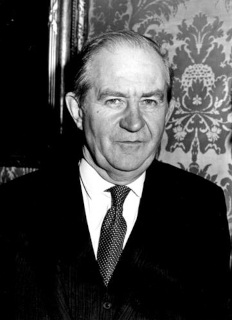
Patrick James Connolly, Irish barrister who serves as Attorney General of Ireland from March 1982 to August 1982, resigns on August 17, 1982, after Malcolm McArthur, wanted for, and later convicted of murder is found to be his house guest. The fallout from the incident leads to one of the most famous acronyms in Irish politics.
Connolly resigns on August 17, 1982 after Malcolm MacArthur, who had been a house-guest of Connolly’s, is arrested for murder. MacArthur, the domestic partner of Connolly’s friend Brenda Little, had committed a horrific double murder in the midst of a botched carjacking and robbery in 1982. Though Connolly is not implicated in the murder and is completely unaware of McArthur’s activities, he is forced to resign at midnight the night of MacArthur’s arrest and never again serves in government.
The much reviled, and correspondingly much loved Taoiseach, Charles Haughey, describes the incident as “a bizarre happening, an unprecedented situation, a grotesque situation, an almost unbelievable mischance.” Conor Cruise O’Brien, one of Haughey’s political opponents who despises the most corrupt Taoiseach in Irish history coins the phrase GUBU – Grotesque, Unprecedented, Bizarre, Unbelievable – to describe not just what happened but Haughey’s overall response.
Connolly returns to practice at the Irish bar and to work as a senior counsel in Dublin. A life-long bachelor, he dies at the age of 88 on January 7, 2016. Though he never marries, he has a very close relationship with his extended family, including his nephew and two nieces who speak at his funeral Mass. He is buried in Deans Grange Cemetery.
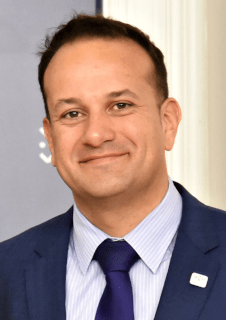
In May 2017, Kenny announces that he is planning to resign as Taoiseach and Fine Gael leader. Varadkar stands in the leadership election to replace him. Although more party members vote for his opponent, Simon Coveney, he wins by a significant margin among Fine Gael members of the Oireachtas and is elected leader on June 2. Twelve days later, he is appointed Taoiseach, and at 38 years of age becomes the youngest person to hold the office. He is Ireland’s first, and the world’s fourth, openly gay head of government and the first Taoiseach of Indian heritage.
In 2020, Varadkar calls a general election to be held in February. While polls in 2019 have suggested a favourable result for Fine Gael, they ultimately come in third in terms of seats and votes, behind Fianna Fáil and Sinn Féin, with 35 seats, a loss of 15 seats for the party from the previous general election, when it had finished in first position. He resigns and is succeeded by Micheál Martin as Taoiseach. He is subsequently appointed Tánaiste and Minister for Enterprise, Trade and Employment as part of a three-party coalition composed of Fianna Fáil, Fine Gael and the Green Party.
Patrick Joseph McCall, Irish songwriter and poet known mostly as the author of lyrics for popular ballads, is born at 25 Patrick Street in Dublin on March 6, 1861. He is assisted in putting the Wexford ballads, dealing with the Irish Rebellion of 1798, to music by Arthur Warren Darley using traditional Irish airs. His surname is one of the many anglicizations of the Irish surname Mac Cathmhaoil, a family that were chieftains of Kinel Farry (Clogher area) in County Tyrone.
He spends his summer holidays in Rathangan, County Wexford, where he spends time with local musicians and ballad singers. His mother came from Rathangan near Duncormick on the south coast of County Wexford. His aunt Ellen Newport provides much of the raw material for the songs and tunes meticulously recorded by her nephew. He also collects many old Irish airs but is probably best remembered for his patriotic ballads. Airs gathered at rural céilí and singsongs are delivered back to the Royal Irish Academy in Dublin.
He marries Margaret Furlong, a sister of the poet Alice Furlong, in 1901. They live in the suburb of Sutton, near Howth.
In 1902 he is elected as a Dublin City councillor, defeating James Connolly, and serves three terms. As a councillor he concerns himself with local affairs, particularly projects to alleviate poverty.
Patrick Joseph McCall dies on March 5, 1919, one day before his 58th birthday, in Sutton, Fingal, Dublin.


 seamus dubhghaill