seamus dubhghaill

Promoting Irish Culture and History from Little Rock, Arkansas, USA


Leave a comment

The Carnew Executions

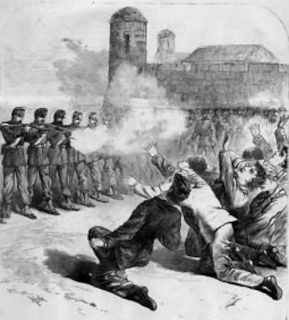
The Carnew executions, the summary execution of 28 prisoners being held as suspected United Irishmen by the local garrison in the British army barracks base of Carnew Castle, Carnew, County Wicklow, takes place on May 25, 1798.

The Society of United Irishmen having failed to advance its aims of Catholic emancipation and parliamentary reform by political means, instigate a rebellion against British rule. The rebellion begins on the morning of May 24, 1798, but the only significant uprisings outside of the province of Ulster occur in counties Wicklow and Wexford, both south of County Dublin. The rebels are met with a swift response from British forces and the bulk of the rebellion is suppressed within a year.

By the morning of the May 25, news of the long-expected outbreak of the 1798 rebellion in neighbouring County Kildare and of military losses in the battles of Ballymore-Eustace, Naas, and Prosperous have reached the garrison in Carnew, who decide to take preventative measures by assembling the rebel suspects in detention. The suspects are marched from Carnew Castle to the local Gaelic handball alley and executed by firing squad as a warning to the local populace.

A similar mass execution of 36 nationalist prisoners occurs on the following day at Dunlavin Green.

News of the summary executions, together with news of the similar massacre at Dunlavin, spread throughout County Wicklow and across the border into County Wexford, giving substance to the rumours of widespread killing already prevalent. On June 7, the town is burned and sacked in a revenge raid by Wexford rebels, led by Anthony Perry.


Leave a comment

Founding of the Gaelic Athletic Association

gaelic-athletic-associationThe Gaelic Athletic Association (GAA) is founded on November 1, 1884, by a group of Irishmen gathered in the billiard room of the Hayes’ Hotel in Thurles, County Tipperary. The architects and founding members are Michael Cusack of County Clare, Maurice Davin, Joseph K. Bracken, Thomas St. George McCarthy, P.J. Ryan of Tipperary, John Wyse Power, and John McKay. Their goal is to to formulate a plan and establish an organisation to foster and preserve Ireland’s unique games and athletic pastimes.

The GAA focuses primarily on promoting Gaelic games, which include the traditional Irish sports of hurling, camogie, Gaelic football, handball, and rounders. The Association also promotes Irish music and dance, as well as the Irish language.

It has more than 500,000 members worldwide, assets in excess of €2.6 billion, and declares total revenues of €94.8 million in 2010, with a total gross profit of €78.5 million.

Gaelic football and hurling are the most popular activities promoted by the organisation, and the most popular sports in the Republic of Ireland in terms of attendances. Gaelic football is also the largest participation sport in Northern Ireland. GAA competitions, activities, and structures are organised on an all-Ireland basis, without reference to the border drawn in 1921. The women’s version of these games, ladies’ Gaelic football and camogie, are organised by the independent but closely linked Ladies’ Gaelic Football Association and the Camogie Association respectively. GAA Handball is the Irish governing body for the sport of handball, while the other Gaelic sport, rounders, is managed by the GAA Rounders National Council.

Since its foundation in the late 19th century, the Association has grown to become a major influence in Irish sporting and cultural life with considerable reach into communities throughout Ireland and among the Irish diaspora.