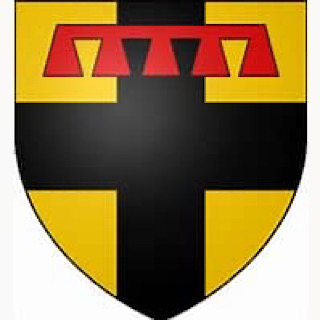
The conflict arises from a series of accusations FitzThomas makes in England. He claims that de Vescy has called Edward I “the most perverse knight of the kingdom” and has accused the king of cowardice during the siege of Kenilworth Castle in 1266. He also alleges that de Vescy is organizing an uprising against the king.
These allegations are part of a broader rivalry between the two nobles over claims to the Crown of Connaught and competing political influence in Ireland.
FitzThomas has previously brought the matter to the attention of the Irish commission of inquiry, but de Vescy sought redress before the Dublin council. The dispute escalates to the English court, where both men are summoned to Westminster for a formal hearing.
On the appointed date, July 24, 1294, de Vescy appears in full armor, but FitzThomas does not attend. De Vescy requests a judgment by default in his favor, but the court does not grant it. The matter is not resolved immediately but is later addressed during the Parliament of August 1295.
Although de Vescy technically loses the default judgment, the absence of FitzThomas and the political context likely weakens the case. De Vescy has already been removed from the Lord Justiciarship in October 1294 following a commission of inquiry into his governance in Ireland. He continues to serve the king in other capacities, including in Wales and Gascony, and is summoned to Parliament in 1295.
In summary, the July 24, 1294, event marks the formal accusation of defamation in Dublin, a legal and political clash between two powerful Irish barons, with the case ultimately decided in England’s court at Westminster, where FitzThomas’s non-appearance becomes a key factor in the proceedings.
FitzGerald is born in Ireland in 1194, the son of Gerald FitzMaurice, 1st Lord of Offaly, and Eve de Bermingham. He succeeds to the title of Lord of Offaly on January 15, 1204, and is invested as a knight in July 1217, at the age of 33. In 1224, he founds South Abbey, Youghal, the proto-friary of the Irish Province of the Observant Franciscans, dedicated to Saint Nicholas. He is summoned to London to accompany King Henry III of England to Poitou and Gascony in October 1229. He is appointed Justiciar of Ireland in September 1232 and holds the post until 1245. His reputation is marred by rumours that he had contrived the death of Richard Marshal, 3rd Earl of Pembroke in 1234. He meets Marshal at the Battle of the Curragh on April 1, where Marshal is wounded and dies shortly after. It is rumoured that Marshal had been betrayed. FitzGerald then proceeds to London, where he takes an oath before Henry III, that he is innocent of any participation in Marshal’s death. In 1253, he founds Sligo Abbey, a Dominican convent in Sligo, to house a community of monks to say prayers for Earl Marshal’s soul.
In February 1235, the King criticises FitzGerald for his proceedings in office and describes him as “little pleasant, nay, beyond measure harsh in executing the King’s mandates.” The same year, he takes part in the subjugation of Connacht. In the years 1241 and 1242, and later in 1246, 1247, and 1248 he musters armies against the Irish. In 1247, he invades Tír Chonaill and fights the combined forces of Cenél Conaill and Cenél nEógain at the Battle of Ballyshannon. According to various Irish annals, three eminent lords fall in battle against him: Maol Seachlainn Ó Domhnaill, King of Tír Chonaill, An Giolla Muinealach Ó Baoighill, and Mac Somhairle, King of Argyll (a man seemingly identical to Ruaidhrí mac Raghnaill).
In 1245, FitzGerald is dismissed from his post as Justiciar as a result of tardiness in sending the King assistance in the latter’s military campaigns in Wales. His successor is John FitzGeoffrey. That same year he lays the foundations for Sligo Castle. In 1250, he holds both the office of Member of the Council of Ireland and Commissioner of the Treasury. He also founds the Franciscan Friary at Youghal; hence his nickname of an Brathair, which is Irish for The Friar. He is at the English royal court in January 1252, and receives an urgent summons from King Henry in January 1254.
He married Juliana de Grenville and by her, they have four sons:
In 1257, FitzGerald and his Norman army engage the forces led by Gofraidh Ó Domhnaill, King of Tír Chonaill, at the Battle of Creadran Cille, in Cairbre Drom Cliabh, now the northern part of County Sligo. The two men fight each other in single combat and both are gravely wounded. FitzGerald dies of his injuries at South Abbey, wearing the habit of the Franciscans, on May 20, 1257, aged 63 years. In the Annals of the Four Masters, 1257, his death is described thus: “Maurice FitzGerald for some time Lord Justice of Ireland and the destroyer of the Irish, died.” (In Irish this reads as: “Muiris macGerailt lustis Ereann re h-edh diosccaoilteach Gaoidheal d’écc”.)
Upon FitzGerald’s death, the properties of Lea, Rathangan, and Geashill pass to his grandson Maurice, son of Gerald FitzMaurice, who dies in 1243.
FitzGerald is succeeded as Lord of Offaly by his son, Maurice FitzGerald, 3rd Lord of Offaly, rather than the rightful successor, his grandson, Maurice, son of his eldest son, Gerald.
In the final years of his reign, Henry is increasingly infirm and focused on securing peace within the kingdom and his own religious devotions. Edward becomes the Steward of England and begins to play a more prominent role in government. Henry’s finances are in a precarious state as a result of the war, and when Edward decides to join the crusades in 1268 it becomes clear that fresh taxes are necessary.
Henry is concerned that Edward’s absence might encourage further revolts, but is swayed by his son to negotiate with multiple parliaments over the next two years to raise the money. Although Henry had initially reversed Simon de Montfort‘s anti-Jewish policies, including attempting to restore the debts owed to Jews where these could be proven, he faces pressure from parliament to introduce restrictions on Jewish bonds, particularly their sale to Christians, in the final years of his reign in return for financing. Henry continues to invest in Westminster Abbey, which becomes a replacement for the Angevin mausoleum at Fontevraud Abbey, and in 1269 he oversees a grand ceremony to rebury Edward the Confessor in a lavish new shrine, personally helping to carry the body to its new resting place.
Edward leaves for the Eighth Crusade, led by Louis IX of France, in 1270, but Henry becomes increasingly ill. Concerns about a fresh rebellion grow and the following year the King writes to his son asking him to return to England, but Edward does not turn back. Henry recovers slightly and announces his renewed intention to join the crusades himself, but he never regains his full health. On the evening of November 16, 1272, Henry dies in Westminster, probably with his wife, Eleanor of Provence, in attendance. He is succeeded by Edward, who slowly makes his way back to England via Gascony, finally arriving in August 1274.
At his request, Henry is buried in Westminster Abbey in front of the church’s high altar, in the former resting place of Edward the Confessor. A few years later, work begins on a grander tomb for the King and in 1290 Edward moves his father’s body to its current location in Westminster Abbey. His gilt-brass funeral effigy is designed and forged within the abbey grounds by William Torell. Unlike other effigies of the period, it is particularly naturalistic in style, but it is probably not a close likeness of Henry himself.
Eleanor likely hopes that Henry will be recognised as a saint, as his contemporary Louis IX of France had been. Indeed, Henry’s final tomb resembles the shrine of a saint, complete with niches possibly intended to hold relics. When the King’s body is exhumed in 1290, contemporaries note that the body is in perfect condition and that Henry’s long beard remains well preserved, which at the time is considered to be an indication of saintly purity. Miracles begin to be reported at the tomb, but Edward is sceptical about these stories. The reports cease, and Henry is never canonised. In 1292, Henry’s heart is removed from his tomb and reburied at Fontevraud Abbey with the bodies of his Angevin family.
(Pictured: Effigy of Henry in Westminster Abbey, c. 1272)