seamus dubhghaill

Promoting Irish Culture and History from Little Rock, Arkansas, USA


Leave a comment

Birth of William Thompson, Naturalist

William Thompson, Irish naturalist celebrated for his founding studies of the natural history of Ireland, especially in ornithology and marine biology, is born on December 2, 1805, in the booming maritime city of Belfast.

Thompson is the eldest son of William Thompson, a prosperous linen merchant, and Elizabeth Thompson (née Callwell). He has at least two older sisters and several younger brothers. His mother’s father is Robert Callwell, a printer, book-collector, partner in the Commercial Bank, Belfast, and one of the owners of the Northern Star newspaper.

After attending the Royal Belfast Academical Institution (RBAI) from 1818, Thompson is apprenticed in the linen business of William Sinclair in 1821. When his apprenticeship ends, he goes with his cousin George Langtry, later a wealthy shipowner, on a four-month tour (May–September 1826) of the Low Countries, the Rhine, Switzerland, and Italy. On his return to Belfast, he sets up his own business in linen bleaching. Despite early success, losses are incurred. As family and economic circumstances change, he increasingly concentrates on his natural history studies. By 1831 he has given up business. A self-taught naturalist, related by ties of kinship or friendship to most of the liberal and cultivated families of the “northern Athens,” he is shy and fastidious, but is persuaded in 1826 to join the Belfast Natural History Society by its founder, his friend James Lawson Drummond. He reads his first scientific paper, The Birds of the Copeland Islands, to the society on August 13, 1827. In that year he becomes a member of the Belfast Natural History Society’s council, and in 1833 he is chosen as one of the society’s vice-presidents. He is president from 1843 until his death.

Thompson becomes the most important naturalist in mid nineteenth-century Ireland. From 1827 to 1852 he contributes almost eighty papers on Irish natural history to the Magazine of Zoology and Botany and the Proceedings of the Zoological Society of London. From 1836 to 1851 he contributes to The Magazine of Natural History. Invited to travel to the Levant and the Aegean Sea in April–July 1841 with Edward Forbes, professor of natural history at the University of Edinburgh, on HMS Beacon, he observes twenty-three species of birds on migratory flights and publishes “Notice of migratory birds” in The Annals of Natural History. His authoritative observations add considerably to knowledge of the still-to-be-ascertained details of migratory patterns. Indeed, some people refuse to believe, even at that date, that birds do migrate. He publishes other papers in the same journal during 1841–43. At a meeting of the British Association for the Advancement of Science in Glasgow in 1840 his Report on the fauna of Ireland (Vertebrata) attracts favourable notice. He presents and publishes a second and final part enumerating the invertebrates at the Cork meeting of the British Association in August 1843. The two reports form the most complete catalogue of Irish fauna yet published. Thanks to an assiduous correspondence with a network of informants, as well as his own extensive observations, he adds perhaps more than 800 species to Irish fauna lists.

Thompson’s chief work, The Natural History of Ireland, becomes the standard text in Irish zoology in the nineteenth century. The first three volumes, published between 1849 and 1851, deal with birds, particularly their habits and habitats rather than physical descriptions. He is one of the first naturalists to note the effects of industrialisation and other human activities on birdlife. He leaves instructions for his manuscripts on the remaining vertebrates and all the invertebrates to be prepared for publication by Robert Patterson and James Ramsey Garrett. Robert Ball and George Dickie also assist. His notes, though detailed and comprehensive, all require checking, and are found on tiny scraps of paper, even scribbled on the flaps of old envelopes. James Thompson of Macedon, Belfast, painstakingly gums them all into blank notebooks to facilitate the work of his brother’s literary executors, who preface the posthumous publication in 1856 with a lengthy memoir of their friend.

From about 1820 to 1852 Thompson lives with his mother at 1 Donegall Square West, Belfast, commuting from Holywood House, Holywood, County Down, during the summer. His daily routine begins with research, correspondence, or writing for publications for four hours after breakfast. After a two- or three-hour exercise period and dinner, he returns to work for a further two to three hours. He is president of the Belfast Literary Society (1837–39) and also an enthusiastic patron of the visual arts in the city. He enjoys hunting, wildfowling, shooting in Scotland, and gardening, though his health deteriorates from the 1840s.

Early in 1852 Thompson travels to London to make arrangements for that year’s Belfast meeting of the British Association. On February 15 he becomes ill, having suffered a minor stroke. He dies, unmarried, at his Jermyn Street lodgings on the day he is due to return home, February 17, 1852. He is buried in Clifton Street Cemetery, Belfast. He bequeaths his collection to the Belfast Natural History Society, and in March 1852 the Society adds a memorial Thompson Room to its museum, paid for by subscription.

Thompson is a corresponding member of natural history societies in Boston and Philadelphia and has many friends. He is known to assist many other researchers in Ireland, Britain, and the Continent. One of those who thinks highly of his work is Charles Darwin, with whom he corresponds. He also helps many local people, including the poet Francis Davis, with money and practical assistance. He is much loved, and his friends are deeply saddened by his death. His niece, Sydney Mary Thompson, later known by her married surname, Christen, who is born in Belfast, is an amateur naturalist, geologist, and artist, one of the first women to achieve distinction in geology.

(From: “Thompson, William” by Andrew O’Brien and Linde Lunney, Dictionary of Irish Biography, http://www.dib.ie, October 2009)

Leave a comment

The Allihies Copper Mine Museum

engine-house-allihies

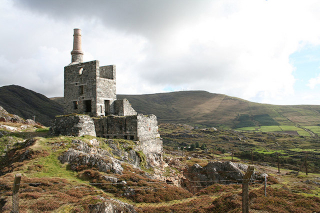
On January 7, 2000, experts underline the important heritage value of a 19th Century relic that stands on the site of a disused copper mine. A conservation appeal is launched to safeguard a unique engine house at a mountain mine in the Beara peninsula. A rare surviving symbol of Cornish type mining technology, the structure is the primary surviving embodiment of a once thriving copper mining industry in Allihies, County Cork.

The industrial mines in Allihies date back to 1812, when they are first opened by John Puxley. Mining activity reaches its peak there in 1845, when the mines employ around 1,600 people, after which the mines suffer with the local area during the Great Famine. The mines are operational until 1962, when they are finally closed. Large Cornish engine houses are constructed around the mining site, ruins of which survive today. These are used to pump out water to allow for deeper mining, and to transport miners and equipment down shafts that go below sea level. The site still contains a number of engine houses, mining shafts and a church. These are constructed by and for the Cornish miners who are brought to the area in the 1800s to mine copper ore. Once the mine becomes unprofitable, many of the miners emigrate to Butte, Montana.

The Allihies Copper Mine Museum (ACMM) is housed in a renovated Methodist church dating from 1845. It is officially opened by President Mary McAleese on September 13, 2007, after ten years of work by the Allihies Mines Co-op, a group that is formed to preserve the history of the area and mining heritage in the Allihies area, supported by the Mining Heritage Trust of Ireland.

The exhibitions cover all aspects of the history of copper mining in the area, from prehistoric times all the way up to the nineteenth century and the Industrial Revolution. The displays also cover the local geology and the social history of the mining heritage. The collections contain examples of mining equipment and tools from the various eras of activity. The exhibition space is also used to display artworks, with local artists such as Charles Tyrrell, Cormac Boydell, Rachel Parry and Tim Goulding exhibiting there.

(Pictured: Engine House, Allihies by John Gibson, view of the 1862 house for the 36″-cylinder beam engine that powered the man-engine and winder on Mountain Mine)


Leave a comment

Death of Nellie Cashman, Philanthropist & Gold Prospector

nellie-cashman

Nellie Cashman, nurse, restaurateur, businesswoman, Roman Catholic philanthropist in Arizona, and gold prospector in Alaska, dies on January 4, 1925, in Sisters of St. Anne hospital, Victoria, British Columbia, Canada.

Cashman is born in Midleton, County Cork, one of two daughters of Patrick and Frances “Fanny” (Cronin) Cashman. Along with her sister, she is brought to the United States around 1850 by her mother, first settling in Boston. As an adolescent, she works as a bellhop in a Boston hotel. In 1865 she and her family migrate to San Francisco, California.

Of the thousands lured by the gold rush fever of the 19th century, few had the staying power or generous spirit of Cashman. She follows gold miners into British Columbia, where, during the early 1870s, she operates a boarding house while learning elementary mining techniques and geology. For the next 50 years, the precious metal leads her to Arizona, Nevada, Mexico, the Canadian Yukon, and north of the Arctic Circle in Alaska. In addition to successfully prospecting and running mines, one time owning 11 mines in the Koyukuk District of Alaska, she operates boarding houses, restaurants, and supply depots.

The quality that truly establishes Cashman’s place in mining lore is her charity, which earns her the titles “Angel of Tombstone” and “Saint of the Sourdoughs” while sometimes obscuring her career as a successful miner. As early as 1874, while visiting Victoria, she leads a dangerous rescue effort to free a group of miners trapped by a severe winter storm. Later, during the glory days of Tombstone, Arizona, she helps establish the town’s first hospital and Sacred Heart Church, its first Roman Catholic church. Although she is known to be tough and aggressive in defending her claims, she is also big-hearted. Upon the deaths of her sister and brother-in-law, she takes in her nieces and nephews and raises them as her own.

Around 1889, Cashman is active in the gold camp at Harqua Hala, Arizona, and comes close to marrying Mike Sullivan, one of the original discoverers of gold in that area. Along with mining, she contributes a number of excellent articles to Tucson‘s Arizona Daily Star, in which she discusses history, techniques, types of claims, and personalities in the field.

Cashman spends the last 20 years of her life on Nolan Creek, in the Koyukuk River Basin of Alaska, then the farthest north of any mining camp in the world. She is among about eight women who join a group of approximately 200 miners to brave the harsh environment and isolation in hopes of striking the “big bonanza.” Once a year, she leaves for supplies and equipment, traveling hundreds of miles to Fairbanks, by sled, boat, or wagon. Her spirit of adventure apparently never dies. In 1921, during one of her trips to the outside, she is interviewed for Sunset, a California publication. Then 76, Cashman tells the writer that, although she loves Alaska, she is not so tied to it that she would not pull up stakes if something turned up elsewhere.

Nellie Cashman dies on January 4, 1925, in Sisters of St. Anne hospital in Victoria, one of the hospitals she had helped fund some 40 years earlier. The United States Postal Service honors her with a stamp on October 18, 1994, as part of its “Legends of the West” series.


Leave a comment

Opening of The Museum of Science and Art, Dublin

national-museum-of-ireland

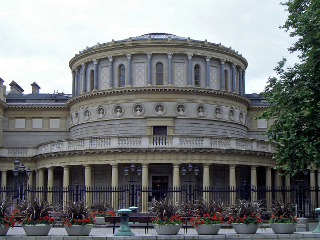
The Museum of Science and Art, Dublin on Kildare Street opens on August 29, 1890. The museum is founded on August 14, 1877, by act of Parliament. The decision to establish a state-run museum arises from requests by the Royal Dublin Society for continued government funding for its expanding museum activities.

A number of developments lead to the Science and Art Museums Act of 1877, which has the effect of transferring the buildings and collections of the Royal Dublin Society to state ownership. The collections are further enhanced by the transfer of other notable collections from institutions such as the Royal Irish Academy and Trinity College Dublin.

The Museum is the responsibility of the Department of Science and Art, which is also responsible for the South Kensington museums in London. State support for the institution is manifested in the construction of the new building on Kildare Street. It is built in the Victorian Palladian style and has been compared with the Altes Museum in Berlin, designed by Karl Friedrich Schinkel in the 1820s. Neoclassical influences can be seen in the colonnaded entrance and the domed rotunda, which rises to a height of 20 metres, and is modeled on the Pantheon in Rome.

The new museum houses coins, medals and significant Irish antiquities from the Royal Irish Academy including the Tara Brooch and Ardagh Chalice, ethnographical collections with material from Captain James Cooke‘s voyages from Trinity College Dublin, and the collections of the Geological Survey of Ireland.

These are joined by material from the decorative arts and ethnographical collections of the Royal Dublin Society along with their Irish collections of antiquities, minerals and plants. The old Royal Dublin Society museum on the Merrion Street side of Leinster House, erected with government assistance and opened in 1856, is devoted to natural history. It is dominated by zoology throughout much of its subsequent history and has an annex devoted to geology.

The building on Kildare Street is designed by Thomas Newenham Deane and is used to show contemporary Irish, British and Continental craftsmanship in its construction. State involvement in the running of the Museum allows for steady funding and a connection with other state museums in London and Edinburgh which is of considerable benefit. The collections grow with material acquired through purchase, public donation and shares of significant collections acquired by the state and dispersed by the London museums.

Catalogues are prepared by leading experts in various disciplines and printed in the Museum’s own press. In 1900 control passes to the Department of Agriculture and Technical Instruction and in 1908 its name is changed from “The Dublin Museum of Science and Art” to the “National Museum of Science and Art.” The name of the institution is changed again in 1921 to the “National Museum of Ireland.”