seamus dubhghaill

Promoting Irish Culture and History from Little Rock, Arkansas, USA


Leave a comment

Birth of Beatrice Moss Elvery Campbell, Painter, Stained Glass Artist & Sculptor

Beatrice Moss Elvery Campbell, Lady Glenavy, painter, stained glass artist and sculptor, is born in Dublin on April 30, 1883.

Elvery is the second among seven children of William Elvery , merchant, and Theresa Elvery (née Moss), singer and music teacher, whose parents are English Quakers. Her father’s ancestors were silk merchants from Spain, called Alvarez. Her early childhood is spent in Carrickmines, County Dublin. In 1896 the family moves to Foxrock and she attends the Dublin Metropolitan School of Art. Her mother’s family is artistic – one aunt is the artist Phoebe Anna Traquair – and she and her sisters are talented artists and singers. Her younger sister, Dorothy Kay, becomes a noted portrait painter in South Africa. At the age of sixteen, she wins a three-week scholarship to study at the Royal College of Art in South Kensington, London. Back in Dublin, she models for William Orpen, then teaching in the school. They become friends, and she regrets never studying painting under him. She concentrates on sculpture under John Hughes and has great success, winning the Taylor scholarship three years in a row (1901–03). The first year she wins, the judges, seeking evidence that she had worked unaided, asks her to model a head from life in their presence.

Elvery’s first exhibit in the Royal Hibernian Academy (RHA) is a bronze statuette of a boy in 1902. Thereafter she is a lifelong exhibitor with the RHA, showing almost annually until her death. Friendship with the older Sarah Purser introduces her to Dublin’s artistic milieu and to the arts and crafts movement. In the movement’s 1904 exhibition she shows ten items, including terracotta statuettes, a holy water stoup, and a plaster cast of a lectern, which is cast in bronze in Paris that year and placed in her former parish church in Carrickmines. The movement’s historian, Paul Larmour, calls this lectern “a remarkable piece of organic Art Nouveau . . . There is nothing else like it in Ireland.”

In 1904, after a brief period studying in Paris with her sister and fellow students Estella Solomons and Frances “Cissie” Beckett, Elvery takes lessons in stained glass from Alfred E. Child, and is then persuaded by Purser to join her Tower of Glass (An Túr Gloine) studio. She remains six years, executing windows for St. Stephen’s Church, Mount Street, Dublin; St. Nicholas Church, Carrickfergus; and a war memorial at the Church of Ireland church, Carrickmines. Although her work is generally well received, she does not rate her skill in the medium highly – “I never got the right feeling for glass or the detached, austere quality necessary for ecclesiastical art” – and her window for a Gort convent leads to a critical review of Purser’s studio by W. B. Yeats. She does not, however, confine herself to glass but also designs for silversmiths and illustrated books for children. For Iosagán agus Sgealta Eile (1907), by Patrick Pearse, she provides a black-and-white frontispiece and four colour illustrations. For the Cuala Press, run by Lily and Elizabeth Yeats, she designs calendars, Christmas cards, and fifteen hand-coloured prints, which continue to be issued until after World War II.

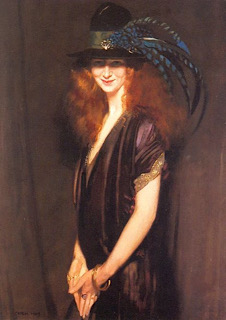
Elvery’s social life in Dublin is busy. An active member of the United Arts Club, she is called by Lady Gregory “the beautiful Miss Elvery,” and Orpen’s portrait, showing her long-necked, graceful, and vivacious, bears out this description. Tiring of glass, and wishing to become a painter, she leaves in 1910 for the Slade School of Fine Art in London. There Henry Tonks is less complimentary than her Dublin teachers. He finds her work facile: “The speed, the slickness, the skill. It is horrible!” Orpen also comes to this view: “her only fault was that the transmission of her thoughts from her brain to paper or canvas, clay or stained glass, became so easy to her that all was said in a few hours. Nothing on earth could make her go on and try to improve on her first translation of her thought.”

Back in Dublin, Elvery takes a studio in Kildare Street and teaches for a time in the Metropolitan School of Art, before her parents arrange a marriage with Charles Henry Gordon Campbell, eldest son of the future Lord Chancellor of IrelandJames Campbell. They marry on August 1, 1912, and move to London where he is called to the English bar. It is not initially a love match but they are well-suited – he likes artistic, Bohemian circles and they become friends with D. H. and Frieda Lawrence, the painter Mark Gertler, the publisher John Middleton Murry, and his wife, the writer Katherine Mansfield, who describes Campbell as “a queer mixture for she is loving and affectionate, and yet she is malicious.”

Campbell’s husband becomes secretary of the Department of Industry and Commerce in the Irish Free State and in 1922 the family moves to Clonard, Terenure, Dublin. His government position means that within six months the house is burned down by anti-Treatyites, who are, however, almost comically accommodating – local men, they express distress at the job and allow her to save the children’s Christmas presents. In 1931 she becomes Lady Glenavy after her husband succeeds to his father’s title, an important member of Dublin’s social and artistic scene. She helps establish the Dublin Drama League and assists Shelah Richards in the production of two plays in 1936. Her friendships are wide and varied and her conversation imaginative and engaged. Dressed in beige – what her son calls “variations on a theme of porridge” – she entertains constantly. Her house has what she terms a “caravanserai” character and is constantly full of people.

Appointed an associate of the RHA in 1932, Campbell becomes a full member in 1934 and takes her turn at teaching. She also joins the more radical Society of Dublin Painters and holds in February 1935 a one-person show at their premises, 7 Stephen’s Green, but she never shows with the Irish Exhibition of Living Art, though her work is more avant-garde than that of most academicians. At its best in still lifes and figure compositions, her work has “a sense of drama and an enigmatic or near-surrealist appearance.” Brian Kennedy notes that she is the first Irish painter to go surrealist (though she never thinks of herself in this way) and although she is serious about her work – taking lessons at an advanced age from Patrick Hennessy  – she is also diffident. Her memoir does not trace her development as an artist and mentions only one work with approbation – The Intruder (exhibited at the RHA in 1932). Now in the National Gallery of Ireland, it depicts in bold, rich colours a female centaur beckoning a young man from a group of picnickers. It immediately attracts attention. Richard Orpen wants the academy to buy it, but they think it obscene.

About 1941 the Campbells move to a large Georgian house in Rathfarnham, and twenty years later they transfer to a smaller house in Sandycove. After her husband’s death in 1962, she publishes her memoirs, And Today We Will Only Gossip (1964). The title is well chosen as the book is not self-revelatory but full of characters she encountered. Monk Gibbon calls her a “unique mixture: of talent and diffidence; of gregariousness and contempt for the herd; of gentle consideration and a savage determination to wound. Only those who knew her well knew her at all; and even to them she remained something of a mystery” (The Irish Times, December 2, 1980).

Campbell dies in Dublin on May 21, 1970, and is survived by her two sons, the writer and humorist Patrick Campbell and the novelist Michael Campbell, and predeceased by her daughter, Bridget, an Irish international lacrosse player and talented scientist, who is killed by a bomb during the London blitz.

Campbell’s work is in inter alia the Ulster Museum, the National Gallery of Ireland, the Hugh Lane Gallery, and the Crawford Art Gallery in Cork, County Cork.

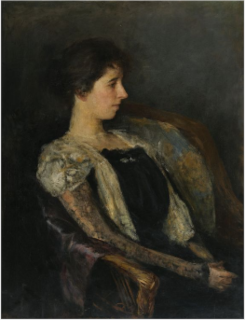
(From: “Campbell, Beatrice Moss” by Bridget Hourican and Pauric J. Dempsey, Dictionary of Irish Biography, http://www.dib.ie, October 2009 | Pictured: “Bridgit – a picture of Miss Elvery (Beatrice Elvery),” oil on canvas by William Orpen, 1909)

Leave a comment

Birth of Patrick Pollen, Stained Glass Artist

Patrick Pollen, a British stained glass artist who spends most of his life working in Ireland, is born Patrick La Primaudaye Pollen in London on January 12, 1928.

Pollen is the second son and second of six children of Arthur and Daphne Pollen (née Baring). His father is a sculptor of religious works, and grandson of John Hungerford Pollen. His mother is a painter of religious matter and the daughter of Cecil Baring, 3rd Baron Revelstoke, who purchases Lambay Island and employs Edwin Lutyens to restore the castle there. Pollen attends St. Philip’s preparatory school in South Kensington, then Avisford, near Arundel, and finally Ampleforth College, going on to serve national service. He attends the Slade School of Fine Art for two years to study painting, going on to work at Académie Julian, an art school in Paris, France.

In 1952, Pollen’s father takes him to see Evie Hone‘s “Crucifixion and Last Supper” window in Eton College Chapel. Upon seeing it he announces, “That’s what I want to do.” He moves to Dublin to study with the stained glass cooperative Evie Hone is a member of, An Túr Gloine, which is run by Catherine O’Brien and she and Hone become his mentors. When Hone dies in 1955, she leaves him her brushes.

Pollen’s early work from the 1950s is mostly in Britain, including a window in a private chapel in the London Oratory, three windows for a chapel at Whitchurch, and a crypt window for Rosslyn Chapel. He works for two years from 1957 on thirty-two windows for the new Cathedral of Christ The King, Johannesburg. He makes the windows in Dublin, then ships them to be assembled in South Africa. He creates the mosaic of St. Joseph the Worker and windows for Galway Cathedral. In 1963, he creates a memorial window to Catherine O’Brien in Christ Church Cathedral, Dublin. He takes on Helen Moloney as an assistant from 1960 to 1962.

Following the Second Vatican Council, newly designed churches feature less stained glass, and Pollen finds he is receiving less commissions. As a consequence he and his family move to the United States in 1981. They settle in Winston-Salem, North Carolina but there is very little work there and in 1997 they return in Ireland, living in his wife’s native County Wexford.

Pollen marries sculptor Nell Murphy in 1963, with the couple buying a house in Dublin in which Pollen had his studio. Murphy works in plaster, clay and stone, her works often featured in churches with those of her husband. They hav four sons, Peter, Ciaran, Laurence and Christopher, and a daughter, Brid.

Pollen dies on November 30, 2010, in Enniscorthy, County Wexford. His remains are cremated and the location of his ashes is unknown.


Leave a comment

Death of Albert Morrow, Illustrator, Poster Designer & Cartoonist

Albert George Morrow, Irish illustrator, poster designer and cartoonist, dies at his home in West Sussex, England, on October 26, 1927.

Morrow is born on April 26, 1863, in Comber, County Down, the second son of George Morrow, a painter and decorator from Clifton Street in west Belfast. Of his seven brothers, four, GeorgeJack, Edwin, and Norman, are also illustrators and all but one are artists. He is a keen ornithologist in his youth. In later life he is a keen walker and paints landscapes for leisure.

Morrow is educated at the Belfast Model School and latterly at the Belfast Government School of Art between 1878 and 1881.

While studying under T. M. Lindsay at the Government School of Art in 1880, Morrow is awarded a £10 prize for drawing from the eminent publishers Cassell, Petter and Galpin. In 1881, while still learning his trade, he paints a mural of Belfast for the Working Men’s Institute in Rosemary Street, where his father is chairman. Later in that same year he exhibits a watercolour sketch of a standing figure entitled Meditative at the gallery of Rodman & Company, Belfast.

Morrow then wins a three-year scholarship worth £52 per year which he takes to the National Art Training School at South Kensington in 1882, where he begins a lifelong friendship with the British sculptor Albert Toft. In 1883, while still attending South Kensington, he joins the staff of The English Illustrated Magazine in preparation for the launch of the first edition. Two of his works are published in the Sunday at Home magazine in September of the same year.

J. Comyns Carr, first editor of The English Illustrated Magazine, commissions Morrow to complete a series on English industry when he has yet to complete his studies at South Kensington.

In 1890, Morrow begins illustrating for Bits and Good Words. He exhibits nine works at the Royal Academy of Arts between 1890 and 1904, all of which are watercolours, and another in 1917, and an offering in chalk at the 159th Exhibition, in the year of his death.

Morrow becomes a member of the Belfast Art Society in 1895, exhibiting with them in the same year. In 1896, a Morrow print is published in Volume 2 of the limited-edition print-collection Les Maîtres de l’Affiche selected by “Father of the Poster” Jules Chéret. In the same year he shows a watercolour of a Gurkha at the Earls Court in the Empire of India and Ceylon exhibition. In 1900, he exhibits with two Ulster artists, Hugh Thomson and Arthur David McCormick, at the Linen Hall Library in Belfast, who along with Morrow had contributed to the early success of The English Illustrated Magazine.

Morrow is one of the founders of the Ulster Arts Club in November 1902 along with five of his brothers, an organisation that has a nonsectarian interest in Celtic ideas, language and aesthetics. In November 1903, he exhibits at the first annual exhibition of the Club when he shows alongside John LaveryHans Iten, James Stoupe and F. W. Hull. He exhibits The Itinerant Musician, a watercolour that he had previously shown at the Royal Academy in 1902. Honorary membership is conferred upon him the following year. Three years later he is honoured with a solo exhibition of sketches and posters in conjunction with the Ulster Arts Club, at the Belfast Municipal Gallery.

In 1908, Morrow joins his brothers in an exhibition at 15 D’Olier Street, Dublin, an address which is later registered to the family business in 1913. Among his contributions to the family exhibition is his painting of Brandon ThomasThe Clarionette Player, which had previously been exhibited at the Royal Academy, and a poster entitled Irving in Dante.

In 1917, Morrow joins his brother George and 150 artists and writers, in petitioning the British Prime Minister David Lloyd George to find a way of enacting the unsigned codicil to Hugh Lane’s will and establish a gallery to house Lane’s art collection in Dublin. Among the 32 notable artists who sign this petition are Jack B. Yeats, Sir William Orpen, Sir John Lavery, and Augustus John.

Morrow illustrates books for children and adults, but he is best known for the hundreds of posters he designs for the theatre, with the bulk of his commissions coming from just one lithographical printer, David Allen and Sons. As a cartoonist he draws for children’s annuals, and contributes three cartoons to Punch in 1923, 1925 and posthumously in 1931.

Morrow dies at his home in West Hoathly, West Sussex, on October 26, 1927, at the age of 64. He is survived by his wife and two children. His headstone in the local churchyard at All Saints Church, Highbrook is designed by his friend, the sculptor and architect, Albert Toft.

Morrow’s works can be found in many public and private collections such as the Victoria and Albert MuseumMusée des Arts Décoratifs and the British Museum.

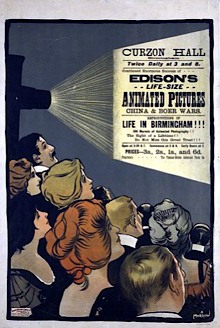
(Pictured: Colour lithograph poster by Albert Morrow advertising a cinematic showing at the Curzon Hall, Birmingham, c. 1902)


Leave a comment

Birth of William Orpen, Irish-born Artist

Major Sir William Newenham Montague Orpen, KBE, RA, RHA, Irish artist who mainly works in London and is best known for his vigorously characterized portraits, is born on November 27, 1878, at Oriel, Grove Avenue, Stillorgan, County Dublin. He also works as an official war artist during World War I.

Orpen is the fourth and youngest son of Arthur Herbert Orpen (1830–1926), a solicitor, and his wife, Anne Caulfield (1834–1912), the eldest daughter of the Right Rev. Charles Caulfield (1804–1862), the Bishop of Nassau. Both his parents are amateur painters, and his eldest brother, Richard Caulfield Orpen, becomes a notable architect. His nieces are Bea Orpen and Kathleen Delap. The historian Goddard Henry Orpen is his second cousin. The family lives at “Oriel,” a large house with extensive grounds containing stables and a tennis court. He appears to have a happy childhood there.

Orpen is a naturally talented painter, and six weeks before his thirteenth birthday is enrolled at the Dublin Metropolitan School of Art. During his six years at the college, he wins every major prize there, plus the British Isles gold medal for life drawing, before leaving to study at the Slade School of Fine Art in London between 1897 and 1899. At the Slade he masters oil painting and begins to experiment with different painting techniques and effects.

While at the Slade, Orpen becomes engaged to Emily Scobel, a model and the subject of his painting The Mirror (1900). She ends their relationship in 1901, and he marries Grace Knewstub, the sister-in-law of Sir William Rothenstein. He and Knewstub have three daughters together, but the marriage is not a happy one. By 1908, he has begun a long-running affair with Evelyn Saint-George, a well-connected American millionairess based in London, with whom he also has a child.

Orpen first exhibits at the New English Art Club (NEAC) in 1899, becoming a member in 1900. In 1901, he holds a solo exhibition at the Carfax Gallery in central London. His portraits, which establish his reputation, show the influence of the Realist artist Édouard Manet. He also becomes known as a painter of group portraits such as Homage to Manet (1909), in which he portrays members of the contemporary English art world sitting in conversation beneath a famous portrait by that artist.

At the start of World War I, a number of Irish people living in England return to Ireland to avoid conscription. Among them is Orpen’s studio assistant and former pupil, Seán Keating. Keating encourages him to do likewise, but he refuses and commits himself to supporting the British war effort. In December 1915, he is commissioned into the Royal Army Service Corps and reports for clerical duty at London’s Kensington Barracks in March 1916. Throughout 1916 he continues painting portraits, most notably one of a despondent Winston Churchill, but soon starts using both his own contacts and those of Evelyn Saint-George, to secure a war artist posting.

He is the official painter of the Paris Peace Conference after World War I. Throughout 1919 he paints individual portraits of the delegates to the Conference and these form the basis of his two large paintings, A Peace Conference at the Quai d’Orsay and The Signing of Peace in the Hall of Mirrors. In both pictures, the architecture overwhelms the gathered politicians and statesmen who’s political wranglings and vainglory diminish them in Orpen’s eyes.

Orpen is appointed Knight Commander of the Order of the British Empire in 1918 and is elected an associate of the Royal Academy of Arts in 1919.

Orpen becomes seriously ill in May 1931, and, after suffering periods of memory loss, dies at the age of 52 on September 29, 1931, in South Kensington, London, of liver and heart failure. He is buried at Putney Vale Cemetery in southwest London. A stone tablet in the Island of Ireland Peace Park Memorial at Mesen, Belgium, commemorates him. He is posthumously regarded as a facile and prolific, but somewhat superficial, artist who nevertheless achieves great popularity in his day.

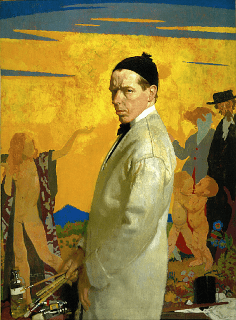
(Pictured: “Self-portrait” (1913), oil on canvas by William Orpen, Saint Louis Art Museum)


Leave a comment

Birth of Harry Ferguson, Mechanic and Inventor

Henry George “Harry” Ferguson, a British mechanic and inventor who is noted for his role in the development of the modern agricultural tractor and its three-point linkage system, for being the first person in Ireland to build and fly his own aeroplane, and for developing the first four-wheel drive Formula One car, the Ferguson P99, is born on November 4, 1884, at Growell, near Dromore, County Down, in what is now Northern Ireland.

Ferguson is the son of a farmer. In 1902, he goes to work with his brother, Joe, in his bicycle and car repair business. While working there as a mechanic, he develops an interest in aviation, visiting air shows abroad. In 1904, he begins to race motorcycles.

In the 1900s Ferguson becomes fascinated with the newly emerging technology of powered human flight and particularly with the exploits of the Wright brothers, the American aviation pioneers who made the first plane flight in 1903 at Kill Devil Hills, North Carolina.

The first person to accomplish powered flight in the UK is Alliot Verdon Roe in June 1908, who also flies an aeroplane of his own design, but this has not yet been achieved in Ireland. Ferguson begins to develop a keen interest in the mechanics of flying and travels to several air shows, including exhibitions in 1909 at Blackpool and Rheims where he takes notes of the design of early aircraft. He convinces his brother that they should attempt to build an aircraft at their Belfast workshop and, working from his notes, they work on the design of a plane, the Ferguson monoplane.

After making many changes and improvements, they transport their new aircraft by towing it behind a car through the streets of Belfast up to Hillsborough Park to make their first attempt at flight. They are at first thwarted by propeller trouble but continue to make technical alterations to the plane. After a delay of nearly a week caused by bad weather, the Ferguson monoplane finally takes off from Hillsborough on December 31, 1909. Ferguson becomes the first Irishman to fly and the first Irishman to build and fly his own aeroplane.

After falling out with his brother over the safety and future of aviation, Ferguson decides to go it alone, and in 1911 founds a company selling Maxwell, Star and Vauxhall cars and Overtime Tractors. He sees at first hand the weakness of having tractor and plough as separate articulated units, and in 1917 he devises a plough that can be rigidly attached to a Ford Model T car — the Eros, which becomes a limited success, competing with the Fordson Model F.

In 1917 Ferguson meets Charles E. Sorensen while Sorensen is in England scouting production sites for the Fordson tractor. They discuss methods of hitching the implement to the tractor to make them a unit. In 1920 and 1921 he demonstrates early versions of his three-point linkage on Fordson tractors at Cork and at Dearborn, Michigan. He and Henry Ford discuss putting the Ferguson system of hitch and implements onto Fordson tractors at the factory, but no deal is struck. At the time the hitch is mechanical. Ferguson and his team of longtime colleagues, including Willie Sands and Archie Greer, soon develop a hydraulic version, which is patented in 1926. After one or two false starts, he eventually founds the Ferguson-Sherman Inc., with Eber and George Sherman.

The new enterprise manufactures the Ferguson plough, incorporating the patented “Duplex” hitch system mainly intended for the Fordson “F” tractor. Following several more years of development, Ferguson’s new hydraulic version of the three-point linkage is first seen on his prototype “Ferguson Black” or ‘Irish tractor’ as he calls it, now in the Science Museum, South Kensington, London. A production version of the “Black” is introduced in May 1936, made at one of the David Brown Engineering Ltd. factories in Huddersfield, West Yorkshire, and designated Ferguson Model A tractor.

Ferguson’s interests are merged with those of David Brown junior to create the Ferguson-Brown Company.

In October 1938, Ferguson demonstrates his latest tractor to Henry Ford at Dearborn, and they make the famous “handshake agreement.” He takes with him his latest patents covering future improvements to the Ferguson tractor and it is these that lead to the Ford-Ferguson 9N introduction to the world on June 29, 1939.

Henry Ford II, Ford’s grandson, ends the handshake agreement on June 30, 1947, following unsuccessful negotiations with Ferguson, but continues to produce a tractor, the 8N, incorporating Ferguson’s inventions, the patents on almost all of which have not yet expired, and Ferguson is left without a tractor to sell in North America. His reaction is a lawsuit demanding compensation for damage to his business and for Ford’s illegal use of his designs. The case is settled out of court in April 1952 for just over $9 million. The court case costs him about half of that and a great deal of stress and ill health.

By 1952, most of the important Ferguson patents have expired, and this allows Henry Ford II to claim that the case had not restricted Ford’s activities too much. It follows that all the world’s other tractor manufacturers can also use Ferguson’s inventions, which they do. A year later Ferguson merges with Massey-Harris Limited to become Massey-Harris-Ferguson Co., later Massey Ferguson.

Ferguson dies at his home at Stow-on-the-Wold, Gloucestershire, England, on October 25, 1960, as the result of a barbiturate overdose. The inquest is unable to conclude whether his death had been accidental or not.

A blue plaque commemorating Ferguson is mounted on the Ulster Bank building in Donegall Square, Belfast, the former site of his showroom. A granite memorial has been erected to Ferguson’s pioneering flight on the North Promenade, Newcastle, County Down, and a full-scale replica of the Ferguson monoplane and an early Ferguson tractor and plough can be seen at the Ulster Folk and Transport Museum at Cultra, County Down. Today his name lives on in the name of the Massey Ferguson company.


Leave a comment

Death of Elizabeth Corbet Yeats, Educator & Publisher

Elizabeth Corbet Yeats, known as Lolly, Anglo-Irish educator and publisher, dies on January 16, 1940. She works as an art teacher and publishes several books on art and is a founder of Dun Emer Press which publishes several works by her brother, W. B. Yeats. She is the first commercial printer in Ireland to work exclusively with hand presses.

Yeats is born at 23 Fitzroy Road, London, on March 11, 1868. She is the daughter of the Irish artist John Butler Yeats and Susan Yeats (née Pollexfen). She is sister to W. B., Jack and Susan Mary “Lily” Yeats. From the age of four she lives in Merville, Sligo, at the home of her grandfather William Pollexfen. In November 1874 her family moves to 14 Edith Villas, West Kensington, London. Her governess is Martha Jowitt from 1876 until 1879 before the family moves to Bedford Park, Chiswick, in 1878.

Yeats returns to Howth, County Dublin, in 1881. She enrolls, with her sister Susan, in the Dublin Metropolitan School of Art in 1883 and takes classes at the Royal Dublin Society.

The family moves to Eardley Crescent, South Kensington, London, in 1886. While there Yeats starts to write fiction and publishes a homemade magazine, The Pleiades, with six friends, contributing “Story without a plot” to the Christmas 1888 issue. In addition, she publishes “Scamp and three friends” in The Vegetarian.

Yeats also attends the Chiswick School of Art with her sister Susan and brother Jack Butler Yeats, learning “Freehand drawing in all its branches, practical Geometry and perspective, pottery and tile painting, design for decorative purposes.”

In the 1890s Yeats lives at 3 Blenheim Road, Bedford Park, London, and trains as a kindergarten teacher at the Froebel College in Bedford, Bedfordshire. She undertakes her teaching practice at the Bedford Park High School. In 1892, when her training is completed, she teaches as a visiting art mistress at the Froebel Society, Chiswick High School and the Central Foundation School.

Yeats earns a good income from lecturing and publication of four popular painting manuals: Brushwork (1896), Brushwork Studies of Flowers, Fruits and Animals (1898), Brushwork Copy Book (1899), and Elementary Brushwork Studies (1900).

Yeats trains and works as an art teacher and is a member of William Morris‘s circle in London before her family returns to Dublin in 1900. She writes and creates the artwork for Elementary Brush-Work Studies (1900), an educational book that teaches young children the technique of painting flowers and plants using her simple method. At the suggestion of Emery Walker, who works with Morris on the Kelmscott Press, she studies printing with the Women’s Printing Society in London.

In Dublin, Yeats accepts the invitation to join Evelyn Gleeson to form the Dun Emer Guild along with Lily, who is an embroiderer. She manages the Dun Emer Press from 1902 with a printing press acquired from a provincial newspaper. The Press is located at Runnymede, the house of Evelyn Gleeson. This is set up with the intention of training young women in bookbinding and printing as well as embroidery and weaving. In 1903 she starts printing and Dun Emer’s first book is W. B. Yeats’s In the Seven Woods (1903).

Despite being a gifted printer, the costings exceed the quality of work that Yeats produces with the result that the press is often at risk financially. Eleven books, decorated with pastels by George William Russell, appear under the Dun Emer imprint produced from a first-floor room. She has several disagreements with her brother William over his directions as literary editor. She also dislikes Evelyn Gleeson. In October 1906 she travels to New York to advertise her products but publishes Dun Emer’s last book, William’s Discoveries (1907), in late November when she returns to Dublin.

After many years of strained relations between the Yeats sisters and Evelyn Gleeson, their business relationship is finally ended. Subsequently, in 1908, Lolly and her brother William start the Cuala Press, publishing over 70 books including 48 by the poet. Yeats manages the press while her sister Lily controls the embroidery section. Cuala continues to be a family strain. Their father, John Butler Yeats, has to castigate his son William for sending overtly critical letters to his sisters about the press. However, Cuala produces magnificent books: W. B. Yeats’ The Green Helmet and Other Poems (1910) and a series of Broadsides (published 1908–15, with illustrations from Jack Yeats).

Yeats works with Cuala Press until just before her death in Dublin on January 16, 1940, after a diagnosis of high blood pressure and heart trouble.

(Pictured: “Elizabeth Corbet Yeats” by Jack Butler Yeats, oil on canvas, circa 1899, National Gallery of Ireland)


Leave a comment

Death of Harry Ferguson, Mechanic & Inventor

Henry George “Harry” Ferguson, a British mechanic and inventor who is noted for his role in the development of the modern agricultural tractor and its three-point linkage system, for being the first person in Ireland to build and fly his own aeroplane, and for developing the first four-wheel drive Formula One car, the Ferguson P99, dies in Stow-on-the-Wold, Gloucestershire, England, on October 25, 1960. Today his name lives on in the name of the Massey Ferguson company.

Ferguson is born on November 4, 1884, at Growell, near Dromore, County Down, in what is now Northern Ireland, the son of a farmer. In 1902, he goes to work with his brother, Joe, in his bicycle and car repair business. While working there as a mechanic, he develops an interest in aviation, visiting airshows abroad. In 1904, he begins to race motorcycles.

In the 1900s Ferguson becomes fascinated with the newly emerging technology of powered human flight and particularly with the exploits of the Wright brothers, the American aviation pioneers who made the first plane flight in 1903 at Kill Devil Hills, North Carolina.

The first person to accomplish powered flight in the UK is Alliot Verdon Roe in June 1908, who also flies an aeroplane of his own design, but this has not yet been achieved in Ireland. Ferguson begins to develop a keen interest in the mechanics of flying and travels to several air shows, including exhibitions in 1909 at Blackpool and Rheims where he takes notes of the design of early aircraft. He convinces his brother that they should attempt to build an aircraft at their Belfast workshop and, working from his notes, they work on the design of a plane, the Ferguson monoplane.

After making many changes and improvements, they transport their new aircraft by towing it behind a car through the streets of Belfast up to Hillsborough Park to make their first attempt at flight. They are at first thwarted by propeller trouble but continue to make technical alterations to the plane. After a delay of nearly a week caused by bad weather, the Ferguson monoplane finally takes off from Hillsborough on December 31, 1909. Ferguson becomes the first Irishman to fly and the first Irishman to build and fly his own aeroplane.

After falling out with his brother over the safety and future of aviation, Ferguson decides to go it alone, and in 1911 founds a company selling Maxwell, Star and Vauxhall cars and Overtime Tractors. He sees at first hand the weakness of having tractor and plough as separate articulated units, and in 1917 he devises a plough that can be rigidly attached to a Ford Model T car — the Eros, which becomes a limited success, competing with the Fordson Model F.

In 1917 Ferguson meets Charles E. Sorensen while Sorensen is in England scouting production sites for the Fordson tractor. They discuss methods of hitching the implement to the tractor to make them a unit. In 1920 and 1921 he demonstrates early versions of his three-point linkage on Fordson tractors at Cork and at Dearborn, Michigan. He and Henry Ford discuss putting the Ferguson system of hitch and implements onto Fordson tractors at the factory, but no deal is struck. At the time the hitch is mechanical. Ferguson and his team of longtime colleagues, including Willie Sands and Archie Greer, soon develop a hydraulic version, which is patented in 1926. After one or two false starts, he eventually founds the Ferguson-Sherman Inc., with Eber and George Sherman.

The new enterprise manufactures the Ferguson plough, incorporating the patented “Duplex” hitch system mainly intended for the Fordson “F” tractor. Following several more years of development, Ferguson’s new hydraulic version of the three-point linkage is first seen on his prototype “Ferguson Black” or ‘Irish tractor’ as he calls it, now in the Science Museum, South Kensington, London. A production version of the “Black” is introduced in May 1936, made at one of the David Brown Engineering Ltd. factories in Huddersfield, West Yorkshire, and designated Ferguson Model A tractor.

Ferguson’s interests are merged with those of David Brown junior to create the Ferguson-Brown Company.

In October 1938, Ferguson demonstrates his latest tractor to Henry Ford at Dearborn, and they make the famous “handshake agreement.” He takes with him his latest patents covering future improvements to the Ferguson tractor and it is these that lead to the Ford-Ferguson 9N introduction to the world on June 29, 1939.

Henry Ford II, Ford’s grandson, ends the handshake agreement on June 30, 1947, following unsuccessful negotiations with Ferguson, but continues to produce a tractor, the 8N, incorporating Ferguson’s inventions, the patents on almost all of which have not yet expired, and Ferguson is left without a tractor to sell in North America. His reaction is a lawsuit demanding compensation for damage to his business and for Ford’s illegal use of his designs. The case is settled out of court in April 1952 for just over $9 million. The court case costs him about half of that and a great deal of stress and ill health.

By 1952, most of the important Ferguson patents have expired, and this allows Henry Ford II to claim that the case had not restricted Ford’s activities too much. It follows that all the world’s other tractor manufacturers can also use Ferguson’s inventions, which they do. A year later Ferguson merges with Massey-Harris Limited to become Massey-Harris-Ferguson Co., later Massey Ferguson.

Ferguson dies at his home at Stow-on-the-Wold on October 25, 1960, as the result of a barbiturate overdose. The inquest is unable to conclude whether his death had been accidental or not.

A blue plaque commemorating Ferguson is mounted on the Ulster Bank building in Donegall Square, Belfast, the former site of his showroom. A granite memorial has been erected to Ferguson’s pioneering flight on the North Promenade, Newcastle, County Down, and a full-scale replica of the Ferguson monoplane and an early Ferguson tractor and plough can be seen at the Ulster Folk and Transport Museum at Cultra.


Leave a comment

Birth of Paul Durcan, Contemporary Irish Poet

Paul Durcan, contemporary Irish poet, is born in Dublin on October 16, 1944.

Durcan grows up in Dublin and in Turlough, County Mayo. His father, John, is a barrister and circuit court judge. He has a difficult and formal relationship with his father. He enjoys a warmer and more natural relationship with his mother, Sheila MacBride Durcan, through whom he is a great-nephew of both Maud Gonne, the Irish social and political activist, and John MacBride, one of the leaders of the Easter Rising, which begins the Irish War of Independence leading to the foundation of the Irish Free State.

In the 1970s Durcan studies Archaeology and Medieval History at University College Cork (UCC). Earlier, in the 1960s, he studies at University College Dublin (UCD). While at college there, he is kidnapped by his family and committed against his will to Saint John of God psychiatric Hospital in Dublin, and later to a Harley Street clinic where he is subjected to electric shock treatment and heavy dosages of barbiturates and Mandrax.

In 1966, Durcan moves to London, where he works at the North Thames Gas Board. He meets Nessa O’Neill in 1967 and they marry and have two daughters, Sarah and Siabhra. They live in South Kensington, then move to Cork, where his wife teaches in a prison. The marriage ends in early 1984.

Durcan’s main published collections include A Snail in my Prime, Crazy About Women, Greetings to Our Friends in Brazil and Cries of an Irish Caveman. He appears on the 1990 Van Morrison album Enlightenment, giving an idiosyncratic vocal performance on the song “In The Days Before Rock’n’Roll,” which he also co-writes.

In 2003, Durcan publishes a collection of his weekly addresses to the nation, Paul Durcan’s Diary, on RTÉ Radio 1 programme Today with Pat Kenny. He gets his inspiration from Paidraig Whitty, a local Wexford poet. He is shortlisted in 2005 for the Poetry Now Award for his collection The Art of Life (The Harvill Press, 2004). In 2009, he is conferred with an honorary degree by Trinity College, Dublin. He is the Ireland Fund Artist-in-Residence in the Celtic Studies Department of St. Michael’s College at the University of Toronto in October 2009. In 2011 he is conferred with an honorary doctorate from University College Dublin.

Between 2004 and 2007 Durcan is the third Ireland Professor of Poetry. He is a member of Aosdána. Awards he has received include the Patrick Kavanaugh Poetry Award (1974), the Irish American Culture Institute Poetry Award (1989), the Whitbread Prize for Daddy, Daddy (1990) and the London Poetry Book Society choice for The Berlin Wall Café.

A number of poems from Durcan’s poetry career are studied by Irish students who take the Leaving Certificate.


2 Comments

Birth of James Patrick Mahon, Journalist, Barrister & Parliamentarian

James Patrick Mahon, Irish nationalist journalist, barrister, parliamentarian and international mercenary, is born into a prominent Roman Catholic family in Ennis, County Clare, on March 17, 1803.

Mahon, the eldest of four children, is the son of Patrick Mahon of New Park, who took part in the Irish Rebellion of 1798, and Barbara, a considerable heiress and the only daughter of James O’Gorman of Ennis. He studies at Clongowes Wood College, where he is one of the earliest pupils, and at Trinity College Dublin, where he takes his BA in 1822 and his MA in law in 1832. Following his father’s death in 1821, he inherits half the family property and becomes a magistrate for Clare.

In 1830, Mahon marries Christina, the daughter of John O’Brien of Dublin. She is an heiress and has property valued at £60,000 in her own right, which gives him the resources to seek election to parliament. The couple spends little time together, and she dies apart from him in Paris in 1877. They have one son who dies in 1883.

In 1826, Mahon joins the newly formed Catholic Association. He encourages fellow member Daniel O’Connell to stand for election at the 1828 Clare by-election. O’Connell’s election, in which Mahon plays a large role, persuades the British Government to pass the Roman Catholic Relief Act 1829, which finalises the process of Catholic Emancipation and permitted Roman Catholics to sit in the British Parliament.

As a result, when Mahon is elected for Clare at the 1830 United Kingdom general election, he is entitled to take his seat. However, during the election campaign he quarrels with O’Connell, and after his election he is unseated for bribery. He is subsequently acquitted and stands again at the 1831 United Kingdom general election, but is defeated by two O’Connell-backed candidates, one of whom is his old schoolfriend Maurice O’Connell, Daniel O’Connell’s son. He gives up on politics, becomes deputy lieutenant of Clare, and captain of the local militia.

Mahon becomes a barrister in 1834, but the following year, he leaves for Paris. There he associates with Charles Maurice de Talleyrand-Périgord, becoming a favourite at Louis Philippe‘s court and working as a journalist. He travels the world, spending time in both Africa, where he befriends Ferdinand de Lesseps, engineer of the Suez Canal, and South America, before returning to Ireland in 1846.

At the 1847 United Kingdom general election, Mahon is elected for Ennis and declares himself a Whig in favour of Irish Repeal. However, he opposes the Young Irelanders and narrowly loses his seat at the 1852 United Kingdom general election.

Following his defeat in the 1852 election, Mahon returns to Paris, then travels on to Saint Petersburg, where he serves in the Imperial Bodyguard. During this period, he journeys through lands from Finland to Siberia. He then travels across China, India and Arabia. His finances largely exhausted, he serves as a mercenary in the Ottoman and Austrian armies before returning to England in 1858. Late that year, he leaves for South America, where he attempts to finance the construction of a canal through Central America.

After exploits abroad Mahon returns to Ireland in 1871 and is a founding member of the Home Rule League. Nearly ruined by his ventures, he even ends up at the Old Bailey as a consequence of his dealings but is acquitted. He is defeated in Ennis at the 1874 United Kingdom general election, and also at the 1877 Clare by-election. Finally, he wins the 1879 Clare by-election and holds the seat at the 1880 United Kingdom general election.

Mahon is a close associate of Charles Stewart Parnell, who he successfully nominates for the leadership of the League in 1880 but is dropped in 1885 as a party candidate because of his age and his tendency to vote with the Liberal Party in Parliament. He is also embroiled in a court case disputing the will of his son.

Parnell personally ensures Mahon is a candidate at the 1887 County Carlow by-election, which he wins at the age of 87 as a Liberal. By this point, he is the oldest MP in the House of Commons of the United Kingdom. He dies at his home in South Kensington, London on June 15, 1891, while still in office.

Mahon had served alongside William O’Shea as an MP, and the two were close friends. He introduced him and Katharine O’Shea, his wife, to Parnell. After Parnell is named in the O’Sheas’ divorce case in 1890, Mahon splits with Parnell, siding with the Irish National Federation. However, Parnell attends Mahon’s funeral in Glasnevin Cemetery a few months later.

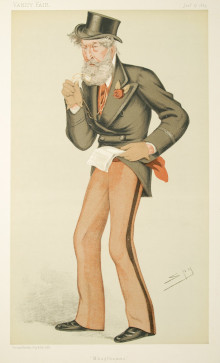
(Pictured: Caricature of James Patrick Mahon by Sir Leslie Matthew Ward under the pseudonym “Spy” published in Vanity Fair in 1885)


Leave a comment

Execution of Major Geoffrey Lee Compton-Smith

geoffrey-lee-compton-smith

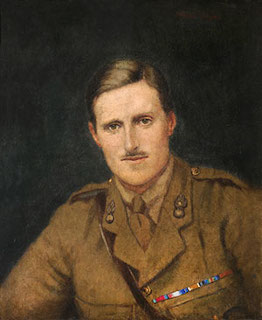
Major Geoffrey Lee Compton-Smith (DSO) of the 2nd Battalion of the Royal Welch Fusiliers is captured and executed by the Irish Republican Army (IRA) on April 30, 1921, during the Irish War of Independence.

Compton-Smith was born in 1889 in South Kensington, London. After finishing school, he decides not to follow the family tradition of studying law. He actually wants to become an artist, but his father insists that he join the army. He studies at the Royal Military College at Sandhurst and during World War I his regiment is sent to France. In 1917 he is wounded at the Battle of Arras, but he continues to fight on. He is awarded the Distinguished Service Order (DSO). In 1919 he is sent to serve in Ireland during the Irish War of Independence.

In 1919 Compton-Smith is commander of the British Army base at Ballyvonane, near Buttevant, but he is also an intelligence officer. As an officer he also sometimes presides over courts martial. In January 1921, for instance, three IRA volunteers are tried by him for involvement in the ambush at Shinanagh, near Charleville, and he sentences them each to six months.

February 1921 is a bad time for the IRA in County Cork. They suffer major losses at the ambushes at Clonmult and Mourne Abbey, and several volunteers are taken prisoner, four of whom are sentenced to death. The IRA believes that these death sentences might be commuted if a British officer is held as a hostage. This leads to the capture of Compton-Smith. On April 16, 1921, he travels to Blarney, supposedly on a sketching trip but actually to meet a nurse in Victoria Barracks with whom he is having an affair. The IRA has spies in Victoria Barracks who likely tip off the IRA that Compton-Smith is coming to Blarney. A squad led by Frank Busteed easily capture him after he gets off the train.

Busteed then meets with Jackie O’Leary, the IRA battalion commander. It is decided that Donoughmore is the perfect place to keep a hostage, because parts of the parish are remote and the IRA is strong there.

On April 18, under the cover of darkness, Compton-Smith is transferred by car to Knockane House, an abandoned big house in Donoughmore. The following night he is moved again, this time by pony and trap, to Barrahaurin, a remote townland in the Boggeragh Mountains. He is kept there for the last eleven days of his life, on the small farm of Jack and Mary Moynihan. He is held prisoner in a shed, always under guard. Every evening he is brought into the house, where he eats and stays at the fireside. He and his guards have conversations about history and politics.

The four IRA prisoners are executed on April 28, 1921. On April 30, O’Leary informs Compton-Smith that he is going to be executed. He then writes a final letter to his wife. He tells her that he will die with her name on his lips and her face before his eyes and that he will “die like an Englishman and a soldier.” He also writes a letter to his regiment and one to Lt. General Strickland.

After finishing his letters, Compton-Smith is led up into Barrahaurin bog behind the Moynihan house, to a place where his grave had already been dug and is given a final cigarette. In his witness statement Maurice Brew writes, “When removed to the place of execution he placed his cigarette case in his breast pocket of his tunic … He then lighted a cigarette and said that when he dropped the cigarette it could be taken as a signal by the execution squad to open fire.”

It is not until late May, following the discovery of the cache of letters in a Dublin raid, that the Compton-Smith family is informed of his death. His father, William, then starts a campaign to find his son’s body. He wrote letters to MPs and to the British Army, seeking information and help. He also writes to Erskine Childers but gets no reply. He offers a reward of £500 for information, but only The Irish Times agrees to print his advertisement.

In November 1921 a cousin of Compton-Smith’s wife, Gladys, meets Michael Collins in London and asks him for help in finding the body. Correspondence between Collins and the Compton-Smith family suggests that Collins is trying to help in 1922, but he fails to get any results before he is assassinated at Béal na Bláth later that same year.

On March 3, 1926, Compton-Smith’s grave is discovered by the Gardaí. The newspapers report that the remains, because of the conditions of the bog, “were not so badly decomposed as to render identification impossible.” The body is brought to Collins Barracks in Cork. On March 5 the Gardaí send a telegram to the Compton-Smiths, informing them that the body has been located.

The reburial of Compton-Smith is carried out with great dignity on March 19, 1926. The Irish Army escorts the coffin from Collins Barracks to Penrose Quay, where British forces from Spike Island take the coffin on board a boat. While the boat travels down the River Lee, the Irish Army’s guard of honour presents arms and sounds the “Last Post.” The British then bring the coffin to Carlisle Fort, near Whitegate, where it was buried in the in the British Military Cemetery with full military honours.