seamus dubhghaill

Promoting Irish Culture and History from Little Rock, Arkansas, USA


Leave a comment

Birth of Patrick Moylett, Businessman & Irish Nationalist

Patrick Moylett, Irish nationalist and successful businessman in County Mayo and County Galway who, during the initial armistice negotiations to end the Irish War of Independence, briefly serves as president of the Irish Republican Brotherhood (IRB), is born in Crossmolina, County Mayo, on March 9, 1878. He is a close associate of Arthur Griffith and frequently travels to London acting as a middleman between Sinn Féin and officials in the British government.

Moylett is born into a farming family and emigrates to London as a young man working in various departments in Harrods for five years before returning to Ireland in 1902. He opens a grocery and provisions business in Ballina and, as it proves successful, he later establishes branches in Galway and London between 1910 and 1914. The London-branch is sold at the outbreak of World War I.

Having founded and organised the recruitment and funding of the Mayo activities of the Irish Republican Army (IRA) he also acts as a justice of the Sinn Féin courts. He is advised to leave the area due to death threats from the Black and Tans and their burning down of his commercial premises in Ballina. On one occasion during the period, according to his military statements, he prevents some over-enthusiastic volunteers from attempting to kidnap and assassinate Prince George, Future King of England, who is sailing and holidaying in the Mayo/Donegal region at the time.

Relocating to Dublin, the Irish overseas Trading Company is formed with a former director of Imperial Chemical Industries. Moylett becomes involved in the Irish nationalist movement and is active in the Mayo and Galway areas during the Irish War of Independence. The Irish Overseas Trading Company, of which he is one of two directors, acts as a front for the importation of armaments covered by consignments of trade goods. According to his subsequent detailed military statements archived in the bureau of military history by the Irish Army, the consignments are imported to a number of warehouses in the Dublin Docks with the three keyholders to the warehouses being Éamon de Valera, Michael Collins and Arthur Griffith.

With Harry Boland in the United States with Éamon de Valera, Moylett succeeds him as president of the Irish Republican Brotherhood (IRB) and, in October 1920, is selected to go to London as the personal envoy of Arthur Griffith. During the next several months, he is involved in secret discussions with British government officials on the recognition of Dáil Éireann, a general amnesty for members of the Irish Republican Army and the organisation of a peace conference to end hostilities between both parties.

Moylett is assisted by John Steele, the London editor of the Chicago Tribune, who helps him contact high-level members of the British Foreign Office. One of these officials, in particular C.J. Phillps, has frequent meetings with him. Discussions center on the possibility of an armistice and amnesty in Ireland with the hope for a settlement in which a national Parliament will be established with safeguards for Unionists of Ulster. These meetings are later attended by H. A. L. Fisher, the President of the Board of Education and one of the most outspoken opponents of unauthorised reprisals against the Irish civilian population by the British government. One of the main points Fisher expresses to Moylett is the necessity of Sinn Féin to compromise on its demands for a free and united republic. His efforts are hindered however, both to the slow and confused pace of the peace negotiations as well as the regularly occurring violence in Ireland, most especially the Bloody Sunday incident on November 21, 1920, which happens while he is in London speaking with members of the cabinet. During the Irish Civil War, although a supporter of the Anglo-Irish Treaty, he chooses not to participate in the Free State government party which he views as an amalgam of Unionists and the old Irish Party. In 1926, he is a founding member of the Clann Éireann party and becomes an early advocate of the withholding of land annuities.

In 1930, Moylett and his family move to Dublin, and by 1940 his political activities in the city have become a concern for the Gardai. He begins moving in antisemitic, pro-German far-right politic circles while in Dublin, engaging with the likes of Gearóid Ó Cuinneagáin and George Griffith. Indeed alongside Griffith, he is deeply involved with the founding of the People’s National Party, an explicitly anti-Jewish Pro-Nazi party whose membership overlaps greatly with that of the Irish Friends of Germany. He leaves the People’s National Party in October 1939 only when he is expelled from the party and his position as treasurer on charges of embezzling party funds. In 1941 he continues to support these far-right groups when he aids Ó Cuinneagáin in setting up the Youth Ireland Association, a group gathered to fight “a campaign against the Jews and Freemasons, also against all cosmopolitan agenda.” When the group is found to be stealing guns from army reservists, the Gardai shuts the group down in September 1942.

Moylett dies on August 14, 1973, at the age of 95 in County Dublin. He is buried in Dean’s Grange Cemetery, Deansgrange, County Dublin.
Leave a comment

Death of John Robert Gregg, Inventor of Gregg Shorthand

John Robert Gregg, educator, publisher, humanitarian, and the inventor of the eponymous shorthand system Gregg shorthand, dies in Cannondale, Connecticut on February 23, 1948.

Gregg is born on June 17, 1867, in Shantonagh, County Westmeath, as the youngest child of Robert and Margaret Gregg, where they remain until 1872, when they move to Rockcorry, County Monaghan. He enters the village school in Rockcorry in 1872. On his second day of class, he is caught whispering to a schoolmate, which prompts the schoolmaster to hit the two children’s heads together. This incident profoundly damages his hearing for the rest of his life, rendering him unable to participate fully in school, unable to understand his teacher. This ultimately leads to him being unnecessarily perceived as dull or mentally challenged by his peers, teachers, and family.

In 1877, after seeing a friend use Pitman shorthand to take verbatim notes of a preacher’s sermon, Robert Gregg sees the shorthand skill as a powerful asset, so he makes it mandatory for his children to learn Pitman shorthand, with the exception of John, who is considered by his family too “simple” to learn it. None of the children succeed in fully learning the system. On his own, John learns the shorthand system of Samuel Taylor. He teaches himself the system fully, since he does not require the ability to hear in order to learn from the book.

Gregg says he initially set out to improve the English adaptation by John Matthew Sloan of the French Duployan shorthand, while working with one of Sloan’s sales agents, Thomas Malone. Malone publishes a system called Script Phonography, of which Gregg asserts a share in authorship is owed to him. Angered by Malone, he resigns from working with him and encouraged by his older brother Samuel, publishes and copyrights his own system of shorthand in 1888. It is put forth in a brochure entitled Light-Line Phonography: The Phonetic Handwriting which he publishes in Liverpool, England.

In 1893, Gregg emigrates to the United States. That year he publishes Gregg shorthand with great success. He settles in Chicago in 1895 and by 1896 dozens of American public schools are teaching Gregg shorthand. The first Gregg Shorthand Association is formed in Chicago that year with 40 members. In 1897 the Gregg Publishing Company is formed to publish shorthand textbooks.

By 1907 Gregg is so successful that he opens an office in New York and then moves there. The popularity of his shorthand system continues to grow with it being taught in 533 school systems by 1912. In 1914 the New York City Board of Education approves the experimental introduction of Gregg shorthand into its high schools, where the Pitman system had long held sway. That same year the system is admitted to Columbia University (New York) and the University of California, Berkeley.

After World War I, Gregg travels extensively throughout Great Britain, hoping to popularize his system there. He is not quite as successful in this endeavor as he had been in America, but he sees Gregg shorthand become wildly popular in France, Germany, Poland, Spain, and especially Latin America, where for years Gregg’s birthday is a national holiday.

Following his wife’s death in 1928 Gregg returns to New York. He throws himself into volunteer work and continues to perfect the Gregg system. Over the next several years he is the recipient of several honorary degrees from American educational institutions. At one such ceremony in June 1930 he renews his acquaintance with Janet Kinley, daughter of the president of the University of Illinois. The two are married in October of that year. They purchase a home in Cannondale, a historic section of Wilton, Connecticut.

In the 1930s Gregg begins writing a history of shorthand, the subject that had been his lifelong obsession. The first chapter is printed in 1933, and successive chapters follow at intervals until 1936. He devotes time to charitable work and institutes scholarships in the arts and in court reporting at his Chicago school. His voluntary work on behalf of Allied soldiers and British civilians during World War II wins recognition from King George VI, who awards him a medal for “Service in the Cause of Freedom” in 1947.

In December 1947 Gregg undergoes surgery from which he seems to recover well. However, on February 23, 1948, he suffers a heart attack and dies in Cannondale, Connecticut at the age of eighty.


Leave a comment

The Republic of Ireland Act 1948 Signed Into Law

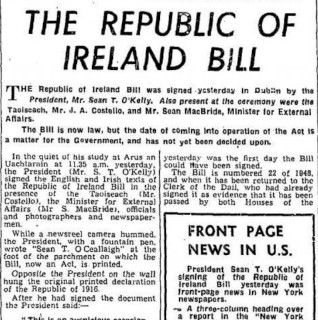
The Republic of Ireland Act 1948 is an Act of the Oireachtas which declares that Ireland may be officially described as the Republic of Ireland, and vests in the President of Ireland the power to exercise the executive authority of the state in its external relations, on the advice of the Government of Ireland. The Act is signed into law on December 21, 1948 and comes into force on April 18, 1949, Easter Monday, the 33rd anniversary of the beginning of the Easter Rising.

The Act repeals the External Relations Act 1936. Under that Act, King George VI acts as the Irish head of state in international relations by accredited ambassadors and on the State’s behalf accepts credentials appointing foreign ambassadors to the State. The Republic of Ireland Act removes this last remaining practical role from the King and vests it instead in the President of Ireland, making the then President of Ireland, Seán T. O’Kelly, unambiguously the Irish head of state.

In 1945, when asked if he plans to declare a Republic, the then Taoiseach Éamon de Valera replies, “we are a republic.” He also insists that Ireland has no king, but simply uses an external king as an organ in international affairs. However, that is not the view of constitutional lawyers including de Valera’s Attorneys General, whose disagreement with de Valera’s interpretation only come to light when the state papers from the 1930s and 1940s are released to historians. Nor is it the view in the international arena, who believe that Ireland does have a king, George VI, who had been proclaimed King of Ireland in December 1936, and to whom they accredit ambassadors to Ireland. King George, in turn, as “King of Ireland” accredits all Irish diplomats. All treaties signed by the Irish Taoiseach or Minister for External Affairs are signed in the name of King George.

In October 1947, de Valera asks his Attorney General, Cearbhall Ó Dálaigh, to draft a bill to repeal the External Relations Act. By 1948 a draft of the bill includes a reference to the state as being a republic. In the end, the draft bill is never submitted to the Oireachtas for approval.

The bill to declare Ireland a republic is introduced in 1948 by the new Taoiseach, John A. Costello of the Fine Gael party. Costello makes the announcement that the bill is to be introduced when he is in Ottawa, during an official visit to Canada. David McCullagh suggests that it is a spur of the moment reaction to offence caused by the Governor General of Canada, Lord Alexander, who is of Northern Irish descent, who allegedly places loyalist symbols before an affronted Costello at a state dinner. What is certain is that an agreement that there be separate toasts for the King and for the President of Ireland is broken. The Irish position is that a toast to the King, instead of representing both countries, would not include Ireland. Only a toast to the King is proposed, to the fury of the Irish delegation. Shortly afterwards Costello announces the plan to declare the republic.

However, according to all but one of the ministers in Costello’s cabinet, the decision to declare a republic had already been made before Costello’s Canadian visit. Costello’s revelation of the decision is because the Sunday Independent had discovered the fact and was about to “break” the story as an exclusive. The evidence of what really happens remains ambiguous. There is no record of a prior decision to declare a republic before Costello’s Canadian trip.

At any rate, the Act is enacted with all parties voting for it. De Valera does suggest that it would have been better to reserve the declaration of the republic until Irish unity had been achieved, a comment hard to reconcile with his 1945 claim that the Irish state was already a republic. Speaking in Seanad Éireann Costello tells senators that as a matter of law, the King is indeed “King of Ireland” and Irish head of state and the President of Ireland is in effect no more than first citizen and a local notable, until the new law comes into force.

The United Kingdom responds to the Republic of Ireland Act by enacting the Ireland Act 1949. This Act formally asserts that the Irish state had, when the Republic of Ireland Act came into force, ceased “to be part of His Majesty’s dominions” and accordingly is no longer within the Commonwealth. Nonetheless the United Kingdom statute provides that Irish citizens will not be treated as aliens under British nationality law. This, in effect, grants them a status similar to the citizens of Commonwealth countries.