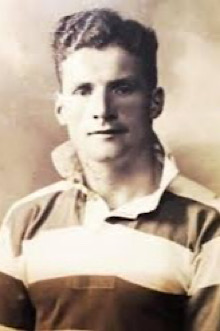
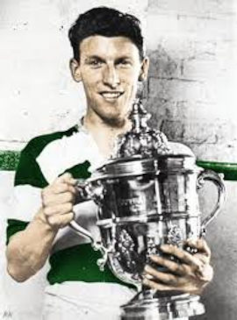
In 1934, aged 16, McAlinden is playing for Glentoran Reserves, when after a game against their reserves, he is offered a professional contract by Belfast Celtic. Together with Jackie Vernon, Tommy Breen, Billy McMillan and Charlie Tully, he subsequently becomes a prominent member of the Celtic team managed by Elisha Scott. This team dominates the Irish League in the era before and during World War II. Among his most notable contributions is scoring in the 2–1 win against Bangor in the 1938 Irish Cup final.
In December 1938, McAlinden signs for Portsmouth for a fee of £7.500. He makes his debut for the club against Chelsea and goes on to become a regular in the side. Within six months of his arrival at the club, he helps them win the 1939 FA Cup final, beating Wolverhampton Wanderers 4–1. After the outbreak of World War II, he plays three times for Portsmouth in wartime regional leagues, but his first spell with the club ends when he then returns to Belfast Celtic in 1939. He returns to Portsmouth for a second stint in 1946. In September 1947, he leaves Portsmouth once again and joins Stoke City for a fee of £7,000.
Following the end of his second stint with Belfast Celtic and before he rejoins Portsmouth, McAlinden signs for Shamrock Rovers in September 1945. He makes his debut against Shelbourne at Glenmalure Park on September 16. While playing for Rovers his teammates include Paddy Coad, Peter Farrell and Tommy Eglington. During his one season with Rovers, he helps the club reach the 1946 FAI Cup final. However Rovers lose 3–1 to Drumcondra.
McAlinden joins Stoke City in September 1947 for a then club record fee of £7,000. He becomes regular inside forward under manager Bob McGrory in 1947–48, playing in 33 matches scoring just twice against Aston Villa and Huddersfield Town. His lack of goals sees him fall out of favour at the Victoria Ground and he is sold to Third Division South side Southend United in October 1948.
In 1948, Southend United signs McAlinden from Stoke City for a fee of £8,000. He continues to play for United until 1954 and during his time with the club he serves as club captain. He also becomes something of a cult hero among the club’s fans and is remembered as being possibly the best player ever to play for the club. In 1950, he is caught up in controversy after it is alleged that he received illegal payments during his second spell with Portsmouth. As a result, he is suspended for the first two months of the 1950–51 season. In April 1954, he makes his last home appearance for United in a 4–1 win over Queens Park Rangers.
When McAlinden begins his international career in 1937 there are in effect, two Ireland teams, chosen by two rival associations. Both associations, the Northern Ireland–based Irish Football Association (IFA) and the Irish Free State–based Football Association of Ireland (FAI), claim jurisdiction over the whole of Ireland and select players from the whole island. As a result, several notable Irish players from this era, including McAlinden play for both teams.
Between 1937 and 1948, McAlinden makes five appearances for the IFA XI, making his international debut in a 1–1 draw with Scotland at Pittodrie Stadium on November 10, 1937. His IFA XI appearances also include the 8–4 defeat against a Combined Services XI at Windsor Park on September 9, 1944. This team is basically a Great Britain XI and features, among others, Matt Busby, Stanley Matthews, Tommy Lawton and Stan Mortensen. He also plays against England in 7–2 defeat at Windsor Park on September 9, 1946. He makes his last appearance for the IFA XI on October 10, 1948, in a 6–2 defeat to England at Windsor Park. He makes his first three appearances for the IFA XI while with Belfast Celtic, his fourth while at Portsmouth and his fifth while at Southend United.
In 1946, while with Portsmouth, McAlinden also makes two appearances for the FAI XI. He is one of several players born in Northern Ireland who benefits from the FAI’s attempts to establish their all-Ireland influence. In June 1946, when the FAI organises an Iberian tour, he, together with Jackie Vernon, Billy McMillan and Paddy Sloan, is one of four Northern Irish players called up. He subsequently plays in both the 3–1 defeat to Portugal on June 16 and then helps Ireland gain a surprise 1–0 victory against Spain on June 23, 1946.
In 1955, McAlinden becomes player/manager of Glenavon. He continues playing for an additional year before finally retiring as a player to concentrate on management. During a thirteen-year stint with Glenavon, he guides them two Irish League titles, three Irish Cup victories and one Gold Cup. After leaving Glenavon, works as a full-time scout for Coventry City before taking charge at Lisburn Distillery in 1969. He subsequently guides a Distillery team that includes a young Martin O’Neill to a win in the 1971 Irish Cup. Later in his first season with Drogheda United, he guides them to the 1976 FAI Cup final, only to lose 1–0 to Bohemian.
McAlinden dies at the age of 75 on November 15, 1993.
In the 19th century, association football outside of Ulster is largely confined to Dublin and a few provincial towns. The British Army teams play a role in the spread of the game to these areas, especially in Munster, as local clubs are initially reliant on them to form opposition teams, leading to the nickname “the garrison game.” Association football is played in relatively few Catholic schools as middle-class schools favour rugby union while others favour Gaelic games. The Irish Football Association (IFA) had been founded in 1880 in Belfast as the football governing body for the whole of Ireland, which was then a part of the United Kingdom and considered a Home Nation. The Leinster Football Association was an affiliate, founded in 1892 to foster the game in Leinster, outside of the Ulster heartlands. This was followed by the establishment of the Munster Football Association in 1901.
By 1913, the Leinster FA becomes the largest divisional association within the IFA, displacing the North East Ulster Football Association, yet all but two clubs in the 1913–14 Irish League are based in Ulster. While this largely reflects the balance of footballing strength within Ireland, southern members feel the IFA is doing little to promote the game outside of the professional clubs in its northern province. In the other provinces, association football is also under pressure from the Gaelic Athletic Association (GAA), which has banned members from playing or watching the sport as it is considered a “foreign” game. Furthermore, there is a growing feeling in Dublin of alleged Belfast bias when it comes to hosting matches and player selection for internationals. This view is not helped by the composition of the IFA’s sub-committees, with over half of the membership consisting of delegates hailing from the North-East, and the International Committee, who chooses the national team, containing just one member from Leinster. The Belfast members are mainly unionist, while the Dublin members are largely nationalist. World War I increases the gulf between the northern teams and the clubs in the south as the Irish League is suspended and replaced by regional leagues, foreshadowing the ultimate split. Tensions are then exacerbated by the Irish War of Independence of 1919–21, which disrupts contact between northern and southern clubs further and prevents resumption of the Irish League. The security situation prompts the IFA to order the March 1920-21 Irish Cup semi-final replay between Glenavon and Shelbourne to be replayed in Belfast, rather than in Dublin as convention dictates. This proves to be the final straw and the Leinster FA confirms their decision to disaffiliate from the IFA at a meeting on June 8, 1921.
The Football Association of Ireland (FAI) is formed in Dublin on September 2, 1921, by the Leinster FA. The Free State League (originally the Football League of Ireland and now the League of Ireland) is founded in June of that year when the Leinster FA withdraws from the IFA. This is the climax of a series of disputes about the alleged Belfast bias of the IFA. Both bodies initially claim to represent the entire island. The split between Southern Ireland (which becomes the Irish Free State in December 1922) and Northern Ireland (which comes into existence as a jurisdiction in 1921) does not produce a split in the governing bodies of other sports, such as the Irish Rugby Football Union (IRFU). The Munster Football Association, originally dominated by British Army regiments, falls into abeyance on the outbreak of World War I, and is re-established in 1922 with the help of the FAI, to which it affiliates. The Falls League, based in the Falls Road of nationalist West Belfast, affiliates to the FAI, and from there Alton United wins the FAI Cup in 1923. However, when the FAI applies to join FIFA in 1923, it is admitted as the Football Association of the Irish Free State (FAIFS) based on a 26-county jurisdiction. (This jurisdiction remains, although Derry City, from Northern Ireland, are given an exemption, by agreement of FIFA and the IFA, to join the League of Ireland in 1985.) Attempts at reconciliation followed. At a 1923 meeting, the IFA rejects an FAIFS proposal for it to be an autonomous subsidiary of the FAIFS. A 1924 meeting in Liverpool, brokered by the English FA, almost reaches agreement on a federated solution, but the IFA insists on providing the chairman of the International team selection committee. A 1932 meeting agrees on sharing this role, but founders when the FAIFS demands one of the IFA’s two places on the International Football Association Board (IFAB). Further efforts to reach agreement are made through a series of conferences between the IFA and FAI from 1973 to 1980 during the height of the Troubles in Northern Ireland.
The IFA does not feel obliged to refrain from selecting Free State players for its international team. The name Football Association of Ireland is readopted by the FAIFS in 1936, in anticipation of the change of the state’s name in the pending Constitution of Ireland, and the FAI begins to select players from Northern Ireland based on the Constitution’s claim to sovereignty there. A number of players play for both the FAI “Ireland” (against FIFA members from mainland Europe) and the IFA “Ireland” (in the British Home Championship, whose members had withdrawn from FIFA in 1920). Shortly after the IFA rejoins FIFA in 1946, the FAI stops selecting Northern players. The IFA stops selecting southern players after the FAI complains to FIFA in 1950.
From the late 1960s, association football begins to achieve more widespread popularity. Donogh O’Malley, TD and then Minister for Education, begins a new programme of state-funded schools in 1966, many with association football pitches and teams. The Gaelic Athletic Association’s ban on members playing “foreign” games is lifted in 1971. RTÉ television, founded in 1962, and British television (available nearly everywhere on cable or microwave relay from the 1970s), broadcast association football regularly. Above all, the increasing success of the international side from the late 1980s gives increased television exposure, more fans, and more funds to the FAI.
However, increased media exposure also highlights some inadequacies of its hitherto largely amateur organisation. In January 1999, the FAI announces a planned national association football stadium, to be called Eircom Park after primary sponsors Eircom. This is to be a 45,000-seat stadium in City West, modeled on the GelreDome in Arnhem. It gradually becomes apparent that the initial forecasts of cost and revenue have been very optimistic. FAI and public support for the project is also undermined by the announcement of the Stadium Ireland in Abbotstown, which would have 65,000 seats and be available free to the FAI, being funded by the state. The Eircom Park project is finally abandoned in March 2001, amid much rancour within the FAI.
During preparation for the 2002 FIFA World Cup, the captain of the senior football team, Roy Keane, leaves the training camp and returns to his home. He is critical of many aspects of the organisation and preparation of the team for the upcoming games, and public opinion in Ireland is divided. As a result of the incident, the FAI commissions a report from consultants Genesis into its World Cup preparations. The “Genesis Report” makes a number of damning criticisms regarding corruption and cronyism within the association, but is largely ignored. The complete report is never published for legal reasons. The FAI subsequently produces its own report of itself titled “Genesis II” and implements a number of its recommendations.
In 2002, the FAI announces a deal with British Sky Broadcasting to sell broadcasting rights to Ireland’s international matches, as well as domestic association football, to be televised on its satellite subscription service. The general public feels it should be on RTÉ, the free-to-air terrestrial service, in spite of their offering much lower rates. Faced with the prospect of the government legislating to prevent any deal, the FAI agrees to accept an improved, but still lower, offer from RTÉ.
Following the respectable performance of the national team in the 2002 FIFA World Cup, the team’s fortunes decline under the management of Mick McCarthy, Brian Kerr and Steve Staunton.
In September 2006, Lars-Christer Olsson, CEO of UEFA, is quoted as anticipating that Lansdowne Road in Dublin (actually owned by the Irish Rugby Football Union) will stage the UEFA Cup Final in 2010, and that the FAI and the IFA will co-host the 2011 UEFA European Under-21 Championship. The 2010 final is ultimately awarded to Hamburg, but in January 2009, UEFA nameS Lansdowne Road as the host stadium for the renamed 2011 UEFA Europa League Final. In August 2010, an FAI spokesman says they will have repaid all of their stadium debt of €46 million within 10 years despite the disastrous sale of 10-year tickets for premium seats at the Aviva Stadium.
In November 2007, the FAI moves to new headquarters at the National Sports Campus in Abbotstown. Its headquarters since the 1930s had been a Georgian terraced house at 80 Merrion Square, which is sold for a sum variously reported as “in excess of €6m” and “almost €9m.”
Patrick “Paddy” Coad, Irish football player and manager, is born at 100 Lower Yellow Road in Waterford, County Waterford, on April 14, 1920. He plays as a forward for Waterford, Glenavon, Shamrock Rovers and Ireland. Although known, primarily, as a maker of goals, he scores 126 goals in the League of Ireland and a further 41 in the FAI Cup. In 1946–47, he is top goal scorer in the League of Ireland. As a player manager, he also guides Shamrock Rovers to three League of Ireland titles and two FAI Cups, before he returns to Waterford and guides them to their first league title in 1966. He is appointed manager of Limerick in September 1967.
Coad is educated at De La Salle College Waterford and first distinguishes himself as a sportsman playing hurling and table tennis, becoming a Munster champion at the latter sport. He also begins to play football with Corinthians, a local junior club based in the Lower Yellow Road area of Waterford. He is soon spotted by Waterford, making his League of Ireland debut in 1937 at the young age of seventeen. He then moves to the Northern Ireland Football League (NIFL) club Glenavon but returns to Waterford after the start of World War II. He is a member of the Waterford team that finishes as a runner up to Cork United in both the League of Ireland and the FAI Cup. Waterford could have won the league title, but their players refuse to turn up for a play-off game against Cork after a dispute over bonus payments.
Coad signs with Shamrock Rovers in 1942 and on February 8 makes his debut against Brideville in the FAI Cup. During his early seasons with the club, he plays alongside Peter Farrell, Tommy Eglington, Jimmy McAlinden and Tommy Breen. He also helps Rovers win the FAI Cup three times. In November 1949, after the untimely death of Jimmy Dunne, he reluctantly accepts the position of player manager. He brings in many young players, including Liam Tuohy, and the team becomes known as Coad’s Colts. The Colts win 19 trophies between 1954 and 1959. Under his guidance, Rovers win three League of Ireland titles and the FAI Cup twice. In 1957, they also make their debut in the European Cup. Despite losing 9–2 on aggregate to Manchester United, Coad at the age of 37, dominates the away game at Old Trafford. He makes two appearances in the European Cup. On May 2, 1955, he is rewarded with a benefit game against Chelsea F.C. with Rovers winning 3-2.
Coad returns home to manage the Blues in 1960. In the 1965–66 League of Ireland season Waterford wins the Championship for the first time. Coad reflects on his legacy: “To bring the first title to my native Waterford leaves everything else in the shade.”
Between 1946 and 1952, Coad also makes eleven appearances and scored three goals for Ireland. He makes his debut on September 30, 1946, in a 1–0 defeat to England. On March 2, 1947, he scores his first goal for Ireland in a 3–2 win against Spain. During this game he also sets up both of Ireland’s other goals for Davy Walsh. On May 22, 1949, he scores the only goal, a penalty, in a 1–0 win over Portugal. His third goal for Ireland comes on May 30, 1951, in 3–2 away win over Norway. Ireland is 2–0 down until Peter Farrell and Alf Ringstead level the score. Then in the 82nd minute Coad scores from 20 yards to win the game. He plays his last game for Ireland in a 6–0 away defeat against Spain on June 1, 1952.
After his professional playing career Coad works for twelve years as a commercial traveler for B. P. Ganley Ltd, a bacon and pork distributor in Waterford. He and his wife, Bud, have two daughters and a son. He is ill for six months prior to his death on March 8, 1992, at his daughter’s home in Waterford.
Coad’s brother, Seamus, plays for Waterford in the late 1960s and manages the team in the 1990s. Seamus’ sons Gary and Nigel Coad continue the family name by lining out for the Blues under their father before both going on to win many trophies locally. Amazingly, both Gary and Nigel become only the third set of second-generation brothers to play together for Waterford, following Paddy and Seamus, the Hales and Fitzgeralds. In 2012, Seamus’ grandson, Conor, becomes the latest Coad to play for Waterford United.
The Shamrock Rovers Player of the Year trophy is named after Paddy Coad.
After playing for the Shamrock Rovers F.C. under-18 squad at the age of 11, Jennings concentrates on Gaelic football until he is sixteen years old, when he makes his soccer comeback with his hometown Newry City F.C. After impressing with the team, he moves to English Third DivisionWatford F.C. in May 1963. He again impresses in his first season in England, playing every league game for his club, and making two international appearances that season. He is signed by Tottenham Hotspur F.C. for £27,000 in June 1964.
Jennings spends thirteen years at White Hart Lane, where he plays in 472 league games for the Spurs, and 591 in all competitions. He wins the FA Cup in 1967, the League Cup in 1971 and 1973, and the UEFA Cup in 1972. In 1973 the Football Writers’ Association name him as its footballer of the year. Three years later he wins the Professional Footballers’ Association‘s (PFA) version of the award, the first goalkeeper to receive this accolade.
In August 1977, Jennings is transferred to Tottenham’s arch-rivals, Arsenal F.C., with Tottenham thinking he is nearing the end of his career. However, Jennings plays for Arsenal for another eight years where he helps Arsenal to the FA Cup final in 1978, 1979, and 1980, as well as the UEFA Cup Winners’ Cup final that year. However, Arsenal only manages to win the second of these finals, a 3–2 victory against Manchester United F.C. In total, Jennings makes 327 appearances for Arsenal between 1977 and his eventual retirement from first-team club football in 1985. On February 26, 1983, he becomes the first player in English football to make 1,000 senior appearances, celebrating this milestone with a clean sheet in a goalless league draw for Arsenal at West Bromwich Albion F.C.
After his retirement, Jennings returns to Tottenham Hotspur, playing mostly in their reserve side to maintain his match sharpness for Northern Ireland’s 1986 FIFA World Cup campaign. His final appearance for Tottenham is in the Football League Super Cup against Liverpool F.C. in January 1986. He also plays briefly for Everton F.C., having been signed as goalkeeping cover for the 1986 FA Cup Final against Liverpool.
Despite retiring from club football in 1985, Jennings plays his final international game at the 1986 FIFA World Cup, on his 41st birthday, making him at the time the World Cup’s oldest ever participant. The match is Northern Ireland’s final group game, a 3–0 defeat against Brazil. In total, he participates in the qualifying stages of six World Cups between 1966 and 1986.



 seamus dubhghaill