seamus dubhghaill

Promoting Irish Culture and History from Little Rock, Arkansas, USA


Leave a comment

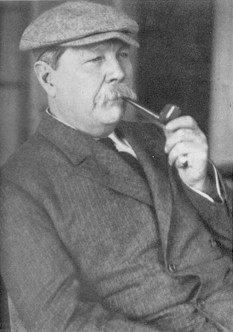
Birth of Sir Arthur Conan Doyle, Creator of Sherlock Holmes

Sir Arthur Ignatius Conan Doyle, British writer and physician, most noted for creating the fictional detective Sherlock Holmes and writing stories about him which are generally considered milestones in the field of crime fiction, is born at 11 Picardy Place, EdinburghScotland, on May 22, 1859.

Doyle’s father, Charles Altamont Doyle, is an Englishman of Irish Catholic descent and his mother, Mary (née Foley), is Irish Catholic. Charles dies in 1893, in the Crichton Royal HospitalDumfries, after many years of psychiatric illness. Supported by wealthy uncles, Doyle is sent to the Jesuit preparatory school Hodder PlaceStonyhurst, at the age of nine. He then goes on to Stonyhurst College until 1875. From 1875 to 1876, he is educated at the Jesuit school Stella Matutina in FeldkirchAustria. Doyle later rejects the Catholic faith and becomes an agnostic. He also later becomes a spiritualist mystic.

From 1876 to 1881 Doyle studies medicine at the University of Edinburgh Medical School. While studying, he begins writing short stories. His first published piece, The Mystery of Sasassa Valley, is printed in Chambers’s Edinburgh Journal on September 6, 1879. After stints as a ship’s doctor and a failed medical practice with former classmate George Turnavine Budd, Doyle arrives in Portsmouth in June 1882 and sets up a medical practice at 1 Bush Villas in Elm Grove, Southsea. The practice is slow to develop and while waiting for patients, Doyle again begins writing fiction. In 1890, Doyle studies ophthalmology in Vienna and moves to London.

Doyle’s first work featuring Sherlock Holmes and Dr. Watson, A Study in Scarlet, is published by Ward Lock & Co. in November 1886. The piece appears one year later in the Beeton’s Christmas Annual and receives good reviews in The Scotsman and the Glasgow Herald.

A sequel to A Study in Scarlet is commissioned and The Sign of the Four appears in Lippincott’s Magazine in February 1890, the last under agreement with the Ward Lock company. Short stories featuring Sherlock Holmes are published in The Strand Magazine.

In December 1893, wanting to dedicate more time to historical novels, Doyle has Holmes and Professor Moriarty plunge to their deaths together down the Reichenbach Falls in the The Final Problem. Public outcry, however, leads him to feature Holmes in 1901 in the novel The Hound of the Baskervilles. Holmes is ultimately featured in a total of 56 short stories, the last published in 1927, and four novels by Doyle.

Between 1888 and 1906, Doyle writes seven historical novels, which many critics regard as his best work. He also authors nine other novels and, later in his career between 1912 and 1929, five stories, two of novella length, featuring the irascible scientist Professor Challenger.

He twice stands for Parliament as a Liberal Unionist, in 1900 in Edinburgh Central and in 1906 in the Hawick Burghs, but he is not elected. In May 1903, he is appointed a Knight of Grace of the Order of the Hospital of Saint John of Jerusalem.

Doyle is a supporter of the campaign for the reform of the Congo Free State, led by the journalist E. D. Morel and diplomat Roger Casement. He becomes acquainted with Morel and Casement and, together with Bertram Fletcher Robinson, they inspire several characters in the 1912 novel The Lost World. When Casement is found guilty of treason against the Crown during the 1916 Easter Rising, Doyle tries unsuccessfully to save him from facing the death penalty, arguing that Casement has been driven mad and cannot be held responsible for his actions.

Found clutching his chest in the hall of Windlesham Manor, his house in CrowboroughEast Sussex, on July 7, 1930, Doyle dies of a heart attack at the age of 71. At the time of his death there is some controversy concerning his burial place, as he is avowedly not a Christian, but rather considers himself a Spiritualist. He is first buried on July 11, 1930, in Windlesham rose garden. He is later reinterred together with his wife in Minstead churchyard in the New ForestHampshire.


Leave a comment

Birth of Thomas James Clarke, Irish Revolutionary Leader

thomas-james-clarke

Thomas James “Tom” Clarke, Irish republican revolutionary leader and arguably the person most responsible for the 1916 Easter Rising, is born to Irish parents on March 11, 1858, at Hurst Castle, Milford-on-Sea, Hampshire, England opposite the Isle of Wight. Clarke’s father, a sergeant in the British Army, is transferred to Dungannon, County Tyrone, in 1865 and it is there that Tom grows up.

In 1878, following the visit to Dungannon of John Daly, Clarke joins the Irish Republican Brotherhood (IRB) and soon becomes head of the local IRB circle. In August, in retaliation to the killing of a man by a member of the Royal Irish Constabulary (RIC), Clarke and other IRB members attack some RIC men in Irish Street but are driven back. Fearing arrest, Clarke flees to the United States.

In 1883, Clarke is sent to London to blow up London Bridge as part of the Fenian dynamite campaign advocated by Jeremiah O’Donovan Rossa. He is arrested along with three others and tried and sentenced to penal servitude for life on May 28, 1883, at London’s Old Bailey. He subsequently serves 15 years in Pentonville and other British prisons. In 1896, a series of public meetings in Ireland call for the release of Clarke and the other four remaining Fenian prisoners.

Following his release in 1898, Clarke moves to Brooklyn, New York where he marries Kathleen Daly, 21 years his junior and niece of John Daly. Clarke works for the Clan na Gael under John Devoy. In 1906, the couple moves to a 30-acre farm in Manorville, New York and purchases another 30 acres in 1907 shortly before returning to Ireland.

In Ireland, Clarke opens a tobacconist shop in Dublin and immerses himself in the IRB which is undergoing a substantial rejuvenation under the guidance of younger men such as Bulmer Hobson and Denis McCullough.

Clarke takes a keen interest when the Irish Volunteers are formed in 1913 but takes no part in the organisation feeling that his criminal record would lend discredit to the Volunteers. With several IRB members taking important roles in the Volunteers, it becomes clear that the IRB will have substantial to total control of the Volunteers. This proves largely to be the case until John Redmond, leader of the Irish Parliamentary Party, demands the Provisional Committee accept 25 additional members of the Party’s choosing, giving IPP loyalists a majority stake. Though most of the hard-liners stand against this, Redmond’s decree is accepted, partially due to the support given by Bulmer Hobson. Clarke never forgives him for what he considers a treasonous act.

Following Clarke’s falling out with Hobson, Sean MacDermott and Clarke become almost inseparable. In 1915, Clarke and MacDermott establish the Military Committee of the IRB to plan what later becomes the Easter Rising. The members are Patrick PearseÉamonn Ceannt, and Joseph Plunkett, with Clarke and MacDermott adding themselves shortly thereafter. When Jeremiah O’Donovan Rossa dies in 1915, Clarke uses his funeral to mobilise the Volunteers and heighten expectation of imminent action. When an agreement was reached with James Connolly and the Irish Citizen Army in January 1916, Connolly is added to the committee. Thomas MacDonagh is added at the last minute in April. These seven men are the signatories of the Proclamation of the Irish Republic, with Clarke as the first signatory.

Clarke is stationed at headquarters in the General Post Office during the events of Easter Week of 1916, where rebel forces are largely composed of Irish Citizen Army members under the command of Connolly. Though he holds no formal military rank, Clarke is recognised by the garrison as one of the commanders and is active throughout the week in the direction of the fight. Following their surrender on April 29, Clarke is held in Kilmainham Gaol until his execution by firing squad on May 3 at the age of 59. He is the second person to be executed following Patrick Pearse.

Before his execution, Clarke asks his wife to give this message to the Irish People:

“I and my fellow signatories believe we have struck the first successful blow for Irish freedom. The next blow, which we have no doubt Ireland will strike, will win through. In this belief, we die happy.”