seamus dubhghaill

Promoting Irish Culture and History from Little Rock, Arkansas, USA


Leave a comment

Death of John Francis Larchet, Composer & Teacher

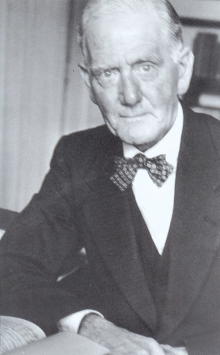
John Francis Larchet, Irish composer and teacher, dies in Dublin on August 10, 1967.

Larchet is born on July 13, 1884, at Sandymount, Dublin, the son of John Edward Larchet, manager of a wine business, and his wife Isabella Emily (née Farmar). Educated at the Catholic University School in Leeson Street, Dublin, he subsequently commences study under Michele Esposito at the Royal Irish Academy of Music (RIAM) in Dublin, winning many prizes for composition, theory, harmony, and counterpoint from 1903 to 1912. As a student at Trinity College Dublin (TCD), he obtains his Bachelor of Music in 1915 and Doctor of Music in 1917 and comes to dominate the music profession in Dublin over the next forty years, moulding the composers, teachers, and conductors of the next generation, while developing an Irish school of music based on folk tradition but writing in the modern idiom. A senior professor at the RIAM by 1920, the following year he is appointed professor of music at University College Dublin (UCD), where he remains until 1958, successfully establishing music as a serious discipline within the university. He is director of music examinations for Irish secondary schools (1907–34) and succeeds in raising standards of teaching, particularly with regard to rectifying weakness in the teaching of the theory of music.

Along with Aloys Fleischmann and composer Frederick May, Larchet keeps discourse on music in the public domain during the 1930s and 1940s, frequently addressing the need for a national school of music and a system of music education that would raise standards of musical appreciation and nurture a school of Irish composers.

Appointed music director at the Abbey Theatre in 1907, he is closely associated with Lady Gregory and W. B. Yeats, establishing a tradition of music at the theatre that delights critics. A popular myth at the time is that there are some who leave the theatre during the acts and return to enjoy Larchet’s music during the intervals. Appointed musical adviser to the army in 1923, he introduces a new philharmonic pitch, and serves as president of the Dublin Grand Opera Society for many years.

A fellow of the RIAM, Larchet also conducts the Dublin Amateur Orchestra Society, is choir master of the Jesuit church in Gardiner Street, Dublin, and organises annual orchestral concerts at the Royal Dublin Society (RDS). He is also involved in preparing a report for the commission on vocational organisation on behalf of the Musical Association of Ireland. The products of his own creative endeavour are mostly orchestral and choral works including An Ardglass Boat Song, Pádraic the Fiddler, and Diarmuid’s Lament.

Perhaps the main challenge facing Larchet in the 1920–50 period is the divide between “colonial” and “native” which has characterised the history of music in Ireland. A gentle-mannered, kindly man who is acutely aware of the lack of a national policy for music, he is a persuasive advocate of the European aesthetic and his main aim is said to have been “a reconciliation between the cultural chauvinism of Ireland as an emergent nation state and the central value (artistic as well as educational) of music as a vital dynamic in Irish cultural affairs.”

Although it can be argued that Larchet is not possessed of a uniquely original voice, with his authority coming rather from his enormous workload and his essential contribution as a teacher, it is no exaggeration to claim that the majority of Irish composers who emerge in the decades after the 1940s are influenced by his guidance, including Frank Llewellyn Harrison, Frederick May, Joan Trimble and Brian Boydell.

In addition to receiving an honorary Doctor of Music from the National University of Ireland (NUI) in 1953, Larchet is made a Commendatore of the Italian Republic.

Larchet dies in Dublin on August 10, 1967. He is survived by his wife, Madeleine Moore, a well-known musician, and their two daughters and son, also musicians. His daughter, Sheila Larchet Cuthbert, is an Irish harpist and author. She publishes The Irish Harp Book: A Tutor and Companion (Dublin, 1975).

(From: “Larchet, John Francis” by Diarmaid Ferriter, Dictionary of Irish Biography, http://www.dib.ie, October 2009)


Leave a comment

Birth of Seóirse Bodley, Composer & Associate Professor of Music at UCD

Seóirse Bodley, Irish composer and former associate professor of music at University College Dublin (UCD), is born George Pascal Bodley in Dublin on April 4, 1933. In 2008, he is the first composer to become a Saoi of Aosdána. He is widely regarded as one of the most important composers of twentieth-century art music in Ireland, having been “integral to Irish musical life since the second half of the twentieth century, not just as a composer, but also as a teacher, arranger, accompanist, adjudicator, broadcaster, and conductor.”

Bodley’s father is George James Bodley (1879–1956), an employee in the Dublin office of the London Midland & Scottish Railway Company, and later of the Ports and Docks Board. His mother, Mary (née Gough, 1891–1977), works for the Guinness Brewery. He attends schools in the Dublin suburbs of Phibsborough and Glasnevin before he moves at the age of nine to an Irish-speaking Christian Brothers school at Parnell Square. He later studies at the School of Commerce in Rathmines, where he obtains his Leaving Certificate.

Music is encouraged in his parents’ home, and Bodley receives initial lessons on the mandolin from his father and on the piano from his mother. He studies the piano, harmony and counterpoint at the Royal Irish Academy of Music and obtains a Licentiate in piano from Trinity College London (TCL). From the age of 13, he also enrolls for a time at the Brendan Smith Academy of Acting. While he is still at school, he receives his first lessons in composition privately from the Dublin-based German choral conductor Hans Waldemar Rosen (1904–94), which continues, on and off, until 1956. From his student days he performs as an accompanist to singers and takes part in chamber music performances. An important element in his musical education is the twice-weekly free concerts given by the Radio Éireann Symphony Orchestra in the Phoenix Hall, Dame Court, where he has the opportunity to hear leading Irish and international performers and conductors presenting both classics and modern repertory.

From 1952 Bodley studies for a Bachelor of Music degree from University College Dublin, mainly with Anthony Hughes. He obtains the degree in 1955. From 1957 to 1959 he studies composition (with Johann Nepomuk David) and conducting at the Württembergische Hochschule für Musik in Stuttgart, Germany, and a year later he obtains a Doctorate in Music from UCD. He also takes classes in conducting with Hans Müller-Kray and Karl Maria Zwißler, and in piano with Alfred Kreutz. He returns to Germany several times in the early 1960s to participate in courses at the Darmstädter Ferienkurse, which significantly expands his knowledge of avant-garde techniques.

From 1959 until his retirement in 1998, Bodley lectures at the university’s music department, becoming associate professor in 1984. During the 1960s, he is conductor of the Culwick Choral Society.

Bodley’s development as a composer sees several distinct phases. In the 1970s he merges avant-garde styles with elements from Irish traditional music and becomes a figure of national importance. He receives several prestigious commissions for large-scale works, such as Symphony No. 3 (1981), written for the opening of the National Concert Hall.

In 1982 Bodley becomes a founder-member of Aosdána and President Mary McAleese confers the distinction of Saoi on him in November 2008. McAleese says that Bodley “has helped us to recast what it means to be an artist in Ireland.”


2 Comments

Birth of Charles Wood, Composer & Teacher

Charles Wood, composer and teacher, is born in Vicars’ Hill in the Cathedral precincts of Armagh, County Armagh on June 15, 1866. His pupils include Ralph Vaughan Williams at Cambridge and Herbert Howells at the Royal College of Music. For most of his adult life he lives in England, but preserves a lively interest in Ireland.

Wood is the fifth child and third son of Charles Wood, Sr. and Jemima Wood. He is a treble chorister in the choir of the nearby St. Patrick’s Cathedral. His father sings tenor as a stipendiary “Gentleman” or “Lay Vicar Choral” in the Cathedral choir and is also the Diocesan Registrar of the church. He is a cousin of Irish composer Ina Boyle.

Wood receives his early education at the Cathedral Choir School and also studies organ with two Organists and Masters of the Boys of Armagh Cathedral, Robert Turle and his successor Dr. Thomas Marks. In 1883 he becomes one of fifty inaugural class members of the Royal College of Music, studying composition with Charles Villiers Stanford and Charles Hubert Hastings Parry primarily, and horn and piano secondarily. Following four years of training, he continues his studies at Selwyn College, Cambridge through 1889, where he begins teaching harmony and counterpoint.

In 1889 he attains a teaching position at Gonville and Caius College, Cambridge, first as organ scholar and then as fellow in 1894, becoming the first Director of Music and Organist. He is instrumental in the reflowering of music at the college, though more as a teacher and organiser of musical events than as composer. After Stanford dies in 1924, Wood assumes his mentor’s vacant role as Professor of Music in the University of Cambridge.

Like his better-known colleague Stanford, Wood is chiefly remembered for his Anglican church music. As well as his Communion Service in the Phrygian mode, his settings of the Magnificat and Nunc dimittis are still popular with cathedral and parish church choirs, particularly the services in F, D, and G, and the two settings in E flat. During Passiontide his St. Mark Passion is sometimes performed, and demonstrates Wood’s interest in modal composition, in contrast to the late romantic harmonic style he more usually employs.

Wood’s anthems with organ, Expectans expectavi, and O Thou, the Central Orb are both frequently performed and recorded, as are his unaccompanied anthems Tis the day of Resurrection, Glory and Honour and, most popular of all, Hail, gladdening light and its lesser-known equivalent for men’s voices, Great Lord of Lords. All of Wood’s a cappella music demonstrates fastidious craftsmanship and a supreme mastery of the genre, and he is no less resourceful in his accompanied choral works which sometimes include unison sections and have stirring organ accompaniments, conveying a satisfying warmth and richness of emotional expression appropriate to his carefully chosen texts.

Wood collaborates with priest and poet George Ratcliffe Woodward in the revival and popularisation of renaissance tunes to new English religious texts, notably co-editing three books of carols. He also writes eight string quartets, and is co-founder of the Irish Folk Song Society in 1904.

He marries Charlotte Georgina Wills-Sandford, daughter of W. R. Wills-Sandford, of Castlerea, County Roscommon on March 17, 1898. Their son is killed in World War I.

Charles Wood dies on July 12, 1926 and is buried at the Ascension Parish Burial Ground in Cambridge alongside his wife.