seamus dubhghaill

Promoting Irish Culture and History from Little Rock, Arkansas, USA


Leave a comment

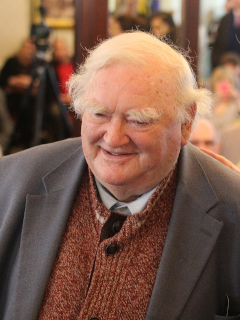
Birth of Tim Pat Coogan, Journalist, Writer & Broadcaster

Timothy Patrick “Tim Pat” Coogan, Irish journalist, writer and broadcaster, is born in Monkstown, County Dublin, on April 22, 1935. He serves as editor of The Irish Press newspaper from 1968 to 1987. He is best known for such books as The IRA (1970) and On the Blanket: The H Block Story (1980), and biographies of Michael Collins and Éamon de Valera.

Coogan’s particular focus is on Ireland’s nationalist/independence movement in the 20th century, a period of unprecedented political upheaval. He blames the Troubles in Northern Ireland on “Paisleyism.”

Coogan is the first of three children born to Beatrice (née Toal) and Eamonn Coogan, a native of Kilkenny who is an Irish Republican Army (IRA) volunteer during the Irish War of Independence and later serves as the first Deputy Commissioner of the newly established Garda Síochána, then a Fine Gael TD for the Kilkenny constituency. His mother, the daughter of a policeman, is a Dublin socialite who is crowned Dublin’s Civic Queen of Beauty in 1927. She writes for the Evening Herald and takes part in various productions in the Abbey Theatre and Radio Éireann. He spends many summer holidays in the town of Castlecomer, County Kilkenny, his father’s hometown.

A former student of the Irish Christian Brothers in Dún Laoghaire and Belvedere College in Dublin, Coogan spends most of his secondary studies at Blackrock College in Dublin.

In 2000, Irish writer and editor Ruth Dudley Edwards is awarded £25,000 damages and a public apology by the High Court in London against Coogan for factual errors in references to her in his book Wherever Green is Worn: The Story of the Irish Diaspora (2000). In the book, he writes that Dudley Edwards had “groveled to and hypocritically ingratiated herself with the English establishment to further her writing career.” He also alleges that Dudley Edwards “had abused the position of chairwoman of the British Association for Irish Studies (BAIS) by trying to impose her political views on it” and that her commission to write True Brits had been awarded because of political favouritism.

When Taoiseach Enda Kenny causes confusion following a speech at Béal na Bláth by incorrectly claiming Michael Collins had brought Lenin to Ireland, Coogan comments, “Those were the days when bishops were bishops and Lenin was a communist. How would that have gone down with the churchyard collections?”

In November 2012, for reasons that are uncertain, the United States embassy in Dublin refuses to grant Coogan a visa to visit the United States. As a result, a planned book tour for his book The Famine Plot, England’s role in Ireland’s Greatest Tragedy (2012) is cancelled. After representations to then Secretary of State Hillary Clinton by United States Senator Chuck Schumer (D-NY) and Congressman Peter T. King (R-NY), he receives his visa.

Coogan has been criticised by the Irish historians Liam Kennedy and Diarmaid Ferriter, as well as Cormac Ó Gráda, for a supposed lack of thoroughness in his research and bias:

“Well, I waited in this book to hear some great revelation, and it just isn’t there. It’s anticlimactic. I could not see the great plot, and indeed there is no serious historian who … I can’t think of a single historian who has researched the Famine in depth – and Tim Pat has not researched it in depth” (The Famine Plot).

“Coogan is not remotely interested in looking at what others have written on 20th-century Irish history…. he does not appear interested in context and shows scant regard for evidence. He does not attempt to offer any sustained analysis in relation to the challenges of state building, the meaning of sovereignty, economic and cultural transformations, or comparative perspectives on the evolution of Irish society. There is no indication whatsoever that Coogan has engaged with the abundant archival material relating to the subject matter he pronounces on. There is no rhyme or reason when it comes to the citation of the many quotations he uses; the vast majority are not referenced. For the 300-page text, 21 endnotes are cited and six of them relate to Coogan’s previous books, a reminder that much of this tome consists of recycled material…. Tim Pat Coogan… he is a decent, compassionate man who has made a significant contribution to Irish life. But he has not read up on Irish history; indeed, such is the paucity of his research efforts that this book amounts to a travesty of 20th-century Irish history” (1916: The Mornings After).

Leave a comment

Neeson & Richardson Donate Libel Payout to Omagh Bombing Victims

On September 27, 1998, film star couple Liam Neeson and Natasha Richardson announce they will donate a five-figure libel payout to a memorial fund for the victims of the Omagh bomb massacre that occurred in Northern Ireland on August 15, 1998, killing 29 people.

Neeson and Richardson win £50,000 ($85,370) in libel damages over newspaper allegations that their marriage is on the rocks. The couple sues the Daily Mirror publishers MGN for libel and malicious falsehood after the tabloid paper claimed Natasha Richardson was filing for divorce behind her husband’s back and that their marriage was a sham.

The story is published in August 1998 in London, Scotland, the Irish Republic and Northern Ireland – where Neeson was born and where his family still live.

A High Court judge in London hears that the actors – married for four years with two young sons – were shocked by the allegations which caused “an explosion of publicity worldwide.”

Neeson, who is nominated for an Academy Award for his role in the film Schindler’s List, is told about the article by his mother. She phones him in great distress from Northern Ireland after seeing the headlines while out shopping.

The actors’ solicitor, Mark Thomson, tells Mr. Justice Gray that the couple then spent several days attempting to deal with the destructive aftermath of the articles denying the allegations to friends and family.

Mirror Group Newspapers accepts “unequivocally” that the story is entirely false and apologises for the embarrassment, hurt and distress caused to the couple. “We entirely accept that there is absolutely no truth in the allegations about Mr. Neeson and Miss Richardson and that the allegations should never have been published. We apologise unreservedly to Mr. and Mrs. Neeson and their family for the distress and embarrassment they have been caused. We have agreed not to repeat the allegations and to pay substantial damages to them, which they are donating to the victims of the Omagh bombing.”

The information came from a source thought to be reliable, but it was clearly a mistake for the reporter to rely on that source, says solicitor Martin Cruddace.


Leave a comment

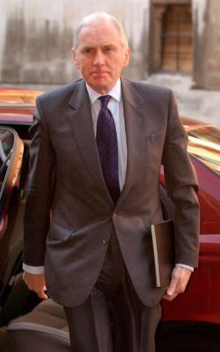
Birth of Brian Hutton, Lord Chief Justice of Northern Ireland

James Brian Edward Hutton, Baron Hutton, PC, a British Lord Chief Justice of Northern Ireland and Lord of Appeal in Ordinary, is born in Belfast, Northern Ireland, on June 29, 1932.

Hutton is the son of a railways executive. He wins a scholarship to Shrewsbury School and Balliol College, Oxford (BA jurisprudence, 1953) before returning to Belfast to study at Queen’s University Belfast and becoming a barrister, being called to the Bar of Northern Ireland in 1954. He begins working as junior counsel to the Attorney General for Northern Ireland in 1969.

Hutton becomes a Queen’s Counsel in 1970. From 1979 to 1989, as Sir Brian Hutton, he is a High Court judge. In 1989, he becomes Lord Chief Justice of Northern Ireland, becoming a member of the Privy Council of Northern Ireland, before moving to England to become a Lord of Appeal in Ordinary on January 6, 1997. He is consequently granted a life peerage as Baron Hutton, of Bresagh in the County of Down.

On March 30, 1994, as Lord Chief Justice of Northern Ireland, Hutton dismisses Private Lee Clegg‘s appeal against his controversial murder conviction. On March 21, 2002 he is one of four Law Lords to reject David Shayler‘s application to use a “public interest” defence as defined in section 1 of the Official Secrets Act 1989 at his trial.

Hutton represents the Ministry of Defence at the inquest into the killing of civil rights marchers on “Bloody Sunday.” Later, he publicly reprimands Major Hubert O’Neil, the coroner presiding over the inquest, when the coroner accuses the British Army of murder, as this contradicts the findings of the Widgery Tribunal.

Hutton also comes to public attention in 1999 during the extradition proceedings of former Chilean dictator General Augusto Pinochet. Pinochet had been arrested in London on torture allegations by request of a Spanish judge. Five Law Lords, the UK’s highest court, decide by a 3-2 majority that Pinochet is to be extradited to Spain. The verdict is then overturned by a panel of seven Law Lords, including Hutton, on the grounds that Lord Lennie Hoffmann, one of the five Law Lords, has links to human rights group Amnesty International which had campaigned for Pinochet’s extradition.

In 1978, Hutton defends the UK at the European Court of Human Rights in the case of Ireland v United Kingdom, when the court decides that the interrogation techniques used were “inhuman and degrading” and breached the European Convention on Human Rights, but do not amount to “torture.” The court also finds that the practice of internment in Northern Ireland had not breached the Convention. He sentences ten men to 1,001 years in prison on the word of “supergrass” informer Robert Quigley, who is granted immunity in 1984.

Hutton is appointed by Tony Blair‘s government to chair the inquiry on the circumstances surrounding the death of scientist David Kelly. The inquiry commences on August 11, 2003. Many observers are surprised when he delivers his report on January 28, 2004 and clears the British Government in large part. His criticism of the BBC is regarded by some as unduly harsh with one critic commenting that Hutton had given the “benefit of judgement to virtually everyone in the government and no-one in the BBC.” In response to the verdict, the front page of The Independent newspaper consists of one word, “Whitewash?”

Peter Oborne writes in The Spectator in January 2004: “Legal opinion in Northern Ireland, where Lord Hutton practised for most of his career, emphasises the caution of his judgments. He is said to have been habitually chary of making precedents. But few people seriously doubt Hutton’s fairness or independence. Though [he is] a dour Presbyterian, there were spectacular acquittals of some very grisly IRA terrorist suspects when he was a judge in the Diplock era.”

Hutton retires as a Law Lord on January 11, 2004. He remains a member of the House of Lords until retiring under the House of Lords Reform Act 2014 on April 23, 2018.

Hutton dies at the age of 88 on July 14, 2020.


2 Comments

Birth of Sir James Comyn, Irish-born English High Court Judge

Sir James Peter Comyn, Irish-born barrister and English High Court judge, is born at Beaufield House, Stillorgan, County Dublin on March 8, 1921. Considered by many to be “the finest all-round advocate at the English bar”, he is appointed to the High Court of Justice in 1978, serving on the bench until his retirement in 1985.

Comyn is the son of Nationalist barrister James Comyn KC and of Mary Comyn. Through his father he is the nephew of the barrister Michael Comyn KC. Both his father and uncle had been political and legal advisers to Éamon de Valera, who at one point uses Beaufield House as a safe house. However, the Comyn brothers have a falling out with de Valera shortly before he comes to power in 1932, and Michael Comyn is passed over as Attorney General of the Irish Free State. As a result, James Comyn, who is then attending Belvedere College in Dublin, is sent by his father to attend The Oratory School in England. He spends six months as a trainee at The Irish Times under the editor R. M. “Bertie” Smyllie, but abandons journalism after a joke he added to an obituary is printed in the paper, leading to his demotion to the racing department.

Comyn then matriculates at New College, Oxford, where he reads law, graduating with Second Class Honours. In 1940, he defeats Roy Jenkins for the presidency of the Oxford Union, winning by four votes. After suffering the first of several breakdowns through his life, he briefly works for the BBC‘s Empire Service during World War II.

Comyn is called to the English bar by the Inner Temple in 1942, the Irish bar in 1947, and the Hong Kong bar in 1969. In 1944, he begins his pupillage with Edward Holroyd Pearce KC, later a law lord, and joins his chambers at Fountain Court. He practises in London and on the Western circuit, supplementing his earnings by teaching banking, a subject of which he knows nothing. On one occasion, he rises in Lambeth County court to cross-examine a female defendant in an eviction case. Just as he begins by saying “Madam,” the defendant opens her bag, takes out a dead cat, and throws it at him. The judge’s reaction is to tell the defendant, “Madam, if you do that again, I’ll commit you.” Comyn wins the case.

Comyn takes silk in 1961, and acquires a large practice as a senior, appearing in many high-profile cases. In 1964, he wins damages for libel for the former safe-breaker Alfred George Hinds against a Scotland Yard inspector by convincing the jury that Hinds is in fact innocent. In 1970, he successfully defends the Labour MP Will Owen, who is accused of providing information to the Czechoslovak intelligence services. In 1975, he defeats the government’s attempt to obtain an injunction against the publication of the diaries of former minister Richard Crossman.

Comyn is Recorder of Andover between 1964 and 1971 (honorary life recorder from 1972), commissioner of assize for the Western Circuit in 1971, and a Recorder of the Crown Court between 1972 and 1977. He is elected a bencher of the Inner Temple in 1968 and serves as chairman of the Bar council from 1973 to 1974.

Having refused a previous invitation by Quintin Hogg, Baron Hailsham of St. Marylebone to join the bench, Comyn is again nominated by Elwyn Jones, Baron Elwyn-Jones, in 1977, and is appointed a High Court judge in 1978, receiving the customary knighthood upon his appointment. Initially assigned to the Family Division, he does not take to the work and is reassigned to the Queen’s Bench Division in 1979. He has a reputation for leniency in sentencing, first acquired as Recorder of Andover. In 1980–81, he presides over an unsuccessful libel action by a member of the Unification Church, colloquially known as the Moonies, against the Daily Mail, the longest libel trial in England up to that time. His Irish background makes him the target of Irish Republican Army (IRA) action, and in 1981 the Provisional IRA burns his house in Tara.

Recurring bouts of depression lead to Comyn’s early retirement, on grounds of ill health, in 1985. In retirement, he divides his time between England and Ireland, whose citizenship he has retained. He writes a number of books, including memoirs, light verse, and books on famous trials. He also breeds Friesian cattle. He dies in Navan, County Meath on January 5, 1997, at age 75.