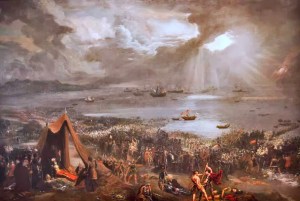
Diarmait Mac Murchada, Irish King of Leinster whose appeal to the English for help in settling an internal dispute leads to the Anglo-Norman invasion and conquest of Ireland by England, dies on May 1, 1171, of “an insufferable and unknown disease.”
Mac Murchada is born around 1110, the son of Donnchad mac Murchada, King of Leinster and Dublin. His father is killed in battle in 1115 by his cousin Sigtrygg Silkbeard, king of the Dublin Vikings, and is buried by them in Dublin along with the body of a dog which is considered to be a huge insult.
After the death of Énna Mac Murchada, his older brother, Mac Murchada unexpectedly becomes King of Leinster. This is opposed by the High King of Ireland, Toirdelbach Ua Conchobair, who fears that Mac Murchada will become a rival. Toirdelbach sends one of his allied Kings, the belligerent Tigernán Ua Ruairc, to conquer Leinster and oust the young Mac Murchada. Ua Ruairc goes on a brutal campaign slaughtering the livestock of Leinster and thereby trying to starve the province’s residents. Mac Murchada is ousted from his throne but is able to regain it with the help of Leinster clans in 1132. Two decades of an uneasy peace followed between Ua Conchobair and Mac Murchada. In 1152 he even assists the High King in a raid of the land of Ua Ruairc who has become a renegade.
As King of Leinster, between 1140–70, Mac Murchada commissions Irish Romanesque churches and abbeys at Baltinglass, Glendalough, Ferns, and Killeshin. He sponsors convents at Dublin, two at Aghade, County Carlow, and at Kilculliheen near Waterford city. He also sponsors the successful career of churchman St. Lorcán Ua Tuathail and presides at the synod of Clane in 1161 when Ua Tuathail is installed as archbishop of Dublin.
In 1166, Ireland’s new High King and Mac Murchada’s only ally, Muirchertach Ua Lochlainn, has fallen and a large coalition led by Mac Murchada’s arch enemy, Tigernán Ua Ruairc, marches on Leinster. The High King deposes Mac Murchada from the throne of Leinster, and he flees to Wales and from there to England and France seeking the support of Henry II of England in the recruitment of soldiers to reclaim his kingship. Henry authorises Mac Murchada to seek help from the soldiers and mercenaries in his kingdom. Those who agreed to help include Richard de Clare (Strongbow) and half-brothers Robert FitzStephen and Maurice FitzGerald.
In Mac Murchada’s absence, Ruaidrí Ua Conchobair, son of Mac Murchada’s former enemy, the High King Toirdelbach Ua Conchobair, has become the new High King of Ireland.
Mac Murchada brings an advance party of adventurers back to Ireland in 1167, recaptures Wexford, and waits for Strongbow to arrive. From his base in Wales, Strongbow launches an offensive in 1170, capturing Waterford and Dublin, taking control of the East coast, much to the dismay of the Gaelic Chieftains and Ua Conchobair. To cement the alliance, Mac Murchada marries his daughter, Aoife, to Strongbow, in Christ Church Cathedral in Dublin 1170.
The Irish Chieftains do not allow the invaders to settle, however, and they are continually attacked and harassed. It begins to appear likely that they will be driven from Ireland. However, they receive support from Henry II, who has become concerned about the amount of power and influence that Strongbow is amassing in Ireland. The subsequent domination of South Wales by the Normans is a result of the need to keep supply lines into Eastern Ireland open.
Mac Murchada dies on May 1, 1171, leaving Strongbow to declare himself King of Leinster. Mac Murchada is buried in the Cathedral graveyard of Ferns village.