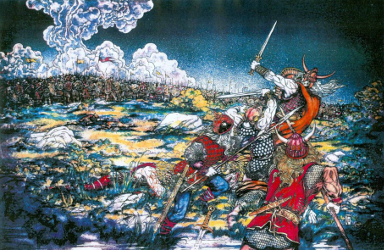
Following the outbreak of the rebellion, signaled in Meath by the prearranged signal of the ceasing of a mail coach near Turvey hill, road blocks are posted on the Navan road. Members of the Society of United Irishmen and rebels in Meath begin to assemble at the Hill of Tara. Tara is chosen as it provides strategic control of road access to the capital of Dublin and cultural significance as the former seat of the High Kings of Ireland. Between 4,000-7,000 rebels gather at the hill. Following the outbreak of the rebellion on May 23, there are incidents of violent encounters throughout the countryside as rallying rebels make their way to Tara.
Picking up yeomanry reinforcements along the way, the combined fencible, yeoman and militia force forms up at the bottom of the hill in advance of the attack on the rebels who have established a large camp on the hill. The lack of any cannon or cavalry places the rebels at a great disadvantage despite their numbers. Disciplined volley fire and flanking cavalry action combined with withering grapeshot delivered from a 6 pounder cannon drive the rebels to within the graveyard walls at the summit. There, at dusk, the rebels make their last stand on the hill until a final grenadier assault finishes them.
The loss to the fencibles, yeomen and militia is minimal. However rebel casualties have estimates running from several hundred to several thousand dead and many wounded. Many bodies are removed during the night of the 26th and 350 dead are counted still lying on the battlefield the following day. Witnesses to the burial recollect many more bodies of those rebels who died of their wounds during the night being collected from the surrounding countryside in carts. It is noted by the witnesses that the bodies are universally disembowelled by the victors. The dead are buried in a mass grave marked by the Lia Fáil stone which is moved to mark the burial site. The defeat effectively ends the United Irishmen’s rising in Meath.
(Pictured: The high cross at the site of the Battle of the Hill of Tara, County Meath)
Edward is the second of five sons of Robert de Brus, 6th Lord of Annandale and Marjorie, Countess of Carrick. His date of birth, believed to be around 1280, is unknown but King Robert is obviously the firstborn. He has eleven siblings, of whom nine survive childhood. One of his older sisters, Lady Christina Bruce, also plays an active role in the wars of independence against England.
By 1307 Edward fights alongside Robert throughout his struggle for the Scottish throne and accompanies him during his flight from Scotland and subsequent guerilla campaign against the English. The three younger Bruce brothers Nigel, Thomas, and Alexander are all captured and executed by the English during this period. Some time between 1309 and 1313, Edward is created Earl of Carrick, a title previously held by his maternal grandfather Niall of Carrick, his mother and his elder brother.
As the Scots become more dominant, Edward commands a number of successful sieges of English-held castles across the country. By November 1313 he commands the siege of the last remaining English outpost in Scotland, Stirling Castle. Without Robert’s knowledge, he makes a deal with the English Constable of the castle that should an English army not arrive to relieve it by June 24, 1314, the castle will surrender, so making an aggressive siege unnecessary. Robert is deeply unhappy, but has little choice but to confront the English army sent by Edward II to relieve Stirling in June 1314. The armies meet at the Battle of Bannockburn, and the result is a decisive victory for the Scots which leaves Robert in fairly unopposed control of Scotland.
Robert decides to open a second front against the English and dispatches an army of 6,000 men under the command of Edward to Ireland. The aim is to challenge English dominance of the British Isles by drawing together Scottish and Irish interests. Scottish and Irish forces are initially successful in defeating the English and on May 2, 1316 Edward is appointed High King of Ireland.
A famine in 1317 proves a setback to Edward and greatly reduces his popularity. This allowed time for an English army under John de Bermingham to be assembled. The English army meets the Scots-Irish army under King Edward Bruce at the Battle of Faughart on October 14, 1318. The Scots-Irish army is badly defeated by de Bermingham’s forces. Edward is killed, his body being quartered and sent to various towns in Ireland, and his head being delivered to King Edward II.
Edward Bruce is the last High King of Ireland.
(Pictured: Grave of King Edward De Bruce, located in Faughart Cemetery)
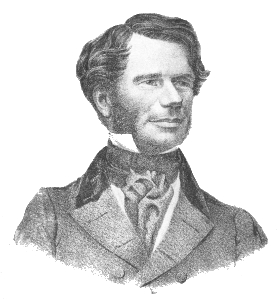
Although a Protestant country-gentleman, O’Brien supports Catholic emancipation while remaining a supporter of British-Irish union. In 1843, in protest against the imprisonment of Daniel O’Connell, he joins O’Connell’s anti-union Repeal Association.
Three years later, O’Brien withdraws the Young Irelanders from the association. In January 1847, with Thomas Francis Meagher, he founds the Irish Confederation, although he continues to preach reconciliation until O’Connell’s death in May 1847. He is active in seeking relief from the hardships of the famine. In March 1848, he speaks out in favour of a National Guard and tries to incite a national rebellion. He is tried for sedition on May 15, 1848, but is not convicted.
On July 29, 1848, O’Brien and other Young Irelanders lead landlords and tenants in a rising in three counties, with an almost bloodless battle against police at Ballingarry, County Tipperary. In O’Brien’s subsequent trial, the jury finds him guilty of high treason. He is sentenced to be hanged, drawn, and quartered. Petitions for clemency are signed by 70,000 people in Ireland and 10,000 people in England. In Dublin on June 5, 1849, the sentences of O’Brien and other members of the Irish Confederation are commuted to transportation for life to Van Diemen’s Land (Tasmania in present-day Australia).
O’Brien attempts to escape from Maria Island off Tasmania but is betrayed by the captain of the schooner hired for the escape. He is sent to Port Arthur where he meets up with John Mitchel.
O’Brien is a founding member of the Ossianic Society, which is founded in Dublin on St. Patrick’s Day 1853, whose aim is to further the interests of the Irish language and to publish and translate literature relating to the Fianna. He writes to his son Edward from Van Diemen’s Land, urging him to learn the Irish language. He himself studies the language and uses an Irish-language Bible and presents to the Royal Irish Academy Irish-language manuscripts he has collected.
In 1854, after five years in Tasmania, O’Brien is released on the condition he never returns to Ireland. He settles in Brussels. In May 1856, he is granted an unconditional pardon and returns to Ireland that July. He contributes to the Nation newspaper but plays no further part in politics.
In 1864 he visits England and Wales, with the view of rallying his failing health, but no improvement takes place, and he dies at Bangor, in Wales on June 16, 1864.
A statue of William Smith O’Brien stands in O’Connell Street, Dublin. Sculpted in Portland limestone, it is designed by Thomas Farrell and erected in D’Olier Street, Dublin, in 1870. It is moved to its present position in 1929.
The earliest verifiable date of a Viking invasion of Ireland is September 9, 872, in Dunrally in what is now County Laois.
The Vikings conduct extensive raids in Ireland and found many towns, including Dublin, Limerick, Wexford, Waterford, Wicklow, Arklow and Leixlip. Literature, crafts, and decorative styles in Ireland and Britain reflect Scandinavian culture. Vikings trade at Irish markets in Dublin. Excavations find imported fabrics from England, Byzantium, Persia, and Central Asia. Dublin becomes so crowded by the 11th century that houses are built outside the town walls.
The Vikings pillage monasteries on Ireland’s west coast in 795 and then spread out to cover the rest of the coastline. The north and east of the island are most affected. During the first 40 years, the raids are conducted by small, mobile Viking groups. From 830 on, the groups consist of large fleets of Viking ships. From 840, the Vikings begin establishing permanent bases at the coasts. Dublin is the most significant settlement in the long term. The Irish become accustomed to the Viking presence and culture. In some cases, they become allies and also intermarry.
In 832, a Viking fleet of about 120 ships under Turgesius invades kingdoms on Ireland’s northern and eastern coasts. Some believe that the increased number of invaders coincides with Scandinavian leaders’ desires to control the profitable raids on the western shores of Ireland. During the mid-830s, raids begin to push deeper into Ireland. Navigable waterways make this deeper penetration possible. After 840, the Vikings have several bases in strategic locations throughout Ireland.
In 838, a small Viking fleet enters the River Liffey in eastern Ireland, probably led by the chieftain Saxolb, who is killed later that year. The Vikings set up a base, which the Irish call longphorts. This longphort would eventually become Dublin. After this interaction, the Irish experience Viking forces for about 40 years. The Vikings also establish longphorts in Cork, Limerick, Waterford, and Wexford. The Vikings are driven out of Ireland for a short period around 900 but return to Waterford in 914 to found what would become Ireland’s first city. The other longphorts are soon re-occupied and developed into cities and towns.
The last major Irish battle involving Vikings is the Battle of Clontarf in 1014, in which a large force from the pan-Viking world and their Irish allies oppose Brian Boru, then the High King of Ireland and his forces, a small contingent of which are Viking defectors. The battle is fought in what is the now Dublin suburb of Clontarf on Good Friday of that year. Boru, the Irish High King has allowed the Viking King of Dublin, Sigtrygg Silkbeard, one year to prepare for his coming assault. Silkbeard responds by offering the bed of his mother to several Viking lords from Scandinavia, Ireland and Britain. The savage mêlée between the heavily mailed Norse and the unarmoured, yet undaunted Gaels ends in a rout of the Vikings and their Irish allies. Careful accounts are taken by both sides during the battle, and thus many famous warriors seek each other out for personal combat and glory. High King Brian, who is nearly eighty, does not personally engage in the battle but retires to his tent where he spends the day in quiet prayer.
The Viking Brodir of Man chances upon Brian’s tent as he flees the field. He and a few followers seize the opportunity, and surprise the High King, killing the aged Brian before being captured. Brian’s foster son Ulf the Quarrelsome later tracks down and dispatches Brodir by disembowelment. The battle is fairly matched for most of the day and each side has great respect for the prowess of the other, however, in the end, the Irish forces the Norse to return to the sea. Many of the fleeing Vikings are drowned in the surf due to their heavy mail coats as they struggled for the safety of their longships. Others are pursued and slain further inland.
After the battle, Viking power is broken in Ireland forever, though many settled Norse remain in the cities and prosper greatly with the Irish through trade. With Brian dead, Ireland returns to the fractured kingdom it had once been but is now cleared of further Viking predation.
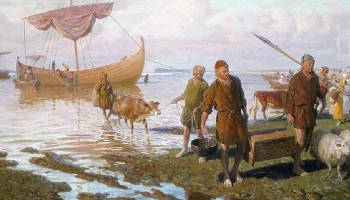
(Pictured: Guest from Overseas, Nicholas Roerich, 1901)
Ua Conchobair is born in 1153 and serves as King of Connacht from 1189 to 1199, and is re-inaugurated on the stone at Clonalis about 1201, reigning until 1224. He first succeeds his elder half brother Ruaidri‘s son Conchobar Máenmaige Ua Conchobair as ruler of Connacht. Conchobar Máenmaige’s son Cathal Carrach Ua Conchobair then rules from 1199 to 1202, with Cathal Crobhdearg back in power from then.
From his base west of the River Shannon he is forced to deal with the Norman invaders. He is a competent leader despite problems, avoiding major conflicts and winning minor skirmishes. Ua Conchobair attempts to make the best of the new situation with Ireland divided between Norman and Gaelic rulers. His long reign is perhaps a sign of relative success. He is the subject, as Cáhal Mór of the Wine Red Hand, of the poem A Vision of Connaught in the Thirteenth Century by the 19th-century Irish nationalist James Clarence Mangan.
In 1224 Ua Conchobair writes to Henry III as Lord of Ireland, asking that his son and heir Od (Aedh) be granted all of Connacht, in particular those parts, Kingdom of Breifne, owned by William Gorm de Lacy.
An account of Ua Conchobair’s inauguration has been preserved, written down by Donogh Bacach Ó Maolconaire, the son of O’Connor’s very inaugurator Tanaide Ó Maolconaire, who is also his historian.
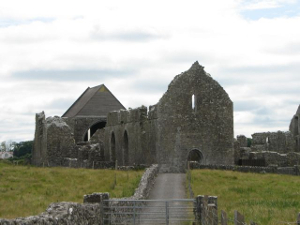
(Pictured: Ruins of the 12th century Cistercian Knockmoy Abbey which contains the burial site of King Cathal Crobhdearg Ua Conchobair)
Diarmait and the Normans seize Leinster within weeks and launch raids into neighbouring kingdoms. This military intervention has the backing of King Henry II of England and is authorized by Pope Adrian IV.
And there and then the high king stood strong and lay down too led by Richard de Clare, 2nd Earl of Pembroke, more commonly known as Strongbow. By May 1171, Strongbow has assumed control of Leinster and seized the Norse-Irishcity kingdoms of Dublin, Waterford, and Wexford. That summer, High King Ruaidrí Ua Conchobair (Rory O’Connor) leads an Irish counteroffensive against the Normans, but they manage to hold most of their conquered territory. In October 1171, King Henry lands a large Anglo-Norman army in Ireland to establish control over both the Cambro-Normans and the Irish. The Norman lords hand their conquered territory to Henry. He lets Strongbow hold Leinster in fief and declares the cities to be crown land. Many Irish kings also submit to him, likely in the hope that he will curb Norman expansion. Henry, however, grants the unconquered Kingdom of Meath to Hugh de Lacy. After Henry’s departure in 1172, Norman expansion and Irish counteroffensives continue.
The 1175 Treaty of Windsor acknowledges Henry as overlord of the conquered territory and Ruaidrí as overlord of the rest of Ireland, with Ruaidrí also swearing fealty to Henry. However, the Treaty soon falls apart. The Anglo-Norman lords continue to invade Irish kingdoms and they in turn launch counter-attacks. In 1177, Henry adopts a new policy. He declares his son John to be “Lord of Ireland” (i.e. of the whole country) and authorizes the Norman lords to conquer more land. The territory they hold becomes the Lordship of Ireland and forms part of the Angevin Empire. The largely successful nature of the invasion has been attributed to a number of factors. These include the Normans’ military superiority and programme of castle-building, the lack of a unified opposition from the Irish, and the Church’s support for Henry’s intervention.
The Norman invasion is a watershed in the history of Ireland, marking the beginning of more than 700 years of direct English and, later, British involvement in Ireland.
Lally is born at Romans-sur-Isère, Dauphiné, the son of Sir Gerald Lally, one of the original “Wild Geese” of 1691 and an Irish Jacobite from Tuam, County Galway, who married a French lady of noble family. His title is derived from the Lally’s ancestral home, Castel Tullendally in County Galway where the Lally’s, originally called O’Mullallys, are prominent members of the Gaelic Aristocracy who can trace their ancestry back to the second century High King of Ireland, Conn of the Hundred Battles.
Entering the French army in 1721 he serves in the war of 1734 against Austria. He is present at the Battle of Dettingen in 1743 and commands the regiment de Lally in the famous Irish brigade in the Battle of Fontenoy in May 1745. He is made a brigadier on the field by Louis XV of France.
When war breaks out with Britain in 1756 Lally is appointed governor-general of French India and commands a French expedition to India, made up of four battalions, two of whom are from his own Regiment of Lally of the Irish Brigade. He reaches Pondicherry in April 1758, and within six weeks has pushed the British back from the coast to Madras, the headquarters of the British East India Company.
He is a man of courage and a capable general, but his pride and ferocity make him unpopular with his officers and men. He is unsuccessful in an attack on Tanjore, and as he lacks French naval support he has to retire from the Siege of Madras in 1758, owing to the timely arrival of the British fleet. He is defeated by Sir Eyre Coote at the Battle of Wandiwash in 1760, and besieged in Pondicherry, where he is forced to capitulate in 1761.
Lally is sent to England as a prisoner of war. Public opinion in France is very hostile, blaming him for the defeat by the British, and there are widespread calls for Lally to be put on trial. While in London, he hears that he is accused of treason in France, and insists, against advice, on returning on parole to stand trial. He is kept prisoner for nearly two years before the trial begins in 1764. When the Advocate General of the Paris ParlementJoseph Omer Joly de Fleury begins the prosecution, Lally has not received any documentation of the charges and is not allowed a defence lawyer. Throughout the trial, which lasts for two years, Lally fights against Joly de Fleury’s charges but on May 6, 1766, he is convicted and sentenced to death.
Lally makes an unsuccessful attempt at suicide in prison after his sentencing. On May 9, 1766, three days after his conviction, he is gagged to prevent him from protesting his innocence further and is transported in a garbage cart to the Place de Grève to be beheaded. The executioner’s first blow only slices open his skull, and it takes a second blow to kill him.
Máel Sechnaill belongs to the Clann Cholmáin branch of the Uí Néill dynasty. He is the grandson of Donnchad Donn, great-grandson of Flann Sinna and great-great-grandson of the first Máel Sechnaill, Máel Sechnaill mac Máele Ruanaid. The Kings of Tara or High Kings of Ireland have for centuries alternated between the various Uí Néill branches. By Máel Sechnaill’s time this alternating succession passes between Clann Cholmáin in the south and the Cenél nEógain in the north, so that he succeeds Domnall ua Néill in 980.
In 980, Amlaíb Cuarán, King of Dublin, summons auxiliaries from Norse-ruled Scottish Isles and from Man and attacks Meath, but is defeated by Máel Sechnaill at Tara. Reginald, Olaf’s heir, is killed. Máel Sechnaill follows up his victory with a siege of Dublin which surrenders after three days and nights. When Maél Sechnaill takes Dublin in 980 he frees all the slaves then residing in the town.
In 997, at a royal meeting near Clonfert, Máel Sechnaill meets with his long-time rival Brian Boru, King of Munster. The two kings make a truce, by which Brian is granted rule over the southern half of Ireland, while Máel Sechnaill retains the northern half and high kingship. In honour of this arrangement, Máel Sechnaill hands over to Brian the hostages he has taken from Dublin and Leinster. The following year Brian hands over to Máel Sechnaill the hostages of Connacht. In the same year, Brian and Máel Sechnaill begin co-operating against the Norse of Dublin for the first time.
Late in 999, however, the Leinstermen, historically hostile to domination by either the Uí Néill overkings or the King of Munster, ally themselves with the Norse of Dublin and revolt against Brian. The Annals of the Four Masters records that Brian and Máel Sechnaill unite their forces and, according to the Annals of Ulster, they meet the Leinster-Dublin army at Glenmama on Thursday, December 30, 999. Glenmama, near Lyons Hill in Ardclough, County Kildare, is the ancient stronghold of the Kings of Leinster. The Munster-Meath army defeats the Leinster-Dublin army. Ó Corráin refers to it as a “crushing defeat” of Leinster and Dublin, while The dictionary of English history says the battle effectively “quelled” the “desperate revolt” of Leinster and Dublin. Most importantly, the defeat leaves the road to Dublin “free and unimpeded for the victorious legions of Brian and Mael Sechlainn.”
The system of alternating succession between the various Uí Néill branches is ended by Brian Boru’s so-called overthrow of Máel Sechnaill in 1002. It is a bloodless shift resulting from the failure of the Northern Uí Néill to support Máel Sechnaill against the aspirations of the extremely militarized overlord of Munster.
With the deaths of Brian Boru, his son, grandson, and many other Munster nobles at Clontarf in 1014, Máel Sechnaill succeeds in regaining the titular High Kingship, but the High Kingship, albeit with opposition, does not reappear until Diarmait mac Maíl na mBó of Leinster rises to power.
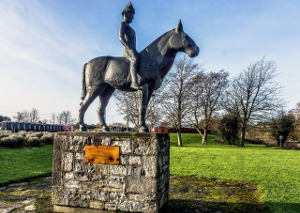
(Pictured: Sculpture of Máel Seachnaill in Trim, County Meath, by James McKenna)
A Viking settlement that would later become the city of Dublin is founded on the banks of the River Liffey on July 10, 988.
The first documented history of Dublin begins with the Viking raids in the 8th and 9th century. These lead to the establishment of a settlement on the south side of the mouth of the Liffey, named Dubh Linn (Black Pool) after the dark tidal pool where the River Poddle enters the Liffey which is where the Danes first moor their boats.
The Vikings, or Ostmen as they call themselves, rule Dublin for almost three centuries, although they are expelled in 902 only to return in 917 and notwithstanding their defeat by the Irish High KingBrian Boru at the Battle of Clontarf in 1014. From that date, the Norse are a minor political force in Ireland, firmly opting for a commercial life. Viking rule of Dublin ends completely in 1171 when the city is captured by King Dermot MacMurrough of Leinster, with the aid of Anglo-Normanmercenaries. An attempt is made by the last Norse King of Dublin, Ascall mac Ragnaill, to recapture the city with an army he raises among his relations in the Scottish Highlands, where he is forced to flee after the city is taken, but the attempted reconquest fails and Ascall is killed.
Dublin becomes the centre of English power in Ireland after the Norman invasion of the southern half of Ireland (Munster and Leinster) in 1169-1171, replacing Tara in Meath, seat of the Gaelic High Kings of Ireland, as the focal point of Ireland’s polity. On May 15, 1192, Dublin’s first written Charter of Liberties is granted by John, Lord of Ireland, and is addressed to all his “French, English, Irish and Welsh subjects and friends.” On June 15, 1229, his son Henry grants the citizens the right to elect a mayor who is to be assisted by two provosts. By 1400, however, many of the Anglo-Norman conquerors are absorbed into the Gaelic culture, adopting the Irish language and customs, leaving only a small area of Leinster around Dublin, known as the Pale, under direct English control.
The battle is allegedly the largest battle ever fought on the island of Ireland, and results in the death of Congal and the retreat of Domnall Brecc. The battle is caused as a result of the invading Gaels spreading out from Galway Bay. The Gaels have fled France and Spain to escape the Roman invasion of those areas. The Gaels are later to be known as Irish but are not native to the island. The native people of Ulster have been pushed into an area the size of two counties in what is now Antrim and Down.
Congal first establishes his power base in Dál nAraidi, where he becomes King before being recognised as King of Ulster in 627. His ambitions soon come into conflict with Domnall II, who becomes High King of Ireland in 628. Ironically, Domnall II rises to such a position because Congal has defeated and killed the previous High King, Suibne Menn, in a previous battle.
Domnall continues to press the rivalry with Congal very quickly. In 629 the two kings engage each other at the Battle of Dún Ceithirn in what is now County Londonderry. On that occasion Congal is defeated and Domnall is left unchallenged as the High King.
Throughout the 630s, Domnall continues to wage war on his rivals in the Uí Néill clan. In 637, however, Congal once again rises to challenge the Ard Rí, and enlists the help of Dál Riata to do so. The two forces meet just east of Lough Neagh.
Little is known about the actual battle itself. The armies of both Domnall II and Congal are primarily made up of warriors native to Ireland. However, Domnall I of Dál Riata brings a more varied force to the fight. His army included Scots, Picts, Anglo-Saxons, and Britons (Welshmen). At least one side has a substantial cavalry force.
There is reason to believe that the battle might have lasted a week, at the end of which the defeated force flees towards the woods of Killultagh. The forces of Ulster and Dál Riata are defeated, with Domnall of Dál Riata forced to flee north to his kingdom’s holdings. Congall is killed in the course of the battle.
The scale of the battle is confirmed in the 19th century when the railway line in Moira is being constructed. Thousands of bodies of men and horses are excavated. When one considers that the survivors probably numbered quite considerably more, then the reputation of the scale of the battle becomes obvious.