seamus dubhghaill

Promoting Irish Culture and History from Little Rock, Arkansas, USA


Leave a comment

Birth of Standish James O’Grady, Author, Journalist & Historian

Standish James O’Grady (Irish: Anéislis Séamus Ó Grádaigh), Irish author, journalist, and historian, is born in Castletownbere, County Cork, on September 18, 1846. He is inspired by Sylvester O’Halloran and plays a formative role in the Celtic Revival, publishing the tales of Irish mythology, as the History of Ireland: Heroic Period (1878), arguing that the Gaelic tradition has rival only from the tales of Homeric Greece.

O’Grady’s father is the Reverend Thomas O’Grady, the scholarly Church of Ireland minister of Castletown Berehaven, County Cork, and his mother Susanna Doe (or Dowe). The Glebe, his childhood home, lies a mile west of Castletownbere near a famine mass grave and ruined Roman Catholic chapel. He is a cousin of Standish Hayes O’Grady, another noted figure in Celtic literature, and of Standish O’Grady, 1st Viscount Guillamore. After a rather severe education at Tipperary Grammar School, he follows his father to Trinity College, Dublin, where he wins several prize medals and distinguishes himself in several sports.

O’Grady is a paradox for his times, proud of his Gaelic heritage, he is also a member of the Church of Ireland, a champion of aristocratic virtues (particularly decrying bourgeois values and the uprooting cosmopolitanism of modernity) and at one point advocates a revitalised Irish people taking over the British Empire and renaming it the Anglo-Irish Empire.

O’Grady proves too unconventional of mind to settle into a career in the church, and takes a job as a schoolmaster at Midleton College, then in a period of expansion. He also qualifies as a barrister, while earning much of his living by writing for the Irish newspapers. Reading Sylvester O’Halloran’s A general history of Ireland (1778) sparks an interest in early Irish history. After an initial lukewarm response to his writing on the legendary past in History of Ireland: The Heroic Period (1878) and Early Bardic Literature of Ireland (1879), he realises that the public wants romance, and so follows the example of James Macpherson in recasting Irish legends in literary form, producing historical novels including Finn and his Companions (1891), The Coming of Cuculain (1894), The Chain of Gold (1895), Ulrick the Ready (1896) and The Flight of the Eagle (1897), and The Departure of Dermot (1913).

O’Grady also studies Irish history of the Elizabethan period, presenting in his edition of Sir Thomas Stafford‘s Pacata Hibernia (1896) the view that the Irish people had made the Tudors into kings of Ireland to overthrow their unpopular landlords, the Irish chieftains. His The Story of Ireland (1894) is not well received, as it sheds too positive a light on the rule of Oliver Cromwell for the taste of many Irish readers. He is also active in social and political campaigns in connection with such issues as unemployment and taxation.

Until 1898, O’Grady works as a journalist for the Daily Express of Dublin, but in that year, finding Dublin journalism in decline, he moves to Kilkenny to become editor of the Kilkenny Moderator, which is printed at 28 High Street. It is here he becomes involved with Ellen Cuffe, Countess of Desart, and Captain Otway Cuffe. He engages in the revival of the local woolen and woodworking industries. In 1900 he founds the All-Ireland Review and returns to Dublin to manage it until it ceases publication in 1908. He also contributes to James LarkinsThe Irish Worker paper.

O’Grady’s influence crosses the divide of the Anglo-Irish and Irish-Ireland traditions in literature. His influence is explicitly stated by the Abbey Theatre set with Lady Gregory, W. B. Yeats and George William Russell attributing their interest in the Fenian Cycle of Gaelic tradition in part to him. This leads to him being known as the “Father of the Celtic Revival.” Some of the figures associated with the political party Sinn Féin, including its founder Arthur Griffith, have positive things to say about his efforts in helping to retrieve from the past the Gaelic heroic outlook.

O’Grady marries Margaret Allen Fisher, daughter of William Allen Fisher, and they have three sons. Advised to move away from Ireland for the sake of his health, they leave Ireland in 1918. After living in the north of France and Northamptonshire, they move to the Isle of Wight. He is working on a final exposition of his ideas when he dies suddenly on May 18, 1928.

O’Grady’s eldest son, Hugh Art O’Grady, is for a time editor of the Cork Free Press before he enlists in World War I in early 1915. He becomes better known as Dr. Hugh O’Grady, later Professor of the Transvaal University College, Pretoria (later the University of Pretoria), who writes the biography of his father in 1929.
Leave a comment

Laying of the Trinity College Foundation Stone

The foundation stone of Trinity College is laid by the Lord Mayor of Dublin on March 13, 1592.

By 1590 English rule is, with the exception of Ulster, firmly secured throughout Ireland. The Catholic Gaels and Old English of Munster, Leinster, and Connacht have been more or less brought to heel, and Presidencies are established over each of them.

English law is dominant, and Protestant English planters are laying claim to the lands seized from the Catholics. The present-day counties are already taking shape, land divisions modeled on the shires of Great Britain. Queen Elizabeth I feels that the time is right to bolster up English civility and in 1592 she grants the city of Dublin a charter to establish a university.

The university is to be named The College of the Holy and Undivided Trinity of Queen Elizabeth, juxta Dublin. It has been commonly called Trinity College Dublin ever since.

The lands and buildings of the college are donated by the city corporation and are originally those of the Augustinian All Hallows Priory which had been suppressed in 1583. This property is situated about half a mile from the city walls.

The first Provost of the university is the Protestant Archbishop of Dublin Adam Loftus. A favorite of Elizabeth I, he had originally been brought over from England and appointed Dean of Armagh in 1565 but his tenure there was a short one as he fled the wrath of Shane (the Proud) O’ Neill the following year.

In Dublin Loftus is appointed the dean of St. Patrick’s Cathedral and in 1567 he is appointed to the See of Dublin. He has opposition from the Lord Deputy of Ireland Sir John Perrot who had sought to have the university put to St. Patrick’s Cathedral. However, at this time Perrot is under suspicion for having verbally abused her majesty’s legitimacy and is to die in the Tower of London in September 1592.

Within two years of its foundation, Trinity College, consisting of a small square, is up and running with some fellows and a handful of students. Its raison d’etre is to provide a Protestant education and to consolidate the Tudor monarchy. Catholics and Dissenting Christians are not permitted entrance unless they convert to the Anglican faith. Those who do attend are the children of the New English and the children of Old English and native Irish who have abandoned their ancestors’ faith, for reasons of dogma or, as is more likely, in order to retain their lands and wealth.

Trinity is, over the next three centuries, to grow into a wealthy establishment. It receives appropriated properties and has annuities paid in from the government. In later years it is to be the the alma mater of many famous men. Sons of the Protestant Ascendency consider it their own during the 17th and 18th centuries but in the 20th century Trinity manages to adapt to the new Irish state with which it is fully involved in all aspects of Irish education and Irish life, and it is much loved by the Irish people.

(From: “The Founding of Trinity College Dublin 1592,” YourIrishCulture, http://www.yourirish.com)


Leave a comment

City of Londonderry Established by Royal Charter

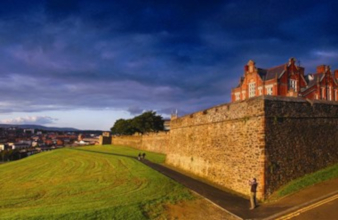
walls-of-londonderry

A charter incorporates Derry as the city of Londonderry on March 29, 1613 and also creates the new county of Londonderry. Despite the official name, the city is more usually known as simply Derry, which is an anglicisation of the Old Irish Daire, which in modern Irish is spelled Doire, and translates as “oak-grove/oak-wood.” The name derives from the settlement’s earliest references, Daire Calgaich (“oak-grove of Calgach”). The name is changed from Derry in 1613 during the Plantation of Ulster to reflect the establishment of the city by the London guilds.

Ulster is finally brought under the control of Elizabeth I’s government at the beginning of the 17th century following a long struggle between the Tudor monarchy and the Gaelic chieftains. This follows the defeat of the chieftains at the Siege of Kinsale in 1601 after a war lasting nine years. Although the Gaelic chieftains are allowed to remain on their land, their positions have been weakened. A group of them leave Ireland for the continent in 1607, never to return. The “Flight of the Earls”, as it is known, is seen as treason by James I’s government and their lands are confiscated. This important event opens the way for James I to further increase his control over Ulster by settling tens of thousands of settlers from England, Scotland and Wales on the confiscated lands.

Surveying and planning for the plantation take place during 1608 and 1609 and the plantation proper begins in 1610. The towns of Derry and Coleraine, as well as much of the lands that are to become County Londonderry, are granted to the City of London Corporation, which is charged with planting them.

The Society of the Governor and Assistants, London, of the New Plantation in Ulster, within the realm of Ireland, known after the Restoration as the Irish Society, is formed in 1609 by the City of London, to manage the estates which it has been obliged very reluctantly to take on. The Irish Society takes charge of the overall management of the Irish estates, with direct control of the new city of Derry and of the town of Coleraine.

The City of London livery companies are required to take on estates in the surrounding County of Londonderry. The Great Twelve livery companies bear the heaviest financial burden. The county is divided among them into twelve “proportions,” distributed by the drawing of lots. The Great Twelve are in turn supported by a number of minor companies, so that thirty livery companies in all have Irish estates derived from their participation in James I’s scheme for the plantation of Ulster.

However, the first phase of the existence of the Irish Society is short-lived. The Great Parchment Book is compiled in the late 1630s when Charles I claims the estates as forfeit after a politically motivated case in Star Chamber rules that the Londoners have not fulfilled their obligations of plantation.

The City of Londonderry is very much a product of the plantation and plays a pivotal role in safeguarding the plantation. Its walls, which are still intact today, repulse sieges in 1641, 1649 and 1689.

By the end of the 17th century, Ulster, which had been the most Gaelic part of Ireland, has become the most “British.” The plantation creates Ulster we know today with its socio-economic base, its religious and political diversity, and its shared heritage.

The archives of the Irish Society and the City of London livery companies are held by the City of London at London Metropolitan Archives and Guildhall Library respectively.


Leave a comment

Death of Historian Richard Bagwell

richard-bagwell-ireland-under-the-tudors

Richard Bagwell, noted historian of the Stuart and Tudor periods in Ireland and a political commentator with strong Unionist convictions, dies on December 4, 1918 at Marlfield, Clonmel, County Tipperary. He is the eldest son of John Bagwell, M.P. for Clonmel from 1857 to 1874. His son John Philip Bagwell follows the family tradition in politics becoming a Senator in the government of the Irish Free State in 1923.

Bagwell is educated at Harrow School and the University of Oxford in England and is called to the Bar, being admitted to Inner Temple in 1866. He serves as a special local government commissioner (1898–1908) and as a commissioner of national education (1905–18).

As a historian of sixteenth- and seventeenth-century Ireland, Bagwell works for nearly sixty years to produce his two three-volume works, Ireland under the Tudors (1885–90) and Ireland under the Stuarts (1909–16), using manuscript sources throughout. He is the first to treat this period in a systematic and scholarly fashion. For this solid work he is made Member of the Royal Irish Academy (MRIA) and honoured by the University of Dublin and the University of Oxford in 1918. He also writes the historical entry on “Ireland” for the Encyclopædia Britannica (Chicago 1911).

A one-time liberal, Bagwell is a founder member (1885) of the Irish Loyal and Patriotic Union, renamed the Irish Unionist Alliance (IUA) in 1891. A “diehard” unionist, he is one of the most prominent and respected southern unionists. A tireless political publicist, he is an assiduous letter-writer to the newspapers, a didactic pamphleteer, and a regular speaker at political meetings throughout Ireland. He opposes the majority report of the Irish Convention (1917) and is one of the original signatories of the “Call to unionists” that splits the IUA.

Bagwell serves as a Commissioner on National Education between 1905 and 1918 and a member of the Patriotic Union (Southern Unionists). He holds the position of High Sheriff of Tipperary in 1869. He is a Justice of the Peace for County Tipperary, and later for County Waterford, and holds the office of Deputy Lieutenant of Tipperary. He is also Special Local Government Commissioner between 1898 and 1903 and President of the Borstal Association of Ireland.

Bagwell marries Harriet Philippa Joscelyn, fourth daughter of P. J. Newton of Dunleckney Manor, County Carlow, on January 9, 1873. The couple has one son, John Philip Bagwell, and three daughters, Emily Georgiana, Margaret and Lilla Minnie.

Richard Bagwell dies one hundred years ago today on December 4, 1918 at Marlfield, having suffered from gout for many years.