John F. Kennedy, an Irish American and the first Catholic to become president of the United States, arrives in Ireland on a state visit on June 26, 1963. After Air Force One touches down at Dublin airport, Kennedy’s motorcade weaves through the streets of Dublin city, the thrilled crowd, lacking ticker tape, improvises by throwing rolls of bus tickets.
Kennedy is proud of his Irish roots and makes a special visit to his ancestral home in Dunganstown, County Wexford, while in the country. There, he is greeted by a crowd waving both American and Irish flags and is serenaded by a boys’ choir that sings TheBoys of Wexford. Kennedy breaks away from his bodyguards and joins the choir for the second chorus, prompting misty-eyed reactions from both observers and the press.
Kennedy meets with 15 members of his extended Irish family at the Kennedy homestead in Dunganstown. There he enjoys a cup of tea and some cake and makes a toast to “all those Kennedys who went and all those Kennedys who stayed.” His great-grandfather, Thomas Fitzgerald, had left Ireland for the United States in the middle of the Great Famine of 1848 and settled in Boston, becoming a cooper. Generations of his descendants go on to make their mark on American politics.
Kennedy later tells his aides that his favourite part of the trip was the wreath laying and silent funeral drill done by the Irish Army cadets at Arbour Hill military cemetery in Dublin.
Five months later, his widow, Jacqueline Kennedy, makes a special request to the Irish government. She asks that those same Irish army cadets, who so impressed the President on his visit, perform the drill again at his state funeral. Within days, those awe-stuck, trembling young men stand just inches away from foreign dignitaries from over 90 countries and perform their silent funeral drill in memory of a president that had inspired their country just a few short months earlier.
On June 21, 1877, a day that will long be remembered as Black Thursday, ten members of the Molly Maguires, an Irish labor organization, are executed in Pennsylvania, the first of twenty executions that make up the largest mass execution of any group by the U.S. federal government in history.
The Molly Maguires is an Irish 19th-century secret society active in Ireland, Liverpool, and parts of the eastern United States, best known for their activism among Irish American and Irish immigrant coal miners in Pennsylvania. The Mollies are believed to have been present in the anthracite coal fields of Pennsylvania in the United States since at least the Panic of 1873.
Members of the Mollies are accused of murder, arson, kidnapping and other crimes, in part based on allegations by Franklin B. Gowen and the testimony of a Pinkerton detective, James McParland, a native of County Armagh. Fellow prisoners testified against the defendants, who were arrested by the Coal and Iron Police. Gowen acts as a prosecutor in some of the trials. The Molly Maguires become largely inactive following the executions of 1877 and 1878.
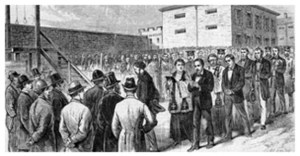
On June 21, 1877, the first ten executions take place. Six Mollies – James Carroll, James Roarity, Hugh McGehan, James Boyle, Thomas Munley, and Thomas Duffy – are hanged in the prison at Pottsville, Pennsylvania. The sheriff hangs them successively two-by-two rather than build special gallows to accommodate six. An immense crowd gathers covering the surrounding hills. Boyle carries a blood-red rose and McGehan has two roses in his lapel. Carrol and Roarity declare their innocence from the scaffold. In County Donegal, McGehan’s relatives meet in the kitchen and, it is said, the sky blackens at the moment of hanging.
On the same date, Alexander Campbell, John “Yellow Jack” Donohue, Michael J. Doyle, and Edward J. Kelly are hanged at a Carbon County prison in Mauch Chunk for the murders of John P. Jones and Morgan Powell, both mine bosses. Here gallows have been erected to accommodate four hangings and the four are hung at the same instant. Campbell, just before his execution, allegedly slaps a muddy handprint on his cell wall stating, “There is proof of my words. That mark of mine will never be wiped out. It will remain forever to shame the county for hanging an innocent man.” The handprint remains to this day.
Ten more condemned, Thomas Fisher, John “Black Jack” Kehoe, Patrick Hester, Peter McHugh, Patrick Tully, Peter McManus, Dennis Donnelly, Martin Bergan, James McDonnell, and Charles Sharpe, are hanged at Mauch Chunk, Pottsville, Bloomsburg, and Sunbury over the next year. Peter McManus is the last Molly Maguire to be tried and convicted for murder at the Northumberland County Courthouse in 1878.
Five Irish J-1 visa students and one Irish American die and seven others are injured in Berkeley, California, on June 16, 2015, after a fourth-floor balcony on which they are standing collapses. Thirteen people fall from the balcony and four are pronounced dead at the scene while two die later at the hospital.
One of the six killed is a dual Irish American citizen, Ashley Donohoe, 22, of Rohnert Park, California. The other five are Olivia Burke (Donohue’s cousin), Eoghan Culligan, Niccolai ‘Nick’ Schuster, Lorcán Miller, and Eimear Walsh, all aged 21 and from Dublin.
In June 2015, Berkeley Mayor Tom Bates promises a broad and wide-ranging investigation into the cause of the accident with the likely cause being that the balcony of the building had not been constructed properly leading to the development of dry rot, leading to the balcony becoming structurally compromised. Overwhelming evidence points to dry rot as the cause of the collapse, and not the weight of the 13 students on it at the time.
TheNew York Times publishes an article reporting the deaths and suggesting the deceased are to blame for the collapse. The paper states that Irish students coming to the U.S. on J-1 visas are an “embarrassment to Ireland.” TaoiseachEnda Kenny and former President Mary McAleese criticise the newspaper for “being insensitive and inaccurate” in its handling of the story. The newspaper subsequently apologizes, although the article remains available at its website.
Alameda County prosecutors open up a criminal investigation on the accident on June 25. They state that involuntary manslaughter charges could be filed. Berkeley District Attorney Nancy O’Malley denies that pressure from the Irish community have led to the collapse inquiry.
On July 3, 2015, the Alameda County Superior Court rejects a restraining order bid against the examination of evidence by construction company Segue Builders. D.A. O’Malley had argued that the granting of a restraining order would amount to an interference in her duty to investigate the tragedy.
In December 2015, a court is told that the collapse happened because contractors cut corners to save costs. It is alleged that Greystar, the management company for the building, ignored a “red flag” when students who rented the apartment complained about the presence of mushrooms growing on the balcony. Legal cases by some of the victims are set to be combined and heard together sometime in 2016.
A joint funeral service for Olivia Burke and her cousin Ashley Donohoe takes place on June 20, four days after the collapse, in a church in Cotati, California. Funeral services are held in Dublin for the remaining victims.
First elected Mayor of Baltimore in 1999, O’Malley is re-elected as mayor in 2003. Considering a run for governor in 2002, O’Malley instead focuses on his mayoralty. In 2006, nearing the end of his second term as mayor, O’Malley announces his candidacy for Governor of Maryland, an office he wins by a sizeable margin. He is re-elected by a wider margin in a rematch against Bob Ehrlich in 2010. O’Malley has been seen as a potential presidential candidate since at least November 2012.
O’Malley’s announcement includes a swing at Democratic candidate Hillary Rodham Clinton and Republican candidate Jeb Bush, “Recently, the CEO of Goldman Sachs let his employees know that he’d be just fine with either Bush or Clinton. Well, I’ve got news for the bullies of Wall Street—the presidency is not a crown to be passed back and forth by you between two royal families.”
During his speech, O’Malley cast Baltimore’s recent racial unrest, including a night of riots after the funeral of Freddie Gray who died of injuries sustained in police custody, as a symptom of a larger American problem. “What took place here was not only about race…not only about policing in America. It’s about everything it is supposed to mean to be an American,” he said. “The scourge of hopelessness that happened to ignite here that evening, transcends race or geography.”
O’Malley also takes swings at Wall Street. “Tell me how it is, that you can get pulled over for a broken taillight in our country, but if you wreck the nation’s economy you are untouchable.”
Highlighting his record as Maryland’s governor, O’Malley notes that he supported a successful bid to legalize gay marriage and helped raise the minimum wage.
O’Sullivan is the daughter of Evangeline “Mary Eva” Lovatt and Charles Joseph O’Sullivan, an officer in the Connaught Rangers who serves in World War I. She attends a convent school in Dublin, then the Convent of the Sacred Heart at Roehampton, England. One of her classmates there is Vivian Mary Hartley, future Academy Award-winning actress Vivien Leigh. After attending finishing school in France, O’Sullivan returns to Dublin to work with the poor.
O’Sullivan’s film career begins when she meets motion picture director Frank Borzage, who is doing location filming on Song o’ My Heart for 20th Century Fox. He suggests she take a screen test, which she does, and wins a part in the movie, which stars Irish tenor John McCormack. She travels to the United States to complete the movie in Hollywood. O’Sullivan appears in six movies at Fox, then makes three more at other movie studios.
In 1932, she signs a contract with Metro-Goldwyn-Mayer. After several roles there and at other movie studios, she is chosen by Irving Thalberg to appear as Jane Parker in Tarzan the Ape Man, opposite co-star Johnny Weissmuller. She is one of the more popular ingenues at MGM throughout the 1930s and appears in a number of other productions with various stars. In all, O’Sullivan plays Jane in six features between 1932 and 1942.
She plays another Jane in Pride and Prejudice (1940) with Laurence Olivier and Greer Garson and supports Ann Sothern in Maisie Was a Lady (1941). After appearing in Tarzan’s New York Adventure (1942), O’Sullivan asks MGM to release her from her contract so she can care for her husband who has just left the Navy with typhoid. She retreats from show business, devoting her time to her family. In 1948, she re-appears on the screen in The Big Clock, directed by her husband for Paramount Pictures. She continues to appear occasionally in her husband’s movies and on television. However, by 1960 she believes she has permanently retired. In 1958, Farrow’s and O’Sullivan’s eldest son, Michael, dies in a plane crash in California.
Actor Pat O’Brien encourages her to take a part in summer stock, and the play A Roomful of Roses opens in 1961. That leads to another play, Never Too Late, in which she co-stars with Paul Ford in what is her Broadway debut. Shortly after it opens on Broadway, John Farrow dies of a heart attack. O’Sullivan sticks with acting after Farrow’s death. She is also an executive director of a bridal consulting service, Wediquette International. In June and July 1972, O’Sullivan is in Denver, Colorado, to star in the Elitch Theatre production of Butterflies are Free with Karen Grassle and Brandon deWilde. The show ends on July 1, 1972. Five days later, while still in Denver, deWilde is killed in a motor vehicle accident.
When her daughter, actress Mia Farrow, becomes involved with Woody Allen both professionally and romantically, she appears in Hannah and Her Sisters, playing Farrow’s mother. She has roles in Peggy Sue Got Married (1986) and the science fiction oddity Stranded (1987). Mia Farrow names one of her own sons Ronan O’Sullivan Farrow for her mother. In 1994, she appears with Robert Wagner and Stefanie Powers in Hart to Hart: Home Is Where the Hart Is, a feature-length made-for-TV movie with the wealthy husband-and-wife team from the popular weekly detective series Hart to Hart.
Maureen O’Sullivan dies in Scottsdale, Arizona, of complications from heart surgery on June 23, 1998, at the age of 87. O’Sullivan is buried at Most Holy Redeemer Cemetery, Niskayuna, New York. She is survived by six of her children, 32 grandchildren, and 13 great-grandchildren. Michael, her oldest son, is killed at age 19 in a plane crash in 1958.
For the first time in the 230-year history of the New York City St. Patrick’s Day parade, members of an LGBT group, the Irish Lesbian & Gay Organisation, are allowed to march in the parade on March 16, 1991.
New York Mayor David N. Dinkins gives up the traditional lead-off position in the parade and instead marches with the Irish gay group more than two hours later. It marks the first time in memory that a New York City mayor has declined to lead a St. Patrick’s Day Parade.
On March 14, Dinkins agrees to march with the gay group “for reasons we all understand” as part of a compromise to get the group into the parade. The mayor and the 135-member gay group are guests of Division 7 of the Ancient Order of Hibernians, the midtown Manhattan chapter of the fraternal order that sponsors and organizes the parade.
Normally, politicians jockey for high-profile spots in the parade, which is billed as the world’s largest civilian parade. No mayor has ever been in the difficult spot of trying to resolve such a public dispute between Irish American groups, which have long been political powers in New York City, and gay groups, which have gained strength and are an important part of the coalition that helped bring Dinkins to office.
Police officials have 3,100 officers along the parade route to provide security for the estimated one million spectators and 150,000 people marching in the parade. The parade costs the city more than $500,000 in overtime for police, sanitation, traffic, and other employees.
Dinkins is booed for nearly 40 blocks, briefly showered with beer, and dodges two thrown beer cans as he and other elected officials march up Fifth Avenue with the gay Irish group.
Governor Mario M. Cuomo also gives up a place at the front of the parade, marching with a group of handicapped children in wheelchairs that had been denied a place among the bands and bagpipes until they threatened to sue the parade organizers.
As in previous years, some marchers wear green sashes reading, “Free Joe Doherty,” referring to the Irish Republican Army soldier jailed in New York City. Others wear yellow ribbons to honor soldiers returning home from the Persian Gulf war. But the dispute about the homosexuals is the focus for much of the march.
After the parade, Dinkins says although he expected to draw protests for marching with the lesbian and gay group, he is surprised by the depth of anger directed against him and the homosexual marchers. “It was like marching in Birmingham, Alabama during the civil rights movement,” he said. “I knew there would be deep emotions, but I did not anticipate the cowards in the crowd. There was far, far too much negative comment.”
Major Thomas Buchanan McGuire, Jr., the second highest scoring United States ace of World War II and winner of the Medal of Honor, is shot down and killed over the Pacific on January 7, 1945.
McGuire is an Irish American born in Ridgewood, New Jersey on August 1, 1920. He spends most of his childhood in Sebring, Florida, where he and his mother move after his parents are divorced.
McGuire enlists in the army as a aviation cadet in July 1941 and earns his pilot’s wings in February 1942. Sent to Alaska, McGuire bristles at the lack of combat and requests a transfer to a combat squadron. In December he is sent to California to learn to fly the twin-engine P-38 Lightning in which he earns his fame. In March 1943 he ships out to the Pacific, joining the 49th Fighter Group. One of the veteran combat pilots in the 49th is Richard Bong, who becomes the highest scoring ace of World War II.
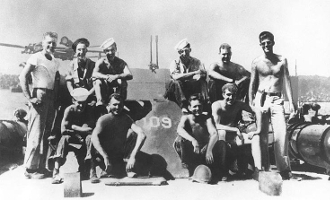
In just his second mission, on August 18, McGuire is credited with shooting down three Japanese planes. On his next mission, on the 21st, he shoots down two more, making him an ace after just three missions. In October he is shot down but manages to bail out over the ocean and is rescued by a PT boat. When he takes off from his base in the Philippines on Christmas day 1944, he has thirty-one kills. In the next two days he shoots down seven enemy planes to bring his total to thirty-eight, putting him only two behind Bong, who has been sent home for a fund-raising tour. McGuire is anxious to pass him.
Early on the morning of January 7, McGuire leads a flight of four P-38s over Japanese airbases on Negros Island. The group is confronted by a lone Ki-43 “Oscar.” As the Japanese fighter approaches from behind, McGuire makes an extremely sharp turn to the left. This extremely dangerous maneuver, performed at an altitude of only 300 feet, causes McGuire’s P-38 to stall. It snap rolls inverted and noses down into the ground. Despite the low altitude, McGuire nearly pulls out successfully. Had he jettisoned his drop tanks at the start of the dogfight, he might have managed it, however McGuire is killed on impact.
A memorial, placed by aviation archaeologist and former fighter pilot David Mason in 2007, stands at McGuire’s fatal crash site on Negros Island as a tribute. McGuire is posthumously awarded the Medal of Honor for his seven kills in two days in December. He is memorialized by the renaming of Fort Dix Army Air Force Base in Burlington County, New Jersey, to McGuire Air Force Base in 1948.