

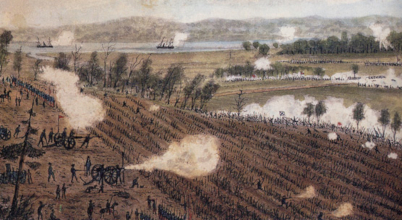
A small Confederate force commanded by Lieutenant Richard W. Dowling, a red-headed 25-year-old native of Knockballyvishteal, Milltown, County Galway, and Houston saloon owner, wins one of the most remarkable victories of the American Civil War on September 8, 1863. The Second Battle of Sabine Pass is a failed Union Army attempt to invade the Confederate state of Texas. The Union Navy supports the effort and loses three gunboats during the battle, two captured and one destroyed. It is often credited as the war’s most one-sided Confederate victory. Confederate President Jefferson Davis writes in 1876 that he “considered the [second] battle of Sabine pass the most remarkable in military history.”
On the afternoon of September 8, 1863, Union Navy Lieutenant Frederick Crocker (“Acting Captain”) is in command of the advance squadron composed of four gunboats. Crocker is a veteran officer of considerable recent experience in Union river-gunboat actions and blockade duty. His ship is the USS Clifton, a steam-powered side-wheeler. Besides the USS Clifton, Crocker’s advance squadron includes USS Granite City, USS Sachem, and USS Arizona, all recently commissioned ironclad warships. Less than three miles southeast downriver, well out of range of the Confederate fort’s cannons, are anchored seven U.S. Navy transports carrying most of the Union Army soldiers of the landing force. The USS Suffolk, hosting invasion force commander Union Army Major General William B. Franklin and his staff, heads the seven-vessel squadron. Outside the principal Gulf shore sandbar, an additional two miles downstream of this squadron, lay at anchor the remaining ships of the 22-vessel invasion fleet. The total number of Union infantry assault troops in the landing force is given as 5,000 infantrymen, which includes 500 listed as aboard the USS Granite City, those aboard the six troop transports in the seven-ship squadron headed by USS Suffolk, plus an artillery company somewhere among them. The first wave of 500 men aboard USS Granite City, which steams as close behind USS Clifton as possible but out of range of the fort’s guns, are to land in the open space adjacent to and downstream of the fort. This is a flat, often muddy area already cleared of brush by the Confederate garrison as a clear field of fire for the canister and grapeshot of the fort’s artillery. The Union Army’s invasion plan, therefore, absolutely requires that the Confederate guns be silenced before any troops are debarked. This engagement is to be the largest amphibious assault on enemy territory in the history of the U.S. military to date.
Confederate Captain Leon Smith, who is at Beaumont, Texas, immediately orders all Confederate troops in Beaumont, some eighty men, aboard the steamer Roebuck and sends them down the river to reinforce Fort Griffin. Smith and a Captain Good ride to the fort on horseback, reaching the fort some three hours before the steamer, arriving just as the Union gunboats USS Clifton and USS Sachem come within range, and assist in the defense of the fort.
Dowling’s well practiced Irish-Texan artillerymen, whose chosen and officially approved unit name is “Jefferson Davis Guards,” had placed range-stakes in the two narrow and shallow river channels. These are the “Texas channel” near the southwest shore and the “Louisiana channel” against the Louisiana shore. The white-painted stakes are for determining accurate range of the fort’s six old smooth-bore cannons. Each “Davis Guards” gun crew during gunnery practice thereby works to predetermine the approximate amount of gunpowder needed for each type of projectile (ball, canister, or grapeshot) available for their specific gun and which specific guns, charges, and loads have the best potential to hit each range-stake.
Crocker’s squadron has no local river pilots, only general knowledge of the river’s channels, no assurance of locations of the constantly varying depths especially of large oystershell “reefs” or “banks” between the river’s two channels. There is no mention in official U.S. Navy reports of whether Union sailors were making observations and taking depth soundings from the gunboats now dangerous top decks, while the Confederate cannon shots pounded and shook their ships. The few maps to which they have access are old and outdated and cannot account for recent changes in river-bottom conditions. On Captain Crocker’s signal the USS Sachem, followed by USS Arizona, advance up the right channel (Louisiana side) as fast as they dare, firing their port-side guns at the fort. USS Clifton approaches in the lead, ascending the Texas channel at full speed. USS Granite City hovers out of range behind USS Clifton, having orders not to risk debarking the 500 assault troops until the fort surrenders or its guns are silenced. As USS Sachem enters among the range-stakes, the Confederates open fire. Then USS Clifton comes into range, followed by USS Arizona. Despite their old smoothbore cannon, one of which has just become inoperable, after only a few rounds it is obvious the Confederate artillerymen’s months of training and target practice is an astounding success as their aim is deadly accurate.
The Confederates capture USS Clifton and USS Sachem with a total of 13 heavy cannon, including at least two new potent Parrott rifles, which are handed over to Leon Smith’s Texas Marine Department. The Union casualties amount to two dozen killed and badly wounded, about 37 missing, and 315 Navy men captured. The combined Union Army and Navy invasion force withdraw and return to New Orleans. The Confederates have no casualties.
In recognition of the victory, the Confederate States Congress passes a resolution of special thanks to the officers and men of the Davis Guard. In addition, Houston residents raise funds to provide medals to the Guard. The Davis Guards Medals are made from silver Mexican pesos by smoothing off the coins, then hand-stamping and hand-engraving on one side the battle name and date and on the other side the initials “D G” and a cross pattée. The medals are hung on green ribbons and presented to the members of the Davis Guard. The official Confederate silver medals are presented in a public ceremony a year later and are the only such medal ever awarded by that government.
The Battle of Sabine Pass is of moderate tactical or strategic significance to the American Civil War. It is successful in ensuring that the anticipated overland Union invasion of Texas is delayed indefinitely. A Confederate supply line from Mexico to Texas had existed out of the Port of Bagdad since the outbreak of the war but is held by the increasingly isolated Mexican Republicans. By the time Imperial French and Mexican forces capture Baghdad in 1864, a supply line to anywhere in the Confederacy east of the Mississippi River is no longer feasible on account of the Union victory at Vicksburg in July 1863. The Confederacy is therefore forced to continue its reliance on blockade running to import valuable materials and resources.
In 1937 a statue of Dowling is unveiled on the site of the fort. In 1998 a bronze plaque honoring Dowling is unveiled at the Tuam Town Hall in County Galway.
(Pictured: Richard William “Dick” Dowling, circa 1865)
 seamus dubhghaill