seamus dubhghaill

Promoting Irish Culture and History from Little Rock, Arkansas, USA


Leave a comment

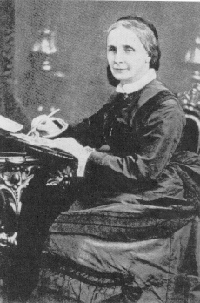
Birth of Irish Author Mary Anne Sadlier

mary-anne-sadlier

Mary Anne Sadlier, Irish author, is born Mary Anne Madden in Cootehill, County Cavan, on December 30, 1820.

Sadlier publishes roughly sixty novels and numerous stories in her lifetime. She writes for Irish immigrants in both the United States and Canada, encouraging them to attend mass and retain the Catholic faith. In so doing, Sadlier also addresses the related themes of anti-Catholicism, the Great Famine, emigration, and domestic work. Her writings are often found under the name Mrs. J. Sadlier.

Upon the death of her father, Francis, a merchant, Mary Madden emigrates to Sainte-Marthe, Quebec in 1844, where she marries publisher James Sadlier, also from Ireland, on November 24, 1846. Sadlier publishes much of her work in the family’s Catholic magazine, The Tablet. Sadlier experiences her most productive literary period after her marriage and is most creative after the time all of her children are born. While living in Canada, Sadlier publishes eighteen books — five novels, one collection of short stories, a religious catechism, and nine translations from the French — in addition to assorted magazine articles she contributes to the Pilot and American Celt free of charge. In New Lights (1853), Sadlier deals with the Great Famine for the first time. The book proves one of her most popular, going through at least eight editions in fifty years. In this novel, Sadlier focuses a polemical attack on the Protestant practice of converting Irish peasants by promising them soup but condemns peasant retaliation and violence.

In the early 1860s, the couple moves to New York City. The Sadlier’s New York home becomes the hub of literary activity in the Catholic community, and Sadlier also enjoys the company of the brightest Irish writers in the United States and Canada, including New York Archbishop John Hughes, editor Orestes Brownson, and Thomas D’Arcy McGee. She holds weekly salons in her Manhattan home, as well as her summer home on Far Rockaway on Long Island. Her closest friend is D’Arcy McGee, a poet, Irish nationalist exile and Canadian statesman known as one of the founding “Fathers of Confederation” who helps bring about Canada’s independence. McGee and Sadlier share an interest in a “national poetry” that does not only capture the spirit of a people but inspires them to political and national independence. While McGee, as a man, can take part in political rallies and organize Irish American support for Home Rule, Sadlier, as a woman, directs her support for Irish independence into literature. McGee’s biographer notes that Sadlier’s success inspires him to write emigrant novels and is planning a novel on this subject at the time of his assassination by an Irish American radical in 1868. His death is a crushing blow to Sadlier and her husband. Sadlier edits a collection of McGee’s poetry in 1869 in tribute to his memory.

Sadlier remains in New York for nine years before returning to Canada, where she dies in Montreal on April 5, 1903. In later years she loses the copyright to all her earlier works, many of which remain in print. One of Mary Anne’s daughters, Anna Theresa Sadlier, also becomes a writer.


1 Comment

Death of Terence Bellew MacManus in San Francisco

terrence-bellew-macmanus

Terence Bellew MacManus, an Irish rebel and Young Irelander, dies in San Francisco, California, on January 15, 1861.

MacManus is born in 1811 in Tempo, County Fermanagh, Ireland, and was educated in parochial schools. As a young man he moves to the major port of Liverpool, where he becomes a successful shipping agent. In 1848 he returns to Ireland, where he becomes active in the Repeal Association, which seeks to overturn the Act of Union between Great Britain and Ireland. After joining the Irish Confederation, he is among those who take part with William Smith O’Brien and John Blake Dillon in the July 1848 Young Ireland Rebellion in Ballingarry, County Tipperary, where the only substantial armed action occurs. MacManus and the other leaders are charged and convicted of treason and sentenced to death for their actions.

Due to public outcry for clemency, the men’s sentences are commuted to deportation for life. MacManus, along with O’Brien, Thomas Francis Meagher, and Patrick O’Donoghue, is transported to Van Diemen’s Land in Tasmania, Australia in 1849. They are assigned to different settlements to reduce their collaboration in the new land; however, the Irish men continue to meet secretly.

In 1852 MacManus and Meagher escape from Australia and make their way to San Francisco, California, where MacManus settles. Meagher goes on to New York City. Like other immigrants, the Irish revolutionaries carry their issues to the United States. A Captain Ellis, of a ship that is supposed to carry O’Brien to freedom, also emigrates to San Francisco. MacManus holds a lynch court of Ellis among Irish emigrants for his betrayal of O’Brien in his escape attempt from Van Diemen’s Land. The court-martial acquits Ellis for lack of evidence.

Failing to re-establish his career as a shipping agent, MacManus lives in San Francisco and dies in poverty in 1861. It is after his death, however, that he performs his most valuable service to the cause of Irish freedom. On learning of his death, American Fenian leaders decide to return his body to Ireland for burial. This foreshadows the treatment given to Jeremiah O’Donovan Rossa at his famous funeral in 1915. Crowds of Irish gather in New York as Archbishop John Hughes, like MacManus born in Ulster, blesses MacManus’ body. Thousands greet his body when it arrives in Cork and crowds gather at rail stations all the way to Dublin.

The church, in the person of Archbishop of Dublin Paul Cullen, refuses permission for his body to lie-in-state at any church in Dublin. Thus, for a week MacManus’ body lies in the Mechanics’ Institute, while thousands pass by paying their respects. But Father Patrick Lavelle, a Fenian supporter, defies Cullen and performs the funeral ceremony on November 10, 1861. A crowd estimated at 50,000 follow the casket to Dublin’s Glasnevin Cemetery, and hundreds of thousands line the streets. The MacManus funeral is a seminal moment for the Fenian movement. It invigorates the nationalist movement in Ireland, just as Rossa’s funeral does 54 years later.

MacManus is notable for his statement in court in 1848 where he explains his actions by saying, “It was not because I loved England less, but because I loved Ireland more.”


Leave a comment

Death of Archbishop John Joseph Hughes

john-joseph-hughes

John Joseph Hughes, Irish-born prelate of the Roman Catholic Church in the United States and the fourth Bishop and first Archbishop of the Archdiocese of New York, dies in New York City on January 3, 1864.

Hughes is born in the hamlet of Annaloghan, near Aughnacloy, County Tyrone. He emigrates to the United States in 1817.

After several unsuccessful applications to Mount St. Mary’s College in Emmitsburg, Maryland, he is eventually hired as a gardener at the college. During this time, he befriends Mother Elizabeth Ann Seton, who is impressed by Hughes and persuades the rector to reconsider his admission. Hughes is subsequently admitted as a regular student of Mount St. Mary’s in September 1820.

On October 15, 1826, Hughes is ordained to the priesthood by Bishop Henry Conwell at Old St. Joseph’s Church in Philadelphia. His first assignment is as a curate at St. Augustine Church in Philadelphia, where he assists its pastor by celebrating Mass, hearing confessions, preaching sermons, and other duties in the parish.

Hughes is chosen by Pope Gregory XVI as the coadjutor bishop of the Diocese of New York on August 7, 1837. He is consecrated bishop at St. Patrick’s Old Cathedral on January 7, 1838, with the title of the titular see of Basilinopolis, by the Bishop of New York, John Dubois, his former Rector.

Hughes campaigns actively on behalf of Irish immigrants and attempts to secure state support for parochial schools. Although this attempt fails, he founds an independent Catholic school system which becomes an integral part of the Catholic Church’s structure at the Third Plenary Council of Baltimore (1884), which mandates that all parishes have a school and that all Catholic children be sent to those schools. In 1841, Hughes founds St. John’s College in New York City which is now Fordham University.

Hughes is appointed Apostolic Administrator of the diocese due to Bishop Dubois’ failing health. As coadjutor, he automatically succeeds Dubois upon the bishop’s death on December 20, 1842, taking over a diocese which covers the entire state of New York and northern New Jersey. He is a staunch opponent of Abolitionism and the Free Soil movement, whose proponents often express anti-Catholic attitudes. Hughes also founds the Ultramontane newspaper New York Freeman to express his ideas.

Hughes becomes an archbishop on July 19, 1850, when the diocese is elevated to the status of archdiocese by Pope Pius IX. As archbishop, he becomes the metropolitan for the Catholic bishops serving all the dioceses established in the entire Northeastern United States. To the dismay of many in New York’s Protestant upper-class, Hughes foresees the uptown expansion of the city and begins construction of the current St. Patrick’s Cathedral on Fifth Avenue between 50th and 51st Street, laying its cornerstone on August 15, 1858. At the request of President Abraham Lincoln, Hughes serves as semiofficial envoy to the Vatican and to France in late 1861 and early 1862. Lincoln also seeks Hughes’ advice on the appointment of hospital chaplains.

Hughes serves as archbishop until his death. He is originally buried in St. Patrick’s Old Cathedral, but his remains are exhumed in 1882 and reinterred in the crypt under the altar of the new cathedral he had begun.