seamus dubhghaill

Promoting Irish Culture and History from Little Rock, Arkansas, USA


Leave a comment

Death of Theobald Walter, the First Chief Butler of Ireland

Theobald Walter, sometimes Theobald FitzWalter, Theobald Butler, or Theobald Walter le Boteler, the first Chief Butler of Ireland, dies on February 4, 1206, at Arklow Castle at Wicklow, in present day County Wicklow. He also holds the office of Chief Butler of England and is the High Sheriff of Lancashire for 1194. He is the first to use the surname Butler of the Butler family of Ireland. He is involved in the Irish campaigns of King Henry II of England and John of England. His eldest brother, Hubert Walter, becomes the Archbishop of Canterbury and justiciar and Lord Chancellor of England.

Walter is born in Norfolk, England, in 1165, the son of Hervey Walter and his wife, Matilda de Valoignes, who is one of the daughters of Theobald de Valoignes. Their children were Theobald, Hubert, Bartholomew, Roger, and Hamon. He and his brother Hubert are brought up by their uncle Ranulf de Glanvill, the great justiciar of Henry II of England who had married his mother’s sister Bertha.

On April 25, 1185, Prince John, in his new capacity as Lord of Ireland, lands at Waterford and around this time grants the hereditary office of butler of Ireland to Walter, whereby he and his successors are to attend the Kings of England at their coronation, and on that day present them with the first cup of wine. His father had been the hereditary holder of the office of butler of England. Sometime after, King Henry II of England grants him the prisage of wines, to enable him and his heirs, the better to support the dignity of that office. By this grant, he has two barrels of wine out of every ship, which breaks bulk in any trading port of Ireland, and is loaded with 20 tons of that commodity, and one ton from 9 to 20. He accompanies John on his progress through Munster and Leinster. At this time, he is also granted a large section of the north-eastern part of the Kingdom of Limerick. The grant of five and a half cantreds is bounded by:

“…the borough of Killaloe and the half cantred of Trucheked Maleth in which it lay, and the cantreds of Elykarval, Elyochgardi, Euermond, Aros and Wedene, and Woedeneoccadelon and Wodeneoidernan.”

These are the modern baronies of Tullough (in County Clare), Clonlisk and Ballybritt (in County Offaly), Eliogarty, Ormond Upper, Ormond Lower, Owney and Arra (in County Tipperary), Owneybeg, Clanwilliam and Coonagh (in County Limerick).

Walter is active in the war that takes place when Rory O’Connor attempts to regain his throne after retiring to the monastery of Cong (present day County Mayo), as his men are involved in the death of Donal Mor McCarthy during a parley in 1185 near Cork. In 1194, he supports his brother during Hubert’s actions against Prince John, with him receiving the surrender of John’s supporters in Lancaster. He is rewarded with the office of sheriff of Lancaster, which he holds until Christmas of 1198. He is again sheriff after John takes the throne in 1199.

In early 1200, however, John deprives Walter of all his offices and lands because of his irregularities as sheriff. His lands are not restored until January 1202. A manuscript in the National Library of Ireland points to William de Braose, 4th Lord of Bramber, as the agent of his restoration:

“Grant by William de Braosa, (senior) to Theobald Walter (le Botiller) the burgh of Kildelon (Killaloe) … the cantred of Elykaruel (the baronies of Clonlisk and Ballybrit, County Offaly), Eliogarty, Ormond, Ara and Oioney, etc. 1201.”

“Elykaruel” refers to the Gaelic túath of “Ely O’Carroll”, which straddles the southern part of County Offaly and the northern part of Tipperary (at Ikerrin). The other cantreds named are probably the modern baronies of Eliogarty, Ormond Upper, Ormond Lower and Owney and Arra in County Tipperary.

Walter founds the Abbey of Woney, of which nothing now remains, in the townland of Abington, near the modern village of Murroe in County Limerick around 1200. He also founds the Cockersand Abbey in Lancaster, Abbey of Nenagh in County Tipperary, and a monastic house at Arklow in County Wicklow.

Walter marries Maud le Vavasour (1176–1226), heiress of Robert le Vavasour, a baron of Yorkshire. John Lodge in the Peerage of Ireland in 1789 gives the year as 1189, but on no apparent authority, as no other author follows him on this. Their children are Theobald le Botiller, 2nd Chief Butler of Ireland, and Maud (1192–1244), who marries three times yet only has two surviving children, Ralph and Marie.

Walter dies on February 4, 1206, at Arklow Castle, County Wicklow, and is buried at Wotheney Abbey.

Leave a comment

Birth of Anthony Foley, Rugby Union Player and Coach

Anthony Gerard Foley, Irish rugby union player and head coach of Munster, is born on October 30, 1973, in Limerick, County Limerick. He is attached to the same squad during his professional playing career. He is a member of the Munster team that wins the 2002–03 Celtic League and is the winning captain during their 2005–06 Heineken Cup success. He plays for Ireland from 1995 until 2005 and captains the squad on three occasions. He is nicknamed “Axel,” after the fictional character Axel Foley of the Beverly Hills Cop film series. His father Brendan Foley and sister Rosie Foley also play rugby for Ireland.

In March 1989, Foley leads St. Munchin’s College to victory in the Munster Schools Junior Cup. He later represents Munster and Ireland Schools on several occasions over two seasons, notably during the 1992 Irish Schools tour of New Zealand. Winning six games out of eight, Ireland narrowly loses the final game to a New Zealand side featuring Jonah Lomu. A controversial Jeff Wilson penalty-goal wins the game in the final minutes.

Foley makes his professional debut for Munster against Swansea in November 1995, a game that is also Munster’s first ever Heineken Cup fixture. He is on the Munster team that loses 8–9 to Northampton Saints in the 2000 Heineken Cup Final, and is again the runner-up when Munster loses 15–9 to Leicester Tigers in the 2002 Heineken Cup Final. He is finally on the winning side when Munster wins the 2002–03 Celtic League.

When Mick Galwey resigns as Munster captain, Foley narrowly loses to Jim Williams in a vote to decide the next captain. When Williams leaves Munster in 2005, Foley becomes the new captain, and in his first season in the position, he leads Munster to victory over Biarritz Olympique in the 2006 Heineken Cup Final. He has played in all but one of Munster’s first 78 Heineken Cup games until a shoulder injury sustained during Munster’s 21–19 victory over Leicester Tigers at Welford Road Stadium in their first game of the 2006–07 Heineken Cup causes him to miss his side’s subsequent victory over CS Bourgoin-Jallieu, as well as back-to-back games against Cardiff in December 2006.

Foley stands down as captain at the beginning of the 2007–08 season, making way for Paul O’Connell. He is dropped for Munster’s final fixtures of the 2007–08 Heineken Cup, and announces his retirement for the end of the season.

Foley makes his debut for Ireland against England in the 1995 Five Nations Championship on January 21, 1995. He scores a try on his debut in an 8-20 defeat. He goes to the 1995 Rugby World Cup in South Africa, and plays as a replacement in one pool game against Japan which Ireland wins 50-28. He misses the 1999 Rugby World Cup, but is selected for the 2003 Rugby World Cup, featuring in two of the pool games against Romania and Australia.

Foley captains Ireland three times: in 2001 against Samoa, and in 2002 against Romania and Georgia. His last international is against Wales in the 2005 Six Nations Championship. In total he plays in 62 matches for Ireland and scores 5 tries against England in 1995, Romania in 2001, Fiji in 2002, France in 2004, and Wales in 2004.

In March 2011, it is announced that Foley will take over as Munster forwards coach at the end of the 2011 season. He temporarily replaces Gert Smal as Ireland’s forwards coach during the 2012 Six Nations Championship, after Smal is forced to miss the remainder of the tournament with an eye condition. He signs a contract extension with Munster in May 2013. The following year it is announced that he will succeed Rob Penney as Munster’s head coach, signing a two-year contract that begins on July 1, 2014.

Foley dies in his sleep on October 16, 2016, of an acute pulmonary edema brought on by heart disease while staying at a hotel in the Paris suburb of Suresnes with the Munster squad. The team is preparing to face Racing 92 in its opening game of the 2016–17 European Rugby Champions Cup. The match is postponed as a result of his death. President Michael D. Higgins and then-Taoiseach Enda Kenny make tributes to Foley, and the Irish flag flies at half mast at government buildings in Munster.

Foley is brought home to Ireland on Wednesday, October 19, 2016. His funeral takes place on Friday, October 21, 2016 at St. Flannan’s Church in Killaloe, County Clare.

On October 22, 2016, in the first game after Foley’s death, Munster beats Glasgow 38–17 at a sold-out Thomond Park. Tributes are paid to Foley before, during and after the game and the number 8 jersey is retired for the game, with CJ Stander wearing the number 24 for the occasion. Before their historic first ever win against New Zealand at Soldier Field, Chicago, on November 5, 2016, the senior Irish men’s team pays tribute to Foley by forming a figure of 8, led by Munster’s CJ Stander, Simon Zebo, Conor Murray and Donnacha Ryan, to face the All Blacks Haka. Ahead of a game against Munster on November 11, 2016, the Māori All Blacks team pays tribute to Foley by placing a jersey with his initials on the halfway line before performing a Haka. Māori captain Ash Dixon then presents the jersey to Foley’s sons. Munster goes on to win the historic game 27–14. On January 7, 2017, further tributes are paid to Foley when the rescheduled Round 1 fixture between Racing 92 and Munster takes place.

To honour Foley’s memory and contribution to European rugby, the European Professional Club Rugby (EPCR) announces that the 2016–17 European Player of the Year would receive the Anthony Foley Memorial Trophy. The trophy is commissioned with the agreement of the Foley family and Munster Rugby and it is envisaged that it will be presented to all future European Player of the Year winners.


Leave a comment

The Rineen Ambush

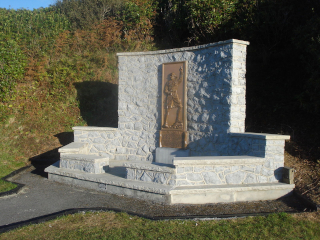
File source: http://commons.wikimedia.org/wiki/File:Rineen_Monument.JPG

The Rineen ambush is carried out by the Irish Republican Army (IRA) on September 22, 1920, during the Irish War of Independence. It takes place at Drummin Hill in the townland of Drummin, near the hamlet of Rineen, County Clare.

The Volunteers in County Clare have been active since 1917 and by late 1920 have forced the Royal Irish Constabulary (RIC) to abandon most of its small rural barracks in the county. This gives the IRA greater freedom to move in the countryside. In August 1920, the RIC are reinforced by the British deployment of Black and Tans and Auxiliaries to the county. Five RIC men, eleven IRA volunteers and four civilians have been killed in County Clare during the two years before the ambush.

The Rineen Ambush is ordered by the leadership of the IRA’s Mid-Clare Brigade, who had noticed that a RIC lorry travels every week on the Ennistymon to Milltown Malbay road. John Joe Neylon, leader of the local IRA battalion, is put in charge, although the actual attack is led by Ignatius O’Neill, the Officer Commanding. He is a veteran of World War I who had formerly fought with the Irish Guards. The ambush party has only nine rifles and some grenades, the remainder being armed with shotguns or handguns. They prepare to attack the lorry from a railway bridge that overlooks the road at Rineen.

As the IRA party is lying in wait, Alan Lendrum, the local resident magistrate, drives unwittingly into a roadblock of the IRA’s West Clare Brigade, in an unrelated action. He is stopped at a railway crossing at Caherfeenick near Doonbeg. When the IRA demand he surrender his car, he draws an automatic pistol and the IRA men shoot him twice in the head, fatally wounding him. The IRA weights his body with stones and dumps it in a nearby lake. Even though the British Military inquest establishes that Lendrum had died of gunshot wounds, members of the RIC in Clare spread a false version of events and claim that Lendrum had died of drowning.

Although in strict military sense not related to the ambush, it has serious consequences for the ambush. It is quite quickly noticed that the magistrate is missing and the military in Ennistymon decide to send out a search party of ten lorries of soldiers.

The RIC lorry passes safely through the ambush position, travelling from Ennistymon to Milltown Malbay, due to some confusion among the IRA over the numbers they face. However, when they learn that there is only one lorry, it is attacked on its return journey from Milltown Malbay. The lorry is hit by a grenade and blasted at close range by rifle and shotgun fire. The shooting is over in seconds, with five out of the six RIC men being killed outright. The sixth man manages to run about 300 yards before being shot dead. Five of the dead are Irish RIC officers and one is an English Black and Tan. The IRA take their weapons and burn the lorry.

Not long after the lorry has been set ablaze, the ten-lorry search party arrives on the scene. A running fight develops, as four IRA riflemen keep the troops at bay while the other volunteers make their escape. Two IRA volunteers and several British soldiers are wounded in the firing. Padraic O’Farrell lists the casualties as three British soldiers killed, but this is not confirmed by the other sources.

The British forces, enraged by the ambush and the escape of the IRA force, take out reprisals on civilians in the surrounding area. Immediately after the action ends, they burn the house and farm of the O’Gorman family and shoot a local farmer, Sean Keane, who later dies of his wounds.

That night, a mixed force of police and soldiers raid the Lahinch home of Dan Lehane, whose two sons had taken part in the ambush. They shoot him dead and burn his house. Patrick Lehane, who is hiding in the attic, perishes in the blaze. Several other houses are burned in Lahinch and a further eight are razed in Milltown Malbay. A separate RIC raid takes place in Ennistymon, in which several homes and businesses are burned.

In what may have been a belated reprisal for the ambush, four IRA men are arrested by the Auxiliaries at Killaloe on November 16, beaten, interrogated and then shot dead. Another two are summarily executed in the same manner on December 22 at Kilkee.

The reprisals are condemned in the British, Irish and international press. In the House of Commons, the British Labour Party tables a resolution condemning the reprisals and calling for an investigation. This is defeated by 346 votes to 79. Hamar Greenwood, the Chief Secretary for Ireland, defends the State Forces’ actions, saying that the houses destroyed were those of “notorious Sinn Féiners…I am convinced that the people of those two villages knew of this ambush.”

In Clare itself, according to IRA man Anthony Malone, the ambush has two effects. One is that the RIC becomes careful to travel in convoys of no less than three lorries. The other is that, as a result of the reprisals, the civilian population becomes embittered against the British and adopt a more defiant attitude to the British military and Black and Tans.

The death of Resident Magistrate Alan Lendrum, however, according to pro-republican Catholic priest Sean Gaynor, “was not to our credit.” On October 1, the local IRA remove Lendrum’s body from the lake, put it in a roughly constructed coffin and leave it on the railway tracks at Craggaknock railway station for British forces to find.

(Pictured: Monument for the attack at Rineen during the Irish War of Independence, designed by Walter Kiernan)