seamus dubhghaill

Promoting Irish Culture and History from Little Rock, Arkansas, USA


Leave a comment

Death of Diarmait Mac Murchada, Irish King of Leinster

diarmait-mac-murchada

Diarmait Mac Murchada, Irish King of Leinster whose appeal to the English for help in settling an internal dispute leads to the Anglo-Norman invasion and conquest of Ireland by England, dies on May 1, 1171, of “an insufferable and unknown disease.”

Mac Murchada is born around 1110, the son of Donnchad mac Murchada, King of Leinster and Dublin. His father is killed in battle in 1115 by his cousin Sigtrygg Silkbeard, king of the Dublin Vikings, and is buried by them in Dublin along with the body of a dog which is considered to be a huge insult.

After the death of Énna Mac Murchada, his older brother, Mac Murchada unexpectedly becomes King of Leinster. This is opposed by the High King of Ireland, Toirdelbach Ua Conchobair, who fears that Mac Murchada will become a rival. Toirdelbach sends one of his allied Kings, the belligerent Tigernán Ua Ruairc, to conquer Leinster and oust the young Mac Murchada. Ua Ruairc goes on a brutal campaign slaughtering the livestock of Leinster and thereby trying to starve the province’s residents. Mac Murchada is ousted from his throne but is able to regain it with the help of Leinster clans in 1132. Two decades of an uneasy peace followed between Ua Conchobair and Mac Murchada. In 1152 he even assists the High King in a raid of the land of Ua Ruairc who has become a renegade.

As King of Leinster, between 1140–70, Mac Murchada commissions Irish Romanesque churches and abbeys at Baltinglass, Glendalough, Ferns, and Killeshin. He sponsors convents at Dublin, two at Aghade, County Carlow, and at Kilculliheen near Waterford city. He also sponsors the successful career of churchman St. Lorcán Ua Tuathail and presides at the synod of Clane in 1161 when Ua Tuathail is installed as archbishop of Dublin.

In 1166, Ireland’s new High King and Mac Murchada’s only ally, Muirchertach Ua Lochlainn, has fallen and a large coalition led by Mac Murchada’s arch enemy, Tigernán Ua Ruairc, marches on Leinster. The High King deposes Mac Murchada from the throne of Leinster, and he flees to Wales and from there to England and France seeking the support of Henry II of England in the recruitment of soldiers to reclaim his kingship. Henry authorises Mac Murchada to seek help from the soldiers and mercenaries in his kingdom. Those who agreed to help include Richard de Clare (Strongbow) and half-brothers Robert FitzStephen and Maurice FitzGerald.

In Mac Murchada’s absence, Ruaidrí Ua Conchobair, son of Mac Murchada’s former enemy, the High King Toirdelbach Ua Conchobair, has become the new High King of Ireland.

Mac Murchada brings an advance party of adventurers back to Ireland in 1167, recaptures Wexford, and waits for Strongbow to arrive. From his base in Wales, Strongbow launches an offensive in 1170, capturing Waterford and Dublin, taking control of the East coast, much to the dismay of the Gaelic Chieftains and Ua Conchobair. To cement the alliance, Mac Murchada marries his daughter, Aoife, to Strongbow, in Christ Church Cathedral in Dublin 1170.

The Irish Chieftains do not allow the invaders to settle, however, and they are continually attacked and harassed. It begins to appear likely that they will be driven from Ireland. However, they receive support from Henry II, who has become concerned about the amount of power and influence that Strongbow is amassing in Ireland. The subsequent domination of South Wales by the Normans is a result of the need to keep supply lines into Eastern Ireland open.

Mac Murchada dies on May 1, 1171, leaving Strongbow to declare himself King of Leinster. Mac Murchada is buried in the Cathedral graveyard of Ferns village.


Leave a comment

The Battle of Clontarf

battle-of-clontarf

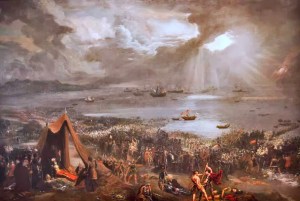
The Battle of Clontarf takes place on Good Friday, April 23, 1014, at Clontarf, near Dublin, on the east coast of Ireland. The battle is the culmination of two centuries of strife, treachery, failed alliances and treaties that pits the forces of Brian Boru, high king of Ireland, against a Norse-Irish alliance comprised of the forces of Sigtrygg Silkbeard, king of Dublin, Máel Mórda mac Murchada, king of Leinster, and a Viking contingent led by Sigurd of Orkney and Brodir of Mann.

The first Norsemen, also known as Vikings, arrive in Ireland some two centuries earlier, initially plundering the gold, chalices, crosses, and manuscripts of the monasteries and the corn harvests of the settled communities. Gradually they establish Viking settlements around Ireland and engage in trade and commerce.

There is, however, significant opposition to their presence in Ireland, not least in Munster where King Brian Boru has defeated their armies on several occasions. Brian’s aim is to unite all the warring Celtic kingdoms under one rule and one High King.

In 1013, Máel Mórda, the king of Leinster goes into revolt after inter-marriage alliances with Brian have broken down and joins forces with the Vikings. Together, they initially attack the kingdom of Mael Sechlainn of Meath who summons the help of King Brian. Brian sets off toward Dublin with 4,900 troops. Opposing them are Máel Mórda’s army of 4,000 Leinster men allied to 3,000 Viking warriors.

Although but a small segment of the battle is fought close to the seafront at Clontarf, the historic encounter of Good Friday 1014 enters the annals as the Battle of Clontarf. This is largely because some 2,000 Vikings had landed in longboats at Clontarf by sunrise on the morning of April 23.

As the two opposing armies face one another, the Vikings and the Leinster men are lined across the sloping plains bounded by the sea and the River Tolka, while King Brian’s army occupies the rising ground near Tomar’s Wood in Phibsborough.

The most ferocious part of the battle is fought at the “Battle of the Fishing Weir,” which approximates to the site of the former D.W.D. Whiskey Distillery on Richmond Road. Historic accounts of the battle also refer to the “savage encounters” fought on the “Bloody Fields of Marino” and what is today Phibsboro and Cross Guns.

The result of the bloodiest day in ancient Ireland is a rout for King Brian, although some 4,000 of his troops are killed on the battlefield. In contrast some 6,000 Leinster men and Vikings are slaughtered including every single Viking leader. King Brian’s army drives the fleeing Vikings back towards the sea at Clontarf.

Although Brian has won the greatest victory of his long career, he does not live long to enjoy it. As he kneels praying in his tent near Cross Guns, the Isle of Man Viking Leader, Brodir, who is hiding in the adjacent woods, runs into his tent and kills the 84-year-old Brian with his axe. Brodir is later captured and slaughtered by Ulf the Quarrelsome, the younger brother of King Brian.

The Battle of Clontarf is the watershed of all the hatred, division, and rivalries that have consumed Ireland for centuries. A period of relative peace follows where the Celtic chieftains and the Vikings live together in a spirit of harmony with the emphasis on greater integration, cooperation, and commerce.


Leave a comment

Death of Richard de Clare, 2nd Earl of Pembroke

strongbow-effigy-christ-church-dublin

Richard de Clare, 2nd Earl of Pembroke, Lord of Leinster, Justiciar of Ireland, and Cambro-Norman lord notable for his leading role in the Norman invasion of Ireland, dies in Dublin on April 20, 1176. Like his father, he is also commonly known by his nickname “Strongbow.”

As the son of Gilbert de Clare, 1st Earl of Pembroke, Richard succeeds to his father’s estates after his death in 1148 but is deprived of the title by King Henry II of England in 1154 for siding with King Stephen of England against Henry’s mother, the Empress Matilda. He sees an opportunity to reverse his bad fortune in 1168 when he meets Diarmait Mac Murchada, the deposed King of Leinster.

In 1167, Diarmait Mac Murchada is deprived of the Kingdom of Leinster by the High King of Ireland, Ruaidrí Ua Conchobair. To recover his kingdom, Mac Murchada solicits help from King Henry II of England. Henry provides a letter of comfort for willing supporters of Mac Murchada’s cause in his kingdom. However, after his return to Wales, he fails to rally any forces to his standard. He eventually meets Richard de Clare and other barons of the Welsh Marches. Mac Murchada comes to an agreement with de Clare where, for the Earl’s assistance with an army the following spring, he can have Mac Murchada’s eldest daughter, Aoife, in marriage and the succession to Leinster.

Mac Murchada and Richard de Clare raise a large army, which includes Welsh archers and arranges for Raymond FitzGerald to lead it. The force takes the Ostman towns of Wexford, Waterford, and Dublin in rapid succession between 1169 and 1170. Richard de Clare, however, is not with the first invading party and arrives later, in August 1170.

In May 1171, Diarmait Mac Murchada dies and his son, Donal MacMurrough-Kavanagh claims the kingdom of Leinster in accordance with his rights under the Brehon Laws. Richard de Clare also claims the kingship in the right of his wife. At this time, Strongbow sends his uncle, Hervey de Montmorency, on an embassy to Henry II, which is necessary to appease the King who is growing restive at the count’s increasing power. Upon his return, de Montmorency conveys the King’s terms – the return of Richard de Clare’s lands in France, England, and Wales as well as leaving him in possession of his Irish lands. In return, Richard de Clare surrenders Dublin, Waterford, and other fortresses to the English king. Henry’s intervention is successful and both the Gaelic and Norman lords in the south and east of Ireland accept his rule. Richard de Clare also agrees to assist Henry II in his upcoming war in France.

Richard de Clare dies on April 20, 1176, of an infection in his leg or foot. He is buried in Holy Trinity Church in Dublin with his uncle-in-law, Lorcán Ua Tuathail, Archbishop of Dublin, presiding. King Henry II takes all of Strongbow’s lands and castles for himself and places a royal official in charge of them.


Leave a comment

The Night of the Big Wind

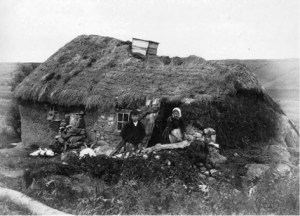
night-of-the-big-windThe Night of the Big Wind (Irish: Oíche na Gaoithe Móire), a powerful European windstorm sweeps without warning across Ireland beginning in the afternoon of January 6, 1839, causing severe damage to property and several hundred deaths. As many as one quarter of the houses in north Dublin are damaged or destroyed and 42 ships are wrecked. The storm tracks eastward to the north of Ireland bringing winds gusts of over 100 knots to the south before moving across the north of England and onto the European continent where it eventually dies out. At the time, it is the most damaging Irish storm in 300 years.

The storm develops after a period of unusual weather. Heavy snow, which is rare in Ireland, falls across the country on the night of January 5, and is replaced on the morning of January 6 by an Atlantic warm front, which brings a period of complete calm with dense, motionless, cloud cover. Through the day, temperatures rise well above their seasonal average, resulting in rapid melting of the snow.

Later in the day, a deep Atlantic depression begins to move towards Ireland, forming a cold front bringing strong winds and heavy rain when it collides with the warm air over land. First reports of stormy weather come from western County Mayo around noon and the storm moves very slowly across the island through the remainder of the day, gathering strength as it progresses.

By midnight the winds reach hurricane force. It is estimated that between 250 and 300 people lose their lives in the storm. Severe property damage is caused, particularly in Connacht, but also in Ulster and northern Leinster. Much of the inland damage is caused by a storm surge that draws large quantities of sea water inland, resulting in widespread flooding.

The Night of the Big Wind has become part of Irish folk tradition. Irish folklore held that Judgement Day would occur on the Feast of the Epiphany, January 6. Such a severe storm led many to believe that the end of the world was at hand.