seamus dubhghaill

Promoting Irish Culture and History from Little Rock, Arkansas, USA


Leave a comment

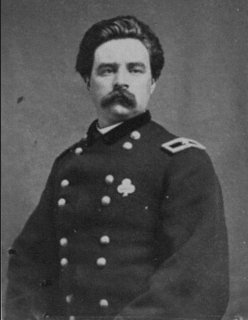
Birth of Brigadier General Thomas Alfred Smyth

thomas-alfred-smyth

Thomas Alfred Smyth, brigadier general in the Union Army during the American Civil War, is born in Ballyhooly, County Cork on December 25, 1832. He is the last Union general killed in the war. In March 1867, he is nominated and confirmed a brevet major general of volunteers posthumously to rank from April 7, 1865.

Smyth works on his father’s farm in Ireland as a youth. He emigrates to the United States in 1854, settling in Philadelphia, Pennsylvania. He participates in William Walker‘s expedition to Nicaragua. He is employed as a wood carver and coach and carriage maker. In 1858, he moves to Wilmington, Delaware.

In 1861 Smyth enlists in the Union army in an Irish American three-months regiment, the 24th Pennsylvania, and is quickly made a captain. He is later commissioned as a major of the 1st Delaware Infantry, a three-years regiment. He serves at the battles of Chancellorsville and Fredericksburg, following which he is promoted to lieutenant colonel and then to colonel. During the Gettysburg campaign, he commands the 2nd Brigade, 3rd Division of the II Corps. During the Battle of Gettysburg, his men help defend Cemetery Ridge and advance to the area of the Bliss farm to oust enemy sharpshooters. He is wounded on the third day of the battle and relinquishes command briefly.

Smyth retains brigade command during the reorganization of II Corps before Ulysses S. Grant‘s Overland Campaign. He leads the second brigade of the first division from March 25 to May 17, 1864. When Colonel Samuel S. Carroll is wounded, Smyth is transferred to his command, the third brigade of second division, the Gibraltar Brigade. In October 1864, he is promoted to brigadier general during the Siege of Petersburg. He retains command of his brigade throughout the siege.

Between July 31, 1864, and August 22, 1864, and between December 23, 1864, and February 25, 1865, Smyth commands the 2nd division of the corps. In April 1865 near Farmville, Virginia, he is shot through the mouth by a sniper, with the bullet shattering his cervical vertebra and paralyzing him. He dies two days later at Burke’s Tavern, concurrent with the surrender of Robert E. Lee and his Confederate States Army at Appomattox Court House.

On March 18, 1867, President Andrew Johnson nominates Smyth for posthumous appointment to the grade of brevet major general of volunteers to rank from April 7, 1865, the date he was mortally wounded, and the United States Senate confirms the appointment on March 26, 1867. He is the last Union general killed or mortally wounded during the war and is buried in Wilmington and Brandywine Cemetery in Wilmington, Delaware.


6 Comments

Death of Colonel Dennis O’Kane

dennis-o-kane

Colonel Dennis O’Kane, officer in the Union Army during the American Civil War, dies on July 4, 1863, of wounds sustained the previous day when fighting with the 69th Pennsylvania Irish Brigade at the Battle of Gettysburg.

Born in Coleraine, County Londonderry, O’Kane is a tavern owner in Philadelphia, Pennsylvania and a member of the 2nd Pennsylvania Militia regiment prior to the Civil War. When the conflict starts, he helps recruit the 24th Pennsylvania Volunteer Infantry, a unit that has the 2nd Pennsylvania Militia as its nucleus. Commissioned Major, Field and Staff, on May 1, 1861, he is with his regiment as it serves first in Maryland and then Virginia before their enlistment expires in July 1861.

In August 1861 O’Kane joins with many of the men from the 24th Pennsylvania in re-enlisting to continue the war effort, and they form the basis of what becomes the 69th Pennsylvania Infantry Regiment. Commissioned Lieutenant Colonel, Field and Staff on August 19, 1861, his new regiment is composed largely of Irish immigrants like himself, and they emblazon the Irish harp on their flag. The unit eventually is joined with the 71st, 72nd and 106th Pennsylvania Infantry Regiments to form the famous Philadelphia Brigade.

O’ Kane serves as second-in-command through 1862, participating in the Peninsular Campaign of May and June, the Second Battle of Bull Run in August, and the September 1862 Battle of Antietam, where his brigade is caught in the West Woods area and takes heavy losses. In November 1862, the 69th Pennsylvania’s commander, Colonel Joshua T. Owen, is promoted to Brigadier General, US Volunteers. O’Kane is advanced to Colonel on December 1, 1862, to fill the vacancy.

At the Battle of Fredericksburg on December 14, 1862, O’Kane leads his men in the third of four waves of futile Union charges on strong Confederate positions at Marye’s Heights south of the town, and sees his regiment sustain fifty-one casualties. In May 1863 during the Battle of Chancellorsville, his brigade is held in reserve and sees limited action.

During the Battle of Gettysburg in July 1863, O’Kane finds the 69th Pennsylvania positioned along a rock fencing in the middle of the Union lines that becomes famous as “The Angle.” That position becomes the epicenter of Pickett’s Charge on July 3, the third day of the battle, as the remnants of the Confederate forces, having been much devastated from Union artillery fire, crash over the rock walls and engage the Philadelphia Brigade in brutal hand-to-hand fighting.

O’Kane is shot in the head at the wall and dies the following day. His regiment again takes high casualties but succeeds in helping to repulse the rebels and defeat the charge. The monument for the 69th Pennsylvania Infantry in Gettysburg National Military Park stands on the spot where O’Kane was mortally wounded.


Leave a comment

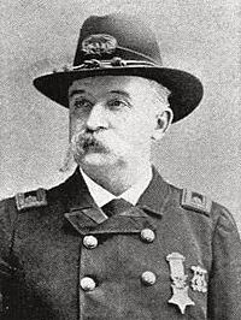
Birth of St. Clair Mulholland, Union Army Colonel

File source: http://commons.wikimedia.org/wiki/File:St_Clair_Mulholland.jpg

St. Clair Augustine Mulholland, colonel in the Union Army in the American Civil War and Medal of Honor winner, is born in Lisburn, County Antrim on April 1, 1839.

Mulholland emigrates to Philadelphia with his parents while a boy. His youthful tastes incline him to military affairs, and he becomes active in the ranks of the militia. At the outbreak of the Civil War, he is commissioned lieutenant colonel of the 116th Pennsylvania Infantry Regiment, which is attached to Thomas Francis Meagher‘s Irish Brigade. When the regiment‘s size is reduced to a battalion, he accepts a reduction in rank to major.

Mulholland is wounded during the famous charge of the Irish Brigade up Marye’s Heights at the Battle of Fredericksburg on December 13, 1862. At the Battle of Chancellorsville on May 3 and 4, 1863, he leads his regiment and distinguishes himself by saving the guns of the 5th Maine Battery that had been abandoned to the enemy. For this he is complimented in general orders and later receives the Medal of Honor from the United States Congress. In this campaign he is given the command of the picket line by Major General Winfield Scott Hancock and covers the retreat of the Army of the Potomac across the Rappahannock River.

Although Mulholland later claims that at the Battle of Gettysburg on July 2, 1863, he personally took command of the 140th Pennsylvania Infantry and led it into action, this fact is mentioned in neither his own official report of the battle, nor that of the lieutenant colonel commanding the 140th. When the 116th is returned to full strength in early 1864, he is promoted to colonel. He is wounded a second time at the Battle of the Wilderness on May 5, 1864. At the Battle of Spotsylvania Court House, he is wounded a third time but remains in the hospital only ten days. Resuming his command, he is dangerously wounded again at the Battle of Totopotomoy Creek. He recovers rapidly and commands his brigade in all the actions around the Siege of Petersburg, particularly distinguishing himself by storming a fort on the Boydton Plank Road. He is mustered out of the volunteer service on June 3, 1865.

On May 4, 1866, President Andrew Johnson nominates Mulholland for the brevet grade of brigadier general of volunteers to rank from March 13, 1865, for his conduct at the Battle of the Wilderness and the U.S. Senate confirms the appointment on May 18, 1866. On January 13, 1869, President Johnson nominates Mulholland for appointment to the brevet grade of major general of volunteers, to rank from March 13, 1865, for his actions on the Boydton Plank Road and the Senate confirms the appointment on February 16, 1869. The brevet is issued February 20, 1869. It is the last brevet of major general issued for service during the Civil War.

Returning to civilian life after the war, Mulholland is appointed Chief of Police in Philadelphia in 1868 and signalizes his administration by the good order in which he keeps both the force and the city. President Grover Cleveland appoints him United States Pension Agent, in which office he is continued by Presidents William McKinley and Theodore Roosevelt. He is considered an authority on the science of penology and also devotes much of his leisure time to art studies, and as a lecturer and writer on the Civil War and its records. He compiles a history of the 116th Regiment, and another of those to whom Congress voted the Medal of Honor. In the Catholic affairs of Philadelphia, he is always active and a leader among the best-known laymen.

St. Clair Augustin Mulholland dies on February 17, 1910, in Philadelphia, Pennsylvania. He is buried at Old Cathedral Cemetery, Philadelphia.


Leave a comment

Birth of James Joseph Quinlan, Union Army Officer

james-joseph-quinlan

James Joseph Quinlan, Union Army officer during the American Civil War, is born in Clonmel, County Tipperary on September 13, 1833.

Quinlan is appointed as Major of the 88th New York Infantry in December 1861. He becomes the regiment’s Lieutenant Colonel in October 1862 and is discharged in February 1863.

Quinlan receives America’s highest military decoration, the Medal of Honor, on February 18, 1891, for his actions at the Battle of Savage’s Station in Henrico County, Virginia, the fourth of the Seven Days Battles (Peninsula Campaign). His citation states he “led his regiment on the enemy’s battery, silenced the guns, held the position against overwhelming numbers, and covered the retreat of the Second Army Corps.”

James Joseph Quinlan dies on August 29, 1906, in Queens, New York and is buried at Calvary Cemetery, Woodside, Queens County, New York.