seamus dubhghaill

Promoting Irish Culture and History from Little Rock, Arkansas, USA


Leave a comment

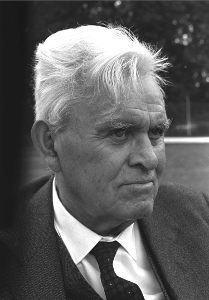
Death of Dan Breen, Irish Patriot & Politician

Irish republican Dan Breen (1967)

Daniel “Dan” Breen, volunteer in the Irish Republican Army during the Irish War of Independence and the Irish Civil War, dies in Dublin on December 27, 1969. In later years, he was a Fianna Fáil politician.

Breen is born in Grange, Donohill parish, County Tipperary, on August 11, 1894. His father dies when he is six, leaving the family very poor. He is educated locally before becoming a plasterer and later a linesman on the Great Southern Railways.

Breen is sworn into the Irish Republican Brotherhood in 1912 and the Irish Volunteers in 1914. On January 21, 1919, the day the First Dáil meets in Dublin, Breen takes part in the Soloheadbeg Ambush. The ambush party of eight men, led by Seán Treacy, attacks two Royal Irish Constabulary (RIC) men who are escorting explosives to a quarry. The two policemen, James McDonnell and Patrick O’Connell, are fatally shot during the incident. The ambush is considered to be the first incident of the Irish War of Independence.

During the conflict, the British put a £1,000 price on Breen’s head, which is later increased to £10,000. He quickly establishes himself as a leader within the Irish Republican Army (IRA). He is known for his courage. On May 13, 1919 he helps rescue his comrade Seán Hogan at gunpoint from a heavily guarded train at Knocklong station in County Limerick. Breen, who is wounded, remembers how the battalion is “vehemently denounced as a cold-blooded assassins” and roundly condemned by the Catholic Church. After the fight, Treacy, Séamus Robinson, and Breen meet Michael Collins in Dublin, where they are told to make themselves scarce although they do not necessarily agree.

Breen and Sean Treacy shoot their way out through a British military cordon in the northern suburb of Drumcondra (Fernside). They escape, only for Treacy to be killed the next day. Breen is shot at least four times, twice in the lung.

The British reaction is to make Tipperary a “Special Military Area,” with curfews and travel permits. Volunteer GHQ authorises entrerprising attacks on barracks. The British policy forces Breen and Treacy to retreat to Dublin. They join Michael Collins’ Squad of assassins, later known as the Dublin Guard, and Dublin becomes the centre of the war.

Breen is present in December 1919 at the ambush in Ashtown beside Phoenix Park in Dublin where Martin Savage is killed while trying to assassinate the Lord Lieutenant of Ireland, Viscount John French. The IRA hides behind hedges and a dungheap as the convoy of vehicles drives past. They have been instructed to ignore the first car but this contains their target, Lord French. Their roadblock fails as a policeman removes the horse and cart intended to stop the car.

Breen utterly rejects the Anglo-Irish Treaty, which makes him, like many others, angry and embittered. In the June 1922 elections Breen is nominated as a candidate by both the pro- and anti-Treaty sides, but is not elected.

Breen is elected to Dáil Éireann at the 1923 general election as a Republican anti-Treaty Teachta Dála (TD) for the Tipperary constituency. Following the Anglo-Irish Treaty, Breen joins the Anti-Treaty IRA in the civil war, fighting against those of his former comrades in arms who support the Treaty. He is arrested by the National Army of the Irish Free State and interned at Limerick Prison. He spends two months there before going on hunger strike for six days followed by a thirst strike of six days, prompting his release.

Breen writes a best-selling account of his guerrilla days, My Fight for Irish Freedom, in 1924. He represents Tipperary from the Fourth Dáil in 1923 as a Republican with Éamon de Valera and Frank Aiken. He is defeated in the June 1927 general election and travels to the United States where he opens a prohibition speakeasy. In 1932 he returns to Ireland and regains his seat as a member of Fianna Fáil in the Dáil at that year’s general election. During World War II he is said to hold largely pro-Axis views. He represents his Tipperary constituency without a break until his retirement at the 1965 election.

Breen dies in Dublin on December 27, 1969 and is buried in Donohill, near his birthplace. His funeral is the largest seen in west Tipperary since that of his close friend and comrade-in-arms Seán Treacy at Kilfeacle in October 1920. An estimated attendance of 10,000 mourners assemble in the tiny hamlet, giving ample testimony to the esteem in which he was held.

Breen is the subject of a 2007 biography Dan Breen and the IRA by Joe Ambrose.


Leave a comment

The Peace Preservation Force is Established

robert-peel

Robert Peel (pictured), chief secretary of Ireland (1812-18), establishes the Peace Preservation Force to counter rural unrest on July 25, 1814. This rudimentary paramilitary police force is designed to provide policing in rural Ireland, replacing the 18th century system of watchmen, baronial constables, revenue officers, and British military forces.

Peel masterminds Act 54, George III, c.131, which is passed on July 25, 1814, to “provide for the better execution of the Laws in Ireland, by appointing Superintending Magistrates and additional Constables in Counties in certain cases.” On foot of this Act, Peel forms the Peace Preservation Force.

The Peace Preservation Force is at the disposal of the Lord Lieutenant of Ireland for use in any district that has been “proclaimed” in a disturbed area. The first resident magistrates are appointed under the 1814 Act.

Sir Richard Willcocks, a former Dublin Magistrate and Special Government Magistrate, is the first appointed Chief Magistrate of the Peace Preservation Force and is allocated to the Barony of Middlethird, County Tipperary, with twenty constables who are ex-cavalry sergeants operating from a base at Cashel. He is appointed Inspector General of Munster and Stipendiary Magistrate. He dies in Dublin and is buried in Chapelizod Church of Ireland Cemetery.

The cost of the Peace Preservation Force operation has to be paid for by the area “proclaimed,” and when tranquility is restored the force will be either withdrawn or disbanded. Between 1814 and 1922 a total of four members of the Peace Preservation Force are killed on duty, namely, Sub Constable Thomas Manning is shot dead on August 16, 1821 when his patrol challenges a gang of insurgents; Chief Police Magistrate Richard Going, is shot dead on October 14, 1821 by a gang of four men while out riding; Sub Constable Hugh Colligan is killed on January 31, 1822 when his barracks are attacked; Sub Constable Thomas Knox is killed on March 10, 1822 while on sick leave and is identified as a policeman.


Leave a comment

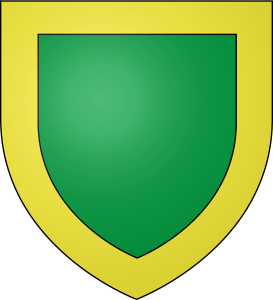
Hugh de Lacy Appointed 1st Earl of Ulster

1st-earl-of-ulster-coat-of-arms

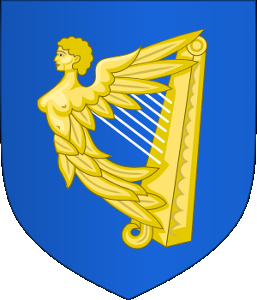
King John of England appoints Hugh de Lacy, a leading figure in the Norman invasion of Ireland in the 12th century, as the 1st Earl of Ulster on May 29, 1205.

Circa 1189 de Lacy is appointed Viceroy of Ireland, a position previously held by his father, Hugh de Lacy, Lord of Meath. He is replaced in 1190 by Guillaume le Petil. He is later reappointed to serve as viceroy from 1205 to 1210.

In 1199, King John authorises de Lacy to wage war on John de Courcy, who has conquered much of Ulster without help or permission from the King. Hugh captures de Courcy in 1204. An account of the capture appears in the Book of Howth.

After King John creates him Earl of Ulster in 1205, he makes what was de Courcy’s territory in Ulster the Earldom of Ulster. He grants Drogheda its charter and continues the conquest of the northeastern over-kingdom of Ulaid, building on de Courcy’s success, with the earldom spanning across the modern counties of Antrim and Down and parts of Londonderry.

In 1207, war breaks out between the Earl of Ulster and the justiciar. This brings King John to Ireland, where he expels the earl’s brother, Walter de Lacy, from Meath, and compels the earl himself to flee to Scotland.

For several years Ulster takes part in the wars in France, and de Lacy does not return to Ireland until 1221, when he allies himself with the O’Neills against the English. In 1226, his lands in Ulster are handed over to his brother Walter, but they are restored to him in the following year, after which date, he appears to loyally serve the king, being more than once summoned to England to give advice about Irish affairs.

De Lacy purportedly separates from his first wife and lives in adultery. He has legitimate and natural children. In 1226, his daughter by his first wife marries Alan, Lord of Galloway. He marries his second wife, Emmeline de Riddlesford, the daughter of Walter de Riddlesford around 1242. Hugh de Lacy dies shortly thereafter in 1242 or 1243. Emmeline’s second marriage takes place around 1243 with Stephen Longespee, grandson of Henry II of England, by whom she has two daughters, Ela Longespee, Lady of Ashby, and Emmeline Longespee, Lady of Offaly.

Left with no surviving legitimate children, the earldom of Ulster reverts to the crown upon de Lacy’s death.


Leave a comment

The Phoenix Park Murders

phoenix-park-murders

Lord Frederick Cavendish, newly appointed Chief Secretary for Ireland, and Thomas Henry Burke, the Permanent Undersecretary, are fatally stabbed in Phoenix Park, Dublin, on May 6, 1882 in what becomes known as the Phoenix Park Murders.

Cavendish, who is married to Lucy Cavendish, the niece of British Prime Minister William Ewart Gladstone, and has worked as Gladstone’s personal secretary, arrives in Ireland on the day he is murdered. Cavendish and Burke are attacked as they walk to the Viceregal Lodge, which is the out-of-season residence of the Lord Lieutenant of Ireland. Thomas Myles, resident surgeon at nearby Dr. Steevens’ Hospital, is summoned to render medical assistance to the victims. The then Lord Lieutenant, Lord Spencer, describes suddenly hearing screams, before witnessing a man running to the Lodge grounds shouting “Lord Frederick Cavendish and Mr. Burke are killed.” Responsibility for the assassinations is claimed by a small hitherto unheard-of Republican organisation called the Irish National Invincibles.

The hunt for the perpetrators is led by Superintendent John Mallon, a Catholic man from Armagh. Mallon has a pretty shrewd idea of who has committed the crime and suspects a number of former Fenian activists. A large number of suspects are arrested and kept in prison by claiming they are connected with other crimes. By playing one suspect against another, Mallon gets several of them to reveal what they know.

James Carey, leader of The Invincibles, Michael Kavanagh, and Joe Hanlon agree to testify against the others. Joe Brady, Michael Fagan, Thomas Caffrey, Dan Curley, and Tim Kelly are convicted of the murders and all are hanged by William Marwood in Kilmainham Gaol in Dublin between May 14 and June 9, 1883. Others, convicted as accessories to the crime, are sentenced to long prison terms. The getaway driver, James Fitzharris, is acquitted of murder but is retried as an accessory and convicted.

Only the case of Tim Kelly gives any real difficulty as he is only nineteen and generally said to look much younger. By referring to him as “a child” his defence counsel creates enough unease for two juries to disagree. He is found guilty only after an unprecedented third trial.

Charles Stewart Parnell makes a speech condemning the murders in 1882, which increases his already huge popularity in both Britain and Ireland. He has just enabled some reforms under the Kilmainham Treaty four days prior to the murders. Parnell’s reputation increases in Ireland, being seen as a more moderate reformer who would never excuse such tactics.

However, Parnell’s policy of allying his party to Gladstone’s Liberal Party in 1886 to enable Home Rule is also ultimately defeated by the murders. Gladstone’s Minister, Lord Hartington, is the elder brother of Lord Frederick Cavendish. Infuriated by the manner of his brother’s early death, Hartington splits with Gladstone on the Home Rule bills of 1886 and 1893 and leads the breakaway Liberal Unionist Association which allies itself to Lord Salisbury‘s conservative governments. In the ensuing 1886 general election, the Conservatives and Liberal Unionists sweep the board. This delays Home Rule by twenty-eight years, when the Third Irish Home Rule Bill is passed in 1914 but never effected.

In March 1887, The Times prints letters purportedly from Parnell claiming sympathy with the murderers and that his public denunciation of them was insincere. It emerges that the letters are forgeries written by journalist Richard Pigott. Parnell is personally vindicated by the Parnell Commission in 1888–89.


Leave a comment

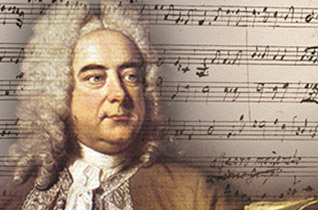
First Performance of Handel’s Messiah

george-friedrich-handel

George Friedrich Handel’s Messiah is performed for the first time at Mr. Neale’s Great Musick Hall on Fishamble Street in Dublin on April 13, 1742. It receives its London premiere nearly a year later. After an initially modest public reception, the oratorio gains in popularity, eventually becoming one of the best known and most frequently performed choral works in Western music.

Handel decides to give a season of concerts in Dublin in the winter of 1741–42 arising from an invitation from the Duke of Devonshire, then serving as Lord Lieutenant of Ireland. After arriving in Dublin on November 18, 1741, Handel arranges a subscription series of six concerts, to be held between December 1741 and February 1742 at the Great Musick Hall on Fishamble Street. These concerts are so popular that a second series is quickly arranged. Messiah figures in neither series.

In early March, Handel begins discussions with the appropriate committees for a charity concert, to be given in April, at which he intends to present Messiah. He seeks and is given permission from St. Patrick’s Cathedral and Christ Church Cathedral to use their choirs for this occasion. The women soloists are Christina Maria Avoglio, who sang the main soprano roles in the two-subscription series, and Susannah Cibber, an established stage actress and contralto who sang in the second series. The performance, also in the Fishamble Street hall, is originally announced for April 12, but is deferred for one day “at the request of persons of Distinction.” The orchestra in Dublin, the exact size of which is unknown, is comprised of strings, two trumpets, and timpani. Handel has his own organ shipped to Ireland for the performances.

The three charities benefit from the performance – the prisoners’ debt relief, the Mercer’s Hospital, and the Charitable Infirmary. In its report on a public rehearsal, the Dublin News-Letter describes the oratorio as “… far surpassing anything of that Nature which has been performed in this or any other Kingdom.” Seven hundred people attend the premiere on April 13. In order to accommodate the largest possible audience, gentlemen are requested to remove their swords and ladies are asked not to wear hoops in their dresses. The performance earns unanimous praise from the assembled press: “Words are wanting to express the exquisite delight it afforded to the admiring and crowded Audience.” A Dublin clergyman, Rev. Delaney, is so overcome by Susanna Cibber’s rendering of “He was despised” that he reportedly leaps to his feet and cries, “Woman, for this be all thy sins forgiven thee!” The takings amount to around £400, providing about £127 to each of the three nominated charities and securing the release of 142 indebted prisoners.

Handel remains in Dublin for four months after the premiere. He organises a second performance of Messiah on June 3, which is announced as “the last Performance of Mr. Handel’s during his Stay in this Kingdom.” In this second Messiah, which is for Handel’s private financial benefit, Cibber reprises her role from the first performance, although details of other performers are not recorded.


Leave a comment

William Gladstone Introduces the First Home Rule Bill

gladstone-introduces-home-rule-bill-1886

William Gladstone introduces the Government of Ireland Bill 1886, commonly known as the First Home Rule Bill, in the Parliament of England on April 8, 1886. It is the first major attempt by a British government to enact a law creating home rule for part of the United Kingdom of Great Britain and Ireland. The bill proposes to create a devolved assembly for Ireland which will govern Ireland in specific areas. The Irish Parliamentary Party under Charles Stewart Parnell has been campaigning for home rule for Ireland since the 1870s.

The Bill, like his Landlord and Tenant (Ireland) Act 1870, is very much the work of Gladstone, who excludes both the Irish MPs and his own ministers from participation in the drafting.

If passed, the 1886 Bill would create a unicameral assembly consisting of two Orders which could meet either together or separately. The first Order would consist of the 28 Irish representative peers plus 75 members elected through a highly restricted franchise. It could delay the passage of legislation for up to 3 years. The second Order would consist of either 204 or 206 members. All Irish MPs would be excluded from Westminster altogether.

Executive power would be possessed by the Lord Lieutenant of Ireland whose executive would not be responsible to either Order.

Britain would still retain control over a range of issues including peace, war, defence, treaties with foreign states, trade, and coinage. No special provision would be made for Ulster. Britain would retain control of the Royal Irish Constabulary (RIC) until it deems it safe for control to pass to Dublin. The Dublin Metropolitan Police would pass to Irish control.

When the bill is introduced, Charles Stewart Parnell has mixed reactions. He says that it has great faults but is prepared to vote for it. In his famous Irish Home Rule speech, Gladstone beseeches Parliament to pass it and grant Home Rule to Ireland in honour rather than being compelled to one day in humiliation. Unionists and the Orange Order are fierce in their resistance. For them, any measure of Home Rule is denounced as nothing other than Rome Rule.

The vote on the Bill takes place on 8 June 1886, after two months of debate. The Government of Ireland Bill is defeated by a vote of 341-311. In the staunchly loyalist town of Portadown, the so-called “Orange Citadel” where the Orange Order is founded in 1795, Orangemen and their supporters celebrate the Bill’s defeat by “Storming the Tunnel.”

Parliament is dissolved on June 26 and the U.K. general election of 1886 is called. Historians have suggested that the 1886 Home Rule Bill was fatally flawed by the secretive manner of its drafting, with Gladstone alienating Liberal figures like Joseph Chamberlain who, along with a colleague, resigned in protest from the ministry, while producing a Bill viewed privately by the Irish as badly drafted and deeply flawed.


Leave a comment

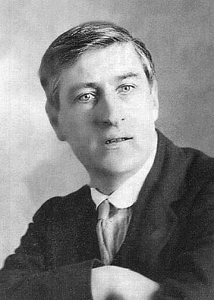
Birth of Irish National Land League Founder Michael Davitt

michael-davitt

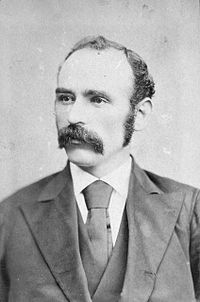
Michael Davitt, Irish republican and agrarian agitator, is born in Straide, County Mayo, on March 25, 1846. Davitt is the  founder of the Irish National Land League, which organizes resistance to absentee landlordism and seeks to relieve the poverty of the tenant farmers by securing fixity of tenure, fair rent, and free sale of the tenant’s interest.

Davitt is the son of an evicted tenant farmer. After their eviction, the family emigrates to England. In 1856, at the age of 10, he starts work in a cotton mill, where he loses an arm in a machinery accident a year later. In 1865, he joins the revolutionary Fenian Brotherhood, an international secret society that seeks to secure political freedom for Ireland. He becomes secretary of its Irish analogue, the Irish Republican Brotherhood (IRB), in 1868. Arrested  in Paddington Station in London for sending firearms to Ireland on May 14, 1870, he is sentenced to 15 years in Dartmoor Prison and there lays plans to link Charles Stewart Parnell’s constitutional reform with Fenian activism to achieve political-agrarian agitation.

Paroled from prison in 1877, Davitt rejoins the IRB and goes to the United States, where the Fenian movement originated. There he is deeply influenced by Henry George’s ideas about the relationship between land monopoly and poverty.

Back in Ireland, using funds raised by John Devoy and Clan na Gael in the United States, Davitt wins Parnell’s cooperation in organizing the Land League in 1879, which leads, however, to his expulsion from the supreme council of the IRB in 1880. He is elected member of Parliament for County Meath in 1882 but is disqualified as he is a convict. He is also imprisoned for seditious speeches in 1881 and 1883.

Because of his public championing of Henry George’s theories of land reform, Parnell repudiates him. Davitt actively defends the Nationalists before the Parnell Commission, which meets between 1887 and 1889. When the Irish party splits in 1890 over Parnell’s involvement in Capt. William Henry O’Shea’s divorce case, Davitt is among the first to oppose Parnell’s continuance as leader.

Davitt is elected to Parliament in 1892 and 1893 but is unseated in both cases. He is elected again, for South Mayo in 1895, but resigns in 1899 in protest against the Second Boer War.

Davitt dies in Elphis Hospital, Dublin on May 30, 1906, at the age of 60, from blood poisoning. The fact that the Lord Lieutenant of Ireland attends his funeral is a public indication of the dramatic political journey this former Fenian prisoner has taken. There is no plan for public funeral, and hence Davitt’s body is brought quietly to the Carmelite Friary, Clarendon Street, Dublin. However, the next day over 20,000 people file past his coffin. His remains are taken by train to Foxford, County Mayo, and buried in the grounds of Straide Abbey at Straide, near his place of birth.

Davitt’s book, The Fall of Feudalism in Ireland (1904), is a valuable record of his time.