seamus dubhghaill

Promoting Irish Culture and History from Little Rock, Arkansas, USA


Leave a comment

Birth of Margaret Pearse, Politician & Mother of Patrick Pearse

Margaret Pearse (née Brady), Irish politician and mother of Patrick and Willie Pearse, who are both executed after the 1916 Easter Rising, is born in Dublin on February 12, 1857.

Margaret Brady is born to Patrick Brady, a coal merchant whose family are from County Meath, and Brigid Brady (née Savage) of Oldtown, Dublin. She is baptised in St. Lawrence O’Toole’s parish. At the time, her parents are living at 1 Clarence Street. She has three known siblings and is educated by the Sisters of St. Vincent de Paul. She is employed as a stationery shop assistant where she meets her future husband, James Pearse.

In 1877, she marries James Pearse at St. Agatha’s Church, off the North Strand. James is born in Bloomsbury, Middlesex, on December 8, 1839, and later lives in Birmingham. He comes to Ireland to work as a sculptor in the late 1850s with his first wife, Emily Susanna Fox, who dies in 1876. They have four children together. The first three children are Margaret Mary (born on August 4, 1878), Patrick (born on November 10, 1879) and William (born on November 15, 1881). All three children are born while the family lives in 27 Great Brunswick Street. Their youngest child, Mary Brigid, is born on September 29, 1888, by which time the family has moved to Newbridge Avenue, Sandymount. Pearse’s aunt, Margaret Brady, an Irish speaker, is a frequent visitor to the family home and encourages the children’s interest in the Irish language and culture. Her husband dies in 1900. Pearse does not permit her children to play with other children, however, she supports her children in all their aspirations. She has a very strong relationship and consequent effect on her eldest son, Patrick, who founds St. Enda’s School in 1908 and is the headmaster up until the time of his execution. She takes over the responsibility of Housekeeper at the school.

Pearse supports her sons’ political beliefs. After their execution, she wishes to maintain their legacy and becomes involved in political life. She joins Sinn Féin after the Rising and gives support and endorsement to candidates during the 1918 Westminster election. During the 1920 Poor Law Elections for the Rathmines area of Dublin, she stands as a Sinn Féin candidate and is elected on the first count. She is elected to Dáil Éireann as a Sinn Féin Teachta Dála (TD) for the Dublin County constituency at the 1921 Irish elections.

Pearse strongly opposes the Anglo-Irish Treaty, as do all the female TDs. She states during the Treaty debate that:

“I rise to support the motion of our President for the rejection of the Treaty. My reasons for doing so are various, but my first reason for doing so I would like to explain here today is my son’s account. It has been said here on several occasions that Patrick Pearse would have accepted this Treaty. I deny it. As his mother I deny it, and on his account, I will not accept it.”

Later she continues in a similar vein:

“Always we had to be on the alert. But even the Black and Tans alone would not frighten me as much as if I accepted this Treaty; because I feel in my heart – and I would not say it only I feel it – that the ghosts of my sons would haunt me.”

Following the ratification of the Treaty Pearse leaves the Dáil with the other anti-Treaty deputies. She is defeated at the 1922 Irish general election. She supports those who oppose the Treaty during the Irish Civil War and continues to be a member of Sinn Féin until 1926. In 1926 she leaves the party conference with Éamon de Valera and becomes a founder member of Fianna Fáil. She never stands for election again.

At the launch of The Irish Press newspaper, Pearse is asked to press the button to start the printers rolling. At many public occasions she states that were her sons alive they too would have joined Fianna Fáil. Accordingly, Patrick Pearse is recognised as the spiritual figurehead of the party to this day.

After Patrick’s death, the responsibility for running the school falls to Pearse and her two daughters. As Patrick Pearse had died without a will, the school is left in a precarious financial position. In May 1924, when she is aged 70, she undertakes a trip to the United States to raise funds for the school, alongside showing support for Éamon de Valera and the Irish Republic. At an event in Brooklyn on May 19, 1924, when referencing the execution of her two sons, she declares herself the “proudest mother in Ireland.” She also states that Michael Collins had attempted to “bribe” her with an offer to subsidise the school, which she refused. During a meeting in Seattle on August 11, 1924, she again discusses her sons and how she believes “the best way to honour their memory was to carry on their work for Ireland.” She raises over $10,000 in donations for the school during the trip. Notwithstanding her fundraising activities, St. Enda’s continues to decline and eventually closes in 1935. Great Brunswick Street, where she and the Pearse family originally lived, is renamed Pearse Street in 1920 by a resolution passed at the Dublin City Council meeting.

Pearse dies on April 22, 1932. She is honoured with a large state funeral and a motion is passed at the meeting of Dublin City Council expressing sympathy with the Pearse family. On April 26, 1932, sizeable crowds pay their respects as her funeral procession makes its way through the streets of Dublin. At the General Post Office (GPO), where Patrick and William fought during the Easter Rising, the funeral cortege pauses for a minute of silence before proceeding to Glasnevin Cemetery. Éamon de Valera gives an oration as she is laid to rest, which praises her inspiring courage, charity and cheerfulness during the years after her son’s death.

After Pearse’s death, her daughter, Mary Margaret, continues to reside at St. Enda’s. She also joins Fianna Fáil, and serves as a TD from 1933 to 1937 and later serves in Seanad Éireann as a Senator from 1938 until her death in 1968. Upon her death, as per her mother’s request, she passes St. Enda’s on to the people of Ireland.


Leave a comment

Death of Margaret Mary Pearse

margaret-mary-pearse

Margaret Mary Pearse, Fianna Fáil politician and teacher, dies at Linden Convalescent Home in Dublin on November 7, 1968. She is a sister of Patrick Pearse, one of the leaders of the 1916 Easter Rising, and Willie Pearse, both of whom are executed for their part in the Rising.

Pearse is born on August 24, 1878, at 27 Great Brunswick Street (now Pearse Street) in Dublin, the eldest child of James Pearse and Margaret Pearse (née Brady), who serves as a Teachta Dála (TD) in the 1920s. She is educated at the Holy Faith Convent in Glasnevin. After leaving school, she trains as a teacher. She helps to found St. Enda’s School with her brothers Patrick and Willie. Following the executions of her brothers in the aftermath of the Easter Rising, she continues to run St. Enda’s, along with Fergus De Búrca, until 1933.

Following in her mother’s footsteps, Pearse is first elected to Dáil Éireann as a Fianna Fáil TD for the Dublin County constituency at the 1933 general election. She is defeated at the 1937 general election on the 7th count of votes but is elected to the Administrative Panel of the 2nd Seanad. She serves in the Seanad until her death in 1968, however, she and her mother are never considered to be more than figureheads for the party. She is a founding member of the teaching staff of Ardscoil Éanna in Crumlin, Dublin, upon its establishment in 1939.

Illness forces Pearse into the Linden Convalescent Home in Blackrock, County Dublin when she is in her 80s. In 1967, when she is 89 years old, her condition is described to be deteriorating. However, in 1968 during the months leading up to her 90th birthday, she leaves the Linden Convalescent Home for a short while in order to spend her birthday at St. Endas in Rathfarnham. The president of Ireland at the time, Éamon de Valera, visits her at St. Endas to congratulate her on her upcoming 90th birthday.

Margaret Pearse dies, unmarried, at the Linden Convalescent Home in Blackrock, County Dublin, on November 7, 1968, and is given a state funeral. President de Valera, the church and the state all pay tribute to her at the funeral. She is buried beside her parents and sister at Glasnevin Cemetery. The Taoiseach, Jack Lynch, says that Margaret Mary Pearse is the last remaining member of the noble Pearse family. He says her life, like her patriotic brothers, was dedicated to Ireland.

As per her mother’s wishes, Pearse bequeaths St. Enda’s to the people of Ireland as a memorial to her brother’s sacrifice. The school is now home to the Pearse Museum.


Leave a comment

Patrick Pearse Arrives in Ros Muc

patrick-pearse-cottage

Patrick Pearse arrives in Ros Muc, County Galway on September 13, 1903, and takes up residence at his cottage in Inbhear.

Born in Dublin on November 10, 1879, Pearse joins the Irish Republican Brotherhood (IRB) in September 1913, becoming Director of Military Organisation of the Irish Volunteers in 1914 and is later co-opted into the IRB’s secretive Military Council, which infiltrates the Volunteers for the Easter Rising.

A writer and Irish language enthusiast long before he becomes a revolutionary, Pearse first comes to Ros Muc in 1903 as a 23-year-old handpicked by Conradh na Gaeilge to act as an Irish examiner.

Pearse develops a strong affinity with the area, buying land on Loch Eileabhrach in 1905, upon which he builds a cottage in 1909. Unusually for a professional at the time, he has it thatched in the style of poor country dwellings and on his regular visits between 1903 and 1915, spends time in the cabins of the poor, soaking up the folklore which finds its way into his writings.

Pearse has a rival for the affections of the locals in the shape of the Lord Lieutenant of Ireland, the Queen’s representative in Ireland. William Ward, 2nd Earl of Dudley also spends summers in the area, where he organises hunts with gentry and children’s fetes.

In response, Pearse organises an evening of Irish festivities for Ros Muc. Pearse gives scholarships to local gaeilgeoiri boys to his St. Enda’s School in Dublin.

Pearse’s last visit to the cottage is in 1915, when he composes the rousing oration for the funeral of Jeremiah O’Donovan Rossa. The following April, he goes one step further, declaring a Republic on the steps of the General Post Office (GPO) in Dublin.

After Pearse’s execution on May 3, 1916, his cottage passes to his mother Margaret. In 1921 it is burned down by the “Black and Tans” and Auxiliaries. Restored by Ó Conghaile and then again by Criostóir Mac Aonghusa, by 1943 Pearse’s sisters Senator Margaret Mary Pearse and Mary Brigid Pearse hand the cottage to the State.

Opened in 2016, a new visitor centre next to Pearse’s Cottage provides an introduction to the Irish language, Gaeltacht culture, and Pearse’s connection to Ros Muc.

(From: “Patrick Pearse’s cottage: a cultural visit to Ros Muc,” Darragh Murphy, The Irish Times, January 13, 2016)


Leave a comment

First Edition of the “Irish Press” Published

irish-press-may-25-1995

The first edition of the Irish Press, a Dublin daily newspaper founded by Éamon de Valera as a platform for Fianna Fáil, is published on September 5, 1931.

Irish Press Ltd. is officially registered on September 4, 1928, three years before the paper is first published, to create a newspaper independent of the existing media where the Independent Newspapers group is seen as supporting Cumann na nGaedheal/Fine Gael, and The Irish Times being pro-union, and with a mainly middle-class or Protestant readership.

The paper’s first issue is published on the eve of the 1931 All-Ireland Senior Hurling Championship Final between Cork and Kilkenny. Other newspapers do not cover GAA sports in any detail at the time. Margaret Pearse, the mother of Patrick and Willie Pearse, presses the button to start the printing presses. The initial aim of its publisher is to achieve a circulation of 100,000 which it quickly accomplishes. It goes on to list 200,000 subscribers at its peak.

The money to launch the Irish Press is raised in the United States during the Irish War of Independence by a bond drive to finance the First Dáil. Five million dollars is raised; however, 60 percent of this money is left in various banks in New York City. No one knows why de Valera ordered the bulk of the money to be left in New York when he returned to Ireland in late 1920.

In 1927, as a result of legal action between the Irish Free State government and de Valera, a court in New York orders that the bond holders be paid back outstanding money due to them. However, de Valera’s legal team has anticipated the ruling and has prepared for the outcome. A number of circulars are sent to the bond holders asking them to sign over their holdings to de Valera. The bond holders are paid 58 cents to the dollar. This money is then used as startup capital to launch the Irish Press. Following the 1933 Irish General Election, de Valera uses his Dáil Éireann majority to pass a measure allowing the bond holders to be paid the remaining 42 percent of the money still owed.

In December 1931, editor Frank Gallagher is prosecuted by an Irish Free State military tribunal for publishing articles alleging that Garda Síochána had mistreated the Anti-Treaty republicans of the Irish Free State government. This is facilitated by Amendment 17 of the Constitution of the Irish Free State and Gallagher is convicted and fined £50. An example of animosity from those who support Independent Newspapers and the Free State government is that the Irish Press is excluded from the special train which delivers newspapers from Dublin to the countryside. As a result, it is circulated throughout Ireland by a specially rented train.

The Irish Press sustains itself with its own resources until The Sunday Press is founded in 1949. In its heyday, the Irish Press has a number of first-rate reporters and columnists. One notable section, New Irish Writing is edited by David Marcus.

In the 1970s, the Minister for Posts and Telegraphs, Conor Cruise O’Brien, tries to use and amend The Emergency Powers Act and Section 31 of the Broadcasting Authority Act, to censor coverage of the Troubles in Northern Ireland. The Irish Press editor, Tim Pat Coogan, publishes editorials attacking the Bill. The Fine Gael/Labour Coalition Government tries to prosecute the Irish Press for its coverage of the maltreatment of republican prisoners by the Garda “Heavy Gang,” with the paper winning the case.

The Irish Press starts two further newspapers, the Evening Press (1954), and The Sunday Press. The Evening Press is aimed at an urban readership and achieves a daily circulation of 100,000. The new newspapers subsidise the Irish Press when its circulation sags. Its adoption of a tabloid format does not rescue its declining circulation.

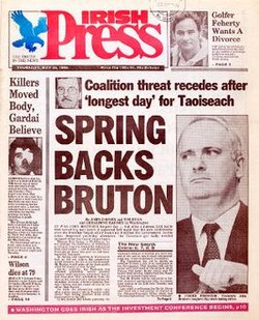
The final issue of the Irish Press and Evening Press is on Thursday, May 25, 1995. The newspapers close because of a bizarre industrial dispute over the sacking of the group business editor, Colm Rapple. The group has not been in a healthy financial state for several years. When it eventually closes, with indebtedness of £20 million, 600 people lose their jobs.

(Pictured: Cover of last ever edition of the Irish Press from May 25, 1995)


Leave a comment

Patrick Pearse Opens St. Edna’s School

pearse-museum

St. Enda’s School, or Scoil Éanna, a secondary school for boys set up in Ranelagh, Dublin, by Irish nationalist Patrick Pearse, is opened on September 8, 1908.

Pearse, generally known as a leader of the 1916 Easter Rising, has long been critical of the educational system in Ireland, which he believes teaches Irish children to be good Englishmen. He has for years been committed to the preservation of the Irish language, mostly through the Gaelic League, and is dearly concerned about the language’s future. A trip abroad to Belgium and his observations of bi-lingual education there inspires him to attempt a similar experiment at home.

Pearse is not a practical businessman, but he is never one to let lack of finances get in the way of his plans. With promises from prominent nationalists as proponents of Irish heritage that they will give him whatever limited financial support they can, and, when applicable, will enroll their children in his school, Pearse establishes his school, which officially opens on September 8, 1908, in Cullenswood House, Ranelagh, a suburb of Dublin.

The school proves a successful experiment but is never to fully escape the shadow of looming financial woes. In fact, the school would not have survived the crucial first few years without the devoted aid of his good friend and assistant headmaster Thomas MacDonagh, and the solid dedication of Pearse’s brother Willie.

St. Enda’s teaches many of the classes in Irish and particularly stresses the arts and dramatics. Everything is given an Irish approach. After two years the school is doing quite well. Thrilled with his creation and concerned that Cullenswood House is not a location that does St. Enda’s justice, Pearse moves the school to the Hermitage in Rathfarnham, substantially further from Dublin than Cullenswood House. In 1910 St. Enda’s opens its doors at the Hermitage but proves to be a financial disaster. With bankruptcy looming Pearse is forced to look to the United States for further funding which only keeps the school barely in solvency.

Pearse is a person who shows extreme dedication to a project once it catches his interest, but this leaves him unable to fully devote himself to multiple tasks. His involvement in the Irish Volunteers in 1913, and his active participation in the Irish Republican Brotherhood shortly thereafter, leaves St. Enda’s with a less devoted master than it had previously.

Following the execution of the Pearse brothers after the rising, their mother reopens St. Enda’s back at Cullenwood House. The school then returns to the Hermitage in 1919. The international fame the Easter Rising gives Pearse and his martyrdom makes raising funds easier than before and Margaret Pearse raises enough money to buy the property Pearse could never afford in his lifetime. However, without the leadership of either of the Pearse brothers, St. Enda’s could not last, and it eventually closes its doors for good in 1935. Today the Hermitage stands as the Pearse Museum, dedicated to the memory of the school’s founder.

(Pictured: The Pearse Museum in Rathfarnham)