seamus dubhghaill

Promoting Irish Culture and History from Little Rock, Arkansas, USA


Leave a comment

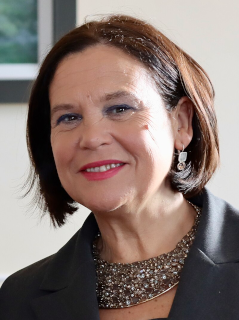
Birth of Mary Lou McDonald, Current President of Sinn Féin

Mary Louise McDonald, Irish politician and President of Sinn Féin since February 2018, is born in Dublin on May 1, 1969.

McDonald is born into a middle-class family in south Dublin. Her father Patrick McDonald, a builder and surveyor, and her mother Joan, separate when she is nine years old, and she stays with her mother in Rathgar. She has three siblings, one older and two younger. Her great-uncle, James O’Connor, was a member of the Anti-Treaty IRA and was executed at the Curragh Camp during the Irish Civil War.

McDonald is educated at Rathgar National School and at the Catholic all-girls, Notre Dame des Missions in Churchtown, South Dublin, where she is involved in debating. She then attends Trinity College Dublin (TCD), the University of Limerick and Dublin City University (DCU), studying English Literature, European Integration Studies and Human Resource Management.

She works as a researcher for the Institute of European Affairs, a consultant for the Irish Productivity Centre, a human resources consultancy that is jointly operated by Ibec and Irish Congress of Trade Unions (ICTU), and a trainer in the Partnership Unit of the Educational and Training Services Trust.

McDonald starts her political career by first joining Fianna Fáil in 1998 but leaves the party after a year due to core policy differences, particularly in relation to Northern Ireland and social justice. She quickly realises that Sinn Féin is a more appropriate party for her Republican views after meeting Sinn Féin members through the Irish National Congress.

She first runs for office at the 2002 Irish general election when she unsuccessfully contests the Dublin West constituency for Sinn Féin, polling 8.02% of first preference votes.

In 2004, McDonald becomes Sinn Féin’s first Member of the European Parliament (MEP) in Ireland, when she is elected at the 2004 European Parliament election in Ireland for the Dublin constituency, receiving over 60,000 first preference votes. She serves until 2009 and is a prominent member of the Employment and Social Affairs committee and Civil Liberties committee.

McDonald is an unsuccessful candidate in the Dublin Central constituency at the 2007 Irish general election. In 2009 she becomes the vice president of Sinn Féin.

McDonald contests the Dublin Central constituency again at the 2011 Irish general election, this time picking up 13.1% of first preference votes. She is successful in taking the last seat in the constituency. Following the election, she becomes Sinn Féin’s Spokesperson for Public Expenditure and Reform and is a member of the Public Accounts Committee from then until 2017.

After her re-election to the Dáil at the 2016 Irish general election, in which she tops the poll in Dublin Central, she becomes Sinn Féin’s All-Ireland Spokesperson for Mental Health and Suicide Prevention, which she holds until being elected president of Sinn Féin in 2018.

At a Sinn Féin party conference on November 18, 2017, Gerry Adams is re-elected party leader but announces that he will ask party leadership to call for a special Ard Fheis to be held within three months to choose a new president, and that he will not stand for re-election as TD for the Louth constituency in the next election.

At the close of nominations to succeed Adams on January 20, 2018, McDonald is announced as the president-elect of Sinn Féin, as she is the sole nominee to enter the race. She is confirmed as president at a special Ard Fheis on February 10, 2018, in Dublin.

McDonald is nominated as Taoiseach on February 20, 2020, but is defeated 45 to 84. On June 26, 2020, Fianna Fáil, Fine Gael, and the Green Party form a coalition government, leaving Sinn Féin as the largest opposition party, and McDonald as Leader of the Opposition. She dismisses the coalition agreement as a “marriage of convenience,” and accuses Fianna Fáil and Fine Gael of conspiring to exclude Sinn Féin from government.

At the 2024 Irish general election, McDonald is re-elected to the Dáil topping the poll in Dublin Central with Sinn Féin increasing their seat share by two seats, remaining the second largest party by representation in the Dáil and attaining 19% of the first preference votes, a fall of 5.5% from 2020 and fall behind Fianna Fáil by 2.9% and Fine Gael by 1.8%.

McDonald is again nominated as Taoiseach on December 18, 2024, but is defeated 44 to 110.

McDonald’s husband, Martin Lanigan, works as a gas control superintendent for the emergency dispatch division of Gas Networks Ireland, a state infrastructure provider. They have two children and live in Cabra, Dublin.

Leave a comment

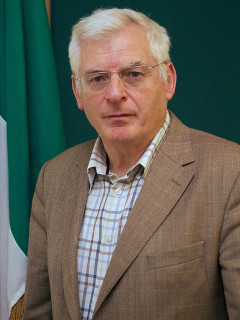
Birth of Joe Higgins, Politician & Member of the European Parliament

Joe Higgins, a former Socialist Party politician who serves as a Teachta Dála (TD) for the Dublin West constituency from 1997 to 2007 and from 2011 to 2016, is born in Lispole, County Kerry, on May 20, 1949. He serves as a Member of the European Parliament (MEP) for the Dublin constituency from 2009 to 2011.

One of nine children of a small farming family, Higgins goes to school in the Dingle Christian Brothers School, and after finishing he enrolls in the priesthood. As part of his training, he is sent to a Catholic seminary school in Minnesota, United States, in the 1960s. He becomes politicised at the time of anti-Vietnam War protests and the civil rights movement. He is a brother of Liam Higgins, who plays football with the Kerry GAA senior team in the 1960s and 1970s. He is bilingual in English and Irish.

Higgins returns to Ireland and attends University College Dublin (UCD), studying English and French. For several years he is a teacher in several Dublin inner city schools. While at university he joins the Labour Party and becomes active in the Militant Tendency, an entryist Trotskyist group that operates within the Labour Party. Throughout his time in the Labour Party, he is a strong opponent of coalition politics, along with TDs Emmet Stagg and Michael D. Higgins. He is elected to the Administrative Council of the Labour Party by the membership in the 1980s. In 1989, he is expelled alongside 13 other members of Militant Tendency by party leader Dick Spring. The group eventually leaves the party and forms Militant Labour, which becomes the Socialist Party in 1996.

Higgins spends over half his salary on the Socialist Party and causes he supports. He is elected to Dublin County Council in 1991 for the Mulhuddart electoral area and is until 2003 a member of Fingal County Council. In 1996, he campaigns against local authority water and refuse charges and contests the Dublin West by-election, losing narrowly to Brian Lenihan Jnr.

Higgins is first elected to Dáil Éireann at the 1997 Irish general election and re-elected at the 2002 general election. He loses his seat at the 2007 general election but regains it at the 2011 general election. From 2002 to 2007, he is a member of the Technical Group in the Dáil which consists of various independent TDs, Sinn Féin and the Green Party grouped together for better speaking time.

Higgins speaks out against the Iraq War while a TD, and addresses the Dublin leg of the March 20, 2003 International Day of Action. He is also prominent in the successful 2005 campaign to bring Nigerian school student Olukunle Eluhanla back to Ireland after he had been deported. He remains an opponent of the deportation policy.

Higgins uses his platform in the Dáil to raise the issue of exploitation of migrant and guest workers in Ireland. He and others claim that many companies are paying migrants below the minimum wage and, in some cases, not paying overtime rates. He expresses opposition in the Dáil to the jailing of the Rossport Five in July 2005. He raises the outsourcing of jobs by Irish Ferries in the Dáil in November 2005, requesting new legislation to regulate what he describes as “these modern slavers.”

Higgins successfully contests the 2009 European Parliament election for the Dublin constituency, beating two incumbents, Mary Lou McDonald of Sinn Féin and Eoin Ryan of Fianna Fáil, for the third and final seat. He is elected on the same day to Fingal County Council for the Castleknock electoral area, topping the poll. As Irish law prohibits politicians having a dual mandate, he vacates the council seat in July 2009 and is replaced by Matt Waine. He was a member of the European United Left–Nordic Green Left (EUL–NGL) group in the European Parliament, the European Parliament’s Committee on International Trade, and the delegation for relations with the countries of South Asia. He is also a substitute member of the Committee on Employment and Social Affairs, the Committee on Petitions and the delegation for relations with the Mercosur countries. Paul Murphy replaces him as an MEP when he is re-elected to the Dáil in 2011.

Higgins is elected again as TD for Dublin West at the 2011 Irish general election. He wins the third seat (of four) with 8,084 first preference votes. In his first speech in the 31st Dáil, he opposed the nomination of Fine Gael‘s Enda Kenny as Taoiseach. On May 4, 2011, Kenny is forced to apologise to Higgins in the Dáil after falsely accusing him of being a supporter of Osama bin Laden after Higgins offers criticism of his assassination by the CIA. He had asked the Taoiseach, “Is assassination only justified if the target is a reactionary, anti-democratic, anti-human rights obscurantist like bin Laden?”

In the Dáil, Higgins accuses Tánaiste Eamon Gilmore of doing nothing for the 14 Irish citizens being held “incommunicado” by Israel in November 2011. In December 2011, he describes as a disgraceful campaign of intimidation the fines imposed by the government on people who are unable to pay a new household charge brought in as part of the latest austerity budget and says to Enda Kenny that he will be “the new Captain Boycott of austerity in this country.” He asks that Minister for Finance Michael Noonan provide EBS staff with the 13th month end-of-year payment they are being denied.

In September 2012, Higgins publicly disagrees with former Socialist Party colleague Clare Daly, saying it is “unfortunate” that she has resigned from the party, but that it is impossible for Daly under the banner of the Socialist Party to continue to offer political support to Mick Wallace, who is at that time embroiled in scandal.

Higgins announces in April 2014 that he will not contest the next Dáil election. At the time he states his belief that the “baton of elected representation” should be carried by another generation of Socialist Party politicians — like Ruth Coppinger and Paul Murphy.


Leave a comment

Birth of Pat Doherty, Sinn Féin Politician & Member of Parliament

Patrick Doherty, retired Sinn Féin politician and the abstentionist Member of Parliament (MP) for West Tyrone from 2001 to 2017, is born in Glasgow, Scotland, on July 18, 1945. He is a member of the Northern Ireland Assembly for the West Tyrone Assembly constituency from June 1998 to June 2012. He serves as Vice President of Sinn Féin from 1988 to 2009, when Mary Lou McDonald becomes the party’s new Vice President.

Doherty is educated at St. Joseph’s College, Lochwinnoch, and is a site engineer who likes building stone walls. He is the brother of former Provisional Irish Republican Army (IRA) member Hugh Doherty, known for his involvement in the Balcombe Street siege. According to The Times Guide to the House of Commons, he is married with three daughters and two sons.

Doherty’s parents are from County Donegal in the Republic of Ireland. He moves to Donegal in 1968, shortly before the Troubles break out across the Irish border in Northern Ireland. He is an abstentionist Sinn Féin Member of Parliament of the British parliament for West Tyrone from 2001 to 2017, as well as a member of the Northern Ireland Assembly from the 1998 Northern Ireland Assembly election until 2012. He also stands for election in the Republic of Ireland, in the constituency of Donegal North-East in 1989, 1996 (a by-election) and 1997, and also in the Connacht–Ulster constituency in the European Parliament elections in 1989 and 1994.

In May 2002, using parliamentary privilege, Ulster Unionist Party (UUP) MP David Burnside names Doherty as a member of the IRA Army Council.

Over a two-and-a-half-year period, Doherty spends £16,000 on printer cartridges, an amount that he admits is “probably excessive.”

In 2012, to some surprise, Doherty writes to the Arts Council of Northern Ireland in support of funding for the loyalist Castlederg Young Loyalist Flute Band. He praises the band for reaching out to “all sections of the community.” The band had sought support for its funding application from a community group who then, unbeknownst to the band, reached out to Doherty. A spokesman for the band, whose website includes sections on IRA atrocities, the controversial B Specials and lyrics to songs, including one glorifying Ulster Volunteer Force (UVF) terrorist Brian Robinson, distances themselves from the application, claiming the band is unaware of Doherty’s support and does not want it. He adds that “The band harbours nothing but contempt for Irish republicanism and its attacks on their community.” Four of the band’s members are killed by the IRA.


Leave a comment

Mary Lou McDonald Ratified as Leader of Sinn Féin

Mary Lou McDonald is ratified as the new president of Sinn Féin at a special party Ardfheis on February 10, 2018. Approximately 2,000 party delegates gather for the meeting in Dublin. After almost 35 years, Gerry Adams officially steps down as party leader, a role he has held since November 1983.

McDonald takes the helm with a sweeping speech that touches on everything from abortion to Brexit and promises a united Ireland “in our time.”

McDonald, 48, is the first woman to lead the party, and the first Sinn Féin leader with no direct connection to Ireland’s period of violence known as the Troubles. “We must only agree that the past is never again repeated,” she says. “On other things, we can agree to disagree. The poet Maya Angelou put it well: ‘History, despite its wrenching pain, cannot be unlived. But if faced with courage, need not be lived again.’”

McDonald takes over for Adams, a divisive politician who was the face of the Irish republican movement as it shifted from violence to peace. The end of Adams’ tenure marks a new era for the party, which wants to unite the United Kingdom’s Northern Ireland with the Republic of Ireland to the south.

Adams, who announced in November 2017 he was stepping down after almost 35 years, was the key figure in the peace process that saw the signing of the 1998 Good Friday Agreement and the formation of a power sharing government between Northern Ireland’s pro-British and republican factions. But many believe Sinn Féin’s popularity among voters has been hindered by the presence of leaders linked to the Troubles, which killed over 3,600 people.

McDonald immediately puts her own stamp on the future, trying to infuse new energy into the movement that has lawmakers on both sides of the Irish border. But she also focuses on Sinn Féin’s founding principle: a united Ireland. “We are the generation of republicans who will see the rising of the moon,” she says. “Sinn Féin in government, both North and South. Irish unity in our time.”

McDonald also lays out her positions on the key issues of the day.

On the United Kingdom’s upcoming departure from the European Union, or Brexit, she says Sinn Féin will not accept any deal that reinstates border controls between Northern Ireland and the Republic. Brexit represents a threat to the prosperity of Ireland as a whole.

“Ireland will not be the collateral damage in the political games and antics of Tories in London,” she says, referring to the Conservative Party of British Prime Minister Theresa May.

McDonald also says the party will campaign for women’s right to an abortion in Ireland’s upcoming referendum on the issue and says she is committed to reaching an agreement that will restore Northern Ireland’s power sharing government on the basis of “respect and integrity for all.”

Northern Ireland’s last government collapsed more than a year earlier amid a corruption scandal.

(From: “Mary Lou McDonald takes over as Sinn Féin party leader” by Danica Kirka, AP News, apnews.com, February 10, 2018)


Leave a comment

Gerry Adams Announces Re-election Bid as Sinn Féin President

Sinn Féin President Gerry Adams announces on September 5, 2017, he will seek re-election as the party president in November and then outline his own future intentions as the former political wing of the Irish Republican Army (IRA) prepares to complete a generational shift in its leadership.

Adams, Sinn Féin leader for over thirty years, will seek re-election to the one-year post at the party’s annual conference and set out his future plans at that time. “I will be allowing my name to go forward for the position of Uachtaran Shinn Féin (President of Sinn Féin),” Adams says in a speech at a meeting of the party’s lawmakers. “And if elected I will be setting out our priorities and in particular our planned process of generational change, including my own future intentions.”

“We have no ambition to be part of the system. Our ambition is to change it. That means we must be in government – North and South,” Adams says.

Reviled by many as the face of the IRA during its campaign against British rule in Northern Ireland, Adams reinvented himself as a peacemaker in the troubled region and then as a populist opposition lawmaker in the Irish Republic. Around 3,600 people were killed during Northern Ireland’s “Troubles,” three decades of sectarian bloodshed between pro-British Protestant unionists and Catholic nationalists seeking a united Ireland that was ended by the 1998 Good Friday Agreement.

Whenever Adams decides to step down, he will almost certainly hand over to a successor with no direct involvement in the decades of conflict in Northern Ireland, say political analysts, making Sinn Féin a more palatable coalition partner in the Irish Republic where it has never been in power. Deputy leader Mary Lou McDonald, who has been at the forefront of a new breed of Sinn Féin politicians transforming the left-wing party’s image, is the clear favorite to take over. Michelle O’Neill, another Sinn Féin lawmaker in her 40s, succeeded Martin McGuinness as leader in Northern Ireland shortly before the former IRA commander’s death in March 2017.

With McGuinness, Adams turned Sinn Féin into the dominant nationalist party in Northern Ireland and the third largest party south of the border. Adams said the previous month that he intended to lead the party into the next parliamentary election in the Irish republic where suspicion of Sinn Féin’s role in the Northern Ireland troubles still runs deep among the main political parties.

The far larger ruling Fine Gael and main opposition Fianna Fáil, a more natural ally, have ruled out governing with Sinn Féin but analysts say a change of leader could soften that stance. The next election is expected in the next 12 months.

(From: “Sinn Féin’s Adams to outline succession plan in November” by Padraic Halpin | Photo: Sinn Féin President Gerry Adams speaks at an event in Gormanstown, Ireland, September 5, 2017, REUTERS/Clodagh Kilcoyne)


Leave a comment

Birth of Bobby Storey, Provisional Irish Republican Army Volunteer

Robert “Bobby” Storey, a Provisional Irish Republican Army (IRA) volunteer, is born in Belfast, Northern Ireland, on April 11, 1956. Prior to an 18-year conviction for possessing a rifle, he also spends time on remand for a variety of charges and in total serves 20 years in prison. He also plays a key role in the Maze Prison escape, the biggest prison break in British penal history.

The family is originally from the Marrowbone area, on the Oldpark Road in North Belfast. The family has to move when Storey is very young due to Ulster loyalist attacks on the district, moving to Manor Street, an interface area also in North Belfast. His uncle is boxing trainer Gerry Storey and his father, also called Bobby, is involved in the defence of the area in the 1970s when Catholics are threatened by loyalists.

Storey is one of four children. He has two brothers, Seamus and Brian, and a sister Geraldine. Seamus and his father are arrested after a raid on their home which uncovers a rifle and a pistol. While his father is later released, Seamus is charged. He escapes from Crumlin Road Prison with eight other prisoners in 1971, and they are dubbed the Crumlin Kangaroos.

On his mother Peggy’s side of the family there is also a history of republicanism, but Storey says the dominant influences on him are the events happening around him. These include the McGurk’s Bar bombing in the New Lodge, some of those killed being people who knew his family, and also Bloody Sunday. This then leads to his attempts to join the IRA. He leaves school at fifteen and goes to work with his father selling fruit. At sixteen, he becomes a member of the IRA.

On April 11, 1973, his seventeenth birthday, Storey is interned and held at Long Kesh internment camp. He had been arrested 20 times prior to this but was too young for internment. In October 1974, he takes part in the protest at Long Kesh against living conditions where internees set fire to the “cages” in which they are being held. He is released from internment in May 1975. He is arrested on suspicion of a bombing at the Skyways Hotel in January 1976 and a kidnapping and murder in the Andersonstown district of Belfast in March 1976, but is acquitted by the judge at his trial. He is arrested leaving the courthouse and charged with a shooting-related incident. He is released after the case cannot be proven, only to be charged with shooting two soldiers in Turf Lodge. Those charges are dropped in December 1977. The same month he is arrested for the murder of a soldier in Turf Lodge, but the charges are again dropped. In 1978 he is charged in relation to the wounding of a soldier in Lenadoon, but is acquitted at trial due to errors in police procedure.

On December 14, 1979, he is arrested in Holland Park, London, with three other IRA volunteers including Gerard Tuite, and charged with conspiring to hijack a helicopter to help Brian Keenan escape from Brixton Prison. Tuite escapes from the same prison prior to the trial, and the other two IRA volunteers are convicted, but Storey is acquitted at the Old Bailey in April 1981. That August, after a soldier is shot, he is arrested in possession of a rifle and is convicted for the first time, being sentenced to eighteen years’ imprisonment.

Storey is one of the leaders of the Maze Prison escape in 1983, when 38 republican prisoners break out of the H-Blocks, the largest prison escape in British penal history and the largest peacetime prison escape in Europe. He is recaptured within an hour and sentenced to an additional seven years’ imprisonment. Released in 1994, he is again arrested in 1996 and charged with having personal information about a British Army soldier, and Brian Hutton, the Lord Chief Justice of Northern Ireland. At his trial at Crumlin Road Courthouse in July 1998, he is acquitted after his defence proves the personal information had previously been published in books and newspapers.

Having spent over twenty years in prison, much of it on remand, Storey’s final release is in 1998, and he again becomes involved in developing republican politics and strategy, eventually becoming the northern chairman of Sinn Féin.

On January 11, 2005, Ulster Unionist Member of Parliament for South Antrim David Burnside tells the British House of Commons under parliamentary privilege that Storey is head of intelligence for the IRA.

On September 9, 2015, Storey is arrested and held for two days in connection with the killing of former IRA volunteer Kevin McGuigan the previous month. He is subsequently released without any charges, and his solicitor John Finucane states Storey will be suing for unlawful arrest.

Storey dies in England on June 21, 2020, following an unsuccessful lung transplant surgery. Sinn Féin president Mary Lou McDonald describes him as “a great republican” in her tribute. His funeral procession in Belfast on June 30 is attended by over 1,500 people including McDonald, deputy First Minister Michelle O’Neill, and former Sinn Féin president Gerry Adams, but is criticised for breaking social distancing rules implemented in response to the COVID-19 pandemic which, at the time operating in Northern Ireland, limited funeral numbers to no more than 30 mourners.

In the 2017 film Maze, dramatising the 1983 prison break, directed by Stephen Burke, Storey is portrayed by Irish actor Cillian O’Sullivan.