
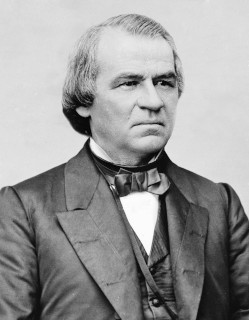
Andrew Johnson, the 17th President of the United States (1865 – 1869), dies on July 31, 1875, at his daughter Mary’s farm near Elizabethton, Tennessee after suffering two strokes.
Johnson assumes the presidency at the time of the assassination of Abraham Lincoln as he is Lincoln’s Vice President. He is a Democrat who runs with Lincoln on the National Union ticket, coming to office as the American Civil War concludes. He favors quick restoration of the seceded states to the Union without protection for the former slaves. This leads to conflict with the Republican-dominated Congress, culminating in his impeachment by the House of Representatives in 1868. He is acquitted in the Senate by one vote. His main accomplishment as president is the Alaska Purchase.
Johnson is born in poverty in Raleigh, North Carolina on December 29, 1808. His grandfather emigrated to the United States from County Antrim in what is now Northern Ireland. He never attends school and is apprenticed as a tailor and works in several frontier towns before settling in Greeneville, Tennessee. He serves as alderman and mayor there before being elected to the Tennessee House of Representatives in 1835. After brief service in the Tennessee Senate, he is elected to the U.S. House of Representatives in 1843, where he serves five two-year terms.
On October 17, 1853, Johnson becomes the 15th Governor of Tennessee serving for four years until November 3, 1857. He is elected by the legislature to the United States Senate on October 8, 1857. During his congressional service, he seeks passage of the Homestead Act of 1862 which is enacted soon after he leaves his Senate seat in 1862.
Southern slave states secede to form the Confederate States of America, which includes Tennessee, but Johnson remains firmly with the Union. He is the only sitting senator from a Confederate state who does not resign his seat upon learning of his state’s secession. In 1862, Lincoln appoints him as military governor of Tennessee after most of it has been retaken. In 1864, he is a logical choice as running mate for Lincoln, who wishes to send a message of national unity in his re-election campaign. Their ticket easily wins the election. He is sworn in as Vice President on March 4, 1865. He gives a rambling speech, after which he secludes himself to avoid public ridicule. Six weeks later, the assassination of Lincoln elevates him to the presidency.
Johnson implements his own form of Presidential Reconstruction, a series of proclamations directing the seceded states to hold conventions and elections to reform their civil governments. Southern states return many of their old leaders and pass Black Codes to deprive the freedmen of many civil liberties, but Congressional Republicans refuse to seat legislators from those states and advance legislation to overrule the Southern actions. Johnson vetoes their bills, and Congressional Republicans override him, setting a pattern for the remainder of his presidency.
Johnson opposes the Fourteenth Amendment which gives citizenship to former slaves. In 1866, he goes on an unprecedented national tour promoting his executive policies, seeking to break Republican opposition. As the conflict grows between the branches of government, Congress passes the Tenure of Office Act in 1867 restricting his ability to fire Cabinet officials. He persists in trying to dismiss Secretary of War Edwin Stanton but ends up being impeached by the House of Representatives and narrowly avoiding conviction in the Senate. He does not win the 1868 Democratic presidential nomination and leaves office the following year.
Johnson returns to Tennessee after his presidency and gains some vindication when he is elected to the Senate in 1875, making him the only former president to serve in the Senate. In late July 1875, convinced some of his opponents are defaming him in the Ohio gubernatorial race, he decides to travel there to give speeches. He begins the trip on July 28 and breaks the journey at his daughter Mary’s farm near Elizabethton, where his daughter Martha is also staying. That evening he suffers a stroke but refuses medical treatment until the following day. When he does not improve two doctors are sent for from Elizabethton. He seems to respond to their ministrations but suffers another stroke on the evening of July 30 and dies early the following morning at the age of 66.
President Ulysses S. Grant has the “painful duty” of announcing the death of the only surviving past president. Northern newspapers, in their obituaries, tend to focus on Johnson’s loyalty during the war, while Southern ones pay tribute to his actions as president. Johnson’s funeral is held on August 3 in Greeneville. He is buried with his body wrapped in an American flag and a copy of the U.S. Constitution placed under his head, according to his wishes. The burial ground is dedicated as the Andrew Johnson National Cemetery in 1906 and, with his home and tailor’s shop, is part of the Andrew Johnson National Historic Site.


 seamus dubhghaill