seamus dubhghaill

Promoting Irish Culture and History from Little Rock, Arkansas, USA


Leave a comment

Birth of Myles Byrne, United Irishman & French Army Officer

Myles Byrne, United Irishman, French army officer and author, is born into a Catholic farming family in the townland of Ballylusk, near Monaseed, County Wexford, on March 20, 1780.

At the age of 17, Byrne is asked to join the government Yeomanry. He chooses instead to join the Society of United Irishmen. In defiance of the British Crown and the Protestant Ascendancy the oath-bound movement is determined to achieve an independent and representative government for Ireland. He participates in preparations in Wexford for the Irish Rebellion of 1798 and, at the age of 18, fights at the Battle of Tubberneering on June 4 and, in command of a division of pikemen, in the Battle of Arklow on June 9, in which the rebel leader Father Michael Murphy is killed. In the face of a general rout, he leads a rebel charge in the Battle of Vinegar Hill on June 21.

Keeping command of a small band, Byrne seizes Goresbridge on June 23 but has to deplore the murder of several prisoners and other atrocities committed by his men in revenge for the torture and executions that had been visited upon the peasantry by the yeomanry and government militia. After further skirmishes he joins Joseph Holt and Michael Dwyer in taking to the Wicklow Mountains to continue a guerrilla resistance.

After Holt accepts transportation to Australia in November, Byrne, assisted by his sister, escapes to Dublin. He recalls of his sister, “If I had not remarked a long scar on her neck, she would not have mentioned anything herself. A yeoman … threatened to cut her throat with his sabre if she did not tell instantly the place in which I was hiding. The cowardly villain, no doubt, would have put his threat in execution had not some of his comrades interfered to prevent him.”

In the winter of 1802-03, Byrne enters into the plans of Robert Emmet and Anne Devlin for a renewed uprising. In his Memoirs he describes a meeting he arranged between Robert Emmet and the Wexford rebel leader Thomas Cloney at Harold’s Cross Green, Dublin, just prior to Emmet’s Rebellion, “I can never forget the impression this meeting made on me at the time – to see two heroic patriots, equally devoted to poor Ireland, discussing the best means of obtaining her freedom.”

In July 1803, the plans unravel when Anne Devlin’s cousin, Michael Dwyer, still holding out in Wicklow, recognises that there are neither the promised arms nor convincing proof of an intended French landing. In the north Thomas Russell and James Hope find no enthusiasm for a renewal of the struggle in what in 1798 are the strongest United Irish and Catholic Defender districts.

In Dublin, with their preparations revealed by an accidental explosion of a rebel arms depot, Emmet proceeds with a plan to seize the centres of government. The rising, for which for Byrne turns out with Emmet and Malachy Delaney in gold-trimmed green uniforms, is broken up after a brief confrontation in Thomas Street.

Two days after the fight in Thomas Street, Byrne meets with the fugitive Emmet and agrees to go to Paris to procure French assistance. But in Paris he finds Napoleon‘s attentions focused elsewhere. The First Consul uses a cessation of hostilities with Britain to pursue a very different venture, the re-enslavement of Haiti.

Byrne is commissioned as a captain in Napoleon’s Irish Legion. But at a time when he is convinced that “all Catholic Ireland” is “ready to rise the moment a rallying point was offered,” the Irish exiles cannot deflect the First Consul from other priorities. Rather than in Ireland, with his diminishing Irish contingent, he is to see action in the Low Countries, Germany and Spain.

Byrne rises to the rank of brigadier general and is awarded the Legion of Honour in 1813. Following the Bourbon Restoration, with fellow legionnaire John Allen, he narrowly avoids deportation as a foreign Bonapartist. An introduction to the Prince de Broglie, then vice-president of the Chamber of Deputies, and two audiences with the Minister of War, Marshal Henri Clarke, the Duke of Feltre, contribute to the latter’s decision to quash the deportation order. In August 1817 Byrne is naturalised as a French citizen.

For much of the next decade Byrne finds himself effectively retired on half pay. Returned to active military service in 1828, he distinguishes himself in the French expedition to Morea during the Greek War of Independence. He retires in 1835 with the rank of Chef de Bataillion.

In the 1840s, Byrne is Paris correspondent for The Nation in Dublin, the Young Irelander newspaper that does much to rehabilitate the memory of the United Irishmen.

In his last years Byrne writes his Memoirs, which are an account of his participation in the Irish Rebellion and his time in the Irish Legion of Napoleon. These are first published in three volumes in 1863, but there have been many subsequent reprints. Against the portrayal of 1798 as a series of disjointed, unconnected risings, his memoirs present the United Irishmen as a cohesive revolutionary organisation whose aim of a democratic, secular, republic had captured the allegiance of a great mass of the Irish people.

Byrne dies at his house in the rue Montaigne (now rue Jean Mermoz, 8th arrondissement, near Champs-Élysées), Paris on January 24, 1862, and is buried in Montmartre Cemetery. His grave there is marked by a Celtic Cross, however this headstone appears to be a 1950s replacement for an earlier one.

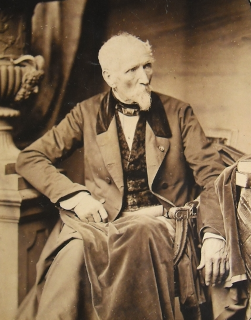
(Pictured: Miles Byrne (1780-1862), United Irishman. Photograph taken by an unknown photographer in Paris in February 1859. The photograph now resides in Áras an Uachtaráin, the residence of the President of Ireland, in Dublin.)

Leave a comment

Death of Michael Dwyer, Journalist & Film Critic

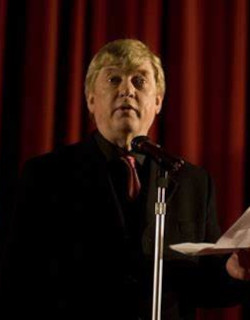
Michael Dwyer, journalist and film critic who writes for The Irish Times for more than 20 years, dies following a lengthy illness on January 1, 2010. He previously fills this role for the Sunday Tribune, The Sunday Press and the magazine In Dublin.

Born on May 2, 1951, Dwyer is originally from Saint John’s Park in Tralee, County Kerry. His mother, Mary, outlives him. He has two sisters, Anne and Maria. As a young man in the early 1970s he takes part in the Tralee Film Society, for which he provides notes to The Kerryman. At this time, he is employed by the County Library in Tralee. He begins working for In Dublin followed by the Sunday Tribune and The Sunday Press.

Dwyer first travels to the Cannes Film Festival in 1982 and attends every one until 2009, months before his death. In 1985, he co-founds the Dublin Film Festival and directs it until the mid-1990s. In 2002, he co-founds the Dublin International Film Festival, of which he is the chairman. In later life he serves on the board of the Irish Museum of Modern Art.

In the 1990s, Dwyer presents the film show Freeze Frame for public service broadcaster RTÉ. The show results from a friendship he had formed with Alan Gilsenan and Martin Mahon of Yellow Asylum Films. He is also known for his appearances on the radio shows Morning Ireland and The Marian Finucane Show. The editor of The Irish Times, Geraldine Kennedy, speaking after Dwyer’s death, says he was an “enthusiastic advocate” of both national and international cinema and had once said he was “one of those lucky people in life who was able to pursue his interests and call them work.”

Dwyer becomes unwell following a trip to the Cannes Film Festival in May 2009. He takes a break from writing for The Irish Times, returning in December 2009 to contribute his first, and what is to be his last ever, piece in six months to weekly entertainment supplement The Ticket. The article is a review of cinema in 2009 and of the 2000s, and in his contribution, he references the ill health which had haunted him for much of the previous year and which had prevented him from viewing any cinema releases between June and September.

Dwyer dies at the age of 58 on January 1, 2010. His partner of 24 years, Brian Jennings, survives him. Irish Minister for Arts, Sport and Tourism Martin Cullen says Dwyer was “the most singular, significant influence on cinema in Ireland for more than three decades.” President of the Labour Party Michael D. Higgins says his work was “incalculable […] he was an activist in promoting a knowledge and appreciation of film in all its forms.” Ireland’s former Director of Film Classification at the Irish Film Classification Office John Kelleher says it was “a huge loss for the world of Irish film.” There are tributes from Gabriel Byrne, Daniel Day-Lewis, Brendan Gleeson, Jonathan Rhys Meyers, Cillian Murphy and Jim Sheridan. The Irish Times publishes tribute pieces on his life.

A ceremony takes place at the Church of the Holy Name in Ranelagh where Dwyer lived. The event is attended by notable politicians, journalists, artists, actors, writers and musicians. RTÉ newsreader Aengus Mac Grianna, a colleague of Jennings, reads a tribute to Dwyer. Daniel Day-Lewis gives a very special tribute at the church service to his dear friend of over 20 years, calling for the Jameson International Dublin Film Festival to be renamed in Dwyer’s honour.

Dwyer is cremated after the funeral on January 5, 2010.


Leave a comment

The Capture of Robert Emmet

robert-emmet

Robert Emmet, one of the most famous revolutionaries in Irish history, is captured by the British at the home of a Mrs. Palmer in Harold’s Cross, outside Dublin on August 25, 1803.

Emmet is born at 109 St. Stephen’s Green in Dublin on March 4, 1778. He is the youngest son of Dr. Robert Emmet, a court physician, and his wife Elizabeth Mason. He attends Oswald’s school in Dopping’s-court, off Golden-lane and enters Trinity College, Dublin, in October 1793 at the age of fifteen. In December 1797, he joins the College Historical Society, a debating society.

While he is in college, his brother Thomas and some of his friends become involved in political activism. Emmet becomes secretary of a secret United Irish Committee in college and is expelled in April 1798 as a result. That same year he flees to France to avoid the many British arrests of nationalists that are taking place in Ireland. While in France, he garners the support of Napoleon, who promises to lend support when the upcoming revolution starts.

After the Irish Rebellion of 1798, Emmet is involved in reorganising the defeated Society of United Irishmen. In April 1799, a warrant is issued for his arrest. He escapes and soon after travels to the continent in the hope of securing French military aid. His efforts are unsuccessful, as Napoleon is concentrating his efforts on invading England. He returns to Ireland in October 1802.

In March of the following year, Emmet begins to prepare a new rebellion, with fellow Anglo-Irish revolutionaries Thomas Russell and James Hope. The revolutionaries conceal their preparations, but a premature explosion at one of Emmet’s arms depots kills a man, forcing Emmet to advance the date of the rising before the authorities’ suspicions are aroused.

Despite being unable to secure help from Michael Dwyer‘s Wicklow rebels and many rebels from Kildare turning back due to the scarcity of firearms, the rising begins in Dublin on the evening of July 23, 1803. Failing to seize the lightly defended Dublin Castle, the rising amounts to a large-scale disturbance in the Thomas Street area. Emmet witnesses a dragoon being pulled from his horse and piked to death, the sight of which prompts him to call off the rising to avoid further bloodshed. However, sporadic clashes continue into the night until finally quelled by British military forces.

Emmet flees into hiding, moving from Rathfarnham to Harold’s Cross so that he can be near his sweetheart, Sarah Curran. He is captured on August 25 and taken to Dublin Castle, then later removed to Kilmainham Gaol. Vigorous but ineffectual efforts are made to procure his escape.

Emmet is tried for and found guilty of high treason on September 19, 1803. Chief Justice John Toler, 1st Earl of Norbury sentences Emmet to be hanged, drawn, and quartered, as is customary for conviction of treason. The following day, Emmet is executed in Thomas Street near St. Catherine’s Church. He is hanged and beheaded after his death. Out of fear of being arrested, no one comes forward to claim his remains.

Emmet’s remains are first delivered to Newgate Prison and then returned to Kilmainham Gaol, where the jailer is under instructions to be bury the remains in a nearby hospital’s burial grounds if no one claims them. No remains have been found there and though not confirmed, it appears that he was secretly removed and reinterred in St. Michan’s Church, a Dublin church with strong United Irish associations. There is also speculation that the remains are buried secretly in the vault of a Dublin Anglican church. When inspected in the 1950s, a headless corpse is found in the vault but cannot be identified. The widely accepted theory is that Emmet’s remains are transferred to St. Peter’s Church in Aungier St. under cover of the burial of his sister in 1804. In the 1980s the church is deconsecrated, and all the coffins are removed from the vaults. The church has since been demolished.


Leave a comment

Death of United Irishmen Leader Michael Dwyer

michael-dwyer

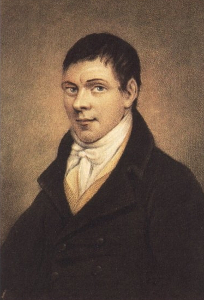
United Irishmen leader Michael Dwyer, whose guerrilla attacks maddened the British Army from 1798, dies in Liverpool, New South Wales, Australia on August 23, 1825.

Dwyer is born in Camara, a townland in the Glen of ImaalCounty Wicklow in 1772 and he participates in the Irish Rebellion of 1798. However, unlike most of the leaders and soldiers in that Rising, he does not either leave the country or return to his normal life, nor is he captured. He retreats into the Wicklow Mountains with a band of men and drives the British to distraction in their attempts to apprehend him. A reward is placed on Dwyer’s head and another for each of his men, but he leads the British authorities on a merry chase for five years, with many daring narrow escapes, each adding to his legend. Some call him the “Outlaw of Glenmalure.”

In 1803, he plans to assist Robert Emmet in his rising but he never receives the signal to join the rising. At this point he recognizes the futility of his situation, and he also wishes to relieve the suffering of a number of his family members, including his sister, whom has been jailed for no offense other than their family relationship to him. Some claim that when he contacts the British to ask terms of surrender, he is promised he and his men will be sent to the United States. If so, and not for the first time, their word to an Irishman proves worthless. After two years of brutal treatment in Kilmainham Gaol, under the infamous Edward Trevor, Dwyer is transported to Botany Bay.

Dwyer and his family, along with a number of his men, set sail for Australia on board the Tellicherry on August 25, 1805, arriving in Sydney on February 14, 1806. However, the story of Michael Dwyer does not end there. In Sydney, Dwyer runs afoul of the Governor, a certain Capt. William Bligh, of HMS Bounty fame. Bligh accuses Dwyer of being the leader of a rebellious plot involving other United Irishmen in the area, which, if true, would certainly not be out of character. Bligh ships Dwyer off to Norfolk Island, one of the worst hellholes of the British penal system in Australia.

After six months he is transferred to Tasmania, where he remains for another two years. In 1808, Bligh leaves the Governorship and Dwyer finally makes it back to his family in Sydney and is granted 100 acres of land nearby. Like many transported Irish rebels, he eventually becomes part of the local establishment and, in a bit of irony, the “Outlaw of Glenmalure” is appointed constable. However, he is dismissed in October for drunken conduct and mislaying important documents.

In December 1822 Dwyer is sued for aggrandising his by now 620 acre farm. Bankrupted, he is forced to sell off most of his assets, which include a tavern called “The Harrow Inn”, although this does not save him from several weeks incarceration in the Sydney debtors’ prison in May 1825. Here he evidently contracts dysentery, to which he succumbs on August 23, 1825.

Dwyer’s wife lives to be 93, not dying until 1861. With her passes the last connection to the “Boys of ’98” in Australia. Dwyer remains a legend among the people of the Wicklow Mountains to this day.


Leave a comment

Surrender of Rebel Leader Michael Dwyer

michael-dwyer

United Irishmen leader Michael Dwyer, whose guerrilla attacks maddened the British Army from 1798, surrenders on December 17, 1803.

Dwyer is born in Camara, a townland in the Glen of Imaal County Wicklow in 1772 and he participates in the Irish Rebellion of 1798. However, unlike most of the leaders and soldiers in that Rising, he does not either leave the country or return to his normal life, nor is he captured. He retreats into the Wicklow Mountains with a band of men and drives the British to distraction in their attempts to apprehend him. A reward is placed on Dwyer’s head and another for each of his men, but he leads the British authorities on a merry chase for five years, with many daring narrow escapes, each adding to his legend. Some call him the “Outlaw of Glenmalure.”

In 1803, he plans to assist Robert Emmet in his rising but he never receives the signal to join the rising. At this point he recognizes the futility of his situation, and he also wishes to relieve the suffering of a number of his family members, including his sister, whom has been jailed for no offense other than their family relationship to him. Some claim that when he contacts the British to ask terms of surrender, he is promised he and his men will be sent to the United States. If so, and not for the first time, their word to an Irishman proves worthless. After two years of brutal treatment in Kilmainham Gaol, under the infamous Edward Trevor, Dwyer is transported to Botany Bay.

Dwyer and his family, along with a number of his men, set sail for Australia on board the Tellicherry on August 25, 1805, arriving in Sydney on February 14, 1806. However, the story of Michael Dwyer does not end there. In Sydney, Dwyer runs afoul of the Governor, a certain Capt. William Bligh, of HMS Bounty fame. Bligh accuses Dwyer of being the leader of a rebellious plot involving other United Irishmen in the area, which, if true, would certainly not be out of character. Bligh ships Dwyer off to Norfolk Island, one of the worst hellholes of the British penal system in Australia.

After six months he is transferred to Tasmania, where he remains for another two years. In 1808, Bligh leaves the Governorship and Dwyer finally makes it back to his family in Sydney and is granted 100 acres of land nearby. Like many transported Irish rebels, he eventually becomes part of the local establishment and, in a bit of irony, the “Outlaw of Glenmalure” is appointed constable.

Michael Dwyer dies in 1825, but his wife lives to be 93, not dying until 1861. With her passes the last connection to the “Boys of ’98” in Australia. Dwyer remains a legend among the people of the Wicklow Mountains to this day.


Leave a comment

Execution of Robert Emmet, Irish Nationalist & Republican

Robert Emmet, Irish nationalist and Republican, orator and rebel leader, is hung, drawn, and quartered in Dublin on September 20, 1803, following his conviction for high treason.

Emmet is born at 109 St. Stephen’s Green, in Dublin on March 4, 1778, the youngest son of Dr. Robert Emmet, a court physician, and his wife, Elizabeth Mason. He attends Oswald’s school, in Dopping’s-court, off Golden-lane and enters Trinity College, Dublin in October 1793, at the age of fifteen. He becomes secretary of a secret United Irish Committee in college and is expelled in April 1798 as a result. That same year he flees to France to avoid the many British arrests of nationalists that are taking place in Ireland.

After the 1798 rising, Emmet is involved in reorganising the defeated Society of United Irishmen. In April 1799 a warrant is issued for his arrest. He escapes and soon after travels to the continent in the hope of securing French military aid. His efforts are unsuccessful, as Napoleon is concentrating his efforts on invading England.

Emmet returns to Ireland in October 1802 and, along with fellow revolutionaries Thomas Russell and James Hope, begins preparations for another uprising in March of the following year. A premature explosion at one of Emmet’s arms depots forces him to advance the date of the rising before the authorities’ suspicions are aroused.

Emmet is unable to secure the help of Michael Dwyer‘s Wicklow rebels. Many rebels from Kildare turn back due to the scarcity of firearms they had been promised, but the rising proceeds in Dublin on the evening of July 23, 1803. Failing to seize Dublin Castle, which is lightly defended, the rising amounts to a large-scale disturbance in the Thomas Street area. He sees a dragoon pulled from his horse and piked to death, the sight of which prompts him to call off the rising to avoid further bloodshed, but he has no control over of his followers. Sporadic clashes continue into the night until finally quelled by British military forces.

Emmet flees into hiding but is captured on August 25 and taken to Dublin Castle, then removed to Kilmainham Gaol. He is tried for treason on September 19. The Crown repairs the weaknesses in its case by secretly buying the assistance of Emmet’s defence attorney, Leonard McNally, for £200 and a pension. McNally’s assistant Peter Burrowes cannot be bought, and he pleads the case as best he can. Emmet is found guilty of high treason.

Chief Justice John Toler, 1st Earl of Norbury sentences Emmet to be hanged, drawn and quartered, as is customary for conviction of treason. The following day, September 20, Emmet is executed in Thomas Street near St. Catherine’s Church. He is hanged and beheaded once dead. As family members and friends of Emmet had also been arrested, including some who had nothing to do with the rebellion, no one comes forward to claim his remains out of fear of arrest.

Emmet’s remains are first delivered to Newgate Prison and then back to Kilmainham Gaol, where the jailer is under instructions that if no one claims them, they are to be buried in a nearby hospital’s burial grounds. A later search there finds no remains. It is speculated that Emmet’s remains were secretly removed from the site and reinterred in St. Michan’s Church, a Dublin church with strong United Irish associations, though it is never confirmed. It is later suspected that they are buried secretly in the vault of a Dublin Anglican church. When the vault is inspected in the 1950s a headless corpse was found, suspected of being Emmet’s, but cannot be identified. Widely accepted is the theory that Emmet’s remains were transferred to St. Peter’s Church in Aungier St. under cover of the burial of his sister, Mary Anne Holmes, in 1804. In the 1980s the church is deconsecrated, and all the coffins are removed from the vaults. The church has since been demolished.


Leave a comment

Birth of Irish Revolutionary Robert Emmet

robert-emmet

Robert Emmet, Irish nationalist, Republican, orator, and one of the most famous revolutionaries in Irish history, is born at 109 St. Stephen’s Green in Dublin on March 4, 1778. He is the youngest son of Dr. Robert Emmet, a court physician, and his wife Elizabeth Mason.

Emmet attends Oswald’s school in Dopping’s-court, off Golden-lane. He enters Trinity College, Dublin, in October 1793 at the age of fifteen. In December 1797, he joins the College Historical Society, a debating society. While he is in college, his brother Thomas and some of his friends become involved in political activism. Robert becomes secretary of a secret United Irish Committee in college and is expelled in April 1798 as a result. That same year he flees to France to avoid the many British arrests of nationalists that are taking place in Ireland. While in France, Emmet garners the support of Napoleon, who promises to lend support when the upcoming revolution starts.

After the 1798 rising, Emmet is involved in reorganising the defeated United Irish Society. In April 1799, a warrant is issued for his arrest. He escapes and soon after travels to the continent in the hope of securing French military aid. His efforts are unsuccessful, as Napoleon is concentrating his efforts on invading England. Emmet returns to Ireland in October 1802.

In March of the following year, Emmet begins to prepare a new rebellion, with fellow Anglo-Irish revolutionaries Thomas Russell and James Hope. The revolutionaries conceal their preparations, but a premature explosion at one of Emmet’s arms depots kills a man, forcing Emmet to advance the date of the rising before the authorities’ suspicions are aroused.

Despite being unable to secure help from Michael Dwyer‘s Wicklow rebels and many rebels from Kildare turning back due to the scarcity of firearms, the rising begins in Dublin on the evening of July 23, 1803. Failing to seize the lightly defended Dublin Castle, the rising amounts to a large-scale disturbance in the Thomas Street area. Emmet witnesses a dragoon being pulled from his horse and piked to death, the sight of which prompts him to call off the rising to avoid further bloodshed. However, sporadic clashes continue into the night until finally quelled by British military forces.

Emmet flees into hiding, moving from Rathfarnam to Harold’s Cross so that he can be near his sweetheart, Sarah Curran. He is captured on August 25 and taken to Dublin Castle, then later removed to Kilmainham Gaol. Vigorous but ineffectual efforts are made to procure his escape.

Emmet is tried for and found guilty of high treason on September 19, 1803. Chief Justice Lord Norbury sentences Emmet to be hanged, drawn, and quartered, as is customary for conviction of treason. The following day, Emmet is executed in Thomas Street near St. Catherine’s. He is hanged and beheaded after his death. Out of fear of being arrested, no one comes forward to claim his remains.

Emmet’s remains are first delivered to Newgate Prison and then returned to Kilmainham Gaol, where the jailer is under instructions to be bury the remains in a nearby hospital’s burial grounds if no one claims them. No remains have been found there and though not confirmed, it appears that he was secretly removed and reinterred in St. Michan’s Church, a Dublin church with strong United Irish associations. There is also speculation that the reamins are buried secretly in the vault of a Dublin Anglican church. When inspected in the 1950s, a headless corpse is found in the vault but cannot be identified. The widely accepted theory is that Emmet’s remains are transferred to St. Peter’s Church in Aungier St. under cover of the burial of his sister in 1804. In the 1980s the church is deconsecrated, and all the coffins are removed from the vaults. The church has since been demolished.