Devlin is born in 1780 in Cronebeg, near Aughrim, County Wicklow, the second of four daughters and three sons of Bryan and Winifred (née Byrne) Devlin, who are Catholics engaged in farming. Her father and several relatives are members of the Society of United Irishmen, advocating for Irish independence. Though she and her immediate family do not initially participate in the Irish Rebellion of 1798, they provide shelter and assistance to rebels, and their home is destroyed by Crown forces, while her father is imprisoned until 1801.
After the family moves to Rathfarnham, Dublin, Devln becomes the housekeeper for Robert Emmet in April 1803, providing cover for his Dublin operations planning a nationalist uprising. She actively aids the United Irishmen by arranging meetings, transporting arms, and acting as a messenger to insurgent forces, notably her cousin Michael Dwyer in the Wicklow Mountains. The rebellion carefully orchestrated for July 23, 1803, collapses due to inadequate popular support and confusion among the rebels.
Following the failed uprising, Devlin and her family are arrested. She endures brutal interrogation by Major Henry Charles Sirr and is subjected to half-hanging, solitary confinement, and threats against her family, yet she refuses to reveal any critical information about Emmet or other conspirators. She spends over two years in Kilmainham Gaol and, despite her endurance, her health is permanently affected. She is released in 1806 after sustained lobbying and public outrage over her mistreatment.
After her release, Devlin works as a maid and laundress, initially assisted by the Emmet family and their acquaintances. She marries William Campbell in 1811, though she experiences increasing poverty after his death in 1845. She continues to be remembered for her courage, and her experiences are recorded by historians and contemporaries such as Dr. Richard Robert Madden and Brother Luke Cullen, preserving her memoirs and accounts of her revolutionary involvement.
Devlin dies on September 18, 1851, in Dublin and is interred at Glasnevin Cemetery, later commemorated with a monument and Celtic cross.
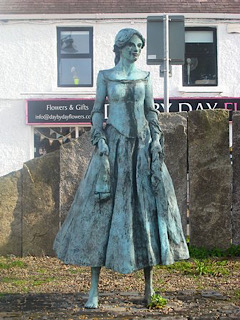
Devlin is widely celebrated as Ireland’s first female political prisoner and a symbol of loyalty and courage. A statue in Rathfarnham, annual memorial services in Dublin’s St. Catherine’s Church, and the naming of community centers in her honor (e.g., Anne Devlin Community Centre, 2026) reflect her enduring impact. Her life has inspired literature and film, including Pat Murphy‘s 1984 movie Anne Devlin, which portrays her perspective during the Emmet rebellion. She is credited in James Joyce’s short story “A Mother” as a model for the character Mrs. Kearney.
Anne Devlin’s life embodies courage, steadfast nationalism, and sacrifice. She actively supports Robert Emmet and the United Irishmen, suffers imprisonment without betrayal, and faces lifelong hardship, yet remains commemorated as a heroine of Irish independence.
(Pictured: Anne Devlin statue in Rathfarnham, Dublin)
Keeping command of a small band, Byrne seizes Goresbridge on June 23 but has to deplore the murder of several prisoners and other atrocities committed by his men in revenge for the torture and executions that had been visited upon the peasantry by the yeomanry and government militia. After further skirmishes he joins Joseph Holt and Michael Dwyer in taking to the Wicklow Mountains to continue a guerrilla resistance.
After Holt accepts transportation to Australia in November, Byrne, assisted by his sister, escapes to Dublin. He recalls of his sister, “If I had not remarked a long scar on her neck, she would not have mentioned anything herself. A yeoman … threatened to cut her throat with his sabre if she did not tell instantly the place in which I was hiding. The cowardly villain, no doubt, would have put his threat in execution had not some of his comrades interfered to prevent him.”
In the winter of 1802-03, Byrne enters into the plans of Robert Emmet and Anne Devlin for a renewed uprising. In his Memoirs he describes a meeting he arranged between Robert Emmet and the Wexford rebel leader Thomas Cloney at Harold’s Cross Green, Dublin, just prior to Emmet’s Rebellion, “I can never forget the impression this meeting made on me at the time – to see two heroic patriots, equally devoted to poor Ireland, discussing the best means of obtaining her freedom.”
In July 1803, the plans unravel when Anne Devlin’s cousin, Michael Dwyer, still holding out in Wicklow, recognises that there are neither the promised arms nor convincing proof of an intended French landing. In the north Thomas Russell and James Hope find no enthusiasm for a renewal of the struggle in what in 1798 are the strongest United Irish and Catholic Defender districts.
In Dublin, with their preparations revealed by an accidental explosion of a rebel arms depot, Emmet proceeds with a plan to seize the centres of government. The rising, for which for Byrne turns out with Emmet and Malachy Delaney in gold-trimmed green uniforms, is broken up after a brief confrontation in Thomas Street.
Two days after the fight in Thomas Street, Byrne meets with the fugitive Emmet and agrees to go to Paris to procure French assistance. But in Paris he finds Napoleon‘s attentions focused elsewhere. The First Consul uses a cessation of hostilities with Britain to pursue a very different venture, the re-enslavement of Haiti.
Byrne is commissioned as a captain in Napoleon’s Irish Legion. But at a time when he is convinced that “all Catholic Ireland” is “ready to rise the moment a rallying point was offered,” the Irish exiles cannot deflect the First Consul from other priorities. Rather than in Ireland, with his diminishing Irish contingent, he is to see action in the Low Countries, Germany and Spain.
Byrne rises to the rank of brigadier general and is awarded the Legion of Honour in 1813. Following the Bourbon Restoration, with fellow legionnaire John Allen, he narrowly avoids deportation as a foreign Bonapartist. An introduction to the Prince de Broglie, then vice-president of the Chamber of Deputies, and two audiences with the Minister of War, Marshal Henri Clarke, the Duke of Feltre, contribute to the latter’s decision to quash the deportation order. In August 1817 Byrne is naturalised as a French citizen.
For much of the next decade Byrne finds himself effectively retired on half pay. Returned to active military service in 1828, he distinguishes himself in the French expedition to Morea during the Greek War of Independence. He retires in 1835 with the rank of Chef de Bataillion.
In the 1840s, Byrne is Paris correspondent for The Nation in Dublin, the Young Irelander newspaper that does much to rehabilitate the memory of the United Irishmen.
In his last years Byrne writes his Memoirs, which are an account of his participation in the Irish Rebellion and his time in the Irish Legion of Napoleon. These are first published in three volumes in 1863, but there have been many subsequent reprints. Against the portrayal of 1798 as a series of disjointed, unconnected risings, his memoirs present the United Irishmen as a cohesive revolutionary organisation whose aim of a democratic, secular, republic had captured the allegiance of a great mass of the Irish people.
Byrne dies at his house in the rue Montaigne (now rue Jean Mermoz, 8th arrondissement, near Champs-Élysées), Paris on January 24, 1862, and is buried in Montmartre Cemetery. His grave there is marked by a Celtic Cross, however this headstone appears to be a 1950s replacement for an earlier one.
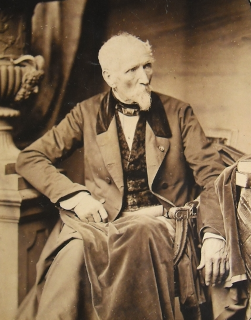
(Pictured: Miles Byrne (1780-1862), United Irishman. Photograph taken by an unknown photographer in Paris in February 1859. The photograph now resides in Áras an Uachtaráin, the residence of the President of Ireland, in Dublin.)
In January 1969, while a student at the New University of Ulster, she joins a civil rights march from Belfast to Derry, organised by the People’s Democracy. At Burntollet Bridge, a few miles from Derry, the march is attacked by loyalists. She is struck on the head, knocked unconscious, falls into the river, and is brought to hospital suffering from a concussion. The march is echoed in her 1994 play After Easter.