Gorbachev, the man who led Russia through the most difficult days of his country’s shift to democracy, is also conferred with an honorary degree. On his arrival he goes to Trinity College Dublin to receive the honour before launching the new European Russian Trust. He later dines as a guest of the Irish Government in Dublin Castle.
On the following day, Gorbachev is accompanied by Dublin’s Lord Mayor Michael Mulcahy during a visit to see members of the city’s Russian community at the Hugh Lane Gallery. He also chats with local shop owners and residents during an informal tour of The Liberties area. After addressing the Institute of European Affairs and lunching with President McAleese at Áras an Uachtaráin, the president’s official residence and principal workplace, he is granted freedom of the Irish capital at a special ceremony.
Following his visit with President McAleese, Gorbachev jokes with Mulcahy that he fully intends to exercise his right to graze sheep in the city. Mulcahy says, “This visit will help to cement relations between us, as well as doing appropriate honour to a genuinely great man whose place in history is already secure.”
Gorbachev formally announced his resignation as Soviet President and Commander-in-Chief on December 25, 1991. The following day, the Soviet of the Republics, the upper house of the Supreme Soviet of the Soviet Union, formally voted the Soviet Union out of existence. The Soviet Union officially ceased to exist at midnight on December 31, 1991. As of that date, all Soviet institutions that had not been taken over by Russia ceased to function.
(Pictured: Mikhail Gorbachev samples a pint of Guinness watched by Dublin’s Lord Mayor Michael Mulcahy, in Doheny & Nesbitt’s pub in Merrion Row. Picture by Donal Doherty)
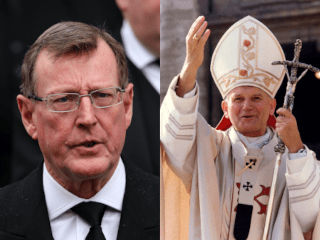
David Trimble becomes the first Ulster Unionist leader to meet a Pope when his historic meeting with John Paul II takes place in Rome on April 21, 1999. The meeting is widely welcomed as a sign that old prejudices are ending but Trimble is hotly criticised by both Protestants and Catholics in his Upper Bann constituency.
The First Minister is one of 54 Nobel Peace Prizelaureates who meets Pope John Paul II briefly at the Vatican, as part of a two-day trip organised by former Russian leader Mikhail Gorbachev. The Nobel Prize winners meet the Pope as a group and are then introduced and shake hands individually. There is a group photograph but no filming of the event. Careful stage-management ensures there are no public photographs of the two men close together.
A spokesman for Trimble says the UUP leader told the Pope he hopes this will be the year when peace will be secured in Northern Ireland. The Pope recalls his visit to Ireland and says murder cannot be condoned or called by another name.
Although the meeting is welcomed on both sides of the North divide, it does little to enhance Trimble’s standing in Upper Bann, particularly in troubled Portadown. In Portadown’s loyalist estates, there is open hostility toward Trimble. Many residents accusing their MP of “putting his personal status above the interests of his constituents.” The response is typified by one angry woman who says, “The loyalist people of this town and Drumcree, put David Trimble into office. Now he has turned his back on us. That’s a fatal mistake, this town and Drumcree will now destroy Trimble.”
“It’s unbelievable that this meeting is actually taking place,” says Orangeman Ivor Young. “It totally contradicts the oath that David Trimble took when he joined the Orange Order. We all knew Trimble was a traitor, this latest escapade puts the final nail in his political coffin here in Upper Bann. There is no way that he will ever be elected here again.”
Trimble also comes in for further criticism from Portadown Orange District, whose Drumcree protest has continued for the past 288 days. David Jones, the District’s press officer says that the people of Portadown once again see their local MP on “a world stage,” instead of being involved locally. “There are a lot of people around Portadown who aren’t very impressed that David Trimble has gone off to meet the Pope and hasn’t got more involved in trying to get the situation here solved,” says Jones.
On Portadown’s Garvaghy Road, Catholics are also critical of Trimble’s visit to Rome. “It’s amazing how he can travel to Rome to meet and talk to strangers,” says one nationalist resident, “yet he can’t be bothered to travel less than 30 miles to meet us, to talk about the serious issues that confront this community. After all we are as much his constituents as are the loyalists in this town.”
The meeting is the first time that the First Minister of Northern Ireland or the head of the Ulster Unionist Party has met the Pope in Rome. It also represents a rare appearance by an Orangeman at the heart of the Roman Catholic Church. Trimble and his entourage meet the Pope in the sumptuous surroundings of the Consistory Hall, the same room where the Cardinals of the Church gather to advise the Pope.
Earlier in the morning Trimble says in an interview with the Vatican radio that besides giving an update on developments in Northern Ireland, he wishes to “express to his Holiness the Pope that he and the Church will do what it can to persuade the paramilitaries to commit themselves irrevocably to peaceful means.”
“You helped change and enhance the lives of hundreds of millions of people,” the Lord Mayor of Dublin, Cllr. Michael Mulcahy says as he presents the award. “There are few people in the history of the world of whom that can be stated.”
City councillors in their robes assemble for the occasion and the guests include CardinalDesmond Connell, the Papal Nuncio, Archbishop Giuseppe Lazzarotto, and other members of the diplomatic corps. Gorbachev is also presented with a dove of peace in Waterford Crystal.
In his acceptance speech, the former Communist leader says there have been many events in his life, big and small, joyful and sad. “The event that is happening today in this wonderful hall is very special.”
He says Ireland has taken the right road in emphasising knowledge, education and high technology. He quips that PresidentMary McAleese had said to him over lunch, “We don’t have any natural resources other than the rain.”
Gorbachev notes that as a Freeman of the City of Dublin he is entitled to graze sheep anywhere in Dublin. He assures his audience he will “buy a flock” to exercise that right. “I have seen some very, very nice places in the Park, near the President’s palace.”
At a news conference in the Mansion House earlier in the day, Gorbachev comes in for sharp questioning from Eoin Ó Murchú, a journalist, who asks “ex-Comrade Gorbachev” if he felt any sense of remorse or guilt when he “stood passively aside” while the Soviet Union was destroyed and ordinary people were reduced to poverty and prostitution. He also queries Gorbachev about his decision to take part in a television commercial for a chain of pizza restaurants.
Ignoring the suggestion that he has demeaned himself by appearing in the television advertisement, Gorbachev replies equally sharply, “My advice to you as a comrade – you used the word ‘comrade’ – is that you too should probably get rid of this kind of ideological straitjacket.”
Gorbachev denies having stood idly by while the USSR was dismantled. Commenting on the Northern Ireland situation he says, “This is one of those processes where people have to make difficult choices. You will see politicians who have a ready-made recipe for everything, in many cases to use force and bombs.”
It was good that, instead of bombing, there was a peace process. Bombing was not a solution and he welcomes the peace efforts being made and the fact that parties are acting “both prudently and responsibly.”
(From The Irish Times, January 10, 2002 | Pictured: Lord Mayor Michael Mulcahy and Mikhail Gorbachev, Doheny & Nesbitt’s Public House, January 8, 2002)
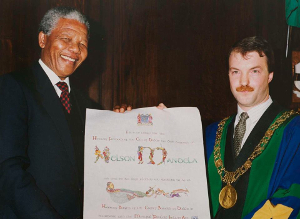
Nelson Rolihlahla Mandela, the first president of South Africa to be elected in a fully representative democratic election, is awarded the Freedom of the City of Dublin on his 70th birthday, July 18, 1988. Mandela is not available to receive his award on the date it is conferred, however, as he is a prisoner in South Africa at the time. On July 1, 1990, after his release from prison, Mandela finally receives the Freedom of the City of Dublin at a ceremony in the Mansion House Dublin.
The Freedom of the City of Dublin is awarded by Dublin City Council after approving a person nominated by the Lord Mayor of Dublin. Eighty people have been honoured under the current process introduced in 1876. Most honourees have made a contribution to the life of the city or of Ireland in general, including politicians, public servants, humanitarians, artists, and entertainers. Others have been distinguished members of the Irish diaspora and foreign leaders, honoured visiting Dublin. Honourees sign the roll of freedmen in a ceremony at City Hall or the Mansion House and are presented with an illuminated scroll by the Lord Mayor.
Mandela is honoured with the Freedom of Dublin city for his contribution to society and commitment to the study and promotion of Human Rights and also his work in the area of development and social inclusion, which has enhanced the lives of local communities in Ireland and fostered global links with institutions and organisations.
Holders of this award have some ancient privileges and duties such as the right to bring goods into Dublin through the city gates without paying customs duties, the right to pasture sheep on common ground within the city boundaries including College Green and St. Stephen’s Green (this right is exercised as a publicity stunt by U2 members the day after their 2000 conferring), and the right to vote in municipal and parliamentary elections. Some of the ancient duties are that freemen/women must be ready to defend the city of Dublin from attack and, at short notice, can be called up to join a city militia. Also a law which was passed in 1454 states that freemen/women must own a bow, a coat of mail, a helmet, and a sword.



 seamus dubhghaill